inflearn logo

Essential Theory for AI Semiconductor Design — From Neurons to LLMs

To design AI semiconductors such as NPUs, transformer accelerators, and mini LLMs yourself, you need to understand theoretically why the computations inside them occur. This course distills and condenses into three parts only the essential theory required for hardware design, covering everything from a single neuron to CNNs, transformers, and LLMs. Rather than memorizing formulas, a professor with 30 years of experience in the semiconductor industry connects software theory with hardware implementation through an intuition for “why it works that way.”

26 learners are taking this course

Level Beginner

Course period Unlimited

Deep Learning(DL)
Deep Learning(DL)
Machine Learning(ML)
CNN
CNN
transformer
transformer
LLM
LLM
Deep Learning(DL)
Deep Learning(DL)
Machine Learning(ML)
CNN
CNN
transformer
transformer
LLM
LLM

What you will gain after the course

  • The ability to intuitively understand how neurons, neural networks, CNNs, transformers, and LLMs work

  • Core theoretical foundations needed for AI hardware design, including learning, gradient descent, and quantization

  • An understanding at the conceptual level of how ChatGPT, GPT, and BERT are created

  • The big picture of how AI theory translates into actual semiconductor circuits (NPUs and accelerators)

  • A theoretical foundation for understanding and following hands-on AI accelerator and NPU design exercises thereafter

■ Why is this course necessary?

NPU, Transformer accelerators, mini LLMs—to design AI semiconductors like these yourself, you need to understand what computations take place inside them, why they take place, and what those computations cost on the chip. Simply following circuit diagrams will only get you so far.

This course distills the essential theoretical foundations into three concise parts. Starting with the multiplication of a single neuron and extending to CNNs, attention, transformers, and LLMs—we have selected only 'what is actually needed for hardware design' from the vast body of AI theory.

Therefore, each part explains the connection to semiconductor design.

Part 1 focuses on the fact that neural network multiplications and additions directly translate into power consumption on the chip,

Part 2 focuses on the fact that the matrix operations of attention call for a dedicated accelerator called a systolic array,

Part 3 concludes with the fact that a significant portion of power is spent not on computation, but on moving data.

This is not theory for academic depth, but theory for building AI semiconductors yourself.


■ Why This Course Is Different

Commercial AI theory courses stop at the perspectives of software and mathematics. This course is designed from the outset as 'theory for building in hardware.' It explains AI theory through the eyes of a semiconductor designer: how the multiplication and addition of neurons become power on a chip, why the matrix operations of transformers call for dedicated accelerators (NPUs), and why low-power AI semiconductors are the future. A current professor with 30 years of experience in the semiconductor industry connects software theory and hardware implementation as one.


■ This lecture is the starting point.

This lecture is the theoretical starting point for the hardware design lectures that follow.

· This lecture (theory) → NPU design → Transformer accelerator → mini LLM SoC

With the theory laid down here, you’ll be able to follow the later lectures while understanding why each circuit is designed this way. Conversely, if you look only at the circuits without the theory, you’ll end up memorizing them and won’t be able to apply what you learn.


■ Three-Part Structure

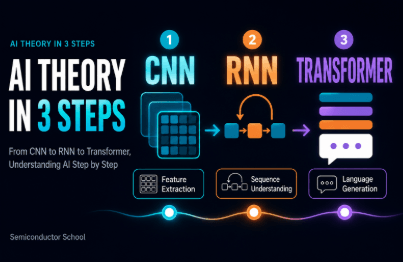
· Part 1: From Neurons to CNNs — Principles of learning (gradient descent), the perceptron and the XOR barrier, deep neural networks (DNNs), and convolutional neural networks (CNNs)

· Part 2: From RNNs to Transformers — sequential data and RNNs, word embeddings, attention mechanisms, and Transformers

· Part 3: From Transformer to LLM — pretraining and transfer learning, BERT and GPT, ChatGPT and RLHF, and low-power semiconductors

The three parts form one continuous story. Studying them in order will give you a complete picture, from neurons to LLMs.


■ Recommended for those who:

· Those who plan to design NPUs, AI accelerators, and AI SoCs themselves in the future (based on that theory)

· Those who want to learn the essential background theory before taking an AI hardware design course

· Those who want to understand AI from its principles, but are looking for the “essentials for building” rather than academic depth

· Those who have heard of terms like CNN, attention, transformers, and LLMs but do not understand how they work


■ This is the kind of course it is

· Carefully selected only the theory needed for hardware design—the essence of extensive AI theory

· Intuition over memorizing formulas — illustrating “why it works that way” through diagrams and analogies

· One seamless story that connects everything from a single neuron to an LLM

· A rare perspective that connects AI theory and semiconductor hardware

· Complete the course using only the videos, without separate hands-on exercises, boards, or installations.


■ Note

· This course focuses on theory. Hands-on practice for building an AI accelerator directly with an FPGA is covered in separate courses. The theory in this course provides the foundation for those hands-on courses.

· All content in this course was created by the instructor, and the narration (voice-over) was produced using TTS.

Recommended for
these people

Who is this course right for?

  • Those who plan to design NPUs, AI accelerators, and AI SoCs themselves but lack a theoretical foundation.

  • I want to solidify the essential background theory before taking an AI hardware design course.

  • Those who know the terms CNN, attention, transformer, and LLM but don’t understand how they work.

  • Those who want to understand AI from its principles, but are looking for the “essentials for building” rather than academic depth

Need to know before starting?

  • Explained intuitively so that it can be understood even without specialized knowledge of the players.

  • Knowing high school-level mathematics (functions and graphs) will make it easier.

  • No coding or hands-on practice is required (theory section)

Hello
This is EdgeChipLab

Career Verified

Design and implement AI semiconductors directly on FPGAs

As a current university professor, I have incorporated 30 years of experience in the system semiconductor industry, along with expertise in AI semiconductor research and education.

This is a hands-on curriculum designed by a professor who teaches semiconductor engineering, based on direct design and FPGA verification experience—from starting as a systems semiconductor researcher in Samsung Electronics’ DS Division, to serving as a Director at the company’s UK and German subsidiaries, and then leading the System LSI marketing and sales group.

This is not simply a course on how to use FPGAs.
It is designed to help you understand AI algorithms → directly design NPUs and CPUs in RTL → implement them on an FPGA → verify them on actual hardware → and ultimately expand to AI SoCs.

AI Algorithm → RTL Design → FPGA Implementation → Bit-True Verification → AI SoC


Beyond theory to real-world AI hardware implementation

It is difficult to develop system-level AI semiconductor design capabilities with only fragmented, scattered knowledge.

Students do not stop at using finished black-box IP. The goal is to gradually develop the system design skills needed to design an AI NPU and RISC-V CPU themselves, integrate memory and peripherals, and ultimately build their own AI SoC.

Starting with the fundamentals of transistors and digital circuits, you will progress through FPGAs, CPUs, and NPUs to hardware for accelerating Transformers and LLMs.


We validate the research results on actual FPGA hardware.

This is not a lecture you simply watch. Rather than stopping at theory or basic simulations, you will run AI semiconductor circuits you designed yourself on an actual FPGA and perform Bit-True verification to confirm that the Python model and RTL results match down to the last bit.

The instructor’s research findings, including four KCI-listed papers on AI semiconductors, FPGAs, and RISC-V, are also connected to the educational content, enabling technologies validated through research to be applied to actual designs and FPGA implementations.

We make the source code needed for hands-on practice publicly available, including our self-developed RISC-V CPU, Python code for image training, and Verilog RTL.

Centered around the affordable Arty S7-25 FPGA board and the free Vivado design tool, this course is designed to enable learners to reproduce the entire process of designing, implementing, and verifying their own work.

It is also compatible with Digilent FPGA boards, including the Zybo Z7. You can use it by modifying the XDC pin mapping (board) and clock division parameters (RTL) to match the board.

The 'MNIST NPU with FPGA' course only requires modifying the XDC pin mapping, while courses using an OLED and Camera require modifying the clock division parameters (RTL).

→The lecture exercises are configured with clock division parameters based on Arty S7’s 100 MHz input clock. Since other boards have different input clocks (for example, Zybo Z7 has 125 MHz), you will need to recalculate the division values so that the target frequency remains the same. If you miss this part, the screen or video may not display properly, which can easily be mistaken for a code error, so please check it.


A Seamless Full-Stack Roadmap: From the Basics to a mini LLM Accelerator

All the lectures are not independent fragments, but a journey toward completing one vast system.

  • Step 1: AI Theory and Image Processing Fundamentals (including Machine Learning)

  • Step 2: AI Accelerator (NPU) Design and Verification (Including Machine Learning)

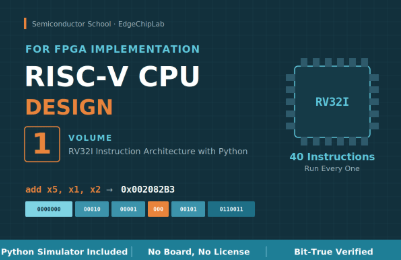
  • Step 3: RISC-V CPU Design and System Integration

  • Step 4: Advanced AI SoC Implementation and Expansion into a mini LLM Acceleration Platform (Continuous Content Updates)


Objective verification metrics

All design outcomes from this course have undergone rigorous validation against global standards and by academia.

  • RISC-V Architecture Verification: In-house developed RISC-V CPU, passed the international foundation’s official compliance test (ACT), with source code released publicly (GitHub)

  • Academic Authority: Four sole-authored academic papers (published in the prestigious KCI A-rated journal IJIBC)

  • Global Recognition: Authored and published two global Amazon technology books (reached No. 3 on the bestseller list)

  • Real-world operation verified: Core IPs including the RV32I CPU, NPU, vision system, GPS, Transformer, and AURA-Edge SoC operate flawlessly in the Arty S7 environment.

Take on the challenge. By the time you complete this process of uploading code directly to the board and verifying the results, you will have leveled up into a hardware engineer with a completely different perspective.

More

Curriculum

All

3 lectures ∙ (1hr 40min)

Published: 
Last updated: 

Reviews

Not enough reviews.
Please write a valuable review that helps everyone!

EdgeChipLab's other courses

Check out other courses by the instructor!

Similar courses

Explore other courses in the same field!

25% off for new members

$7.70

25%

$7.70