inflearn logo

A course for beginner AI engineers

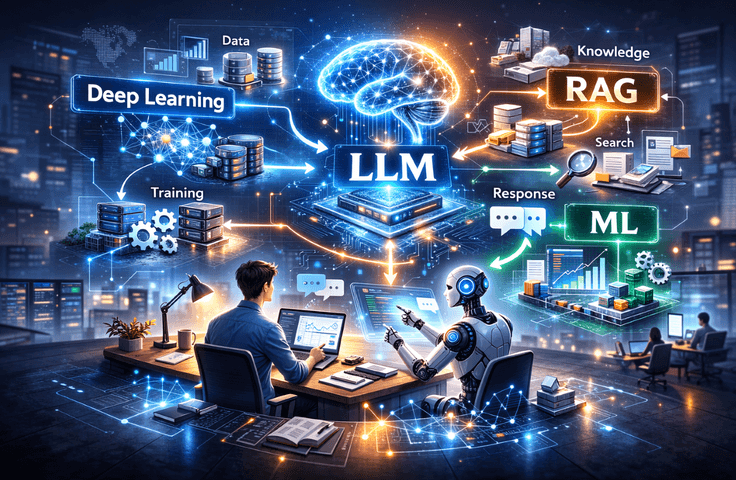
This introductory course for AI engineers is designed to provide a brief hands-on experience of the entire process, from data processing and model development to cloud, MLOps, and ethical considerations. It focuses on building practical skills by helping students understand the process of connecting models to actual services, rather than just creating them. The course includes hands-on exercises and examples so that even those learning AI for the first time can easily follow along.

6 learners are taking this course

Level Beginner

Course period Unlimited

Python
Python
Machine Learning(ML)
FastAPI
FastAPI
LLM
LLM
RAG
RAG
Python
Python
Machine Learning(ML)
FastAPI
FastAPI
LLM
LLM
RAG
RAG

What you will gain after the course

  • Learning technologies used in AI development

  • Understanding the Basic Principles of Machine Learning and Deep Learning

  • Understanding the use cases and concepts of LLM and RAG


🎯 Course Overview

AI (Artificial Intelligence) is no longer a technology confined to laboratories; it plays a core role in the services we use every day and across industrial sites. From voice assistants and recommendation systems to autonomous driving, medical diagnosis, and financial risk management, AI has already become deeply integrated into our lives. However, what an "AI Engineer" actually does and what specific skills and capabilities are required may still feel ambiguous.

This course is designed for beginners who are considering taking their first steps as an AI engineer. Starting with the basics of the Python programming language and data processing, it is structured to provide a broad range of experience—from core machine learning concepts, model training, and deployment workflows to understanding LLMs and RAG, and even model operations through MLOps by building a FastAPI. Rather than simply listing theories, it vividly conveys how the role of "AI Engineering" works in the field through hands-on practice and real-world cases.


👩‍🎓 Target Audience

  • University students or job seekers interested in the AI/data field

  • Those who are currently working as developers but are considering expanding their career into the AI field

  • Those who have experience in data analysis but lack experience in model deployment or operations

  • Beginners who are curious about "exactly what an AI engineer does"


📚 Learning Objectives


  • Understanding the role and required skill set of an AI engineer

  • Acquire basics of Python and data processing libraries (Numpy, Pandas, Matplotlib)

  • Experience the entire pipeline from machine learning model training to deployment


  • Understanding various cases of how AI models are utilized in actual services


📌 Learning Outcomes


  • You can gain a concrete understanding of the practical role of an "AI Engineer."

  • Going beyond simply building a model, you will directly follow the actual workflow of data collection → model training → deployment/operation.

  • Through hands-on practice and case studies, you will develop AI engineering skills that are close to real-world practice and gain experience that can be utilized in your future portfolio and career.

  • In the rapidly changing flow of the AI industry, you can set the learning direction necessary for yourself and build the fundamental strength to grow into an actual AI engineer.


👉 This course aims to go beyond simply "building a machine learning model" and instead provides a hands-on experience of the entire process of turning AI into a service. By the end of the course, you will gain a more realistic and practical understanding of the AI engineer profession, and you will be able to draw a clear picture of what technologies to learn next and what career paths you can take.

Recommended for
these people

Who is this course right for?

  • Beginners new to AI and machine learning

  • Professionals interested in data science and engineering, and developers looking to take on the challenge of cloud-based AI services.

Need to know before starting?

  • Basic Python programming experience

  • Understanding of very basic mathematics (linear algebra and statistics)

  • Interest in data analysis

Hello
This is Sungmin Kim

6,068

Learners

314

Reviews

157

Answers

4.7

Rating

6

Courses

Hello. I completed my undergraduate and master's degrees in the United States, majoring in Computer Science and Data Science, respectively. Currently, I am working as a data engineer at a healthcare company. To briefly describe my daily responsibilities: I use AWS and Airflow to ingest data daily and perform ETL processes. I also monitor the data flow and implement programs whenever issues arise or there is room for improvement. For data monitoring, I primarily use AWS CloudWatch and a program called Splunk. The technologies I currently use at work include Python, AWS, SQL, and more. Recently, we have been migrating to GCP, so I am gaining experience with both AWS and GCP simultaneously.

In 2022, nearly 80% of the company's data and pipelines completed migration to GCP, and I am now working extensively with BigQuery, GCS, and GKE. I am also handling overall IaC tasks using Docker containers and Terraform.

The biggest thing I've realized while working as a data engineer is this: with new technologies emerging every day, will the tools I'm using now become obsolete? If so, why? Can that new technology really replace this one? Are there no downsides? Indeed, finding answers to all these questions seems very difficult. However, through that process, I noticed one commonality. When you dive deep, they are mostly similar. In other words, if you dig into one thing properly, learning other technologies becomes much easier. I want to frequently mention this mechanism in my lectures. I want to share all the knowledge I currently have with you. I will do my best to be your guide.

I, Simon Kim, will present fun and easy-to-understand lectures for you. I promise to become a better person by constantly communicating with all of you. It is my great happiness to watch your skills improve.

Published Book: Introduction to AWS for Immediate Practical Use

I promise to become a better person. Watching your skills improve is a great source of happiness for me. Authored Book: Introduction to AWS for Immediate Practical Use

More

Curriculum

All

24 lectures ∙ (4hr 35min)

Course Materials:

Lecture resources
Published: 
Last updated: 

Reviews

Not enough reviews.
Please write a valuable review that helps everyone!

Sungmin Kim's other courses

Check out other courses by the instructor!

Similar courses

Explore other courses in the same field!

Limited time deal

$3,611.00

53%

$47.30