"In the AI era, the surest response is to build AI semiconductors yourself."
This program is neither a theory-focused university course nor the standardized curriculum of a contract department tailored to specific specifications. Nor is it limited to simply gaining experience using EDA tools or leveraging libraries, as in conventional fragmented practical seminars.
It is a one-of-a-kind, hands-on course designed and FPGA-validated by a practicing engineering professor with 30 years of experience, who began as a systems semiconductor researcher in Samsung Electronics’ DS Division, won the Silver Prize (Group Chairman’s Award) at the Samsung Technology Awards in the field of design automation, and went on to serve as a Director at Samsung’s UK and German subsidiaries and as the head of the System LSI Marketing and Sales Group.
[ Key differentiators for working professionals & aspiring engineers ]
Overcome the limitations of working engineers: Go beyond simply modifying code or using off-the-shelf IP to acquire practical, architecture-level expertise in designing NPUs and CPUs directly in RTL.
Establishing a Full-Flow practical system: Complete the entire value chain, from analyzing AI algorithms to FPGA implementation and Bit-True hardware integration verification, and extending to an AI SoC based on a CPU + NPU + RTOS.
Field validation complete: Going beyond theory taught in university classrooms, we deliver proven processes that can be applied immediately in real-world work, distilling design expertise from the front lines of industry.
AI Algorithm → RTL Design → FPGA Implementation → Bit-True Verification → AI SoC
For undergraduates and graduate students, as well as working professionals seeking to advance as next-generation AI semiconductor/SoC designers, it provides an unparalleled, top-tier practical guide.
Beyond theory to actual AI hardware implementation
It is difficult to develop system-level AI semiconductor design capabilities with only scattered, fragmented knowledge.
Students do not stop at using completed black-box IP. The goal is to progressively develop the system design skills needed to design an AI NPU and RISC-V CPU themselves, integrate memory and peripherals, port an RTOS on top of them, and ultimately build their own AI SoC.
Starting with the fundamentals of transistors and digital circuits, this course connects FPGA, CPU, and NPU technologies to hardware for accelerating Transformers and LLMs.
We validate the research results on actual FPGA hardware.
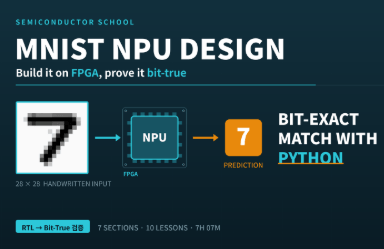
This is not a lecture you only watch. Rather than stopping at theory or simple simulations, you will run AI semiconductor circuits you designed yourself on an actual FPGA and perform Bit-True verification, confirming that the Python model and RTL results match down to the last bit.
The instructor also connects research results, including four KCI-indexed papers on AI semiconductors, FPGAs, and RISC-V, to the educational content, taking technologies validated through research into actual design and FPGA implementation. The source code needed for the exercises—including a self-developed RISC-V CPU, Python code for image training, and Verilog RTL—is made available.
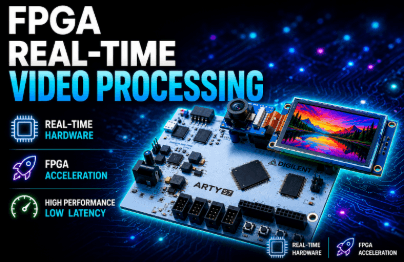
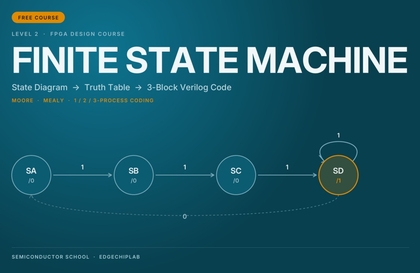
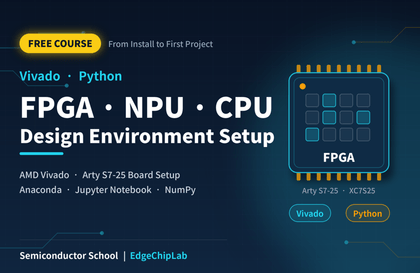
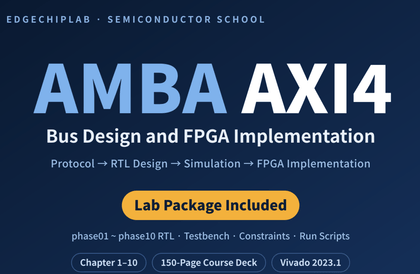
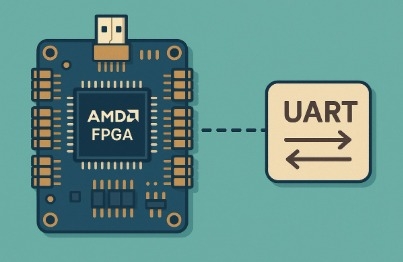
Built around the affordable Arty S7-25 FPGA board and the free Vivado design tool, this course enables learners to reproduce the entire process of designing, implementing, and verifying their own work. It can also be used with Digilent FPGA boards, including the Zybo Z7. Simply modify the XDC pin mapping (board) and clock division parameters (RTL) to match your board. The 'MNIST NPU with FPGA' course only requires modifying the XDC pin mapping, while courses that use an OLED and camera require modifying the clock division parameters (RTL).
→The lecture exercises are configured with divider parameters based on Arty S7’s 100 MHz input clock. Since other boards have different input clocks (e.g., Zybo Z7 uses 125 MHz), you will need to recalculate the divider values so that the target frequency remains the same. If you overlook this, the screen or video may not display properly,so please check, as it can easily be mistaken for a code error.
A seamless full-stack roadmap: from the basics to a mini LLM accelerator
Every lecture is not an isolated fragment, but part of a journey toward completing one vast system.
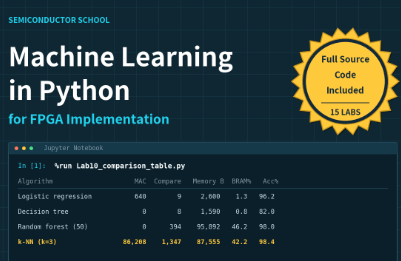
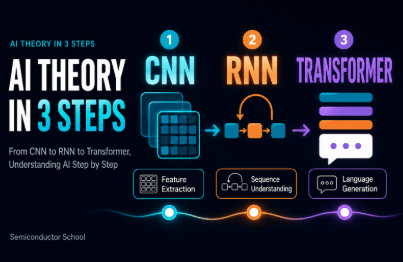
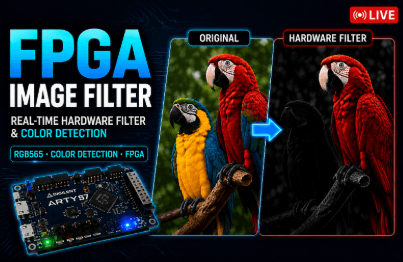
Step 1: AI Theory and Image Processing Fundamentals (including Machine Learning)
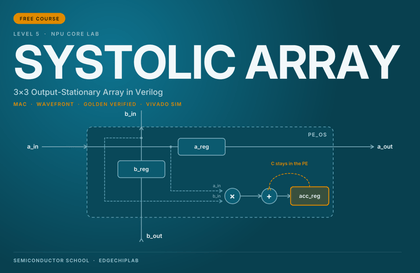
Step 2: AI Accelerator (NPU) Design and Verification (Including Machine Learning)
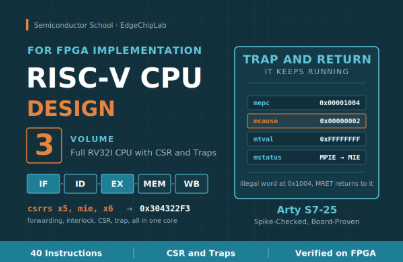
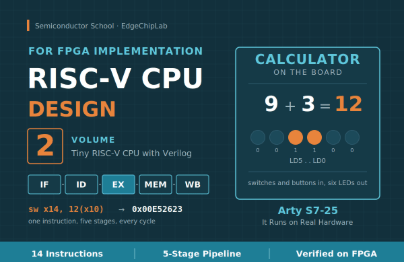
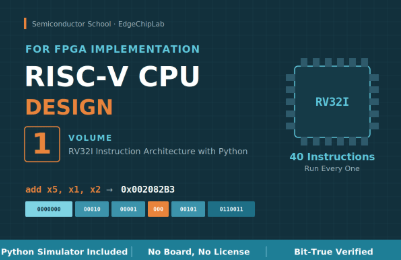
Step 3: RISC-V CPU Design and System Integration
Step 4: Advanced AI SoC Implementation and Expansion into a mini LLM Acceleration Platform (Continuous Content Updates)
Objective verification metrics
All design deliverables from this course have undergone rigorous validation against global standards and by the academic community.
RISC-V Architecture Verification: In-house developed RISC-V CPU, passed the International Foundation’s official compliance test (ACT), and source code released (GitHub)
Academic Authority: Four Sole-Author Academic Papers (published in the prestigious KCI A-ranked journal IJIBC)
Global Recognition: Published four global Amazon technology books (reached #1 bestseller status)
Published books: Roger Kim: books, biography, latest update
Real-World Operation Verification Complete: Core IPs, including the RV32I CPU, NPU, vision system, GPS, Transformer, and AURA-Edge SoC, operate flawlessly in the Arty S7 environment.
Take on the challenge. By the time you complete this process of uploading code to the board yourself and checking the results, you will have leveled up into a hardware engineer with a completely different perspective than before.