inflearn logo

Introduction to AI Semiconductors: Mastering Everything with Excel, No EDA Tools Required

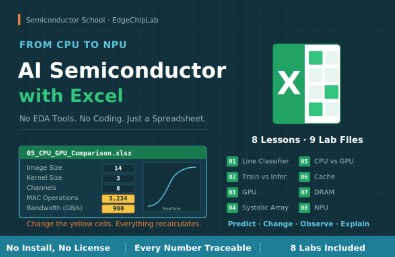
Did you give up while learning Verilog and EDA tools? A semiconductor professor who designs NPUs himself will show you how to understand everything from CPUs to NPUs by calculating with just 9 Excel files.

1 learners are taking this course

Level Beginner

Course period Unlimited

AI
AI
Excel
Excel
Computer Architecture
GPU
GPU
Machine Learning(ML)
AI
AI
Excel
Excel
Computer Architecture
GPU
GPU
Machine Learning(ML)

What you will gain after the course

  • The ability to explain what bottleneck and bandwidth mean in AI semiconductor articles.

  • The ability to explain the differences between CPU, GPU, and NPU based on their structural reasons.

  • Answering ability to not get stuck when asked "Explain the difference between GPU and NPU" in an interview

  • Understanding the differences between DRAM and SRAM through hands-on practice

  • 9 types of AI semiconductor practice Excel files

  • The ability to manually calculate and find the point where performance plateaus even when increasing the number of arithmetic units.

  • The explanatory power of why SRAM is not used as main memory despite being 40 times faster.

■ Without a semiconductor simulator, using only Excel

Attempts to understand AI semiconductors usually stop at a high barrier to entry. You have to learn hardware description languages, install EDA tools, secure licenses, and learn how to interpret waveforms. This process alone takes months, and most of your time is spent learning the tools before you even get a feel for the overall architecture.

This lecture offers a different path. It is designed to implement semiconductor behavior as a calculation model on a spreadsheet, allowing students to directly adjust input values and observe the resulting changes.

Just open the Excel file and change the numbers in the yellow cells.

■ Why Excel can replace EDA tools

The essence of semiconductor simulation is to observe how results change when conditions are altered. The practice files for this lecture perform that function within a spreadsheet.

· No installation required

Excel or a compatible spreadsheet program is sufficient.

There is no need for a separate development environment, license, or setup process.

· The entire calculation process is visible

EDA tools output results as waveforms. The intermediate processes are hidden.

In a spreadsheet, all intermediate values are displayed directly in the cells.

You can directly check which formula was used to produce that value.

· Responds immediately

If you change the value in the input field, the related tables and graphs are updated on the spot.

There is no compiling or waiting for execution.

· Remains even after completing the course

Even after the lecture ends, you can continue to use the files as they are.

You can continue your own experiments by inputting new conditions.

■ These are not static charts

The practice files for this lecture are not tables that merely show pre-calculated results. The execution process of the semiconductor is implemented through formulas, so if the input changes, the entire result is recalculated in a chain reaction.

· By unfolding the process of the CPU executing instructions into 27 steps,

Trace each line to see which values are read and accumulated at each step.

· The point where the GPU's arithmetic unit utilization reaches the bandwidth limit

Calculate it using formulas and verify it through graphs.

· The five stages of charge restoration every time the DRAM reads

Compare it with SRAM by going through it step by step.

· The location where calculations are activated in the systolic array

It tracks the process of moving diagonally over time on a cell-by-cell basis.

· While the NPU's 13×10 arithmetic unit array processes 52 tiles

It calculates the number of memory accesses occurring at each step.

This type of learning material is difficult to find on the market. It was created to fill the gap between introductory books that remain at the level of conceptual diagrams and metaphors, and professional texts that presuppose knowledge of hardware description languages.

■ Eight topics lead to a single problem

This lecture is not a list of independent topics. It is designed with a structure that starts from one question and deepens into the next.

What does artificial intelligence calculate?

What kind of burden arises when performing those calculations with a general-purpose processor?

How does the parallel structure alleviate that burden, and where does it reach its limits?

If memory is the constraint, why not just use faster memory?

What is the reason why high-speed memory cannot be fully adopted?

What changes when data is reused?

What benefits and costs arise when this is implemented as a circuit?

The questions remaining at the end of each session serve as the starting point for the next. Ultimately, you will reach a system design perspective that simultaneously considers performance, power, area, cost, and data movement.

■ Learning Method

Each session includes a process of changing input values. The recommended order is as follows.

First, predict the outcome

After changing the values

observe the actual results,

try to explain the reason why.

Entering values is not the goal itself. The goal is to understand the causal relationship between which inputs affect which results. When expectations and reality do not align, your understanding deepens in the process of finding the reason why.

■ Provided Materials

We provide all 9 types of Excel files used in the lecture.

01_Line_Classifier.xlsx Decision process of a linear classifier

02_MNIST_Learning.xlsx Principles of weight learning

03_Training_and_Inference.xlsx Comparison of computational load between training and inference

04_CPU_Operation.xlsx Instruction Execution and Pipelining

05_CPU_GPU_Comparison.xlsx Parallel Architecture and Memory Bottleneck

06_DRAM_SRAM.xlsx Principles of memory hierarchy formation

07_Systolic_Array.xlsx Data Reuse and Execution Schedule

08_NPU.xlsx Structural Characteristics of Dedicated Accelerators

Each file consists of guidance, main body, conditions, tables, and summary sheets. Input cells are distinguished in yellow, and other areas are protected. You can experiment freely without worrying about damaging the formulas.

■ Target Audience

· Those who come across materials related to AI semiconductors but

Those who wish to systematically organize their technical background

· While preparing for employment in the semiconductor industry

Those who wish to organize their understanding of computer architecture and accelerator concepts

· Those who are non-majors but wish to be able to judge technology trends

Those who wish to acquire foundational knowledge

· Before learning hardware description languages

Those who wish to grasp the overall structure first

· Those who need to explain AI semiconductors in an educational setting

■ Prerequisites

Being able to enter numbers into a spreadsheet is sufficient. No programming experience, semiconductor expertise, or separate development environment is required.

■ Scope of the Lecture Model

The calculation models used in this lecture are simplified for educational purposes and are not intended to predict the performance metrics of actual products.

The conditions assumed for each model are specified on each practice screen, and any differences from actual designs are explained separately during the lecture. The goal is not to memorize the numbers themselves, but to understand the structural reasons why such numbers are derived.

■ Lecture Composition

Total 9 sections · 9 lectures · 3 hours 34 minutes total

Section 1 and Section 2 are available for free.

Recommended for
these people

Who is this course right for?

  • A semiconductor job seeker who wants to grasp the overall structure before learning Verilog and EDA tools.

  • AI developers who want to understand the relationship between model performance and hardware through numerical data

  • An electronics engineering student who wants to verify concepts learned in computer architecture with actual numbers.

  • Educators who need hands-on materials to use when explaining AI semiconductors

  • A semiconductor industry planner who wants to judge technical meetings and documents for themselves.

Need to know before starting?

  • It is enough if you can enter numbers into the spreadsheet.

  • No programming experience or specialized knowledge in semiconductors is required.

  • You will not have to write the formulas yourself. You only need to change the values in the blank cells of the Excel sheet.

Hello
This is EdgeChipLab

Career Verified

Directly design and implement AI semiconductors using FPGA

As a current university professor, I have incorporated 30 years of experience in the system semiconductor industry along with AI semiconductor research and education know-how.

This is a practical curriculum directly designed and verified on FPGA by a professor who currently teaches semiconductor engineering, following a career that began as a system semiconductor researcher at Samsung Electronics DS Division and included roles as Director of the UK and German subsidiaries, as well as Head of the System LSI Marketing and Sales Group.

This is not just a course for learning how to use FPGAs.
It aims for a process of understanding AI algorithms → designing NPUs and CPUs directly with RTL → implementing them on FPGAs → verifying them on actual hardware → and ultimately expanding to AI SoCs..

AI Algorithm → RTL Design → FPGA Implementation → Bit-True Verification → AI SoC


Beyond theory, toward actual AI hardware implementation

It is difficult to reach a system-level AI semiconductor design capability with only scattered, fragmentary knowledge.

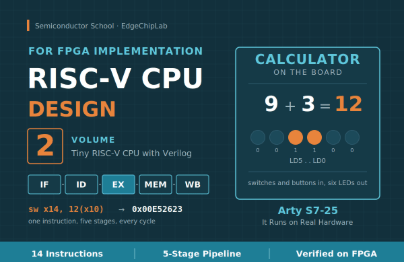
Students will not stop at simply using pre-made black-box IPs. The goal is to step-by-step build system design capabilities to directly design AI NPUs and RISC-V CPUs, integrate memory and peripherals, and ultimately construct their own AI SoC.

Starting from the basics of transistors and digital circuits, it connects through FPGA, CPU, and NPU all the way to Transformer and LLM acceleration hardware.


Verify research results with actual FPGA hardware.

This is not a lecture just for watching. We don't stop at theory or simple simulations; you will operate the AI semiconductor circuits you designed yourself on an actual FPGA and perform Bit-True verification, ensuring the Python model and RTL results match down to a single bit.

The instructor's research results, including four KCI-indexed papers related to AI semiconductors, FPGAs, and RISC-V, are also linked to the educational content, bridging research-proven technologies to actual design and FPGA implementation.

We are releasing the source code necessary for practice, including our self-developed RISC-V CPU, Python code for image training, and Verilog RTL.

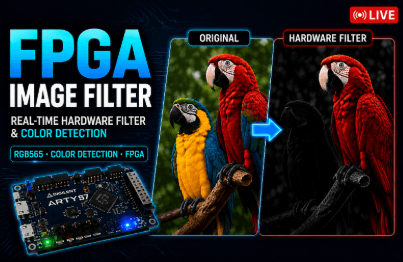
It is structured around the entry-level Arty S7-25 FPGA board and the free Vivado design tool, allowing learners to reproduce the entire process of designing, implementing, and verifying for themselves.


Seamless Full-Stack Roadmap: From Basics to mini LLM Accelerator

Every lecture is not just an isolated fragment, but a journey toward completing one massive system.

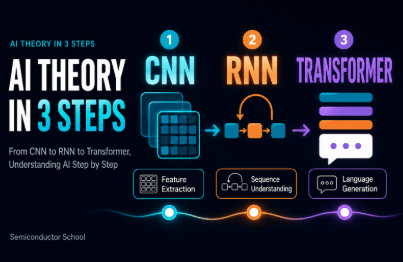
  • Step 1: AI Theory and Image Processing Basics (Including Machine Learning)

  • Step 2: AI Accelerator (NPU) Design and Verification (Including Machine Learning)

  • Step 3: RISC-V CPU Design and System Integration

  • Step 4: Advanced AI SoC Implementation and Expansion to mini LLM Acceleration Platform (Continuous Content Updates)


Objective Verification Metrics

All design outcomes of this course have undergone rigorous verification by global standards and academia.

  • RISC-V Architecture Verification: Self-developed RISC-V CPU, passed the official International Foundation Compliance Test (ACT), and source code released (GitHub)

  • Academic Authority: 4 papers as a sole author (IJIBC, a KCI Grade A-rated prestigious academic journal)

  • Global Recognition: Published 2 global Amazon technical books (Reached #3 Bestseller)

  • Actual operation verification completed: Core IPs including RV32I CPU, NPU, vision systems, GPS, Transformer, and AURA-Edge SoC operate perfectly in the Arty S7 environment

Take the challenge. By the time you finish this process of uploading code to the board yourself and verifying the results, you will have leveled up into a hardware engineer with a completely different perspective than before.

More

Curriculum

All

9 lectures ∙ (3hr 33min)

Published: 
Last updated: 

Reviews

Not enough reviews.
Please write a valuable review that helps everyone!

EdgeChipLab's other courses

Check out other courses by the instructor!

Similar courses

Explore other courses in the same field!

Limited time deal

$77,440.00

20%

$74.80