Mastering Semiconductor Evaluation and Analysis Roles - Application Strategies for Samsung/SK Hynix PE/AE
This lecture is designed for job seekers preparing for Evaluation and Analysis roles in Samsung Electronics' DS Division (Memory, S.LSI, Foundry, TSP, AVP) and PE, AE, and Solution PE roles at SK hynix, who are struggling with the differences between business units and job functions.
You will learn how to categorize job titles by company based on the actual workflow of Product Evaluation roles and how to translate your major-related experiences into professional terminology suitable for resumes and interviews.
We will help you establish an application strategy by connecting experiences in Analog circuit design, Verilog/FPGA, process experiments, and data analysis with key industry terms such as Yield, Wafer Map, Shmoo Plot, and Failure Analysis.
Distinguishing the differences between Evaluation & Analysis roles in Samsung Electronics' DS Division (Memory, S.LSI, Foundry, TSP, AVP) and PE, AE, and Solution PE roles at SK hynix.
Deriving candidate business units for Samsung Electronics DS and job roles for SK hynix that align with your major and experience.
Transforming experiences in analog circuit design, Verilog/FPGA, process experiments, and data analysis into material for a product evaluation job application.
Organize undergraduate experiences into a structure of problem definition, measurement methods, data, root cause analysis, improvement results, and job relevance.
Explanation of key product evaluation interview keywords: Yield, Wafer Map, Shmoo Plot, Defect Patterns, and Reliability.
Completing the answer structure for use in Samsung Electronics DS Evaluation & Analysis and SK hynix PE/AE interviews
✨✨✨✨✨✨✨✨✨✨✨✨✨✨
1st Early Bird Discount EVENT !
1st Early Bird EVENT :200,000 KRW X→ 100,000 KRW
2nd Early Bird EVENT: 200,000 KRW X → 130,000 KRW
3rd Early Bird EVENT: 200,000 KRW X → 160,000 KRW
... ✨✨✨✨✨✨✨✨✨✨✨✨✨✨
Samsung Electronics DS Evaluation & Analysis · SK Hynix PE/AE Job Selection Lecture for Applicants
You've decided on the company, but feel lost about which job role to apply for
Based on my experience at Samsung Electronics DS, ranging from chip design to wafer testing, packaging, and reliability evaluation,
I have organized the preparation for applying to Evaluation & Analysis, Product Engineering, and Application Engineering.
Business unit selection, resume material organization, and interview answer strategies are guided according to the application preparation flow.
Coach Sam's previous circuit and board design lectures focused on the process of creating design outputs. This lecture is different. It was newly created to help you prepare for applications in Evaluation & Analysis and PE/AE roles.
The number of applicants interested in Samsung Electronics DS and SK Hynix has increased. Rather than applying after looking deeply into the entire semiconductor industry from the start, many begin their preparation because they first became interested in these two companies. This is a natural choice.
The problem is what comes next.
I have decided on the company, but I am at a loss as to which job position to apply for. For circuit design or process design, there are many applicants with relevant majors, projects, or master's degrees, while process/equipment/mass production technology has a wide pool of applicants, making the competition quite intense.
In this case, the realistic options are Evaluation & Analysis, PE (Product Engineering), and AE (Application Engineering). However, for these roles, if you apply based on the name alone, your interview answers will easily falter. Simply memorizing keywords like Yield, Wafer Map, Shmoo Plot, PVT, ATE, and Reliability is not enough. You must be able to explain your own experiences from a product evaluation perspective.
This lecture will elevate your ability to discuss Evaluation & Analysis and PE/AE to a level suitable for applications and interviews.
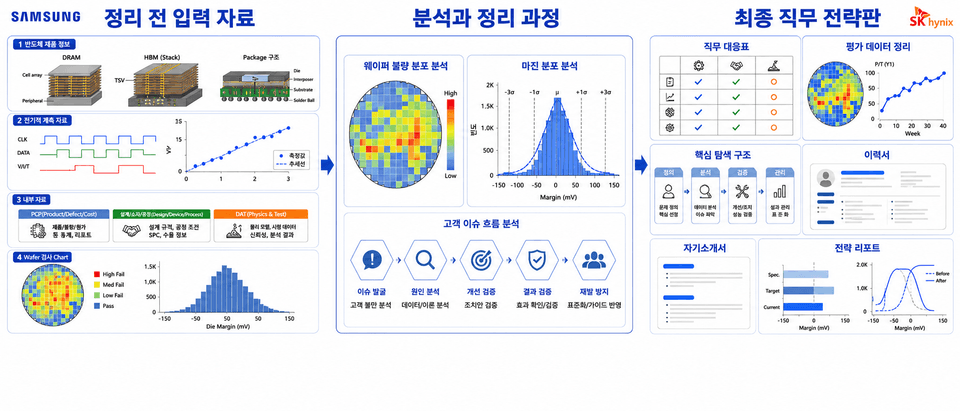
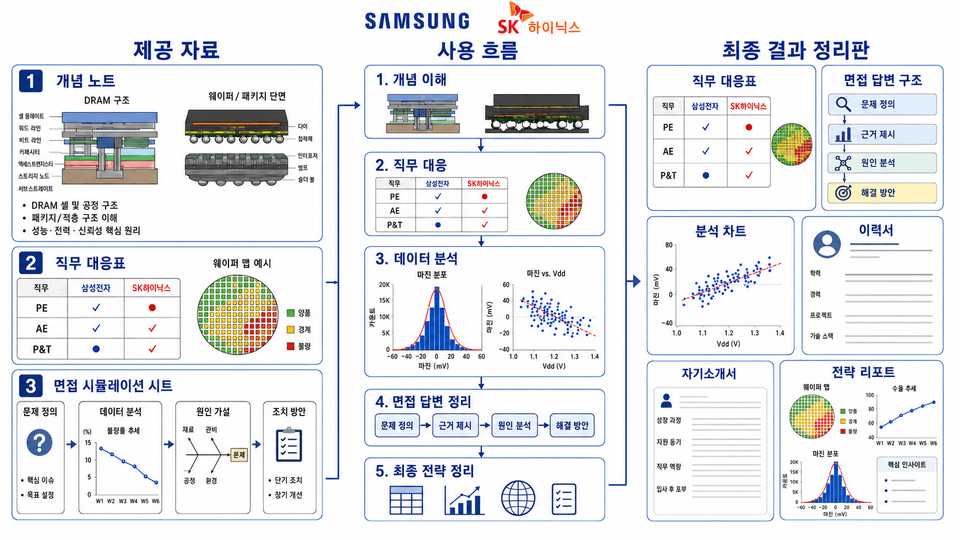
We compare Samsung Electronics DS's 5 business divisions and SK Hynix's 5 job roles based on the same criteria, and transform your major, projects, experiments, and data experience into expressions that can be used in self-introductions and interviews.
Scope of this lecture
What is covered
Samsung DS 5 Business Divisions and SK Hynix PE/AE Job Roles Difference Summary
Selecting candidate business divisions and job roles that match my major and experience
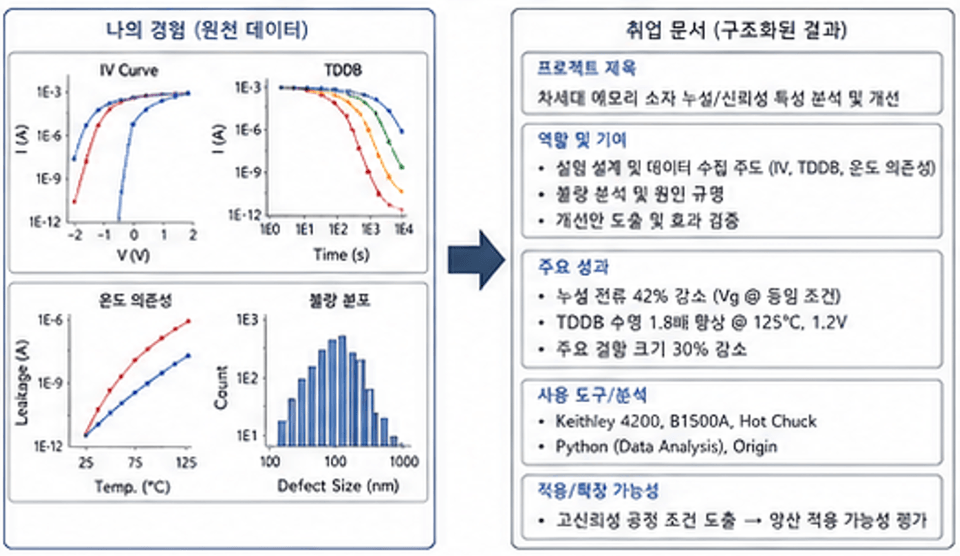
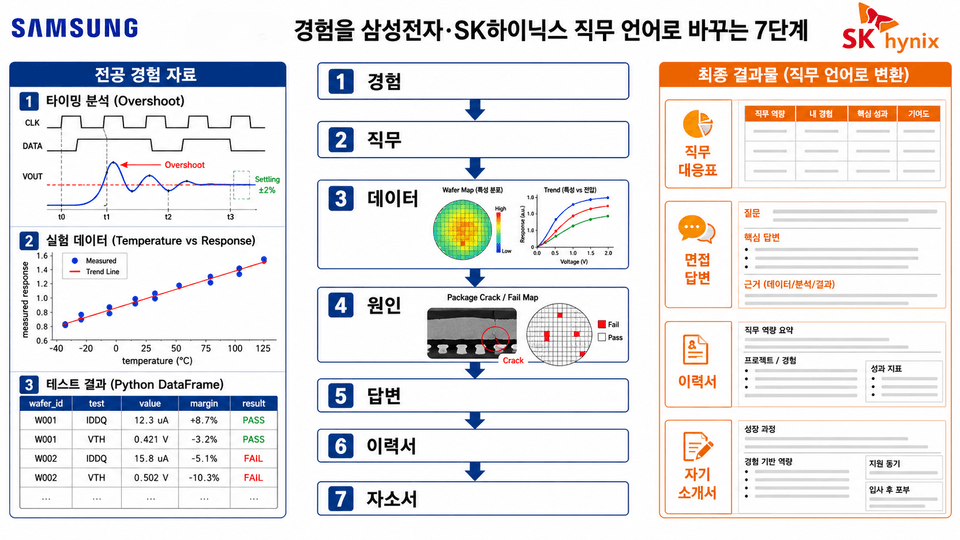
Transforming major experiments, circuit projects, process training, and data analysis experience into content for your self-introduction letter
Organizing the order of answering interview questions for each business division
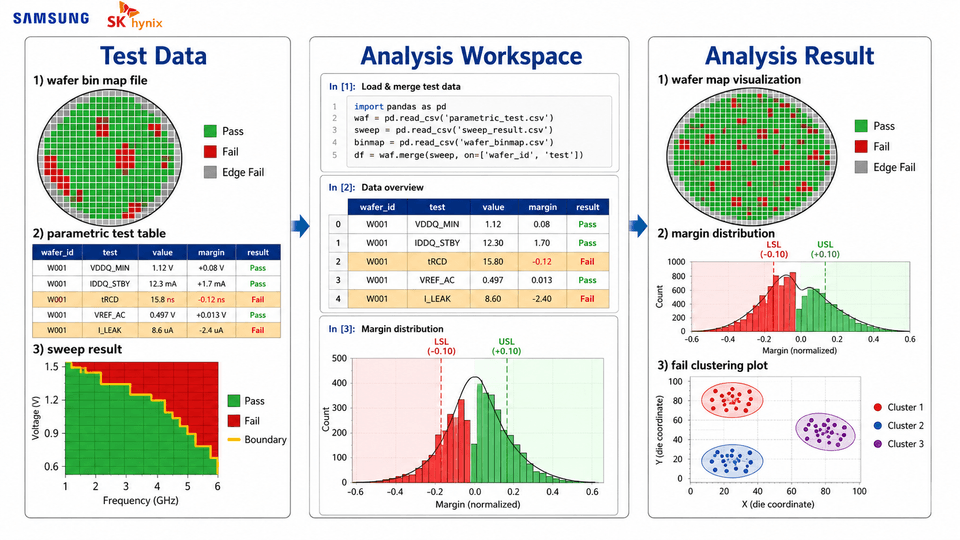
Check the Wafer Map, Shmoo Plot, and Yield analysis topics to be covered in the subsequent data analysis training.
What is not covered
A main practice session where you directly code Wafer Maps or Shmoo Plots to create the final output.
A data analysis project covering Python, Pandas, and Matplotlib from start to finish.
Design practice that deeply covers circuit design, process design, and board design itself
Consulting that guarantees acceptance into a specific company or division
Data analysis practice continues in the subsequent 8-week course. In this lecture, we first establish the necessary job selection, experience organization, and direction for self-introductions and interviews. Therefore, even those new to PE/AE can step-by-step learn "what they need to prepare."
This lecture is different in these ways
There are many semiconductor job preparation courses on the market. Most cover processes, equipment, mass production technology, or semiconductor roles in general. There are relatively few courses that treat Evaluation & Analysis or PE/AE as separate topics and explain them by dividing the business divisions and specific job functions.
This lecture does not stop at just "wanting to go to a semiconductor company."
It continues by covering which business division you should look into at Samsung DS, how to distinguish between PE and AE at SK Hynix, and even which expressions you should use to rephrase your own experiences.
Narrowing down the job roles.
This is not a lecture that skims through everything from circuit design to process and equipment; instead, it focuses on Evaluation & Analysis, PE, and AE.
We will even break it down by business division.
We compare Samsung DS Memory, S.LSI, Foundry, TSP, AVP, and SK Hynix PE/AE-related roles based on the same criteria.
Transforming experiences into sentences
Organize major-related experiments, projects, and data analysis experiences into sentences that can be used in applications and interviews.
Evaluation & Analysis · PE/AE, a Realistic Option
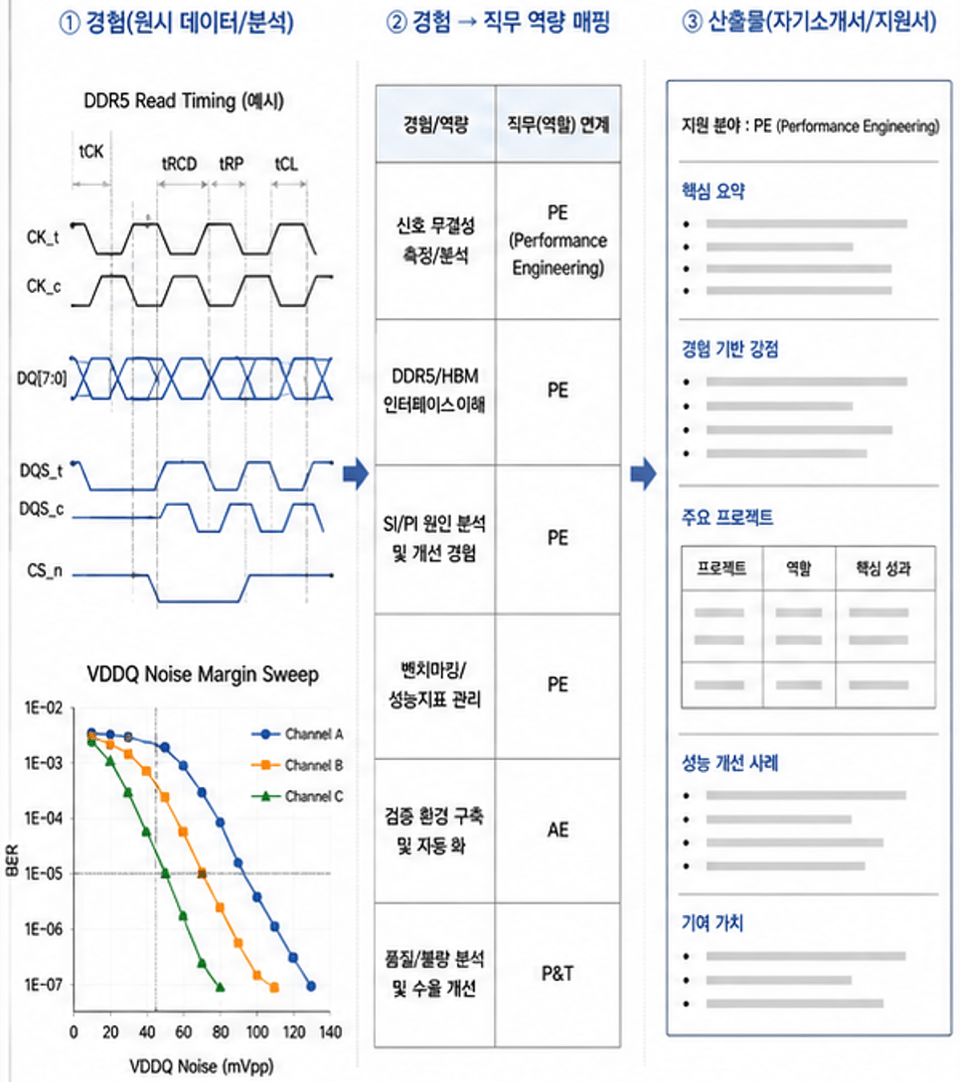
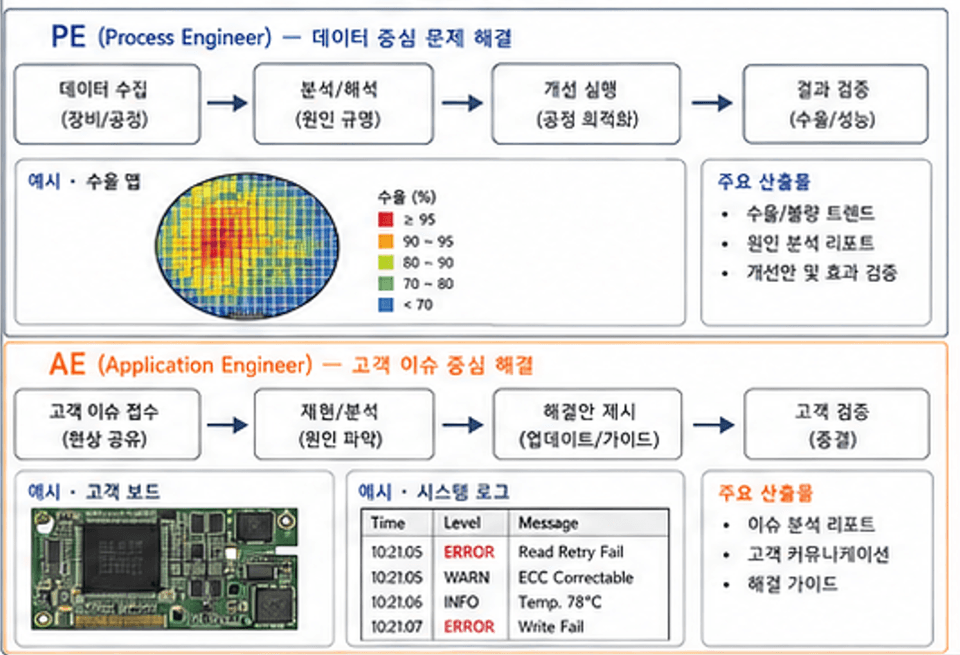
Evaluation & Analysis and PE/AE are roles that verify whether a product meets actual standards and interpret defect and yield issues through data. While these roles differ from those that design new circuits or directly create processes, there is significant potential to connect them with experiences in major-related experiments, circuit projects, process training, and statistical analysis.
However, simply memorizing job titles and definitions will lead to difficulties when explaining them during an interview. Instead of just saying "I will analyze defects," you must be able to explain what data you will look at and how you will categorize the causes. This lecture is the preparation process for crafting that explanation.
Circuit Design / Process Design
Major suitability and project depth are important. You need experience that can deeply demonstrate the design and process itself.
Process / Equipment / Mass Production Technology
The range of eligible majors is broad. As a result, there are many applicants, so you must demonstrate your job suitability specifically.
Evaluation & Analysis / PE / AE
It involves product evaluation, data interpretation, defect root cause isolation, and customer system evaluation. If you can explain your major-related experience from a product evaluation perspective, your application direction will start to become clear.
This is for people like you
If even one of the four points below makes you think, "Is this about me?", please read until the end.
1. Those who have not yet decided which business division to apply for
This is for those who find it difficult to determine which business unit matches their experience, even after looking at the Memory, S.LSI, Foundry, TSP, and AVP job postings.
2. Those who are confused about the difference between PE and AE
People often get stuck when choosing a job category because they don't know what SK Hynix PE, AE, and Solution PE each look for.
4. Those who are unable to translate their major-related experiences into a self-introduction letter
It will be helpful if you have experience with OP Amps, Verilog/FPGA, process experiments, or data analysis but are unsure how to connect them to the Evaluation and Analysis role.
4. Those whose interview answers tend to be too abstract
If you have heard of keywords like Yield, Wafer Map, Shmoo Plot, and Reliability but feel lost on what order to use them in an interview, this lecture will help you establish a structured response sequence.
Post-course Outcomes
10 Job Suitability Diagnostic Table
We compare Samsung DS's 5 business divisions and SK Hynix's 5 job roles based on the same criteria.
Priority Table for Application Job Roles
Narrow down your 1st and 2nd priority application candidates based on your major and experience.
Self-Introduction Keyword Mapping Table
Convert major, project, and experiment experiences into Evaluation & Analysis/PE/AE terminology.
Experience Transformation Notes
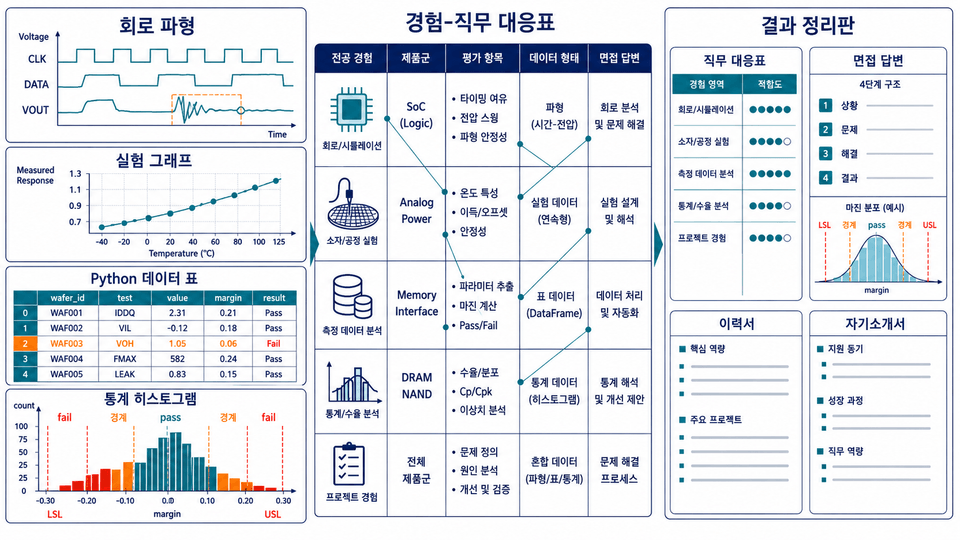
Rewrite your experiences in the following order: problem definition, measurement method, data, cause determination, improvement results, and job connection.
Drafting Interview Responses
Establish a flow for the order in which to answer the expected questions for each business division.
Data Analysis Learning Topic Notes
Organize how Wafer Map, Shmoo Plot, Yield analysis, SPC, and CP/CPK connect to job preparation.
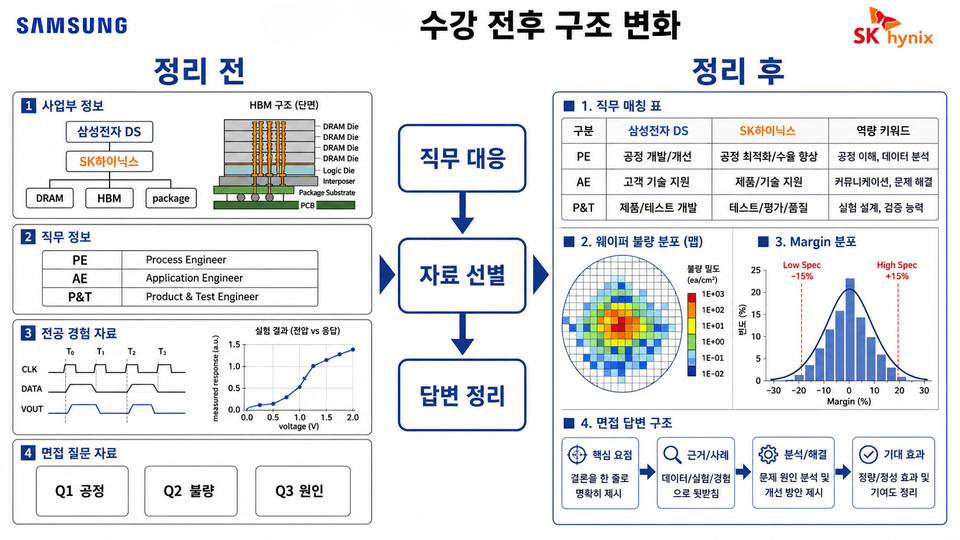
Before vs. After
Before taking the course
Even when looking at the job postings, it is difficult to determine which among Memory, S.LSI, Foundry, TSP, and AVP is the right fit.
After
First, organize the business division and job candidates to apply for based on your major and experience.
Before taking the course
The major projects are simply listed, so the self-introduction does not connect well with the job role.
After training
Reorganize your experience in the order of Measurement → Data → Cause Analysis → Improvement Results.
Before
I know keywords like yield, Shmoo Plot, and reliability, but I can't connect them to interview answers.
After taking the course
Organize the question intent, answer sequence, and experience connection method to create a draft answer.
Samsung DS and SK Hynix have different job titles
Can I use the same expressions that worked for my Samsung self-introduction letter in my SK self-introduction letter?
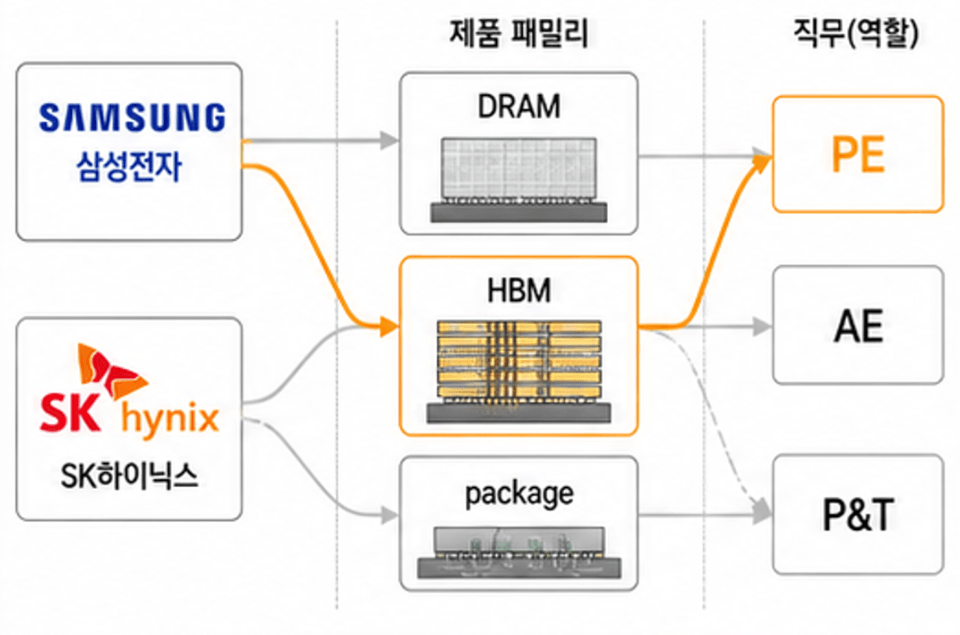
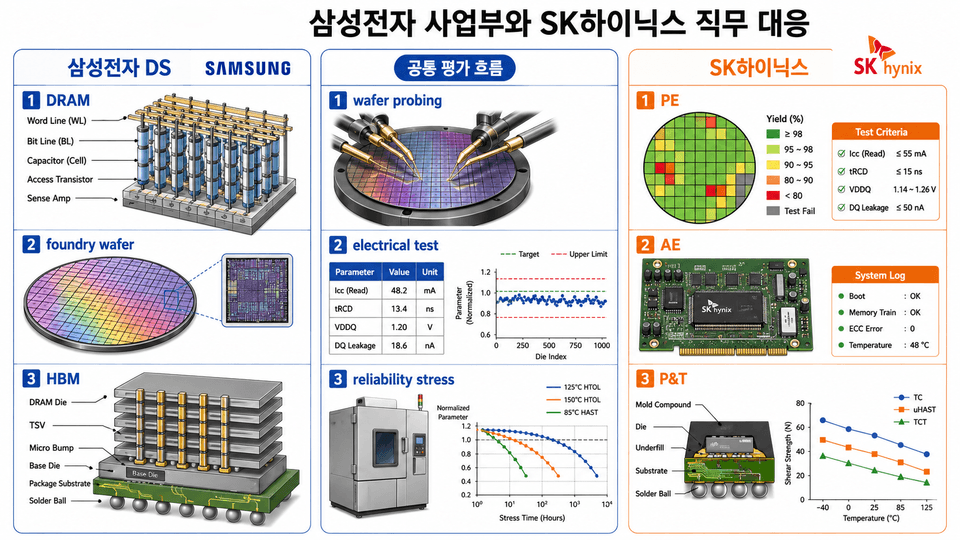
Even for the same product evaluation-related tasks, job titles and terminology vary by company. Content that appears grouped under "Evaluation and Analysis" at Samsung Electronics DS may be divided into PE, AE, Solution PE, etc., at SK hynix. If you don't understand these differences, you will be confused from the moment you start choosing which job to apply for.
Samsung DS expression
Evaluation and Analysis
Expressions you will see at SK hynix
Product Engineering, Application Engineering
Samsung DS terminology
Isolation of yield variation causes
Terminology used at SK hynix
Yield Excursion Analysis
Samsung DS terminology
Wafer-level pattern recognition
Expressions seen at SK hynix
Wafer Map Pattern Analysis
Curriculum
It consists of a total of 12 sections. The first part covers the Evaluation & Analysis and PE/AE roles, while the middle part breaks down the roles at Samsung DS and SK Hynix. The latter part continues with experience transformation, interview answers, and data analysis learning topics.
1
Understanding Evaluation & Analysis · PE/AE Roles
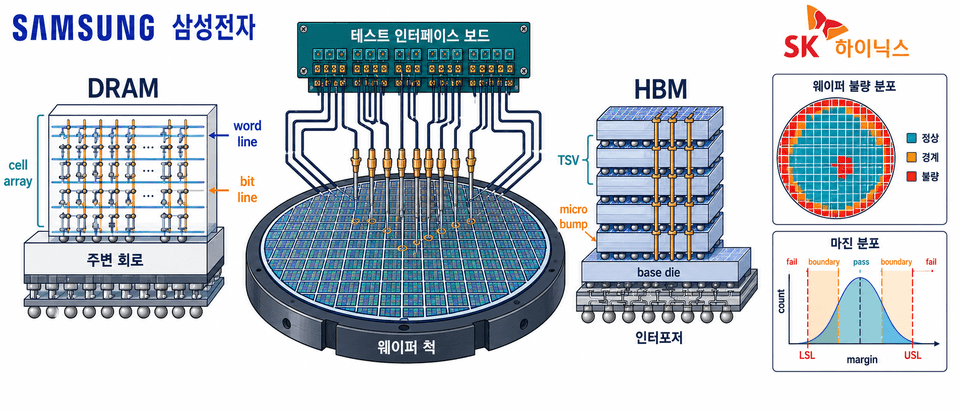
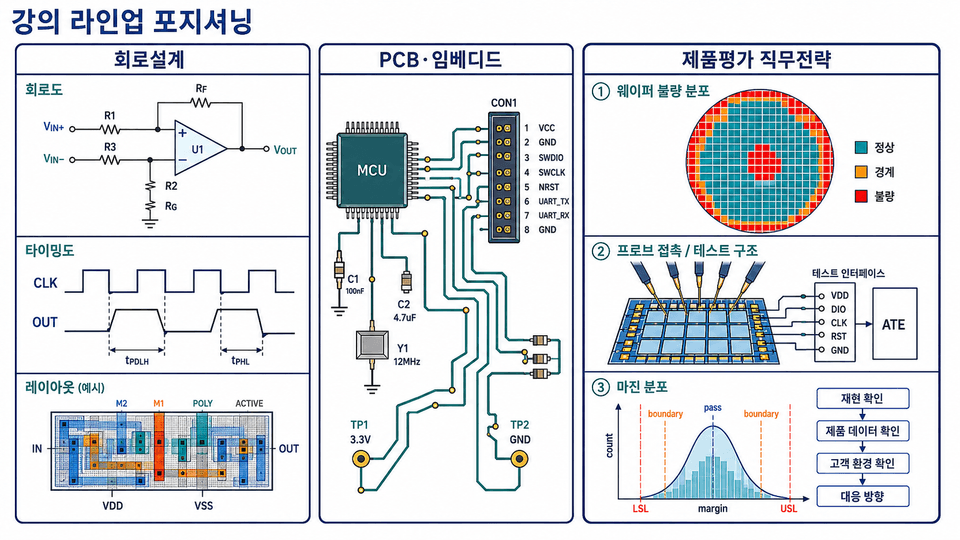
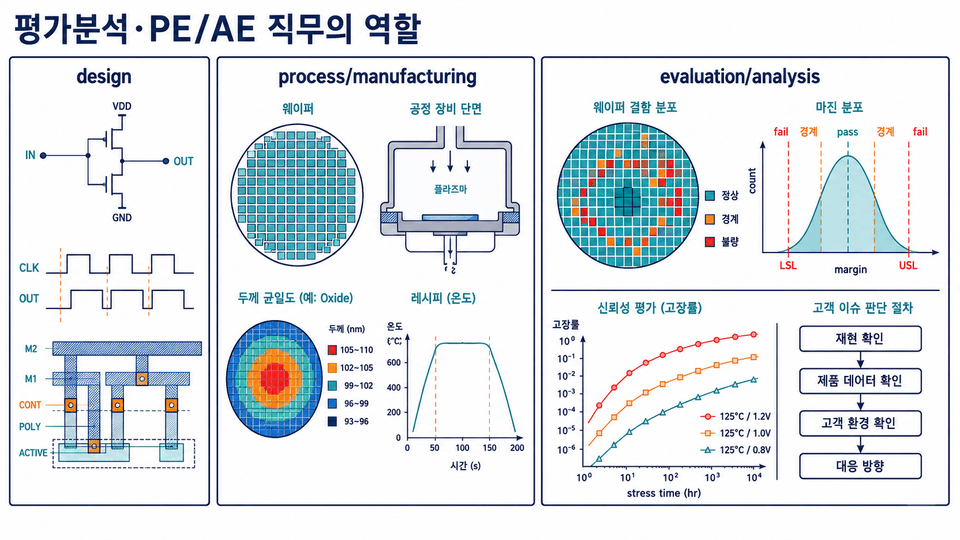
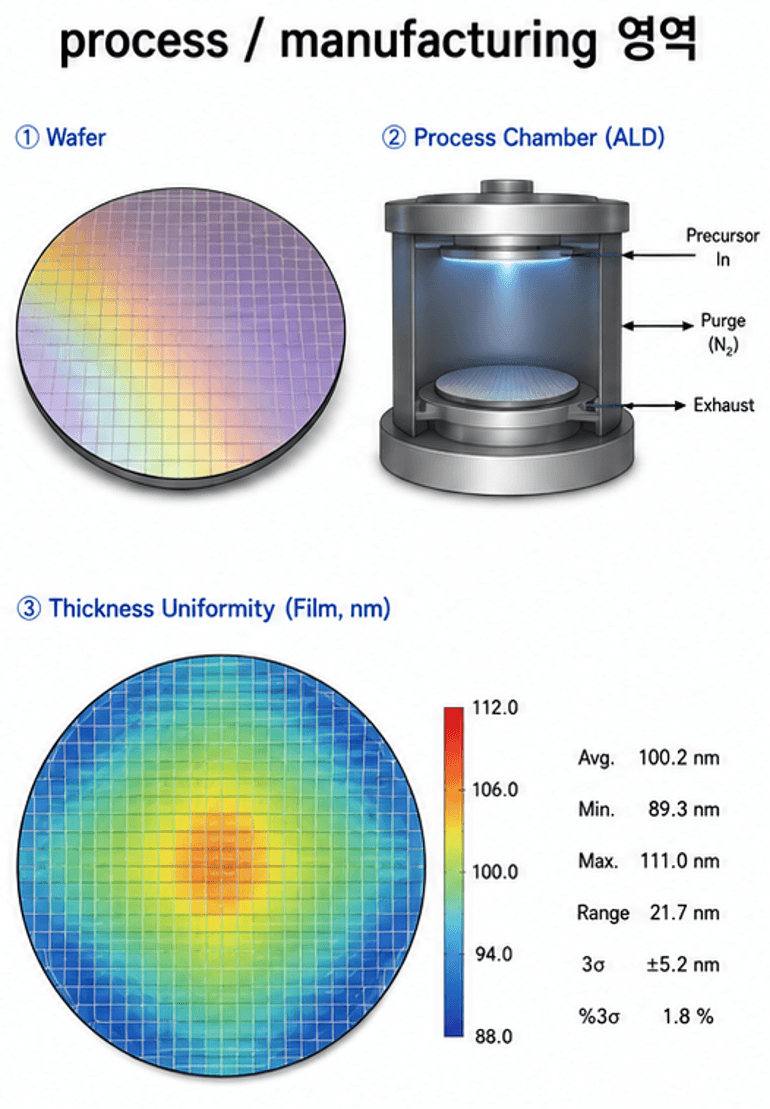
We will summarize which parts the product evaluation job focuses on within the Wafer → Chip → Package → Test flow.
2
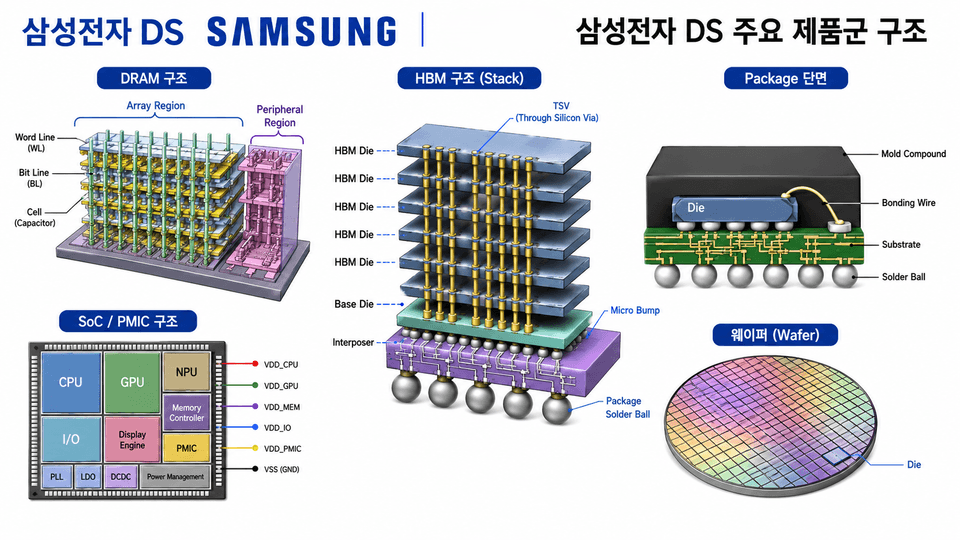
Samsung Electronics DS Evaluation & Analysis — Analysis by Division
We will compare Memory, S.LSI, Foundry, TSP, and AVP using the same framework and highlight key points for your application.
3
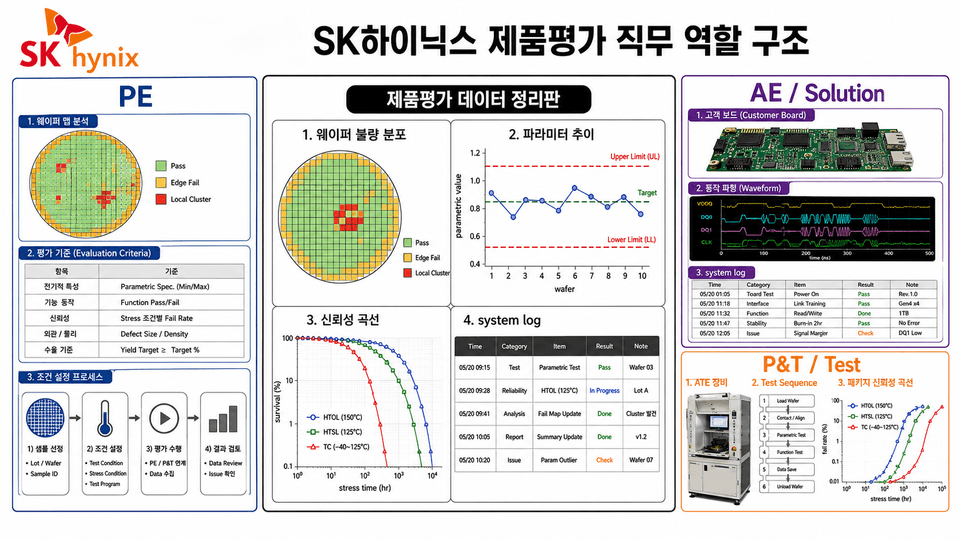
SK Hynix PE/AE — Analysis by Job Role
PE, AE, Solution PE, Development Test&Infra, and P&T Mass Production Technology differences are compared.
4
Converting my experiences into application and interview expressions
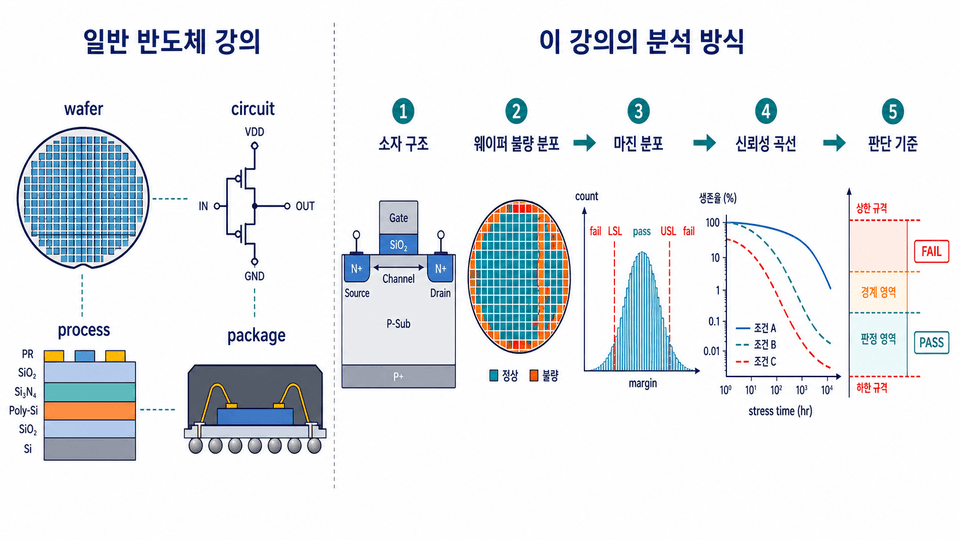
Rewrite your major-related experience in the following order: Problem Definition → Measurement → Data → Judgment → Improvement Results.
5
Memory interview answer practice
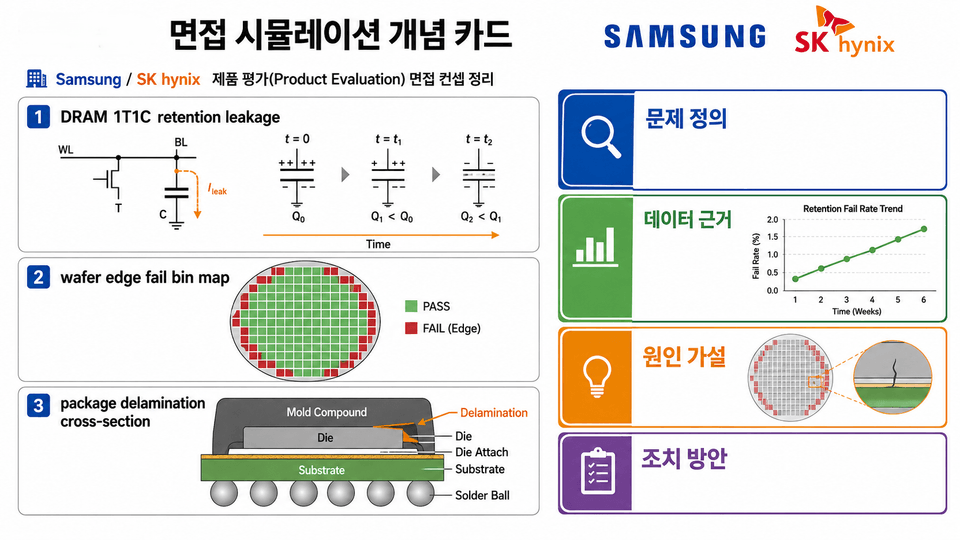
In Memory Division interviews, words such as retention, soft error, and edge wafer fail often appear. Practice the order in which to include these words in your answers.
6
S.LSI Interview Answer Practice
PVT corner, ATE measurement, and AEC-Q100 are expressions that are always included in S.LSI division interview questions. Let's use these expressions to build the framework of your answer.
7
Foundry Interview Answer Practice
In the Foundry division, there are many questions regarding EDS, Final Test, and the separation of responsibility between process failure and design failure. We will organize what to say first in your response.
8
TSP Interview Answer Practice
Keywords such as Warpage, Delamination, MSL, and HTOL frequently appear in TSP business unit interviews. Let's try arranging these keywords to fit the flow of your answers.
9
AVP Interview Answer Practice
It is difficult to discuss AVP division interviews without mentioning HBM, TSV, and hybrid bonding. We will try to construct answers using these keywords.
10
Converting experiences by major
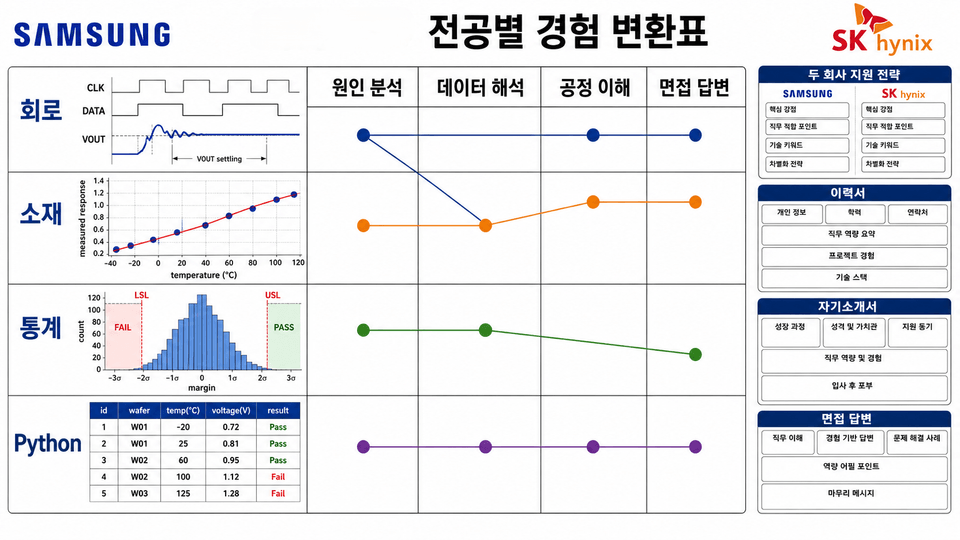
Circuit Design, Advanced Materials/Chemical Engineering, Industrial Engineering/Statistics, and Computer Science/Embedded experiences are organized from a product evaluation perspective.
11
Preparing to learn Python-based data analysis
Check what tools and foundations are required to learn product evaluation data analysis.
12
Summary of topics leading into the data analysis course
We will examine how Wafer Map, Shmoo Plot, Yield Analysis, SPC, and CP/CPK connect to the learning topics of subsequent courses.
Core Content by Business Unit
Memory
Learn yield and reliability analysis expressions, focusing on DRAM retention, soft error, edge wafer fail, and Wafer Map patterns.
S.LSI
Summarize how logic and automotive semiconductors are evaluated using PVT corner, ATE measurement, AEC-Q100, and Shmoo Plot.
Foundry
EDS and Final Test, separation of responsibility between process fail and design fail, and the flow of outsourced chip evaluation for customers will be examined.
TSP
We will examine keywords that appear in the package back-end process, such as Warpage, Delamination, Crack, MSL, and HTOL.
AVP
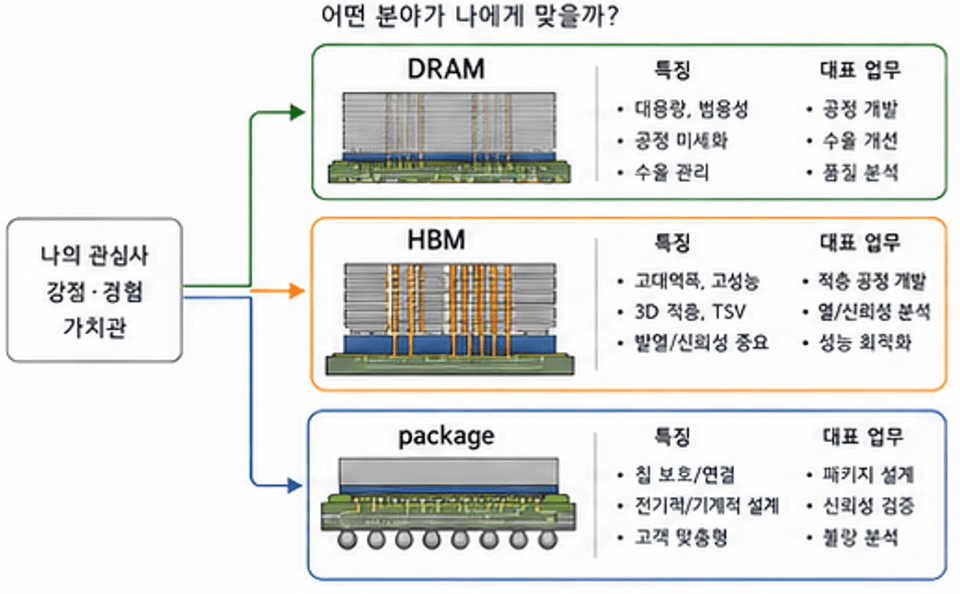
Check how HBM, 2.5D/3D Package, TSV resistance, die-to-die yield, and hybrid bonding are handled in product evaluation.
This is how the data analysis practice continues
In this lecture, we will first look at how the following topics relate to Evaluation & Analysis and PE/AE roles. Actual code writing and project-based practice will be conducted in the subsequent courses.
Wafer Map
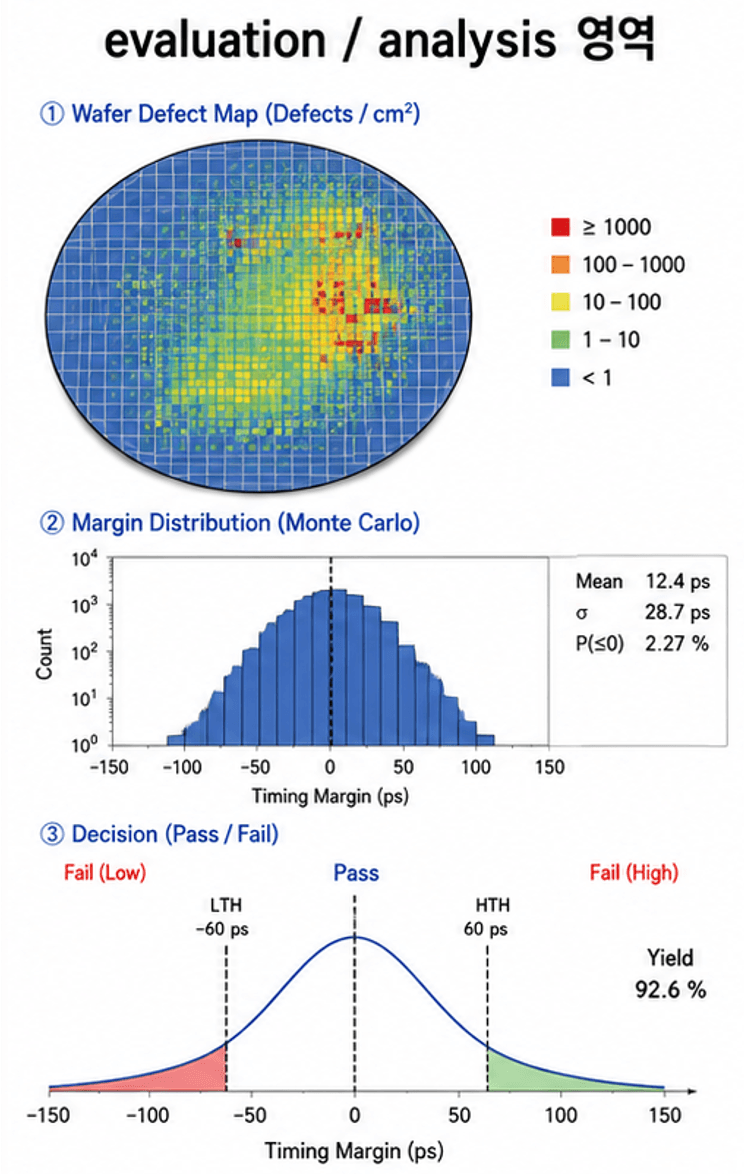
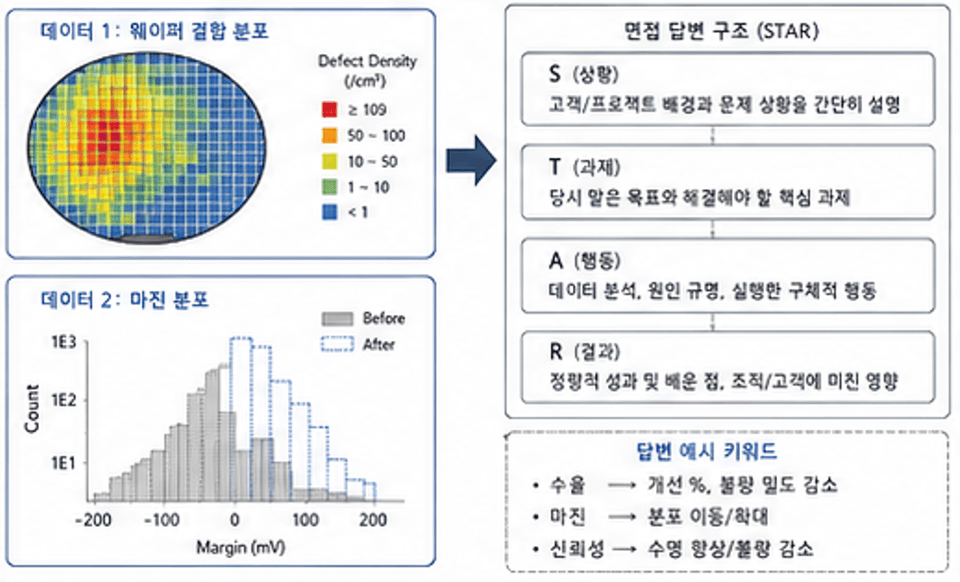
Connect patterns such as edge ring, center cluster, random, line defect with defect cause hypotheses.
Shmoo Plot
Read the pass/fail boundaries under voltage and frequency conditions, and translate them into Vmin and Fmax answers.
Yield Analysis
We will categorize whether the yield decrease is related to process, design, or test conditions.
SPC / CP / CPK
We will explain the indicators used to determine whether process and product data are being managed stably within standards using job-specific terminology.
Provided Materials and Benefits
The materials are organized to be easily accessible and usable during actual application preparation, rather than just "giving a lot." They are provided in the specific formats needed when deciding on a job role, writing a self-introduction letter, and preparing for an interview.
When deciding on a job role to apply for
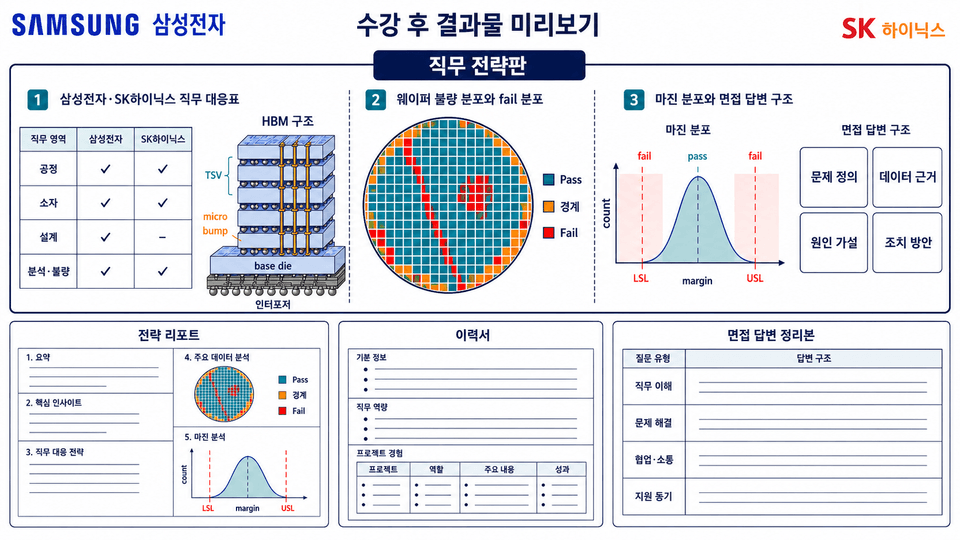
We provide a job suitability diagnostic chart and a job title conversion table for 5 divisions of Samsung DS and 5 roles at SK Hynix.
When writing your self-introduction letter
We provide a keyword mapping table and an experience conversion note to help you translate your major, projects, and lab experiences into the language of product evaluation.
When preparing for an interview
We organize expected questions and answer directions for each business division so that you can establish the sequence for your explanations during the interview.
List of Provided Materials — Over 30 types of workbooks, cards, checklists, and practice materials
They are provided in bundles according to the order of the lecture.
① Job Map · Glossary
Priority Selection Workbook, 30 Essential Terms, Job Map Visual Materials, My Starting Point Card
② Samsung 5 Business Divisions
5 types of business unit cards, self-check worksheet, comprehensive comparison table, 25 memorization cards, and interviewer's perspective checklist
Open KakaoTalk Group Chat Real-time questions, announcements, and student networking https://open.kakao.com/o/gm1KFaCg (Participation Code: 0459)
Monthly Live Class Checking application direction, feedback on report writing direction
Instructor Introduction
Circuit Design Mentor, Coach Sam
I have not only experienced design roles but have also directly gone through the entire process of wafer testing, packaging, and reliability evaluation, where the chip is verified as an actual product. Therefore, I can explain the preparation for Evaluation & Analysis and PE/AE roles from both a design perspective and a product perspective.
6 years of experience in chip circuit design at Samsung Electronics DS Division, System LSI Business Unit
Experience in design and verification of SOC, PMIC, CMOS image sensors, display driver ICs, etc.
Participated in the overall product development flow, including wafer testing, packaging, and reliability evaluation
Semiconductor Job Bible Author
Conducted over 200 interview consulting sessions
Conducted data/AI practical training for universities such as Yonsei University and Korea University, and corporations including Kia, LS Cable & System, LG Energy Solution, HL Mando, Handok, Daesang, and KBS.
FAQ
Q. Do we get hands-on practice with Wafer Maps or Shmoo Plots in this lecture?
A. In this lecture, we first look at how those topics relate to Evaluation & Analysis and PE/AE roles. Project-based hands-on practice, where you code and produce results yourself, will be conducted in the subsequent 8-week course.
Q. Is it okay if I don't know Python at all?
A. Yes. Python practice is not the main focus of this lecture. We will look at it at a level of understanding what topics are covered before moving on to data analysis learning.
Q. Can non-semiconductor majors take this course?
A. Yes. In fact, non-majors or those from other fields often get stuck because they don't know how to connect their experiences to Evaluation & Analysis, PE, or AE. I have specifically included a section on how to translate experiences based on different majors.
Q. Is it worth listening to even if I am preparing for circuit design or process design?
A. This lecture does not cover circuit design or process design in depth. However, it is helpful for those who want to convert those experiences into materials for applying to Evaluation & Analysis or PE/AE.
Q. I am only preparing for Samsung Electronics; do I still need to listen to the SK hynix part?
A. If you are only preparing for Samsung Electronics, you may skim through the SK hynix part quickly. However, comparing the job titles and task expressions of the two companies will give you a clearer understanding of the Evaluation & Analysis role.
Q. When will the Job Strategy Report be completed?
A. After comparing business units and job roles, a draft is created in the experience conversion part, and the content is reinforced in the interview response part. Finally, the target job role, self-introduction letter materials, and interview response directions are organized into a single document.
Q. What are the course duration and refund policies?
A. The course duration and refunds follow Inflearn's policies. Please check the course duration and refund information on the lecture page before making a payment.
Q. How do I ask questions during the course?
A. We primarily use the Inflearn course Q&A board. Additionally, announcements and questions are handled through the Naver Cafe and Open Kakao Chat room, and we review application strategies and report writing directions together during a monthly live class.
Notes before taking the course
Practice Environment
This course focuses on job selection and application preparation. You can take the course even if you do not have a Python practice environment set up in advance.
Prerequisites
You do not need to have a deep understanding of semiconductor processes, circuits, and data analysis. We will organize basic terminology from a job-specific perspective.
Subsequent practice sessions cover Python, Pandas, Matplotlib, Big Data, Data Engineering, Machine Learning, and Artificial Intelligence (AI).
Target Audience
It is suitable for undergraduate students, master's students, and job seekers who are considering applying for Samsung Electronics DS Evaluation & Analysis or SK Hynix PE/AE.
Preparing for Evaluation & Analysis · PE/AE Applications
Don't just decide on a company;
organize everything down to the job you will apply for and the experiences you will talk about in the interview.
If you are preparing for Samsung Electronics DS and SK Hynix, you must now go beyond "which company" and organize "which job role to apply for and with what experiences."
Recommended for these people
Who is this course right for?
Job seekers who cannot decide which business unit to apply for, even after looking at the recruitment announcement for Evaluation and Analysis in Samsung Electronics' DS Division (Memory, S.LSI, Foundry, TSP, and AVP)
Job seekers who are stuck on choosing which role to apply for because they don't know the specific responsibilities of SK hynix's PE, AE, and Solution PE positions.
Applicants who are non-semiconductor majors or non-electrical/electronic engineering majors and are unsure if their undergraduate experience connects to the product evaluation role.
Applicants who have experience in OP Amp, Verilog/FPGA, process experiments, and data analysis but are unable to transform these into materials for their semiconductor job applications.
Candidates who have heard of keywords like Yield, Wafer Map, Shmoo Plot, Failure Analysis, and Reliability, but feel lost on how to answer them during an interview.
Job seekers who want to organize job titles, division selections, and self-introduction letter strategies all at once while preparing for both Samsung Electronics DS and SK Hynix.
Need to know before starting?
Basic interest in the semiconductor product evaluation role
Intention to apply for Samsung Electronics DS Evaluation & Analysis or SK hynix PE/AE.
One of the following: undergraduate experiments, projects, capstone, or data analysis experience
I started listening to this lecture because I became interested in evaluation and analysis roles, and it has given me the confidence that there are more areas I can apply for than I thought. Thank you.










![[Renewed] Beginner’s Python Machine Learning Bootcamp (Easy! Learn by Solving Real Kaggle Problems) [Data Analysis/Science Part 2]Course Thumbnail](https://cdn.inflearn.com/public/courses/327464/cover/55c4db7b-7764-43cc-ac75-d9e8d08098f1/327464-eng.png?w=420)










![[Marketing Archive] Big Data-Driven Marketing StrategyCourse Thumbnail](https://cdn.inflearn.com/public/files/courses/339225/cover/01k7e89h4d1fkmcr1bwfh1j33h?w=420)