Hands-on Python Practice for Machine Learning FPGA Implementation

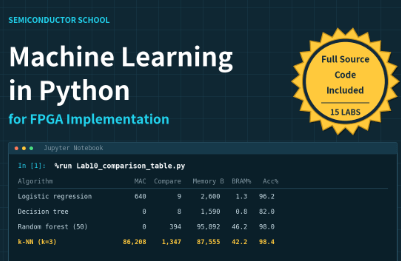
When you study machine learning, you learn how to improve accuracy. But the moment you try to deploy that model onto an actual chip, you are left with questions no one ever taught you to ask: How many multiplications does this model require? What does it need to remember, and how much? Can the target chip specifications handle these demands? Machine learning textbooks focus on accuracy, while semiconductor textbooks focus on circuits, yet resources bridging the two are scarce. I repeatedly encountered this gap while implementing RISC-V CPUs and NPUs on FPGAs—facing situations where the model with the highest accuracy simply wouldn't fit on the board. In this course, you will build six algorithms from scratch in Python, measuring the number of multiplications, comparisons, memory usage, and accuracy for each. You will then translate these metrics into actual FPGA board resources. While knowing the number of multiplications alone doesn't give you a sense of scale, expressing it as a percentage of the board's resources makes it easy to assess. After completing nine labs and compiling the six models into a single table, an unexpected picture emerges. We spent nine sessions counting multiplications, only to find that multiplications weren't the actual bottleneck. From there, we move on to quantizing floating-point numbers to integers, managing bit widths, and even establishing criteria for grading circuits. An FPGA board is not required. The course can be completed using Python alone, with the board serving merely as a reference for translating the measured metrics.

3 learners are taking this course

Level Intermediate

Course period Unlimited

Python
Python
Machine Learning(ML)
Artificial Neural Network
Numpy
Numpy
Scikit-Learn
Scikit-Learn
Python
Python
Machine Learning(ML)
Artificial Neural Network
Numpy
Numpy
Scikit-Learn
Scikit-Learn

What you will gain after the course

  • By examining a machine learning model, you can calculate its resource requirements on a chip across four categories.

  • The feasibility of implementation can be determined by expressing the number of operations and memory requirements as percentages of the actual board resources.

  • From a design perspective, we can explain the area-time tradeoff, which involves trading the number of multipliers for the number of cycles.

  • Floating-point weights can be quantized to integers, and the accumulator bit width can be calculated and determined.

  • We can create a Python golden model to verify the circuit and establish a procedure for value-by-value comparison.

  • You will complete a table comparing the costs of the six algorithms using the same criteria.

  • You'll get 15 Python scripts that you can run and tweak to test different values, along with a verification tool.

■ Course Introduction

Accuracy 98.4%. But this model won't fit on the chip.

When you study machine learning, you learn how to improve accuracy. But the moment you try to deploy that model on an actual chip, you're left with questions no one ever taught you to ask. How many multiplications does this model perform? What does it need to store, and how much? Can the target chip specs handle these requirements?

Machine learning textbooks focus on accuracy, while semiconductor textbooks focus on circuits. Yet, resources bridging the two are scarce. Those trained in machine learning often don't know what their models demand from a chip, while those trained in circuit design don't know what to run on them. This course was designed to bridge that gap.

As you build the six algorithms yourself, you will measure the number of multiplications, comparisons, memory usage, and accuracy for each one. Then, you will convert these metrics into the actual resource utilization of a real FPGA board. Simply stating the number of multiplications doesn't give a clear sense of scale on its own, but expressing it as a percentage of the board makes it much easier to evaluate.

After working through nine labs and compiling six models into a single table, the results reveal a picture quite different from what we expected. We devoted nine sections to counting multiplications, yet what actually became the bottleneck was not the multiplications. The model with the highest accuracy turned out to be the hardest to fit onto the chip.

These are the unseen things behind accuracy.

■ The moment you encounter during this process

  • We completely remove an entire calculation step that is always found in textbooks, deleting it only after verifying across all tests that the results remain unchanged.

  • We build a classifier that never performs a single multiplication. Rather than simply leaving the multiplier units idle, we get to see where that cost is shifted.

  • We witness the moment accuracy collapses from lacking just a single bit. It doesn't degrade gradually—it's a sheer cliff, and it doesn't even throw an error message.

  • You encounter cases where trying to reduce something actually makes it grow, because the very act of reducing it is an operation.

  • We identify the breaking point where the method fails the moment the data scales up. We don't discover this by building it first; rather, we know it through calculation before we even build it.

All values listed in the textbook are taken directly from the provided Python execution logs. Not a single number was filled in by guesswork.

■ What You Will Learn

Every time you create an algorithm, you fill in these four items.

Multiplication: the number of multiply-and-add operations, using dedicated multipliers. Comparison: the number of magnitude comparisons between two values, using logic resources. Memory: the number of bytes to be stored, using embedded memory blocks. Accuracy: the proportion of correct answers.

The first three are not interchangeable. Even with a surplus of multipliers, the design is unviable if memory is insufficient. Therefore, we measure the four individually but evaluate them together.

In Part 1, we establish that learning is essentially the repetition of basic arithmetic: multiplying, adding, and comparing. Starting with arrays, we build multiplication and accumulation, find the direction to reduce error, and expand the classification to ten classes.

In Part 2, we confirm that the resources required vary by algorithm. We build a classifier that avoids multiplication, an ensemble combining several of them, a method that skips learning entirely, and two approaches to reduce samples and dimensions. Finally, we compile all six models into a single table for review.

In Part 3, we transform the selected features into a format suitable for deployment on a chip. We downcast real numbers to integers, manage the bit width to prevent overflow, and establish evaluation criteria for the circuit. Then, we build a classifier structured as an actual circuit and calculate where this approach hits a bottleneck as the data scales up.

■ Principles this process follows

  • Always report accuracy alongside a baseline. In imbalanced problems, a single number alone is meaningless.

  • All values entered in the table are obtained from actual runs. Unmeasured items are left blank and not filled in from memory.

  • Assumptions should be clearly stated where they are made, and must not be changed quietly.

  • The values to be tuned are determined using the validation set, and the test set is opened only once at the very end.

It also includes a script that runs all fifteen notebooks at once and compares the outputs against the answer logs, allowing you to verify for yourself whether your results match the values in the textbook.

■ Recommended for:

  • Those familiar with machine learning who are curious about the hardware requirements of their models.

  • Those who work with FPGAs or semiconductors and want to know what can be deployed on top of them.

  • Those preparing for AI semiconductor design who wish to understand the relationship between algorithms and resources.

  • Those who have felt the need for criteria other than accuracy when selecting a model

■ Prerequisites

  • Basic Python Syntax

  • It will be easier if you have experience working with NumPy arrays.

  • No prior knowledge of machine learning is required. We will build the algorithms during the course.

  • No prior hardware knowledge is required either. All necessary concepts will be explained as we go.

■ Lab Environment

  • Anaconda and Jupyter Notebook

  • numpy, scikit-learn, matplotlib — automatically installed when running the first Lab

  • An FPGA board is not required.

The board is used solely as a reference for converting measured values.

■ What's Included

  • 15 Python practice scripts

  • Fixed training and test datasets

  • Answer logs and batch verification scripts

  • For each Lab, the applied practice section includes three items—the parts to be modified and the expected results are listed together.

The results shown in the hands-on exercises were obtained by actually modifying the values and running the code. Using the same values will produce the same results.

■ Topics Not Covered in This Course

  • Writing Verilog Code — This course uses only Python

  • Deploying and running on an FPGA board

  • Synthesis and Timing Analysis

  • Bit-level verification comparing circuits against Python — going as far as establishing the criteria for it.

  • Latest deep learning architectures — covers six classical algorithms

This course covers the phase of determining what to build before actually designing the circuit. Verilog implementation and board-level practice are then covered in the hands-on sessions using an FPGA.

■ Curriculum

Section 1 Before You Begin 9 min Free preview

Section 2 Data and Operations 29 min Free Preview

Section 3 Learning and Multiclass Classification 31 min

Section 4 Algorithms Without Multiplication 48 min Sec

Section 5 Reduction and Six Models 44 min

Section 6 Rounding Down to Integers 45 min

Section 7 Transitioning to the Board 31 min

Total approximately 4 hours

We are making the first two sections completely free. Going beyond just the environment setup guide, you can see exactly how this course evaluates models and experience the first two labs firsthand. Download the Python code now and run it yourself.

Recommended for
these people

Who is this course right for?

  • Those who know how to build machine learning models but lack the criteria to determine whether they can be deployed on an FPGA or ASIC, and have therefore been making decisions based on intuition every time.

  • For professionals working with semiconductors or FPGAs who have been assigned to AI accelerator projects but still have no clear idea of what exactly needs to be implemented as a circuit, even after reading algorithm-related documentation.

  • For those preparing for a career in AI semiconductor design who feel overwhelmed by the challenge of bridging accuracy-centric machine learning knowledge with resource-centric hardware knowledge.

  • For those who have ever had to start from scratch because they ran out of memory only after finishing building the model.

  • Those who read the MAC counts in papers but have never converted them to determine how many cycles it takes on our chip and what percentage that translates to.

Need to know before starting?

  • Basic Python Syntax

  • Experience working with NumPy arrays (no prior experience required)

  • No prior knowledge of machine learning is required. You will build the algorithms yourself during the course.

  • No prior hardware knowledge is required either. All necessary concepts will be explained as we go.

Hello
This is EdgeChipLab

Career Verified

As a current university professor, I have incorporated 30 years of system semiconductor expertise.

This is a practical curriculum directly designed and verified by a professor of semiconductor engineering, whose career spans from a system semiconductor researcher at Samsung Electronics' DS Division to Director of UK and German subsidiaries and Head of the System LSI Marketing & Sales Group.


Level up your engineering capabilities by going beyond theory to actual hardware implementation.

There are realms that scattered, fragmentary knowledge alone can never reach. Students will not merely be users of pre-built black-box IPs; they will design NPUs and CPUs, integrate peripherals, and ultimately evolve into system architect providers capable of building their own AI SoCs.


This is not a lecture just for watching. We guarantee 100% hardware implementation and Bit-True verification.

It goes beyond theory or simple simulations. Experience the thrill of seeing the instructor's KCI-indexed academic research and custom-designed circuits operate flawlessly on actual FPGA hardware. All source code, including the self-developed RISC-V CPU, is transparently disclosed, allowing anyone to freely use, reproduce, and verify it using only an entry-level FPGA (Arty S7-25) and free tools (Vivado).


Seamless Full-stack Roadmap: From Basics to mini LLM Accelerators

Every lecture is not an isolated fragment, but part of a journey toward completing a single, massive system.

  • Step 1: AI Theory and Image Processing Fundamentals (Including Machine Learning)

  • Step 2: AI Accelerator (NPU) Design and Verification (Including Machine Learning)

  • Step 3: RISC-V CPU Design and System Integration

  • Step 4: Advanced AI SoC Implementation and Expansion to mini LLM Acceleration Platform (Continuous content updates)


Objective Verification Metrics

All design deliverables of this course have undergone rigorous verification against global standards and by the academic community.

  • RISC-V Architecture Verification: Self-developed RISC-V CPU passed the international foundation's official Architectural Compliance Test (ACT) and source code released (GitHub)

  • Academic Authority: 4 single-author academic papers (KCI Grade A prestigious indexed journal IJIBC)

  • Global Recognition: Published two global Amazon technical books (Reached #3 Bestseller)

  • Actual operation verified: Core IPs such as RV32I CPU, NPU, Vision System, GPS, Transformer, and AURA-Edge SoC are fully operational in the Arty S7 environment.

Take on the challenge. By the time you finish the process of uploading code to the board and verifying the results yourself, you will have leveled up into a hardware engineer with a completely different perspective.

More

Curriculum

All

7 lectures ∙ (3hr 23min)

Published: 
Last updated: 

Reviews

Not enough reviews.
Please write a valuable review that helps everyone!

EdgeChipLab's other courses

Check out other courses by the instructor!

Similar courses

Explore other courses in the same field!

Limited time deal

$8,352.00

25%

$66.00