

Machine Learning Python Practice for FPGA Implementation
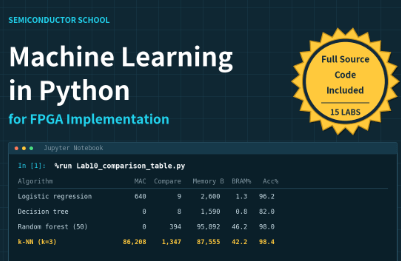
When you learn machine learning, you learn how to improve accuracy. But the moment you try to put that model onto an actual chip, questions no one has answered remain. How many multiplications does this model perform? How much does it need to remember, and for how long? Can the chip specifications you are targeting handle those requirements? Machine learning textbooks talk about accuracy, and semiconductor textbooks talk about circuits, but materials that bridge the gap between them are rare. I repeatedly encountered this gap while implementing RISC-V CPUs and NPUs on FPGAs. The model with the highest accuracy often turned out not to fit on the board. In this course, you will build six algorithms directly in Python, measuring the number of multiplications, comparisons, memory usage, and accuracy each time. Then you will convert those figures into the resources of an actual FPGA board. Saying that something requires a certain number of multiplications is not enough to gauge its size, but knowing that it uses a certain percentage of the board makes the decision clearer. After nine Labs, when the six models are brought together in a single table, an unexpected picture emerges. We spent nine lessons counting multiplications, but multiplications were not what held us back. After that, we reduce floating-point values to integers, manage bit widths, and even establish criteria for evaluating the circuit. You do not need an FPGA board. The course is conducted entirely in Python, and the board is used only as a reference for converting the measurements.
8 learners are taking this course
Level Intermediate
Course period Unlimited
Want to know what questions other learners frequently ask?
