inflearn logo

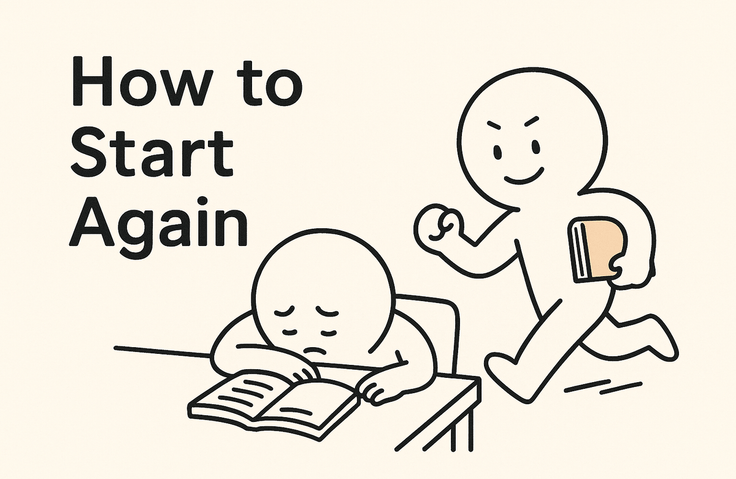
How to start again when you don't want to study

Learn practical techniques to start studying through structure rather than willpower. Master twelve execution design methods along with worksheets to lower the barrier to starting, recover broken focus, and prevent a single day's failure from turning into giving up.

11 learners are taking this course

Level Beginner

Course period Unlimited

Self Improvement
Self Improvement
task-scheduling
task-scheduling
Learning methods
Learning methods
Structure Design & Mission Planning
book-challenge
book-challenge
Self Improvement
Self Improvement
task-scheduling
task-scheduling
Learning methods
Learning methods
Structure Design & Mission Planning
book-challenge
book-challenge

What you will gain after the course

  • Structurally analyze the psychological causes of reluctance and derive solutions by type

  • Implement immediate starting techniques such as the 2-minute rule and the distraction log.

  • Building a sustainable learning routine using reset procedures and check systems

"I'm really going to work hard starting tomorrow."

How many times have you said these words? And how many days did that resolution actually last?

Most study method lectures cover how to study. They focus on things like note-taking, memorization techniques, and review cycles. However, that is not where we actually get stuck. We get stuck before we even sit down at our desks.

This lecture does not talk about building willpower. In fact, it is quite the opposite. It covers how to design environments and procedures so that studying begins even when your willpower is at rock bottom.

Why do resolutions fail

If you diagnose the reason you don't want to study as laziness, there is only one prescription: "Have a stronger mindset." This prescription doesn't last more than a few days. And when it fails, self-reproach remains, and that self-reproach leads to avoidance once again.

The actual structure is different. Right before opening a book, what we feel is boredom, helplessness, and the anxiety that we won't be able to do it. The brain tries to reduce this discomfort immediately, and the fastest way is avoidance. Procrastination is closer to a failure of emotion management rather than a failure of time management.

When the cause changes, the solution changes as well. The twelve tools covered in this lecture all aim at this specific point.

Make your goals laughably easy

The first tool of this lecture is the two-minute rule. Even if you stop after doing it for just two minutes, it counts as a success. Two hours of math is replaced by opening the workbook and solving one problem, and one hundred English words are replaced by opening the vocabulary book and learning five.

You might ask how any real studying can get done with such a small amount. You are right. The purpose of this tool is not the amount of study, but the number of starts. And in practice, hardly anyone stops after just two minutes. Because the difficult part wasn't continuing, but starting.

Change the conditions instead of relying on willpower

Mobile phones provide certain satisfaction within seconds of reaching for them. Studying, however, offers rewards months later, and even then, they are uncertain. Under these conditions, it is only natural for the brain to choose the mobile phone.

So we change the conditions. If you make it take twenty seconds longer to start procrastinating, the number of attempts decreases significantly. It is much easier and lasts much longer than trying to endure through willpower alone.

Dealing with what comes after a breakdown

This is the part where this lecture differs most from other study method lectures. The day you fall apart will come. That is not a failure, but an expected event. What matters is what happens next.

In the final section, I will distinguish between slumps and burnout and provide a five-minute reset procedure for when you've ruined your day. There is only one rule: do not miss two days in a row. Missing one day is an accident, but missing two days means returning to the state of not doing it at all.

Recommended for
these people

Who is this course right for?

  • Office worker students who are unable to start studying after work

  • Learners who pay for online courses but fail to complete them

  • Parents who want to teach their children practical ways to form study habits

Need to know before starting?

  • Possessing basic motivation or goals for study or self-development

  • The minimum willingness for self-reflection required to complete the worksheet

  • Currently more interested in overcoming barriers to execution than in learning methodologies.

Hello
This is jjangkbg7719

Career Verified

341

Learners

23

Reviews

1

Answers

4.8

Rating

11

Courses

Hello, I'm Frank.

I am an infrastructure engineer who has been wrestling with servers for over 20 years. Starting with Linux server operations, I am now in charge of the cloud infrastructure for a large-scale payment service. My daily life involves migrating from data centers to AWS, managing hundreds of instances, and tracing the causes of failures in the early hours of the morning.

The reason I created this course is simple.

I often received questions like these from those around me: "I managed to connect to the server, but I don't know what to do next." "There are so many instance types; which one should I choose?" These are the exact same points where I got stuck at first. However, when I looked for resources, I found that most of them were written for people who already knew what they were doing.

So I decided to create the course I wish I had when I first started learning.

My lectures are based on three principles.

First, I help you understand rather than memorize. Instead of just listing commands, I explain why we use them in the first place.

Second, I boldly omit unnecessary content. I do not increase the volume by including information that is useless to beginners right now.

Third, I also talk about what doesn't work. Instead of just listing the pros, I clearly point out cases where it might not be a good fit. For someone who has to make decisions in the field, that is more important.

If you feel a sense of "Ah, I should start from here" after listening to the lecture, then my goal has been achieved.

Please feel free to leave any questions you may have at any time.

More

Reviews

Not enough reviews.
Please write a valuable review that helps everyone!

jjangkbg7719's other courses

Check out other courses by the instructor!

Similar courses

Explore other courses in the same field!

Limited time deal

$3,300.00

70%

$8.80