inflearn logo

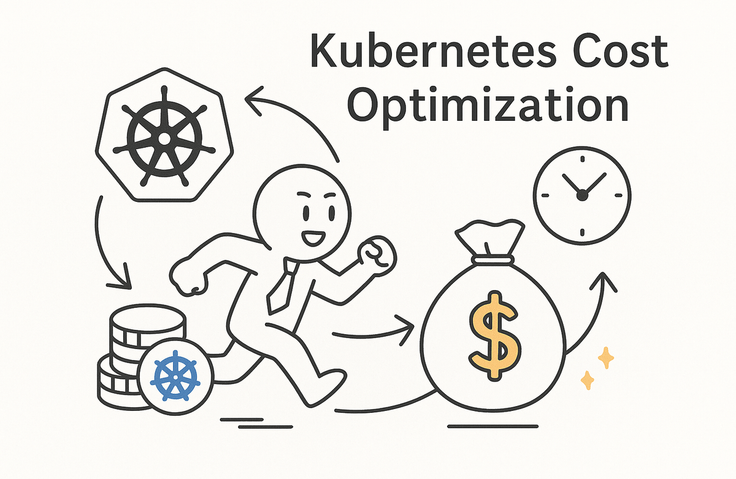
Practical Decision-Making Guide to Kubernetes Cost Optimization

Diagnose cost leakage in a Kubernetes cluster and learn the decision criteria and validation methods needed before introducing automation tools. Validate key cost-saving techniques such as Karpenter, Spot Instances, and Workload Optimization in read-only mode, then practice the entire process of safely applying them to production and rolling them back.

2 learners are taking this course

Level Intermediate

Course period Unlimited

Terraform
Terraform
karpenter
karpenter
ec2
ec2
k8s
k8s
cost reduction
cost reduction
Terraform
Terraform
karpenter
karpenter
ec2
ec2
k8s
k8s
cost reduction
cost reduction

What you will gain after the course

  • Diagnosing Cluster Cost Leakage Points and Calculating Net Savings

  • Design of IAM permission scope for automation tools and completion of the security review

  • Safe Application of Spot Instances and Workload Optimization and Two-Phase Rollback

Course Introduction


Even after cleaning up nodes or changing instance types, the bill remains the same. That’s because the problem isn’t coming from just one place.

Kubernetes costs leak from three places simultaneously: requests set generously by developers, pods scattered across multiple nodes that are only half full, and on-demand nodes left in place because of the management burden. This is why everything returns to its original state within three months, even after a major cleanup.

This course covers how to automatically manage these three areas using Cast AI. However, it is not a feature guide. Since this involves deciding to hand over permission to make cluster changes to an external service, the focus is less on what to enable and more on when to enable it and what to check first.

Lessons 1 through 3 do not make any changes to the cluster. We proceed by verifying the potential savings through actual measurements, calculating the net savings, and then considering automation. In Lesson 1, we first discuss environments where the impact is limited and those where it cannot be applied at all.


Recommended for those who:

  • Those operating EKS clusters who are being asked to reduce costs but don’t know where to start.

  • Those who receive reports from tools like Kubecost but aren’t seeing actual savings as a result

  • Those using Karpenter or Cluster Autoscaler and considering switching to Cast AI

  • Those who want to adopt Spot Instances but have put it off because handling interruptions feels burdensome

  • Those who know they need to adjust their requests values but find coordinating with each team daunting

  • Those who want to manage autoscaling settings as code in a Terraform-based GitOps environment

  • Technology decision-makers who need to assess and report on whether to adopt it and its cost-effectiveness

Recommended for
these people

Who is this course right for?

  • A DevOps engineer under pressure to reduce costs while operating a Kubernetes cluster

  • An SRE considering adopting a cost optimization tool but needing risk assessment criteria

  • Platform Engineer Leading a Cloud Cost Reduction Project

Need to know before starting?

  • At least 6 months of experience operating Kubernetes clusters

  • Basic knowledge of managing resources such as Pods, Deployments, and HPAs

  • Experience using one or more of AWS/GCP/Azure clouds

Hello
This is jjangkbg7719

Career Verified

703

Learners

55

Reviews

3

Answers

4.7

Rating

34

Courses

Hello, I'm Frank.

I am an infrastructure engineer who has been wrestling with servers for over 20 years. Starting with Linux server operations, I am now in charge of the cloud infrastructure for a large-scale payment service. My daily life involves migrating from data centers to AWS, managing hundreds of instances, and tracing the causes of failures in the early hours of the morning.

The reason I created this course is simple.

I often received questions like these from those around me: "I managed to connect to the server, but I don't know what to do next." "There are so many instance types; which one should I choose?" These are the exact same points where I got stuck at first. However, when I looked for resources, I found that most of them were written for people who already knew what they were doing.

So I decided to create the course I wish I had when I first started learning.

My lectures are based on three principles.

First, I help you understand rather than memorize. Instead of just listing commands, I explain why we use them in the first place.

Second, I boldly omit unnecessary content. I do not increase the volume by including information that is useless to beginners right now.

Third, I also talk about what doesn't work. Instead of just listing the pros, I clearly point out cases where it might not be a good fit. For someone who has to make decisions in the field, that is more important.

If you feel a sense of "Ah, I should start from here" after listening to the lecture, then my goal has been achieved.

Please feel free to leave any questions you may have at any time.

More

Curriculum

All

22 lectures ∙ (14min)

Course Materials:

Lecture resources
Published: 
Last updated: 

Reviews

Not enough reviews.
Please write a valuable review that helps everyone!

jjangkbg7719's other courses

Check out other courses by the instructor!

Similar courses

Explore other courses in the same field!

Limited time deal

$3,300.00

70%

$8.80