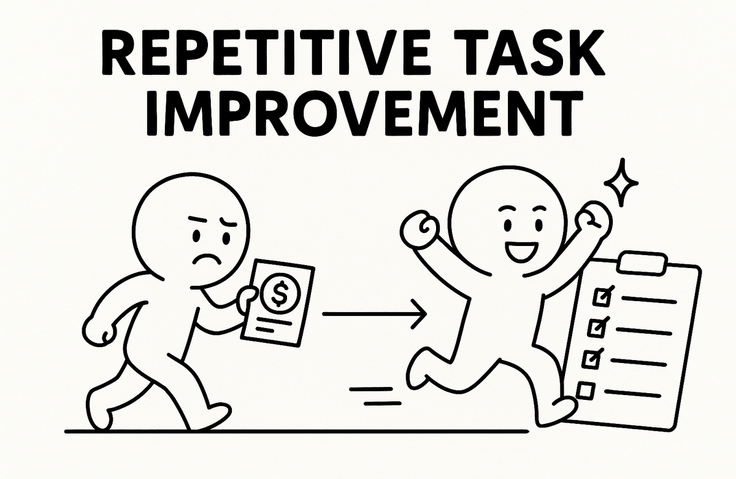
Recurring Work Improvement Strategy: From Cost Calculation to Four-Stage Optimization

Learn how to calculate the 20 minutes that disappear each week on an annual basis, and identify not only exact repetitions but also similar and hidden ones. Use the rule of three and cost-benefit analysis to decide when to improve, and adopt a practical approach that stops at the level you need among four stages, from documentation to automation.

1 learners are taking this course

Level Basic

Course period Unlimited

Refactoring
Refactoring
software-design
software-design
optimizing
optimizing
task-scheduling
task-scheduling
cost reduction
cost reduction
Refactoring
Refactoring
software-design
software-design
optimizing
optimizing
task-scheduling
task-scheduling
cost reduction
cost reduction

What you will gain after the course

  • Distinguishing the Three Types—Identical Repetition, Similar Repetition, and Hidden Repetition—and Applying Them in Practice

  • Establishing Criteria for Determining When to Make Improvements Through the Three-Time Rule and Annual Profit-and-Loss Calculations

  • Select and implement the optimal stage among the four levels: documentation, templating, semi-automation, and automation.


Practical criteria for reducing
the cost of repetition


Even 20 minutes of repetition every week adds up to a significant cost over a year.

I have operated servers for over 20 years, managing large-scale payment services and hundreds of instances.
Through that process, I identified not only the same repetitions, but also similar and hidden ones.

From documentation to templates, checklists, and automation
Use the rule of three and cost-benefit calculations to make only the improvements you need.


What you can gain from this course

Calculate the cost of repetition and find the point at which to improve.

Convert the time that disappears each week into an annual figure, and distinguish between identical repetitions, similar repetitions, and hidden repetitions. Use the rule of three to determine when to start making improvements.

Choose the steps that fit the task—documentation, templates, checklists, or automation. You’ll also learn when to stop so that over-automation doesn’t end up consuming more time.

It incorporates practical insights from more than 20 years of operating servers, migrating data centers to the cloud, and managing hundreds of instances and incidents. Rather than focusing on improvements that merely look good, it focuses on ways to reduce actual costs and operational risks.

You will calculate the cost of repetitive tasks and decide for yourself on the most appropriate improvement steps.
I will clearly convey the criteria you can apply and use to make decisions immediately in the field.


Field Experience Discovering the Cost of Repetitive Work

I learned the cost of repetition on server floors chasing down outages at dawn.


I have spent over 20 years operating Linux servers, building my career as an infrastructure engineer.

After moving the data center to AWS and managing hundreds of instances, I encountered countless moments when small repetitions accumulated into significant operational costs.

Every time I traced the cause of an incident, I repeated the same checks and documentation. From then on, I decided that instead of automating every repetitive task unconditionally, I should calculate the cost and improve only to the necessary level.


Distinguish between types of repetition. Use the rule of three to determine when to improve. Choose only the necessary steps, from recording to automation. Pick one repetitive task today and calculate it.


Practical Curriculum

Recurring Task Optimization

Section 1

Course Materials Guide

This section introduces the course materials for learning the full course content. Review the essential resources to use when identifying and improving repetitive tasks.

Section 2

Understanding the Cost of Repetitive Work

Based on the principle of not doing the same work twice, we examine the concept of repetitive work and its hidden costs. We convert the time accumulated each week into an annual cost to determine the need for improvement.

Section 3

Types of Repetition and Criteria for Improvement

Distinguish among three types of repetition—identical repetition, similar repetition, and hidden repetition—and apply them to practical cases. Learn the three-time rule and a four-stage improvement strategy progressing from documentation and templates to semi-automation and automation.

Section 4

Documentation, Templates, and Checklists

Learn how to improve repetitive tasks through three steps: Step 1, documenting; Step 2, creating templates; and Step 3, creating checklists. Visualize and standardize work procedures to reduce omissions and unnecessary rework.

Section 5

Automation and Cost-Benefit Analysis

Learn how to automate repetitive tasks and examine situations in which automation should be avoided. Calculate the gains and losses before and after improvement by considering the time required for automation and its maintenance costs, and choose an appropriate level of improvement.

Section 6

Summary of Application Results and Practice

Compare the changes before and after improving repetitive tasks, and practice applying the principles you learned to actual work. Identify your own repetitive tasks, determine the appropriate level of improvement, and review the course content as a whole.


Who This Course Is For

Recommended for:

Professionals who want to calculate the time and cost of repetitive tasks
and set improvement priorities

Team leaders and managers who want to choose the appropriate level of improvement using records, templates, and checklists before automation


Notes Before Taking the Course


Practice environment

  • The exercises are conducted on Windows, macOS, and Linux.

  • Prepare a document editor and spreadsheet.
    They will be used for recording work and calculating cost savings.

Prerequisites and Notes

  • No specific programming language is required.
    If you have firsthand experience with repetitive tasks, that is sufficient.

  • We cover the fundamentals of refactoring and software design.
    We also examine cases of work schedule management and optimization.

Learning materials

  • You can refer to the lecture slide documents.
    You can also use the recurring task log template.

  • We use the rule of three and a profit-and-loss statement.
    We provide step-by-step materials from record-keeping to automation.


Recommended for
these people

Who is this course right for?

  • Practitioners who waste time on repetitive tasks but can’t find a starting point for improvement

  • An office worker who tried to automate a task but found that it actually took more time.

  • Team leaders and managers whose work efficiency is declining as small repetitive tasks pile up

Need to know before starting?

  • Experience performing routine, repetitive tasks (at least 3 months)

  • Basic proficiency in office tools such as Excel and Google Sheets

  • Experience documenting or organizing work processes

Hello
This is jjangkbg7719

Career Verified

830

Learners

64

Reviews

6

Answers

4.7

Rating

42

Courses

Hello, I'm Frank.

I am an infrastructure engineer who has been wrestling with servers for over 20 years. Starting with Linux server operations, I am now in charge of the cloud infrastructure for a large-scale payment service. My daily life involves migrating from data centers to AWS, managing hundreds of instances, and tracing the causes of failures in the early hours of the morning.

The reason I created this course is simple.

I often received questions like these from those around me: "I managed to connect to the server, but I don't know what to do next." "There are so many instance types; which one should I choose?" These are the exact same points where I got stuck at first. However, when I looked for resources, I found that most of them were written for people who already knew what they were doing.

So I decided to create the course I wish I had when I first started learning.

My lectures are based on three principles.

First, I help you understand rather than memorize. Instead of just listing commands, I explain why we use them in the first place.

Second, I boldly omit unnecessary content. I do not increase the volume by including information that is useless to beginners right now.

Third, I also talk about what doesn't work. Instead of just listing the pros, I clearly point out cases where it might not be a good fit. For someone who has to make decisions in the field, that is more important.

If you feel a sense of "Ah, I should start from here" after listening to the lecture, then my goal has been achieved.

Please feel free to leave any questions you may have at any time.

More

Curriculum

All

16 lectures ∙ (12min)

Course Materials:

Lecture resources
Published: 
Last updated: 

Reviews

Not enough reviews.
Please write a valuable review that helps everyone!

jjangkbg7719's other courses

Check out other courses by the instructor!

Similar courses

Explore other courses in the same field!

Limited time deal

$3,300.00

70%

$8.80