inflearn logo

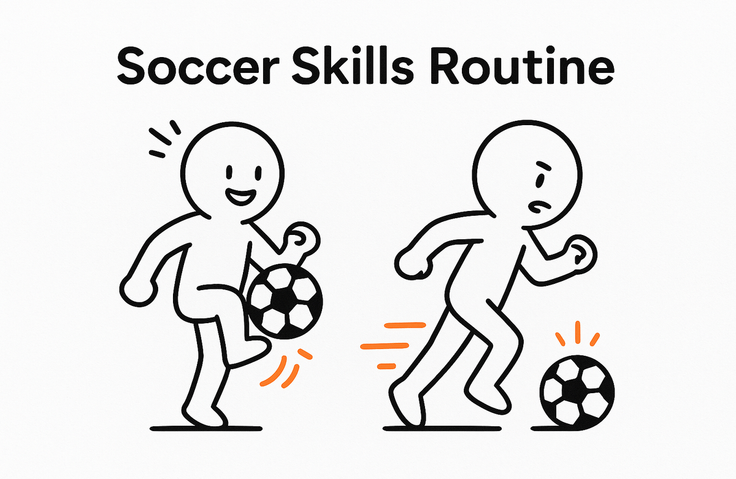
A soccer skill improvement routine to break through a plateau

Analyze why your soccer skills have plateaued and learn how to overcome stagnation by understanding the principles of step-by-step growth. Through actionable routines—15-minute weekday training sessions, setting one goal per match, and writing a three-line post-match review—you can steadily improve your skills without additional time or expense.

1 learners are taking this course

Level Beginner

Course period Unlimited

Self Improvement
Self Improvement
performance-test
performance-test
work out
work out
book-challenge
book-challenge
Self Improvement
Self Improvement
performance-test
performance-test
work out
work out
book-challenge
book-challenge

What you will gain after the course

  • Analyze the causes of skill stagnation by distinguishing between unchangeable conditions and habits that can be improved.

  • Maintaining consistent training motivation during plateaus by understanding the stair-step growth pattern

  • Immediate daily application of the 15-minute weekday training, one goal per game, and three-line journaling routine

This course is for people like you

· Office workers who play futsal once a week on weekends but feel like their skills have plateaued

· Those who have years of experience but keep making the same mistakes in the same situations

· Those who can’t think of what to improve after a game ends

· Those who have been giving up practice because they have difficulty setting aside extra time

· Those who wonder why the gap between themselves and skilled players never narrows


What is covered in Lesson 1

[Why Am I Not Improving?]

If you attribute a plateau in your skills to a lack of effort, you won’t find the answer. Time, energy, feedback, tracking, and recovery. We first identify the five constraints that come with being a working professional, then distinguish which of them we can actually change.

[Growth Happens in Steps]

The growth we expect is a straight line that rises a little each month, but actual athletic ability improves in a staircase pattern. Periods of sudden improvement alternate with plateaus where nothing seems to change. Most people quit during these flat stretches. We’ll explore why a plateau isn’t failure and what determines the next step.

[Out of 90 minutes, the time spent touching the ball is 2 minutes]

In 90 minutes on the weekend, you actually play for only about 30 minutes, and when five players on the court share one ball, each person touches the ball for roughly two minutes. Even over the course of a year, that adds up to less than two hours. Calculating this number yourself makes it clear what needs to change.

[Three Levers]

How to increase the total amount of time you spend touching the ball with 15 minutes of practice during the week, how to turn a game into training by setting just one goal per game, and how to make the following week different with a three-line record after each game. None of the three requires much additional cost or time.

Here’s what you’ll gain

· You will be able to explain whether the reason your performance has plateaued lies in your conditions or your habits.

· You’ll develop a standard that keeps you steady even when you hit a plateau.

· You can immediately start four 15-minute weekday practice routines you can do at home

· You can set one specific goal to use in this weekend’s game and head out.

· You’ll learn a 90-second post-game journaling method that makes your progress visible

Recommended for
these people

Who is this course right for?

  • An amateur soccer player struggling with a plateau in their skills.

  • A recreational soccer player looking for a systematic training method

  • Working soccer club members who want to improve their skills efficiently despite busy schedules

Need to know before starting?

  • Basic soccer match experience

  • Participate in soccer activities at least once a week

  • Commitment to self-improvement and to developing a habit of keeping records

Hello
This is jjangkbg7719

Career Verified

755

Learners

60

Reviews

3

Answers

4.7

Rating

39

Courses

Hello, I'm Frank.

I am an infrastructure engineer who has been wrestling with servers for over 20 years. Starting with Linux server operations, I am now in charge of the cloud infrastructure for a large-scale payment service. My daily life involves migrating from data centers to AWS, managing hundreds of instances, and tracing the causes of failures in the early hours of the morning.

The reason I created this course is simple.

I often received questions like these from those around me: "I managed to connect to the server, but I don't know what to do next." "There are so many instance types; which one should I choose?" These are the exact same points where I got stuck at first. However, when I looked for resources, I found that most of them were written for people who already knew what they were doing.

So I decided to create the course I wish I had when I first started learning.

My lectures are based on three principles.

First, I help you understand rather than memorize. Instead of just listing commands, I explain why we use them in the first place.

Second, I boldly omit unnecessary content. I do not increase the volume by including information that is useless to beginners right now.

Third, I also talk about what doesn't work. Instead of just listing the pros, I clearly point out cases where it might not be a good fit. For someone who has to make decisions in the field, that is more important.

If you feel a sense of "Ah, I should start from here" after listening to the lecture, then my goal has been achieved.

Please feel free to leave any questions you may have at any time.

More

Curriculum

All

16 lectures ∙ (16min)

Course Materials:

Lecture resources
Published: 
Last updated: 

Reviews

Not enough reviews.
Please write a valuable review that helps everyone!

jjangkbg7719's other courses

Check out other courses by the instructor!

Similar courses

Explore other courses in the same field!

Limited time deal

$3,300.00

70%

$8.80