The Skill of Managing Emotions: Cognitive Restructuring and the Three-Column Record Method

Understand the interpretation step that exists between events and emotions, and identify your own patterns of cognitive distortion. Through exercises in naming and rating the intensity of emotions, along with three-column recording, learn practical skills for handling emotions without being overwhelmed by them.

1 learners are taking this course

Level Beginner

Course period Unlimited

Refactoring
Refactoring
reflection
reflection
3-tier
3-tier
resilience4j
resilience4j
soft skills
soft skills
Refactoring
Refactoring
reflection
reflection
3-tier
3-tier
resilience4j
resilience4j
soft skills
soft skills

What you will gain after the course

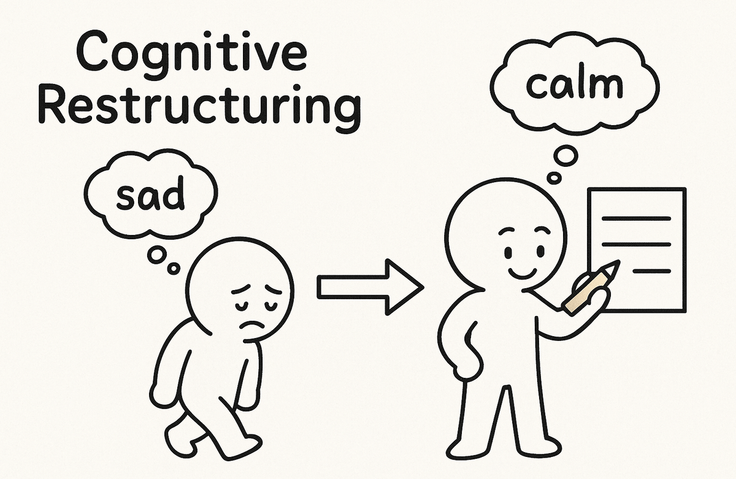
  • Explain the three-stage structure of event–interpretation–emotion using your own case.

  • Identify one of your primary patterns among the six cognitive distortions.

  • Complete one worksheet on naming emotions and the three-column recording method

Subtitle: How to choose your response without being driven by emotions
Length: Approximately 30 minutes · 20 slides · 9 A4-page workbook

One-line introduction

This is not a lecture about eliminating emotions. You will learn to feel your emotions as they are, while not accepting the interpretations they create as facts.

Opening Scene

Have you ever regretted a message you sent while angry five minutes later?

The problem here was not being angry. It was sending a message while angry. The problem was that the emotion and the action were fused together. Lesson 2 is training to create space between them. At first, it is three seconds; once you get used to it, it becomes a day. That interval gives you more choices.


Recommended for those who

  • Those whose entire day is thrown off by a single criticism or piece of feedback

  • Those who have regretted messages they sent while angry

  • Those who create the worst-case scenario while looking at a message with no reply

  • For those who repeatedly replay conversations that have already ended in their heads

  • Those who have never learned any way other than suppressing their emotions.

When It’s Not a Good Fit

  • For those who want a way to stop feeling emotions. This course takes the opposite approach.

  • Those who expect an immediate change in mood. Most of the tools involve writing by hand.

  • Those who are currently not in a good state and find the act of examining their own thoughts burdensome.

Tool 1. Assign a Name and Number (30 seconds)

“Feeling bad” is too broad. If you change it to “I feel hurt because I think I was ignored,” it becomes more precise—and the more precise it is, the less intense it becomes. Once you’ve named it, rate its intensity on a scale of 0 to 10. If the intensity is 7 or higher, don’t make any decisions; deal with it after it has dropped to 4 or below.

Tool 2. Separate Facts and Interpretations (3 minutes)

If it’s captured on camera, it’s a fact; if it isn’t, it’s an interpretation. The team leader asking for the evidence behind the materials is captured on camera, but “doesn’t trust me” isn’t. When you write them down separately, you can see that most of what you believed were facts were actually interpretations, and that your response becomes simpler when you focus only on the facts.

Tool 3. Three-Column Record (10 minutes)

  • Column 1: Situation — Write only the facts

  • Column 2. Automatic thoughts — Write them exactly as they are, without softening them.

  • Column 3: Alternative thoughts — Write based on the evidence

The most effective question is this: What would I say to a colleague in the same situation? People are harsh with themselves and reasonable with others. One entry a day is enough.

Recommended for
these people

Who is this course right for?

  • Office workers struggling at work or in relationships due to emotional ups and downs

  • Learners who want to specifically develop self-regulation, a component of resilience

  • Someone who wants to handle their emotions wisely without suppressing them

Need to know before starting?

  • Basic understanding of the three components of resilience (self-regulation, interpersonal skills, and positivity)

  • Willingness to observe one’s own emotional response patterns

  • Experience of at least one recent emotionally significant event for completing the worksheet

Hello
This is jjangkbg7719

Career Verified

641

Learners

48

Reviews

3

Answers

4.8

Rating

32

Courses

Hello, I'm Frank.

I am an infrastructure engineer who has been wrestling with servers for over 20 years. Starting with Linux server operations, I am now in charge of the cloud infrastructure for a large-scale payment service. My daily life involves migrating from data centers to AWS, managing hundreds of instances, and tracing the causes of failures in the early hours of the morning.

The reason I created this course is simple.

I often received questions like these from those around me: "I managed to connect to the server, but I don't know what to do next." "There are so many instance types; which one should I choose?" These are the exact same points where I got stuck at first. However, when I looked for resources, I found that most of them were written for people who already knew what they were doing.

So I decided to create the course I wish I had when I first started learning.

My lectures are based on three principles.

First, I help you understand rather than memorize. Instead of just listing commands, I explain why we use them in the first place.

Second, I boldly omit unnecessary content. I do not increase the volume by including information that is useless to beginners right now.

Third, I also talk about what doesn't work. Instead of just listing the pros, I clearly point out cases where it might not be a good fit. For someone who has to make decisions in the field, that is more important.

If you feel a sense of "Ah, I should start from here" after listening to the lecture, then my goal has been achieved.

Please feel free to leave any questions you may have at any time.

More

Curriculum

All

21 lectures ∙ (25min)

Course Materials:

Lecture resources
Published: 
Last updated: 

Reviews

Not enough reviews.
Please write a valuable review that helps everyone!

jjangkbg7719's other courses

Check out other courses by the instructor!

Similar courses

Explore other courses in the same field!

Limited time deal

$3,300.00

70%

$8.80