inflearn logo

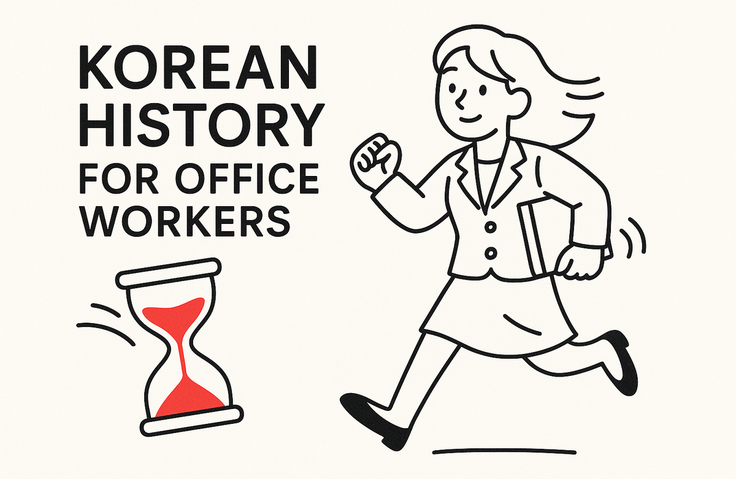
Korean History Read in Context for Working Professionals

Connect the history from Gojoseon to the present day in a single thread through context rather than memorization. Learn how to read historical sources, understand the background of historical stories encountered in the news, dramas, and travel, and reinterpret history from the perspective of working people in this liberal arts course.

1 learners are taking this course

Level Beginner

Course period Unlimited

Reading Method
Reading Method
history
history
compiler
compiler
Data literacy
Data literacy
Reading Method
Reading Method
history
history
compiler
compiler
Data literacy
Data literacy

What you will gain after the course

  • Contextual understanding and explanation of the overall flow of Korean history from Gojoseon to the present day

  • Reading comprehension that interprets historical materials and records with a focus on their purpose and context

  • Utilizing background knowledge of historical subjects in modern media and everyday life

You can forget the dates. As long as you remember the flow.

12 lectures from Gojoseon to the present. Start Korean history anew—not as something to memorize, but as something to understand.


Recommended for those who

Those who learned Korean history only by memorization in school and have nothing left to show for it

Those who have wondered about the background whenever historical stories come up in the news or dramas

Those who want to talk about history with their children but struggle to explain it

Those who want to relearn Korean history for general knowledge, not for an exam

Those who want to listen comfortably for about 20 minutes per episode during their commute


Course Introduction

There is no one who hasn’t learned Korean history. Everyone learned it, but nothing remained because the dates and names of historical figures disappeared the moment the exam ended.

This course changes that approach. Rather than focusing on what happened when, it explores why things happened that way and what they led to in the present. It traces, in order, why Gojoseon could emerge only in the Bronze Age, how Joseon’s governing structure endured for 500 years, and why that structure ultimately reached its limits.

Another thing this course covers is how to read historical records. Rather than arguing over whether the Dangun myth is true or false, we read what the people who created that story wanted to say. From the three surviving lines of the Eight Articles Law, we draw out that society’s concepts of class, property, and currency. Having to make judgments based on incomplete information is something we also do every day at work.

So, at the end of each session, there is a segment that takes another look from the perspective of working people. It is not about forcing lessons out of history, but about pointing out patterns that look familiar to the eyes of someone who has worked for a long time.

After completing all 12 lessons, you will be able to explain the flow from Gojoseon to the present day in one uninterrupted line. That is enough.

Recommended for
these people

Who is this course right for?

  • Office workers in their 30s to 50s who learned Korean history solely as a subject to memorize

  • Liberal arts learners who want to understand the historical background of news, dramas, and travel destinations

  • Parents who want to discuss history with their children

Need to know before starting?

  • Basic Korean history background knowledge at a middle school level

  • Willingness to learn for general knowledge (not for certification purposes)

  • An approach that seeks to understand history through its context and flow

Hello
This is jjangkbg7719

Career Verified

772

Learners

62

Reviews

3

Answers

4.7

Rating

39

Courses

Hello, I'm Frank.

I am an infrastructure engineer who has been wrestling with servers for over 20 years. Starting with Linux server operations, I am now in charge of the cloud infrastructure for a large-scale payment service. My daily life involves migrating from data centers to AWS, managing hundreds of instances, and tracing the causes of failures in the early hours of the morning.

The reason I created this course is simple.

I often received questions like these from those around me: "I managed to connect to the server, but I don't know what to do next." "There are so many instance types; which one should I choose?" These are the exact same points where I got stuck at first. However, when I looked for resources, I found that most of them were written for people who already knew what they were doing.

So I decided to create the course I wish I had when I first started learning.

My lectures are based on three principles.

First, I help you understand rather than memorize. Instead of just listing commands, I explain why we use them in the first place.

Second, I boldly omit unnecessary content. I do not increase the volume by including information that is useless to beginners right now.

Third, I also talk about what doesn't work. Instead of just listing the pros, I clearly point out cases where it might not be a good fit. For someone who has to make decisions in the field, that is more important.

If you feel a sense of "Ah, I should start from here" after listening to the lecture, then my goal has been achieved.

Please feel free to leave any questions you may have at any time.

More

Curriculum

All

16 lectures ∙ (22min)

Course Materials:

Lecture resources
Published: 
Last updated: 

Reviews

Not enough reviews.
Please write a valuable review that helps everyone!

jjangkbg7719's other courses

Check out other courses by the instructor!

Similar courses

Explore other courses in the same field!

Limited time deal

$3,300.00

70%

$8.80