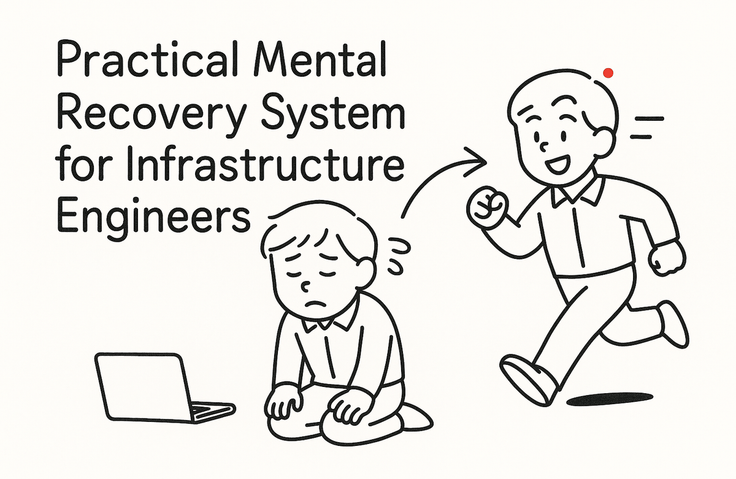
A Practical Mental Recovery System for Infrastructure Engineers

Learn stress management methodologies proven in 20 years of infrastructure operations. Instead of abstract advice, learn concrete procedures for recovering your mental resilience amid incident response, deadlines, and organizational change using actionable tools and worksheets. Learn how to set and maintain a minimum baseline you can keep, rather than a perfect routine.

4 learners are taking this course

Level Basic

Course period Unlimited

resilience4j
resilience4j
dropout
dropout
stress
stress
Essay exam
Essay exam
work out
work out
resilience4j
resilience4j
dropout
dropout
stress
stress
Essay exam
Essay exam
work out
work out

What you will gain after the course

  • Understanding the Structure of Stress Through Analysis of Imbalances Between Demands and Resources

  • Technique for Identifying Early Warning Signals in Four Areas and Separating Reaction from Response

  • Designing Energy Allocation and Recovery Routines Sustainable for More Than Two Weeks Based on Controllable Areas

Recommended for those who

  • For those who know it’s difficult but don’t know where to start

  • Those who have believed that enduring hardship would make them stronger, but are gradually finding it harder to recover.

  • Those who gave up on meditation or mindfulness classes because they felt too abstract

  • Those who work in environments where early-morning responses, deadlines, and sudden changes occur repeatedly

  • Those who don’t think their condition warrants a hospital visit but feel they’re not as they used to be

Cases where it is not suitable

  • Those seeking an immediate mood boost or motivation

  • People who already have symptoms severe enough to make daily life difficult. Consulting a professional should take priority over this course.


Three practical tools to take away

Tool 1. The 90-Second Rule

The chemical reaction of a strong emotion generally leaves the body in about 90 seconds. If you’re still angry after 90 seconds, it’s not the chemical reaction—you’re holding on to the thought. Stop, name it, and count your breaths. Repeat inhaling for 4 seconds and exhaling for 6 seconds six times, and that’s exactly 90 seconds.

Tool 2. Draw Circles of Control

Divide a sheet of paper into two columns and write down everything that is troubling you right now. You will likely find that almost everything you have been worrying about all day falls into the uncontrollable column. Accept the left side, and spend all your energy on the right.

Tool 3. The Minimum Unit of a Recovery Routine

  • 7 hours of sleep — a priority over everything else

  • 20 minutes of movement — walking is enough; frequency matters more than intensity.

  • One connection — a conversation not about work, once a week

These are minimum thresholds, not targets. If you fall short one day, just start again the next day.

Recommended for
these people

Who is this course right for?

  • Infrastructure engineers experiencing burnout from incident response and on-call duties

  • A DevOps practitioner looking for ways to manage their mental well-being amid organizational restructuring and deadline pressure

  • An IT professional who needs actionable stress management tools, not abstract self-help books

Need to know before starting?

  • At least 1 year of practical experience in infrastructure or DevOps.

  • Awareness of Work Stress and the Need for Mental Recovery

  • Willingness to self-assess using a PDF worksheet

Hello
This is jjangkbg7719

Career Verified

634

Learners

46

Reviews

3

Answers

4.8

Rating

31

Courses

Hello, I'm Frank.

I am an infrastructure engineer who has been wrestling with servers for over 20 years. Starting with Linux server operations, I am now in charge of the cloud infrastructure for a large-scale payment service. My daily life involves migrating from data centers to AWS, managing hundreds of instances, and tracing the causes of failures in the early hours of the morning.

The reason I created this course is simple.

I often received questions like these from those around me: "I managed to connect to the server, but I don't know what to do next." "There are so many instance types; which one should I choose?" These are the exact same points where I got stuck at first. However, when I looked for resources, I found that most of them were written for people who already knew what they were doing.

So I decided to create the course I wish I had when I first started learning.

My lectures are based on three principles.

First, I help you understand rather than memorize. Instead of just listing commands, I explain why we use them in the first place.

Second, I boldly omit unnecessary content. I do not increase the volume by including information that is useless to beginners right now.

Third, I also talk about what doesn't work. Instead of just listing the pros, I clearly point out cases where it might not be a good fit. For someone who has to make decisions in the field, that is more important.

If you feel a sense of "Ah, I should start from here" after listening to the lecture, then my goal has been achieved.

Please feel free to leave any questions you may have at any time.

More

Curriculum

All

21 lectures ∙ (26min)

Course Materials:

Lecture resources
Published: 
Last updated: 

Reviews

Not enough reviews.
Please write a valuable review that helps everyone!

jjangkbg7719's other courses

Check out other courses by the instructor!

Similar courses

Explore other courses in the same field!

Limited time deal

$88,736.00

62%

$8.80