inflearn logo

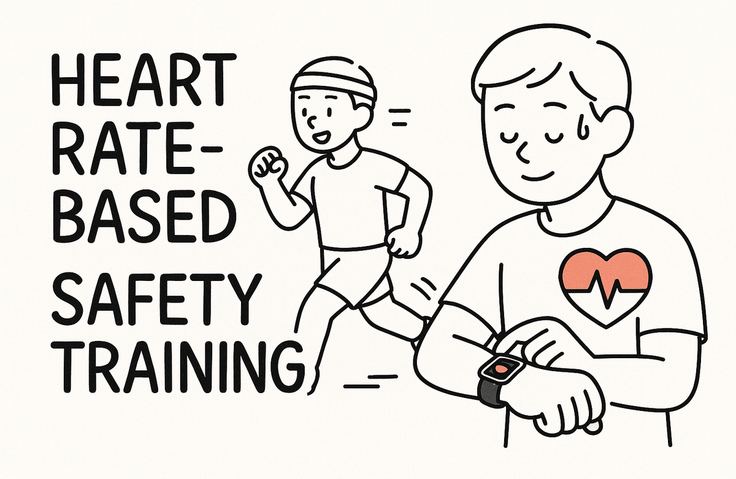
Heart Rate-Based Safety Training Guide You Must Know Before Running

From determining whether a medical consultation is necessary to measuring your resting heart rate and calculating your target heart rate zones, you will learn systematically. You will gain practical knowledge on how to recognize signs to stop training and identify indications of injury, enabling you to continue running safely.

1 learners are taking this course

Level Beginner

Course period Unlimited

Coding Test
Coding Test
monitoring
monitoring
nullsafe
nullsafe
work out
work out
Coding Test
Coding Test
monitoring
monitoring
nullsafe
nullsafe
work out
work out

What you will gain after the course

  • Personalized training intensity settings through resting heart rate measurement and target heart rate zone calculation

  • Ability to distinguish emergency warning signs requiring cessation of training from normal muscle soreness

  • Determine when to consult a hospital using 7 self-check items

Lesson 2. Check Your Body Before Running

This covers the checks you must complete before starting to run. You’ll use the seven-question self-check to determine whether you should consult a doctor first, establish your baseline using your resting heart rate, and learn when to stop.


7-Question Self-Check

These are seven questions about your heart, chest pain, dizziness, medication use, joint condition, recent surgery, and whether you are pregnant. If even one answer is yes, it does not mean you must not run; it means the order of steps should change. We also provide three questions to ask at the hospital.

Creating a resting heart rate

It covers when and in what position to measure, where to check your pulse and how to count it, and why a three-day average is necessary. And the key point is why this matters. This number is the standard you’ll use to decide whether to run or rest today over the next 12 weeks.

Calculate My Target Heart Rate Zone

We calculate your maximum heart rate using the age-subtraction formula from 220, then directly work out the 60 to 70 percent range suitable for beginners. For those without a watch, we also explain the talk test, which determines intensity based on whether you can speak comfortably.

Two types of signals that mean you should stop

This section distinguishes six signs that mean you should postpone today’s training from emergency signs that require you to stop immediately while running. The latter is the most important part of this entire course.

Distinguishing muscle soreness from signs of injury

We distinguish them along five axes: sensation, location, timing, progression, and response. You’ll be able to determine for yourself which pains you can safely ignore and which ones mean you should stop.

By the end of the course

  • You can determine for yourself whether it’s okay to start right away or whether you should go to the hospital first.

  • You will have a baseline resting heart rate.

  • You will learn the target heart rate zone appropriate for your age.

  • You can determine whether your current pace is appropriate even without a watch.

  • You’ll decide whether to run or rest today based on clear criteria, not intuition.

  • You can distinguish between pain you can push through and pain that means you need to stop.

Recommended for
these people

Who is this course right for?

  • A beginner looking to start running who wants to learn safe training methods first

  • Runners with a history of injuries who need systematic intensity management

  • Self-motivated exercisers who want to apply heart rate–based training methods in practice

Need to know before starting?

  • An environment where heart rate can be measured using a smartphone or watch

  • Basic arithmetic skills (for calculating target heart rate)

  • Basic awareness of one’s age and usual state of health

Hello
This is jjangkbg7719

Career Verified

627

Learners

44

Reviews

3

Answers

4.8

Rating

31

Courses

Hello, I'm Frank.

I am an infrastructure engineer who has been wrestling with servers for over 20 years. Starting with Linux server operations, I am now in charge of the cloud infrastructure for a large-scale payment service. My daily life involves migrating from data centers to AWS, managing hundreds of instances, and tracing the causes of failures in the early hours of the morning.

The reason I created this course is simple.

I often received questions like these from those around me: "I managed to connect to the server, but I don't know what to do next." "There are so many instance types; which one should I choose?" These are the exact same points where I got stuck at first. However, when I looked for resources, I found that most of them were written for people who already knew what they were doing.

So I decided to create the course I wish I had when I first started learning.

My lectures are based on three principles.

First, I help you understand rather than memorize. Instead of just listing commands, I explain why we use them in the first place.

Second, I boldly omit unnecessary content. I do not increase the volume by including information that is useless to beginners right now.

Third, I also talk about what doesn't work. Instead of just listing the pros, I clearly point out cases where it might not be a good fit. For someone who has to make decisions in the field, that is more important.

If you feel a sense of "Ah, I should start from here" after listening to the lecture, then my goal has been achieved.

Please feel free to leave any questions you may have at any time.

More

Curriculum

All

13 lectures ∙ (16min)

Course Materials:

Lecture resources
Published: 
Last updated: 

Reviews

Not enough reviews.
Please write a valuable review that helps everyone!

jjangkbg7719's other courses

Check out other courses by the instructor!

Similar courses

Explore other courses in the same field!

Limited time deal

$88,755.00

62%

$8.80