inflearn logo

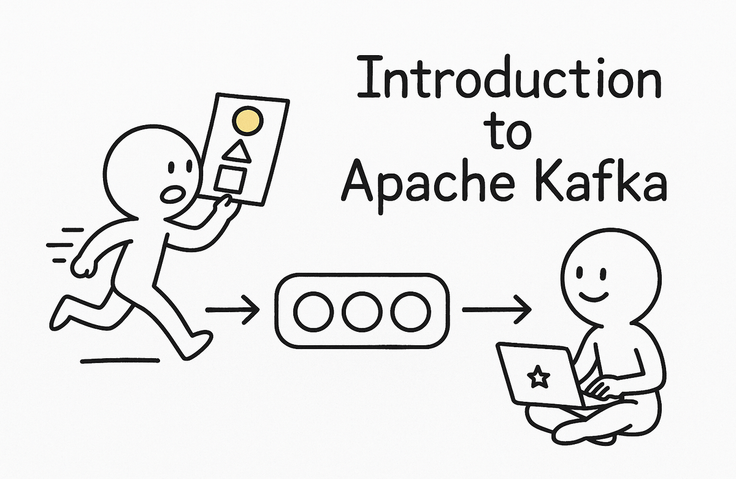
Introduction to Apache Kafka: Fully Understanding Through Illustrations

For beginners new to messaging systems, this guide explains everything from Kafka's origins to its core components, operating principles, and practical applications using only concepts and illustrations. Without the need for code or installation, it clearly distinguishes key terminology such as topics, partitions, and consumer groups, helping you build the fundamental strength to read real-world architecture diagrams.

7 learners are taking this course

Level Beginner

Course period Unlimited

Architecture
Architecture
Kafka
Kafka
streaming
streaming
data-processing
data-processing
spring-messaging
spring-messaging
Architecture
Architecture
Kafka
Kafka
streaming
streaming
data-processing
data-processing
spring-messaging
spring-messaging

What you will gain after the course

  • Explanation of the background of Kafka's creation and the necessity of messaging systems

  • Distinguishing the concepts of Topic, Partition, Offset, and Consumer Group, and understanding the data flow

  • Presenting architectural decision criteria when reviewing practical implementation.

Course Introduction

It's okay if you're new to messaging. This course was designed for those who have never used Kafka before.

Many beginners find Kafka difficult. However, in most cases, this isn't because the technology itself is hard, but because they learn unfamiliar terms in an unfamiliar order. They try to learn about partitions without knowing what a topic is, and consumer groups without understanding partitions, leading to constant setbacks.

This course corrects that order. We set aside the word "Kafka" for a moment and look at the problems that actually occur in a company. Once you understand those problems, Kafka's design will naturally make sense. We focus solely on grasping concepts clearly through illustrations, without any installation or coding. After completing this process, you will no longer be stuck on terminology, no matter what practice materials or official documentation you look at.

What you will learn

What you will learn: Specifically, the reason Kafka was created—the problem of exploding connections as systems grow and how to solve it. The 3 core elements: what Producers, Brokers, and Consumers each do. The most confusing concepts: distinguishing Topics, Partitions, Offsets, and Consumer Groups through diagrams. The reason it's fast: the principles behind processing hundreds of thousands of cases per second despite using disks. The truth about order guarantees: to what extent order is maintained and where it is not. How to protect data: replication, acks, delivery guarantees, and retention policies. Practical decision criteria: when to use it and when not to. Latest trends: based on the current architecture (KRaft) now that ZooKeeper has been removed.


Recommended for
these people

Who is this course right for?

  • A beginner developer who has never worked with a messaging system before

  • Non-major planners and PMs considering the introduction of Kafka

  • A junior backend developer in the early stages of learning distributed systems and infrastructure.

Need to know before starting?

  • Understanding the basic concepts of server and client

  • Willingness to learn without resistance to IT terminology

  • Curiosity to see real-world architecture diagrams

Hello
This is jjangkbg7719

Career Verified

476

Learners

32

Reviews

2

Answers

4.8

Rating

19

Courses

Hello, I'm Frank.

I am an infrastructure engineer who has been wrestling with servers for over 20 years. Starting with Linux server operations, I am now in charge of the cloud infrastructure for a large-scale payment service. My daily life involves migrating from data centers to AWS, managing hundreds of instances, and tracing the causes of failures in the early hours of the morning.

The reason I created this course is simple.

I often received questions like these from those around me: "I managed to connect to the server, but I don't know what to do next." "There are so many instance types; which one should I choose?" These are the exact same points where I got stuck at first. However, when I looked for resources, I found that most of them were written for people who already knew what they were doing.

So I decided to create the course I wish I had when I first started learning.

My lectures are based on three principles.

First, I help you understand rather than memorize. Instead of just listing commands, I explain why we use them in the first place.

Second, I boldly omit unnecessary content. I do not increase the volume by including information that is useless to beginners right now.

Third, I also talk about what doesn't work. Instead of just listing the pros, I clearly point out cases where it might not be a good fit. For someone who has to make decisions in the field, that is more important.

If you feel a sense of "Ah, I should start from here" after listening to the lecture, then my goal has been achieved.

Please feel free to leave any questions you may have at any time.

More
Published: 
Last updated: 

Reviews

Not enough reviews.
Please write a valuable review that helps everyone!

jjangkbg7719's other courses

Check out other courses by the instructor!

Similar courses

Explore other courses in the same field!

Limited time deal ends in 8 days

$5.50

68%

$17.60