
inflearn logo

A complete anatomy of robot systems explained by a current developer

Everything about Robotics High/Low-Level Controllers, Sensors, and High-Speed Communication: Learning through Unitree Go2 Examples Is it difficult to understand the entire robot system? We will completely dissect complex robot systems with the practical know-how of an active developer.

1 learners are taking this course

Level Beginner

Course period 1 months

robotics
robotics
robotics
robotics

What you will gain after the course

  • Structural thinking capabilities in overall robotics H/W and S/W: A clear understanding of the role distribution and mechanisms between High-Level Controllers (HLC) and Low-Level Controllers (LLC)

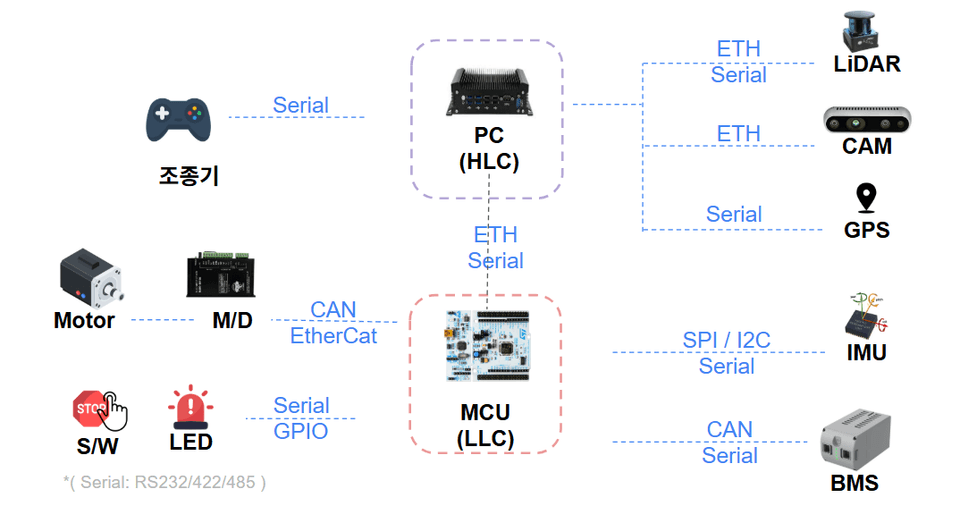
  • Robot internal data flow design and analysis skills: Analyze the differences between core robot internal communication standards such as CAN, Ethernet, and EtherCAT, and master the packet paths through which sensor data and control commands travel.

  • Practical Robotics and Interview Readiness: The ability to provide a structured interview response that fluently explains the "entire process from a user's command to the robot's movement" from the perspectives of sensors, communication, control, and motors.

A Complete Anatomy of Robot Systems Taught by a Current Developer: From Components to Communication

Mastering robotics high-level and low-level controllers, sensors, and high-speed communication concepts through the Unitree Go2 example

Recommended for these people

Job seekers and students who are interested in robotics development roles but feel overwhelmed about how to get started

Junior developers who want to quickly adapt to their work by understanding the overall robotics system

Developers who want to understand the entire robot system in addition to their own area of expertise


After taking this course,

  • What will I understand and be able to do well after taking this course?

    • "I know individual parts well, but when asked how the entire robot moves, my mind goes blank." This is a common concern shared by many junior engineers and job seekers. Fragmented learning, such as only handling sensor data or writing specific control codes, is not enough to design product-level robots or communicate with experts in other fields in the industry.

    • After taking this course, you will change in these ways:

      • Design and tracking of internal robot data flow: You will be able to perfectly sketch and analyze the entire process in your head—from a user's smartphone app command traveling via Wi-Fi to the high-level controller, merging with sensor data (LiDAR, IMU) to create a path, and communicating (CAN, EtherCAT) with the low-level controller (MCU) to drive the motor driver.

      • Structural thinking spanning hardware and software: You will understand how changes in control algorithms affect motor driver current control methods or mechanical characteristics, and develop a structural perspective to collaborate closely with system SW engineers within the limited computational resources of an MCU.

      • Strong competitive edge in technical interviews: You will demonstrate practical capabilities to logically answer frequently asked questions in robotics job interviews from a 'system-wide perspective' rather than simply listing individual components.

Features of this course

Introduce the core features and key differentiators.

100% field-based architecture know-how, not theory-oriented: This is not dead knowledge that simply lists the functions of individual parts. It covers the perfect division of roles between high-level and low-level controllers essential in actual industrial sites, as well as the organic mechanisms of power management (BMS), safety devices (E-Stop), and LED status indicators required for mass production.

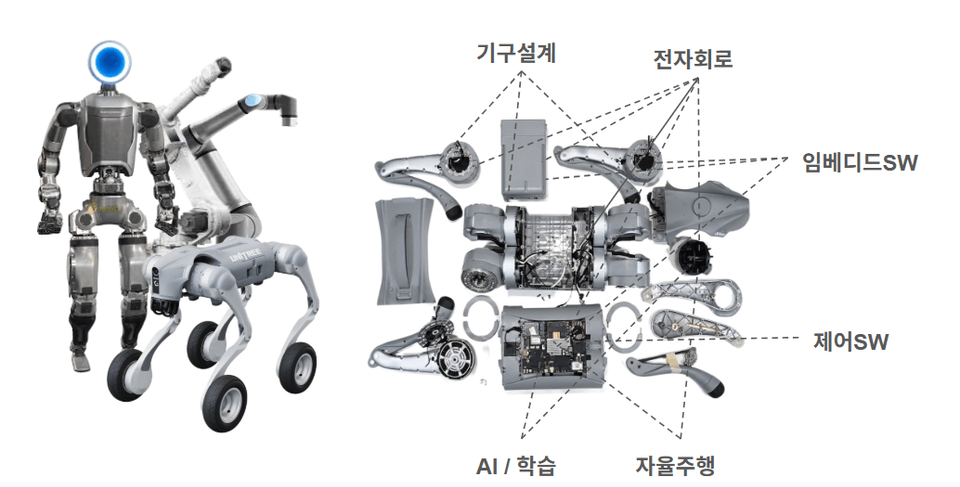
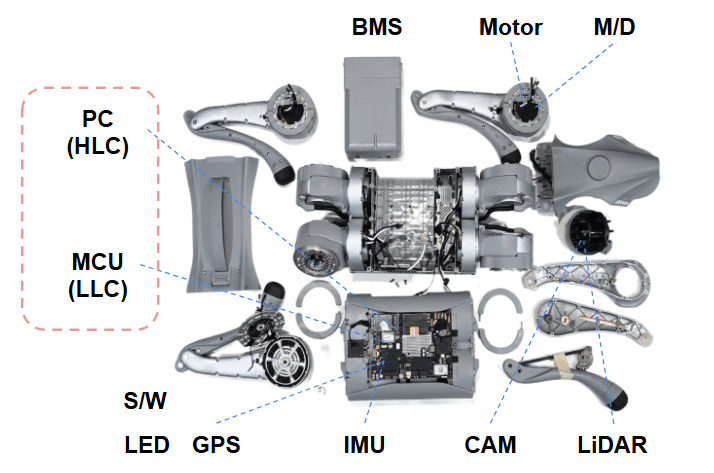
Analysis of the Quadruped Robot 'Unitree Go2': We analyze the Go2, an autonomous multi-joint robot, as a practical example. Even if a robot's appearance changes, the core elements and communication architecture used inside share commonalities, allowing you to gain universal knowledge that can be applied immediately to any robot domain.

Establishing a perfect framework for robotics communication (CAN, Ethernet, EtherCAT): We provide a clear comparative analysis of the differences between affordable and stable CAN communication (including PDO and state machines of the CANOpen protocol), Ethernet for large-capacity data transmission, and ultra-high-speed real-time EtherCAT communication, which is the core of industrial precision control.

What you will learn

Complete Dissection of Robot Mechanisms and Communication Architecture

  • Key Keywords: Upper/Lower Controllers (PC/MCU), Motors and Drivers, Sensors (LiDAR/IMU/Camera), Battery Systems (BMS), CAN/Ethernet/EtherCAT Communication

  • Learning Content: You will learn about the division of computational tasks between high-level and low-level controllers, which serve as the robot's brain and nervous system, as well as the principles of closed-loop control where motors, drivers, and encoders interact. We will cover environmental perception through sensors such as LiDAR, cameras, and IMUs, along with safety systems like BMS and E-Stop. Furthermore, we will completely deconstruct the operation and efficiency differences of core communication methods (CAN, Ethernet, EtherCAT) that act as the data bloodstream, weaving these complex components together.


'Unitree Go2

Data pipeline flow, overall robot system 

  • Key Keywords: Autonomous Driving (SLAM/Path Planning), Data Pipeline, Overall Robot Architecture, Practical Interviews

  • Learning Content: You will gain a clear understanding of how the hardware and communication knowledge learned previously is applied to an actual robot. In particular, in robotics practice and technical interviews, an 'organic understanding of the entire robot system' is questioned much more frequently than knowledge limited to specific parts. Through this section, you will move beyond fragmented, superficial knowledge and gain an architect's perspective by seeing through the flow of data that penetrates the entire robot system, which can be immediately applied to real-world practice and technical interviews.

Robotics System Architecture

The person who created this course

"Real know-how gained from grinding and struggling through everything from the bottom of HW to SW"

Hello, I am a robotics developer currently working at a global corporation.

Having worked in the robotics industry for several years, I have experienced everything from the lowest levels of hardware to the highest levels of software.

This course is not an academic textbook filled with grand theories. I am creating this course to organize the know-how I have fiercely accumulated in the field, while also earning some side income along the way.

If you have any questions about the lecture, please feel free to leave a comment at any time. I will help you get so much out of this that you won't feel like the course fee was a waste!


Do you have any questions?

Write at least 3 questions and answers that prospective students might be curious about before taking the course.
We recommend providing answers that showcase your unique personality as a knowledge sharer, rather than generic or formal responses.

Q. Can I take this course without having the actual hardware or robot parts? A. Yes, absolutely! This course is not about soldering specific hardware or typing code line by line. It focuses on understanding the 'structure and architecture'—how data flows within a robot and how components interact organically—by benchmarking the actual system configuration of the high-performance autonomous robot, Unitree Go2. Since the course is centered on concepts and principles, you can fully immerse yourself in learning with just a computer, even without the physical equipment.

Q. I am not a robotics major or I am a developer in another field; will I be able to follow along? A. The difficulty level is designed so that anyone who has heard basic terms such as embedded systems, embedded communication (UART, CAN), and MCU at least once can take the course. Since it explains in easy-to-understand terms how different major knowledge areas—such as mechanical design, electromagnetics, and computer engineering—interlock and operate within the complex entity of a robot, it will serve as the most perfect introductory compass for those considering a career change or expansion into the robotics field from other domains.

Q. Will taking this course provide practical help for interviews or employment? A. This is not just knowledge for simple theoretical memorization. In the final section of the course, based on actual interview questions for experienced robot developers, we provide close guidance on how to logically explain the entire data pipeline flow—from sensors and communication to control and motors—to an interviewer. You will be able to leave a strong impression on the interviewer that "This applicant is not just a fragmented coder who only knows their own field, but a prepared architect who can immediately and proactively collaborate with all mechanical, electronic, and software engineers on our team!"

Notes before taking the course

Practice Environment

  • Operating System and Version (OS): As this is a concept-oriented theory and architecture analysis lecture, it can be viewed regardless of the OS, such as Windows, macOS, or Linux.

  • Tools Used: This is a pure knowledge-based class that does not require the purchase of any separate paid software or hardware equipment

Learning Materials

  • Provides lecture PDF notes and system architecture conceptual diagrams that systematically summarize the lecture content.

  • Attached is a summary text document that provides an at-a-glance view of core robotics communication methods, packet flows, and the entire data sequence

Prerequisites and Important Notes

  • Prerequisite Knowledge: Having very basic embedded knowledge of computer architecture, MCUs, and communication will make it much easier to fully absorb 100% of the lecture.

  • Copyright Notice: The intellectual property rights of this lecture and all provided teaching materials belong to the instructor. Unauthorized reproduction, distribution, or sharing may result in legal liability. If you have any questions during the course, please leave them on the Q&A board, and I will answer them sincerely from a professional's perspective!

Recommended for
these people

Who is this course right for?

  • Those who are preparing for employment or a career change in the field of robotics

  • A junior robot engineer who wants to understand the entire robot system rather than being confined to a specific major, in order to collaborate smoothly in the field.

  • A researcher who is curious about the practical processes of how data actually flows and how precision motion control is implemented within articulated robots or autonomous robots.

Need to know before starting?

  • Basic electronics/embedded knowledge: If you have heard of terms like MCU, sensors, and serial communication (UART), you will have no trouble following the lecture.

  • Mindset: Rather than the skill of writing a single line of code, you need a sense of inquiry to grasp the big picture of the entire robot architecture.

Hello
This is jelly

Career Verified

Current Robot Developer

Curriculum

All

14 lectures ∙ (1hr 13min)

Course Materials:

Published: 
Last updated: 

Reviews

Not enough reviews.
Please write a valuable review that helps everyone!

Similar courses

Explore other courses in the same field!

Limited time deal

$2.20

66%

$6.60