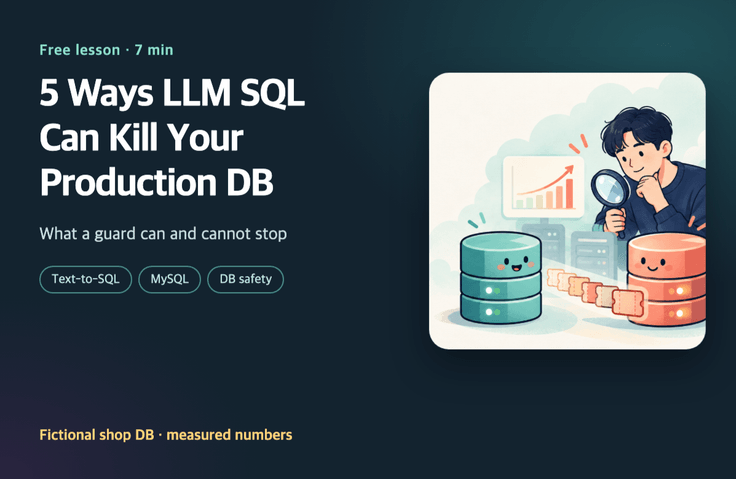

5 Scenarios Where LLM-Generated SQL Takes Down a Production Database

SQL written by an LLM runs without errors. That’s what makes it more dangerous. We’ll reproduce in Docker MySQL how revenue gets inflated threefold, a one-day query reads all 300,000 rows in a table, and the contact details of withdrawn members end up mixed into a list, then organize the findings into a review checklist to catch these issues before connecting to the production database.

18 learners are taking this course

Level Basic

Course period Unlimited

SQL
SQL
MySQL
MySQL
LLM
LLM
SQL
SQL
MySQL
MySQL
LLM
LLM
Thumbnail

What you will gain after the course

  • Identify one-to-many joins in aggregation SQL generated by an LLM, aggregate them first, rewrite the SQL to join the aggregated results, and verify it using reconciliation totals.

  • Use EXPLAIN’s type and rows, along with the number of rows read, to identify and fix conditions that prevent index usage (wrapping columns in functions, type conversions, and leading wildcards).

  • Prevent SQL queries from reading the entire production database with row limits, sort indexes, and execution time limits.

  • Filter out SELECT *, missing masking, and the inclusion of withdrawn or non-consenting members; protect personal data tables with safe views and permissions.

  • Fix conditions that silently go wrong because of NOT IN and NULL, BETWEEN end dates, the final second, and the time difference between UTC and Korea time.

  • Classify LLM SQL as pass, hold, or rewrite using a five-scenario review checklist.

A Demo Takes a Day; Production Is a Different Story

Put the schema in a prompt and run the SQL generated by an LLM, and you can build an internal data chatbot demo in a day. The problem comes the moment you connect that demo to the production database.

This free course recreates five scenarios that unfold at that point using a virtual online store practice database (100,000 members · 400,000 orders), and determines for each scenario whether a guard can prevent it.

Five scenes

  • Scene 1. Revenue was inflated by more than double—2.34x due to duplicate rows from a join. The guard passes.

  • Scene 2. It gave the same answer but read the entire production database — this can be prevented with EXPLAIN before execution.

  • Scene 3. Phone numbers appeared in response to “Show me the VIP list” — this can be prevented with personal information column masking and permissions.

  • Scene 4. “Active members” was off by a factor of two — it’s a definition issue, so a guard can’t prevent it.

  • Scene 5. “Clean up the canceled orders” — blocked on two layers: guardrails and a read-only account.

The most dangerous ones are the ones that pass the guard.

Incorrect numbers pass straight through the guard because they produce no errors and look fast and safe. They can only be caught through schema descriptions, business terminology dictionaries, and answer-set evaluation.

Please be advised.

  • The chatbot SQL shown in the video is an example written by the instructor of a pattern that LLMs commonly produce (as explicitly stated at the end of the video). The numbers are results obtained by running the queries directly against the practice database.

  • All data is custom-made fictional data and is unrelated to any actual company or customer.

  • AI helped with the script and slide drafts, and the narration is AI-generated.

Next steps

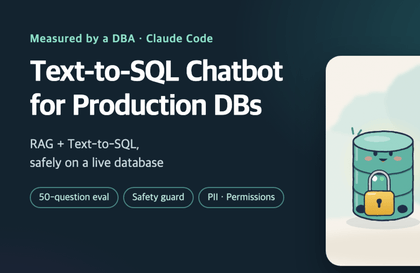
In the full episode, “Practical Guide to In-House Data Chatbots — Safely Connecting RAG and Text-to-SQL to an Operational DB,” we fix these five scenarios for real. We build a chatbot with local Claude Code and use a 50-question answer key to show how we improve accuracy from 20 to 48 (and to 50 in the improved version), while measuring safeguards, privacy, permissions, and operations.

Recommended for
these people

Who is this course right for?

  • Developers who use LLMs (chatbots and coding assistants) to write SQL and run it against production or analytics databases.

  • Data analysts and planners who use figures generated by LLMs in their reports

  • Leaders and DBAs who need to review SQL generated by team members using LLMs

Need to know before starting?

  • SQL at a level sufficient to read SELECT, JOIN, and GROUP BY statements

  • A computer that can run Docker (the exercise is optional)

Hello
This is dorian05202988

Career Verified

A data craftsman with over 20 years of experience in databases and IT. As a DBA and manager of a DB Platform team, I work with database platforms and specialize in MySQL, PostgreSQL, Oracle, MongoDB, SQL tuning, AWS, Terraform, and Python. Drawing on experience in the gaming, finance, and IT services industries, I explain database and cloud architecture. I have published 『Oracle Practical Tuning: Learning SQL Patterns』 and 『Oracle Pro*C Practical Project Guide』, and have presented on serverless architectures, database selection, and multi-database strategies at AWS Summit 2018 and 2019 and DataYa Nolja 2020. Recently, I have been working on slow-query analysis and tuning recommendations using Bedrock LLM, automated DB specification sizing, and query workflows through a DB metadata MCP server and Slack bot. I explain database automation for developers and AI applications for non-developers through hands-on exercises tailored to the audience and objectives of each course. Rather than applying AI suggestions as-is, I teach a decision-making framework that verifies result equivalence, execution plans, and observability conditions, and defers action when the supporting evidence is insufficient. Company operational data and credentials are not included in the course materials.

More

Curriculum

All

7 lectures ∙ (57min)

Course Materials:

Lecture resources
Published: 
Last updated: 

Reviews

Not enough reviews.
Please write a valuable review that helps everyone!

dorian05202988's other courses

Check out other courses by the instructor!

Similar courses

Explore other courses in the same field!

Free