inflearn logo

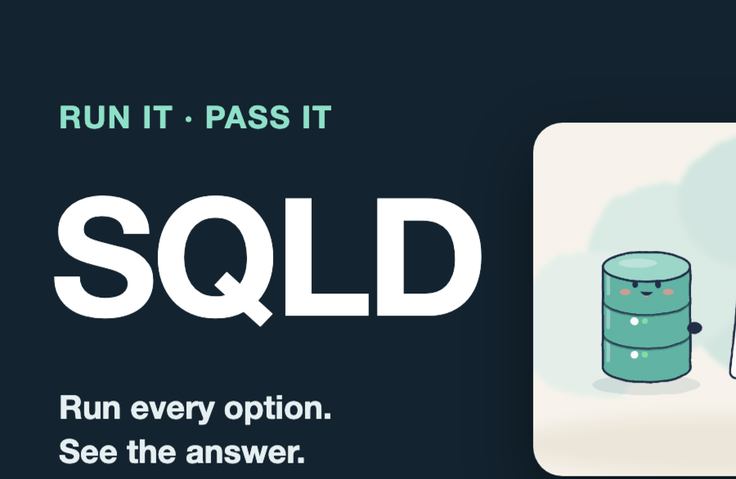
Confusing SQLD answer choices? Run them yourself and the answer becomes clear — 6 hours of hands-on SQLD with a practicing DBA team lead

Run all four answer choices from SQLD questions directly in Oracle and choose the correct answer based on the results. Covers pitfalls involving NULLs, aggregates, joins, ranking, ROWNUM, and hierarchical queries in 52 lessons over 6 hours.

1 learners are taking this course

Level Beginner

Course period Unlimited

SQL
SQL
Oracle
Oracle
SQLD
SQLD
SQL
SQL
Oracle
Oracle
SQLD
SQLD

What you will gain after the course

  • You can demonstrate with examples how pitfalls like NULL in a NOT IN list and COUNT(*) versus COUNT(column) can change the result.

  • You can see how the results differ when a condition is placed in the ON clause versus the WHERE clause in an outer join.

  • You can see the differences between RANK·DENSE_RANK·ROW_NUMBER, ROWS, and RANGE using tied data.

  • You can accurately retrieve TOP-N using ROWNUM and FETCH FIRST.

  • You can read the direction and LEVEL of a CONNECT BY hierarchical query.

  • You can explain modeling terms (entity, attribute, relationship, identifier, and normalization) by applying them to actual tables.

  • You can continue on to SQLP and practical SQL using the same practice database.

Goal of this course: to be able to judge confusing SQLD answer choices based on execution results, not guesswork.

Run all four answer choices in SQLD questions directly in Oracle and choose the correct answer based on the results. Cover pitfalls involving NULLs, aggregates, joins, ranking, ROWNUM, and hierarchical queries in 52 lessons over 6 hours.

This isn’t a lecture that works through questions by textbook number. In every lesson, we test commonly examined tricky conditions directly in a practice database, then run each of the four choices in original exam-style questions we wrote ourselves, using the results to explain why the correct answer is right and the others are wrong. We don’t use questions verbatim from past exams.

By the end of this course

  • You will be able to explain through execution traps that change results, such as NULLs in a NOT IN list and COUNT(*) versus COUNT(column).

  • You can distinguish how results differ when conditions are placed in the ON versus WHERE clauses of an outer join.

  • You can verify how RANK, DENSE_RANK, and ROW_NUMBER differ, as well as the difference between ROWS and RANGE, using tied data.

  • You can accurately retrieve the TOP N using ROWNUM and FETCH FIRST.

  • I can read the direction of CONNECT BY hierarchical queries and interpret LEVEL.

  • You will be able to apply and explain the first-subject modeling terms (entities, attributes, relationships, identifiers, and normalization) using actual tables.

  • You can continue on to SQLP and practical SQL using the same practice database.

Recommended for people like these

  • Non-majors and job seekers preparing for the SQLD exam for the first time.

  • Those who keep getting prediction-of-results questions wrong even after working through practice books.

  • Junior developers and data professionals who have started using SQL at work

Curriculum (7 sections · 52 lessons · approximately 359 minutes)

  • Section 1. Getting Started: Exam Structure and Practice Environment — SQLD, Learn by Running Queries, Set Up the Practice Database, Explore the Practice Data

  • Section 2. Subject 1: Understanding Data Modeling — What Is Data Modeling, Entities, Attributes and Domains, Relationships: Cardinality and Selectivity, Identifiers, Normalization and Anomalies, Relationships and Joins, Transactions in the Model, Null Attributes and Surrogate Identifiers, Subject 1 Practice Questions for the Exam

  • Section 3. Subject 2 ① SQL Basics — Relational Databases and SQL Classification, SELECT and Operators, String Functions, Numeric and Date Functions, Conversion Functions and CASE·DECODE, Null Functions, WHERE Conditions and the NOT IN Pitfall, GROUP BY and Aggregate Functions, HAVING and Execution Order, ORDER BY, Join Basics, Standard Joins: INNER·USING·NATURAL, OUTER JOIN

  • Section 4. Subject 2 ② SQL Applications — Subquery basics, IN·ANY·ALL·EXISTS, scalar·inline view·correlated subqueries, views, set operators, ROLLUP, CUBE and GROUPING SETS, ranking functions, window aggregates and ROWS·RANGE, row order and ratio functions, TOP-N queries, hierarchical queries, self joins and advanced hierarchies, PIVOT and UNPIVOT, regular expressions

  • Section 5. Subject 2 ③ Data Management Statements — DML: INSERT·UPDATE·DELETE·MERGE, TCL: COMMIT·ROLLBACK·SAVEPOINT, DDL: Tables and Constraints, DDL and Auto-Commit, DCL: Privileges and Roles

  • Section 6. Practice: A Comprehensive Review of Tricky Points and Mock Exams — Predicting Execution Results Drill, Mock Exam Solution ①, Mock Exam Solution ②, Summary: Checklist for the Day Before the Exam

  • Section 7. Appendix: Additional Practice Problems — Mock Exam Solutions ③, Execution Result Prediction Drill ②, Focused Questions for Subject 1

Hands-On Environment

We’ll run Oracle’s free edition (Oracle AI Database 26ai Free) in Docker on your laptop and practice with data for a fictional company and café chain (7 tables) created using fixed rules. Each lesson includes a practice SQL file and an execution script, and all results shown in the lectures are the actual, unedited output from running these scripts. You’ll also receive a workbook (PROBLEMS.md) containing the 79 hands-on problems from the course and their answers.

Prerequisites

  • Having seen a SELECT statement at least once is enough.

  • A PC that can run Docker (Mac or Windows; 8 GB of memory or more recommended)

What This Course Does Not Cover

  • Collection of Original Past Exam Questions and Reconstructed Problems

  • Execution Plans and Tuning (SQLP Topics)

  • SQL Server practice (syntax differences are only mentioned verbally)

Notice

The lecture narration is synthesized speech. All data is fictitious and for educational purposes; figures may vary depending on the execution environment.

Recommended for
these people

Who is this course right for?

  • Non-majors and job seekers preparing for the SQLD for the first time

  • For those who keep getting result prediction questions wrong even after working through practice problems.

  • Junior developers and data professionals who have started using SQL at work

Need to know before starting?

  • It's enough if you've seen a SELECT statement at least once.

  • A PC that can run Docker (Mac or Windows; 8 GB of memory or more recommended)

Hello
This is dorian05202988

Career Verified

A data craftsman with over 20 years of experience in databases and IT. As a DBA and manager of a DB Platform team, I work with database platforms and specialize in MySQL, PostgreSQL, Oracle, MongoDB, SQL tuning, AWS, Terraform, and Python. Drawing on experience in the gaming, finance, and IT services industries, I explain database and cloud architecture. I have published 『Oracle Practical Tuning: Learning SQL Patterns』 and 『Oracle Pro*C Practical Project Guide』, and have presented on serverless architectures, database selection, and multi-database strategies at AWS Summit 2018 and 2019 and DataYa Nolja 2020. Recently, I have been working on slow-query analysis and tuning recommendations using Bedrock LLM, automated DB specification sizing, and query workflows through a DB metadata MCP server and Slack bot. I explain database automation for developers and AI applications for non-developers through hands-on exercises tailored to the audience and objectives of each course. Rather than applying AI suggestions as-is, I teach a decision-making framework that verifies result equivalence, execution plans, and observability conditions, and defers action when the supporting evidence is insufficient. Company operational data and credentials are not included in the course materials.

More

Curriculum

All

52 lectures ∙ (5hr 58min)

Course Materials:

Lecture resources
Published: 
Last updated: 

Reviews

Not enough reviews.
Please write a valuable review that helps everyone!

dorian05202988's other courses

Check out other courses by the instructor!

Similar courses

Explore other courses in the same field!

Limited time deal

$68.20

19%

$84.70