inflearn logo

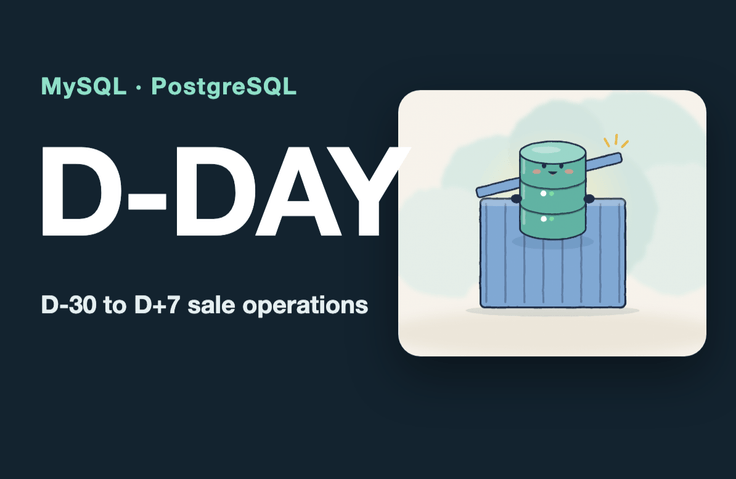
From D-30 to D+7 of a Sale Launch — A Hands-On Guide to Running a Major E-Commerce Event (MySQL·PostgreSQL)

We manage a major sale event by the numbers, from D-30 to D+7. We practice capacity planning, connection budgeting, load assessment, rehearsals, launch decisions, in-event case assessments, scaling down, and retrospectives side by side in MySQL and PostgreSQL.

1 learners are taking this course

Level Intermediate

Course period Unlimited

SQL
SQL
MySQL
MySQL
PostgreSQL
PostgreSQL
DBMS/RDBMS
DBMS/RDBMS
database
database
SQL
SQL
MySQL
MySQL
PostgreSQL
PostgreSQL
DBMS/RDBMS
DBMS/RDBMS
database
database

What you will gain after the course

  • We use the figures from the previous round to prepare the capacity estimate and connection budget table.

  • We set the stopping criteria for load testing and create a report determining whether the system can withstand the load.

  • Create plans for scaling up, failover, and scaling down, then run rehearsals to catch anything missing.

  • We define the launch criteria, the three-color decision board, and the order for disabling features.

  • During an event, monitor issues such as lock waits, retry storms, duplicate payouts, and cache stampedes, then decide whether to ride them out, turn things off, or scale up.

  • We use a three-session retrospective to put numbers to the plan for the next session.

At the exact moment of launch, throughput was cut in half. What would you turn off, what would you scale up, and what would you wait for?

We manage a major sale by the numbers, from D-30 to D+7. We practice capacity planning, connection budgeting, load assessment, rehearsals, launch decisions, in-event incident decisions, scaling down, and retrospectives side by side in MySQL and PostgreSQL.

Rather than teaching how to implement a single feature, this course follows the entire lifecycle of a campaign, step by step through the decisions a conductor makes. It demonstrates the differences between MySQL and PostgreSQL by testing each decision side by side using the same experiment on both engines.

By the end of this course, you will be able to

  • Use last session’s numbers to prepare a capacity estimate and connection budget table.

  • Set the load test stop criteria and create a “holds up / doesn’t hold up” assessment.

  • Write scaling-up, failover, and scaling-down plans, and use a rehearsal to find any omissions.

  • Set the criteria for deciding whether to launch, a three-color status board, and the order for disabling features.

  • Review incidents during the event (lock waits, retry storms, duplicate payouts, cache stampedes, etc.) and decide whether to hold steady, turn features off, or scale up.

  • Use the three session retrospectives to revise the plan for the next session using numbers.

Recommended for

  • A backend lead handling a major sale or event for the first time

  • SREs and infrastructure engineers on call during events

  • Junior DBA managing MySQL and PostgreSQL together

  • Team leads who need to explain event readiness in numbers

Curriculum (11 sections · 79 lessons · approximately 687 minutes)

  • Section 1. Part 0 · Opening Night Preview — A seven-minute record from opening time, the command flow of this course, and launching the practice environment all at once.

  • Section 2. Part 1 · D-30 Demand Forecasting and Capacity Planning — Predicting peak demand from last time’s numbers, tracing a visit down to a query, measuring the cost of a single query, CPU budget and instance size, memory budget: buffers and connections, separating reads from writes, the concentration of a single hot product, a one-page capacity plan

  • Section 3. Part 2 · Connection Budget — How many is the product of pods and pools?, Case: Scaling up overwhelms connections, What happens at the MySQL connection limit, What happens at the PostgreSQL connection limit, Putting a pooler in front, Connection storms and reconnection surges, Idle connections and connection lifetime, Completing the connection budget table

  • Section 4. Part 3 · Load Test Evaluation — From the purpose of load testing to staged loads and stop criteria, the first metrics to fail: MySQL, the first metrics to fail: PostgreSQL, Case: The results are too good, Case: A huge IN list, Case: Write hotspot, Creating diverse test data, Evaluation report: Passes · Fails

  • Section 5. Part 4 · Scaling Up, Replication, and Rehearsals — How to Write a Scaling Plan, Adding a Read Replica, When Replication Lag Shows Up on Screen, Switching Read Paths and Removing Connections, Failover Rehearsal: MySQL, Failover Rehearsal: PostgreSQL, Case Study: An App Connecting to an Old Address, Rehearsing the Plan: Walk Through It by Hand, The Three-Minute Rule for Failure Drills

  • Section 6. Part 5 · Freeze Rules and Schema Changes — Freeze Rules During the Event, MySQL Schema Changes and Waiting, PostgreSQL Schema Changes and Waiting, Long-Running Transactions: MySQL, Long-Running Transactions: PostgreSQL, Final Checks Before the Freeze

  • Section 7. Part 6 · Launch Command — Command structure: one person decides, defining launch criteria, three-color decision board, when the criteria are wrong, alert fatigue and duplicate incidents, order for turning off features, the first fifteen minutes after launch, setting focused monitoring periods, writing a one-line status update

  • Section 8. Part 7 · Case Studies in Decision-Making During Events — Case study: The night request limits caused an outage, Case study: A rush of writes for a single coupon, Case study: The gap between checking and saving, Case study: An external call inside a transaction, Case study: When the cache was empty, the database was right, Case study: A rollback storm at midnight on expiration day, Case study: A commit stalled without running any queries, Case study: A chain reaction of lock waits, Case study: A surge in deadlocks, Case study: One sorting query sent CPU usage soaring, Decision-making exercise: Hold, disable, or scale up?, Case study decision table

  • Section 9. Part 8 · Configuration Mistakes and Consistency — Case: Incorrect discount rate, case: Missing free shipping setting, false positives from safeguards, automated consistency checks immediately after launch, business metric alerts

  • Section 10. Part 9 · Capacity Reduction and Costs — Capacity reduction plans and sequence, case: connections that won’t drain during scale-down, performance checks after scale-down, a one-page cost report, finding overprovisioning

  • Section 11. Part 10 · Reviewing the Three Rounds and the Next Round — Retrospective format: prepared, partially prepared, unprepared; Round 1: the gap between predictions and actual results; Round 2: the bottleneck moved; Round 3: how the numbers changed the plan; Wrap-up: the complete operations checklist

Lab Environment

With just Docker on your laptop, you can run MySQL 8.4 (primary and replica), PostgreSQL 17 (primary and replica), two types of connection poolers, a sale-traffic load generator, and a tool for recording database status. You can reproduce every experiment using data from a fictional online marketplace (100,000 members and 300,000 orders), and each lesson includes scenario scripts.

Prerequisite Knowledge

  • SQL basics (SELECT, UPDATE, indexes)

  • Run commands in the terminal

  • Installing Docker (for hands-on practice)

What This Course Does Not Cover

  • Implementing the coupon and queue features itself

  • How to use a specific cloud console

  • Introduction to Database Installation and Basic Syntax

Notice

The video was made using slides and synthesized speech (TTS). The numbers and results shown on screen are taken from actual execution output. All data is fictional and for educational purposes; numbers may vary depending on the execution environment.

Recommended for
these people

Who is this course right for?

  • A backend lead handling a large-scale sale or event for the first time

  • SREs and infrastructure engineers on call during the event period

  • A junior DBA managing both MySQL and PostgreSQL

  • A team lead who has to explain event preparations with numbers

Need to know before starting?

  • SQL Basics (SELECT, UPDATE, Indexes)

  • Run a command in the terminal.

  • Docker Installation (for Practice)

Hello
This is dorian05202988

Career Verified

129

Learners

3

Reviews

2.3

Rating

46

Courses

A data craftsman with over 20 years of experience in databases and IT. As a DBA and manager of a DB Platform team, I work with database platforms and specialize in MySQL, PostgreSQL, Oracle, MongoDB, SQL tuning, AWS, Terraform, and Python. Drawing on experience in the gaming, finance, and IT services industries, I explain database and cloud architecture. I have published 『Oracle Practical Tuning: Learning SQL Patterns』 and 『Oracle Pro*C Practical Project Guide』, and have presented on serverless architectures, database selection, and multi-database strategies at AWS Summit 2018 and 2019 and DataYa Nolja 2020. Recently, I have been working on slow-query analysis and tuning recommendations using Bedrock LLM, automated DB specification sizing, and query workflows through a DB metadata MCP server and Slack bot. I explain database automation for developers and AI applications for non-developers through hands-on exercises tailored to the audience and objectives of each course. Rather than applying AI suggestions as-is, I teach a decision-making framework that verifies result equivalence, execution plans, and observability conditions, and defers action when the supporting evidence is insufficient. Company operational data and credentials are not included in the course materials.

More

Curriculum

All

79 lectures ∙ (11hr 27min)

Course Materials:

Lecture resources
Published: 
Last updated: 

Reviews

Not enough reviews.
Please write a valuable review that helps everyone!

dorian05202988's other courses

Check out other courses by the instructor!

Similar courses

Explore other courses in the same field!

Limited time deal

$45.10

24%

$59.40