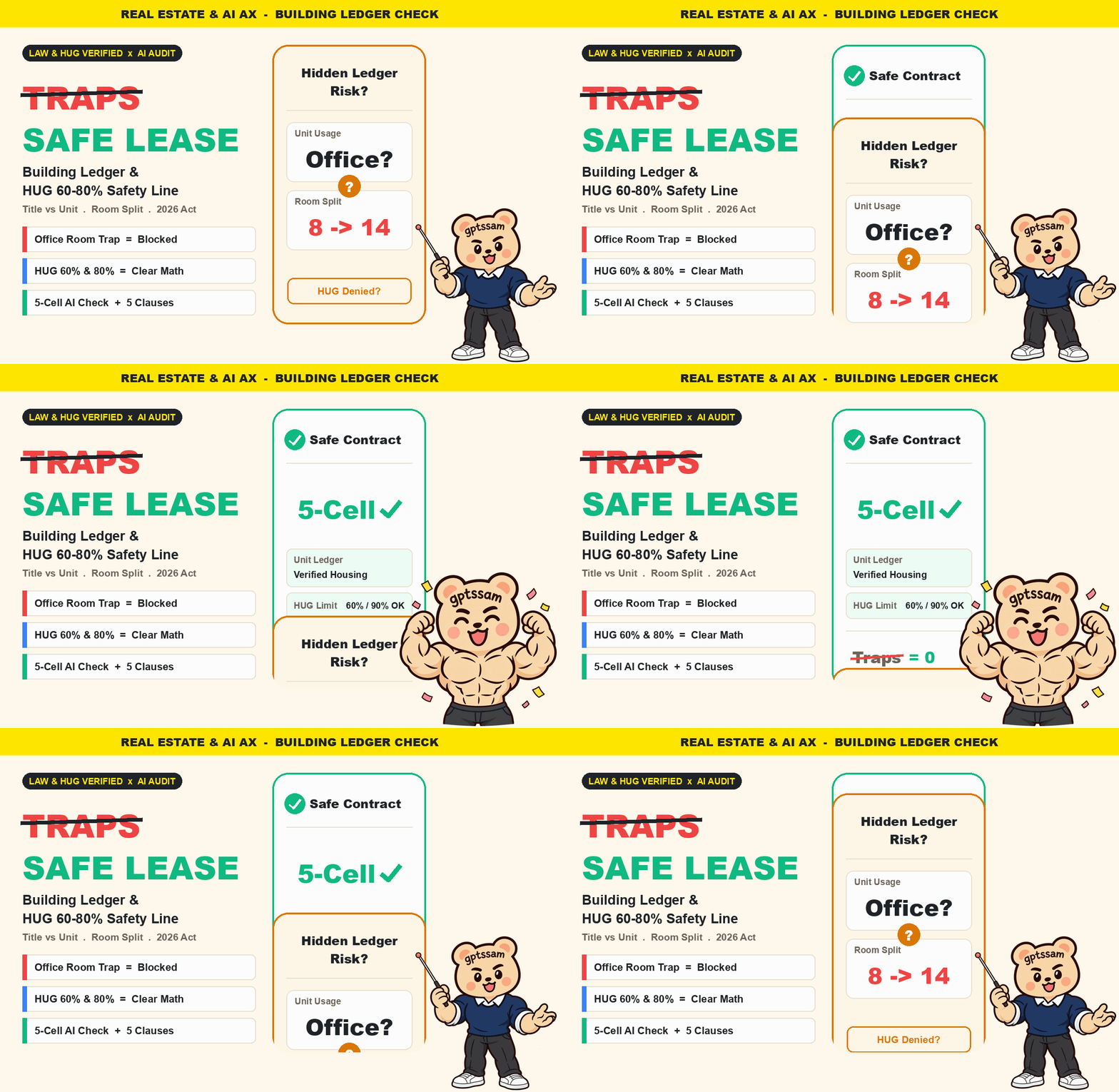
[Free Special Lecture] How to Read a Building Register with AI Before Signing a Villa Contract — Safety Checks for Neighborhood Facility Villas, Multi-Family Homes, and Jeonse Deposits
Even if the property register shows no mortgage, your application for HUG’s Jeonse Deposit Return Guarantee will be rejected if the exclusive-use section of the building register lists the property as a neighborhood living facility (office), if a multi-family home has been illegally subdivided into rooms, or if the senior-priority deposits exceed the limit. We compare the original texts of the Building Act, the Rules on Building Registers, Constitutional Court decision 2020Heonba501, the Special Act on the Arrangement of Specific Buildings (effective December 17, 2026), and HUG’s official product overview side by side, and provide a practical guide to screening risky properties with AI in just 15 minutes before signing, along with five special contract clauses in Korean.
How to Obtain and Correctly Distinguish the General Building Register (Multi-Family, Detached, and Multi-Unit Homes) from the Two Sections of the Collective Building Register—Title and Exclusive Unit (Multi-Family Homes, Row Houses, and Officetels)—and Identify Even Undetected Violations Using Five Key Fields
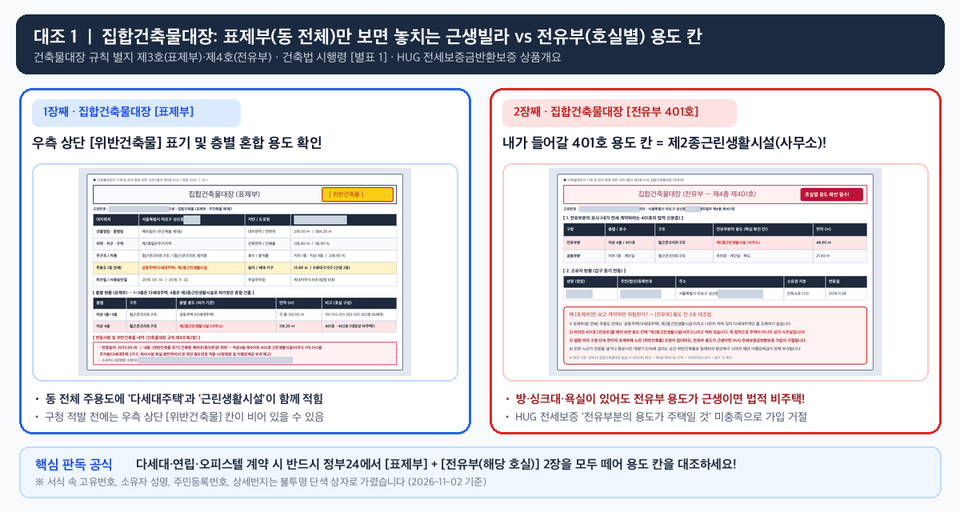
How to Accurately Assess the Risks of Neighborhood-Living-Facility Villas Under Attached Table 1 of the Enforcement Decree of the Building Act (Four-Story Limit for Multi-Family Housing and Ban on Cooking Facilities in Multi-Occupancy Housing) and Article 80 (2019 Abolition of the Five-Time Cap on Compulsory Compliance Charges; Constitutional Court Case 2020Hun-Ba501, Held Constitutional)
How to Identify Subdivided Rooms by Comparing the Number of Households on a Multi-Household House’s General Building Register (e.g., 8) with the Actual Number of Entrance Doors (e.g., 14), and How to Calculate the HUG Jeonse Deposit Guarantee Limit of 90% and Senior Claims Limit of 60% (80% Under Special Provisions) in Real Time
How to use a fact-check of the four requirements (completed by December 31, 2012; at least 50% residential use, etc.) under the Special Measures Act on the Regularization of Specific Buildings (Act No. 21820), effective December 17, 2026, along with three AI analysis prompts (P1–P3) and five protective clauses (T1–T5)
Free GPT Teacher Special Lecture / 6 Main Lessons / 5-Page Practical Kit PDF + Free Web Practice Tool (W1)
There isn’t a single loan on the property registry, so why was my application for rental deposit insurance rejected?
A special lecture on using domain-specific artificial intelligence (AI) for people preparing to sign a lease or purchase contract for a villa (multi-unit dwelling), a studio in a multi-household building, or an officetel. Even if the property register is completely clear, your application for the Korea Housing & Urban Guarantee Corporation (HUG) jeonse deposit return guarantee may be rejected if the building register lists the unit’s use as a neighborhood living facility (office), if rooms in a multi-household home have been illegally subdivided, or if there are undisclosed senior-priority deposits exceeding the limit. We compare the original texts of the Building Act, the Rules on Entries in and Management of Building Registers, Constitutional Court decisions, and HUG’s official product overview side by side, and explain how to screen out risky properties in just 15 minutes before signing a contract.
Original texts of statutes and court rulings
Comparison of Articles 79 and 80 of the Building Act (abolition of the five-penalty limit in 2019; recurring fines of 10% of the standard market value) with the Constitutional Court’s 2020Hun-Ba501 ruling upholding constitutionality
HUG Safety Threshold Calculation
Real-time calculation of residential use of exclusive units in condominium buildings + guarantee limit for multi-family homes (90%) and combined senior liens on other units (60% rule, 80% exception)
2026. 12. 17. Special Act
“Special Act on the Arrangement of Specific Buildings” (Act No. 21820): Fact-check of the four requirements (completed by December 31, 2012; at least 50% residential use, etc.) and five contract special clauses (T1–T5)
If you’ve ever heard anything like this before signing a contract, be sure to check.
It’s a newly built two-room unit with a sink and even an induction cooktop, so why does the building register list it as a Type 2 Neighborhood Living Facility (office)?
I heard that if you pay the enforcement fine just five times, the government will recognize the building as legal. Is that true?
Why is the home rental deposit insurance coverage limit unavailable when the multi-family house’s registry shows only 100 million won in bank loans?
I heard that when the Special Act on Specific Buildings takes effect in December 2026, all illegally built villas will be legalized. Is it safe to buy one now?
None of the four can be determined from the property register alone. The truth only becomes clear when you compare the five key fields in the building register with the figures in the original legal texts. In Lessons 1 through 6, I’ll walk you through them clearly using actual building register forms and the original HUG product overview.
Final Product: A 1:1 comparison of the five key fields in the building register against the laws and original HUG documents
Rather than relying on hearsay, I displayed and cross-checked the current statutes from the National Law Information Center—the Building Act, the Regulations on the Recording and Management of Building Registers, and the Special Act on the Arrangement of Specific Buildings—as well as Constitutional Court and Supreme Court rulings and the original text of the Korea Housing & Urban Guarantee Corporation (HUG)’s official product overview (as cross-checked on November 2, 2026).
Stage 1: Condominium Building Register—Compare the two sections: the building summary (entire building) and the unit section (my unit).
Key safety limit (Enforcement Decree of the Building Act, Appendix 1, and HUG product overview): Multi-family housing is limited to four floors used for residential purposes. To add more floors or avoid parking requirements, upper floors may be approved as neighborhood living facilities (offices), then fitted with rooms and cooking facilities. These are known as “neighborhood-facility villas.” Since the building-wide [title section] may include multi-family housing and can be misleading, be sure to obtain the [exclusive section] for the unit you plan to contract for as well, and check that the use listed for the exclusive area is residential.
Step 2: Multi-Family Housing: Register Unit Count (8 vs. 14) and HUG’s 60% and 80% Safety Thresholds
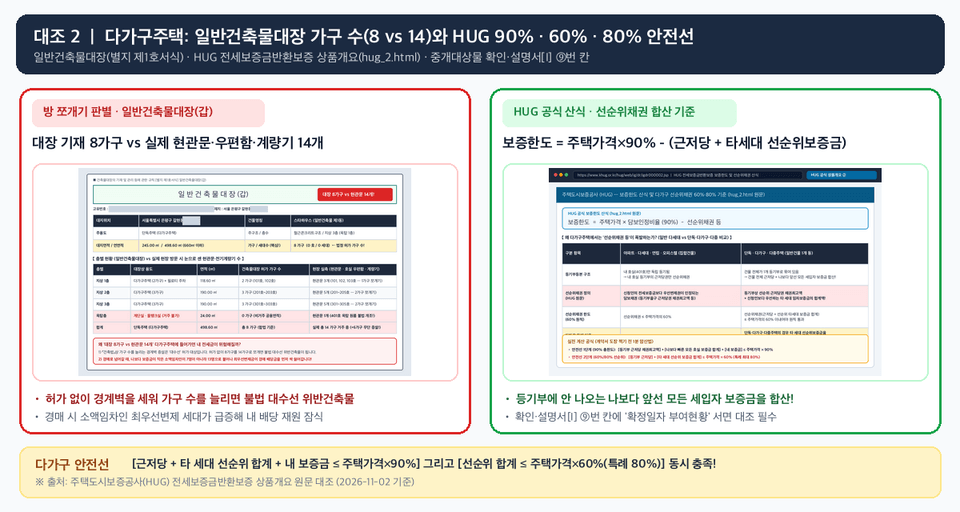
Detecting Room Splitting (Form No. 1 Attached to the General Building Register): A multi-family house is a single detached house comprising the entire building. If the actual number of front doors, mailboxes, and electricity meters (e.g., 14) exceeds the authorized number of households (e.g., 8) listed in the [number of households/units] field of the General Building Register, the building has undergone unauthorized major renovations (room splitting) and is in violation of building regulations. In the event of a foreclosure auction, the priority repayment amount for small-tenant deposits can increase sharply.
HUG guarantee limit and combined senior claims formula: For a multi-family house, senior claims are calculated by adding the maximum claim amount of any registered mortgage to the total rental deposits of all other households that moved in before you. Before signing the contract, compare the figures in item ⑨ of the brokerage property confirmation and explanation form [I] against the status of fixed-date assignments and the certificate of resident households—not the landlord’s verbal explanation—and make sure the amount is within 60% of the property value (80% under the special provision) and the overall limit of 90%.
Stage 3: The Special Act’s Four Requirements as of December 17, 2026, AI Prompt Analysis, and Five Types of Contract Special Clauses
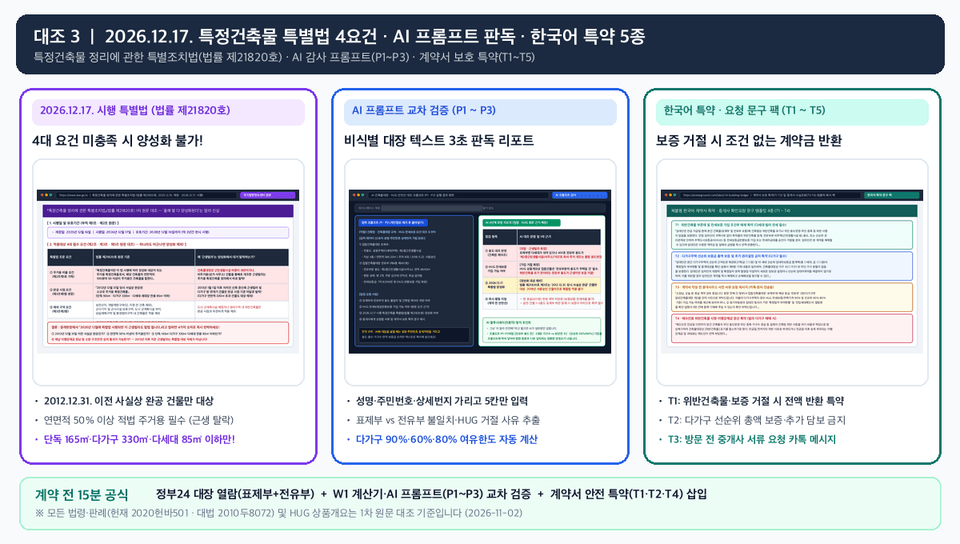
Fact Check: Special Act on Specific Buildings (Act No. 21820), December 17, 2026: The fact that the Special Act takes effect at the end of this year does not mean that all buildings in violation will be legalized. All four requirements must be met: ① Substantially completed before December 31, 2012 + ② At least 50% of the gross floor area is legally approved for residential use + ③ No more than 165㎡ for detached houses, 330㎡ for multi-household houses, and 85㎡ of exclusive area for multi-unit houses + ④ All overdue enforcement fines paid and structural safety review passed. Therefore, newly built neighborhood-facility villas constructed after 2013 are not eligible in the first place.
Pitfall 1 / Commercial-Use Villas and Multi-Unit Housing
Conversion of a private office unit and unauthorized cooking facilities
If the use field in the [exclusive section] of the building register for a multi-unit building lists a Type 1 or Type 2 neighborhood living facility, or if an induction cooktop and sink are installed inside a room in a multi-household residence, your application for jeonse deposit insurance will be rejected—even before any violation is officially noted.
Trap 2 / Subdivided Rooms in a Multi-Family House and Priority Claims
8 Households on the Building Register vs. 14 Entrance Doors
Compare the number of households listed in the general building register with the actual number of front doors, then add the total amount of senior deposits for other units to the mortgage registered on the title to calculate whether it falls within HUG’s 90% limit and the 60% threshold (80% under the special provisions).
Shield 3 / 5 Types of Korean-Language Protective Clauses
Unconditional termination if the guarantee is denied
Copy and use these clauses as written: a guarantee that no building code violations exist by the balance payment date; an unconditional, immediate full refund of the deposit if the jeonse guarantee is denied (T1); and a guarantee covering the total amount of senior deposits in a multi-unit property, with no additional collateral permitted (T2).
A Preview of Copy-Ready Korean Contract Clauses and Request Messages
The Lesson 1 course PDF and free online practice tool (W1) include five Korean templates (T1~T5), including contract clauses and messages to request documents from a real estate agency in advance. Here’s a preview of two of them.
Template T1 (Special Clause for Cancellation Subject to the Absence of Illegal Building Violations and Approval for Lease Deposit Guarantee Insurance)
The Landlord warrants that, as of the date the balance is paid, the building that is the subject of this agreement (including its main section and exclusive-use section) has no violations under the Building Act, such as designation as an illegal building, unauthorized change of use, or unauthorized extension. If, through no fault of the Tenant, the Tenant is denied enrollment in a rental deposit refund guarantee program offered by the Korea Housing & Urban Guarantee Corporation (HUG) or another provider, or approval for a rental deposit loan, due to the property being listed as an illegal building, the exclusive-use portion being designated for non-residential use (such as neighborhood living facilities), or senior-ranking rights, the Tenant may terminate this agreement, and the Landlord shall immediately refund in full all amounts received, including the deposit.
Template T3 (KakaoTalk and text message requesting documents before visiting the real estate office)
Agent, I’m reviewing the contract for the unit we saw today. Before I visit, could you first send photos of ① the title section of the collective building register from Government24 and the exclusive-use section for the unit in question (two pages; for a multi-family house, one page of the general building register)? Also, for a multi-family house, I need to calculate whether it qualifies for HUG jeonse deposit guarantee coverage (based on 90% of the property value and the 60% and 80% thresholds for prior-ranking claims). Could you please confirm whether you can include ② a copy of the land and building register, the status of fixed-date issuance, and a copy of the resident household confirmation document in item 9 of the explanation form?
Three Things You’ll Take Away After the Lecture
1. Six concise core videos and a three-question review quiz
Six concise lessons on how to read the five key fields of a building register, case law on neighborhood-living-facility villas and enforcement fines, HUG safety thresholds for multi-family homes, and the four requirements of the December 2026 Special Act—plus a quiz with explanations available as soon as you submit it.
2. Course materials, page 5 of the PDF (c14_building_ledger_ai_check_kit.pdf)
A five-field summary table of the building register, five copy-and-paste-ready Korean contract clauses and request templates (T1–T5), a 12-item pre-contract checklist, and three AI interpretation prompts (P1–P3). You can download them directly from [Class Materials] in the upper-right corner of Lesson 1.
3. Ongoing Use of the Free Web Practice Simulator (W1)
You can compare the uses listed in the title section and the exclusive-use section, use a calculator for HUG’s 60% and 80% guarantee limits for multi-family homes, and try the four-requirement test for the December 17, 2026 Special Act—all without logging in.
The Order Covered in the 6 Lessons
Lesson 1
[Start with the finished product] Find out why rental deposit guarantees can be denied even when the property register looks clean, then use the free web-based practice tool (W1) to try checking the permitted use of a neighborhood commercial building converted into a villa and calculating the HUG safety limits for a multi-family house.
Lesson 2
[Reading the Building Records] Learn how to distinguish and view the general building register (for multi-household housing) and the title and unit sections of the collective building register (for multi-unit housing and officetels) on Government24, and review the five key fields that can reveal even violations that have gone undetected.
Lesson 3
[Neighborhood Commercial Villas] We examine neighborhood commercial villas that arise from the floor-count restrictions in Appendix 1 of the Enforcement Decree of the Building Act, as well as cooking violations in multi-tenant houses, and review the 2019 removal of the five-penalty cap on enforcement fines and the Constitutional Court’s decision upholding its constitutionality.
Lecture 4
[Multi-family Housing and HUG] We’ll work through practical calculations using the method for detecting room-splitting that turns the 8 households listed in the building registry into 14, and the formula for HUG’s jeonse deposit return guarantee (a 90% cap on the housing price and 60% and 80% thresholds for the combined senior claims of other households).
Lesson 5
[2026 Special Act] We examine the full text of the provisions of the Special Act on the Arrangement of Specific Buildings, which takes effect on December 17, 2026 (Act No. 21820), and verify against four key requirements why newly built neighborhood-facility villas constructed after 2013 are excluded from legalization.
Lesson 6
[Practical Application] Wrap up with a 12-item checklist you can complete in just 15 minutes before signing the contract, and a routine for feeding anonymized building-register text into AI prompts (P1–P3) to generate an audit report and protective special clauses (T1–T5).
Prompt Engineering and the Division of Roles Between Humans and AI
Prompt Engineering: Entrusting De-identified Building Register Text to an AI Auditor
Three-Step Review Prompts to Give an AI Before Signing a Contract (P1–P3)
If you vaguely ask an AI tool (such as Claude, ChatGPT, or Gemini), “Is it safe to rent this villa with a jeonse deposit?”, it may get legal figures wrong or simply list generic precautions. As with the three prompt-engineering templates (P1–P3) included in the course PDF, you can specify the use-designation fields in the title section and unit section, the number of households in the register versus the number of front doors, the HUG 90% and 60%/80% calculations, and the requirement that the building have been completed by December 31, 2012 as criteria for the assessment. If you provide only text with personal information (names, resident registration numbers, and detailed street addresses) removed, you can get an accurate comparison table in under a minute.
What people need to check in person during site inspections and contract signing
What AI Review Prompts (P1–P3) Help With
Automated detection of mismatches between the main use listed in the building register and the use of individual units, and risks associated with villas in neighborhood living facilities (P1) Calculate the 90%, 60%, and 80% limits for mortgages and senior liens on other units combined, relative to the price of a multi-family home (P2) Check for missing verbal disclosures in fields 3 and 9 of the Property Information and Explanation Form, and generate special contract clauses (P3)
Items for the tenant and buyer to verify in person on site
When visiting the property, count the actual front doors, mailboxes, and electricity meters and compare them with the number of units listed in the registry Inspect and cross-check the originals of the records of fixed-date assignments and the resident household confirmation certificate issued by the community center and tax office Personally write the clause in the contract’s special provisions requiring a full, unconditional refund of the deposit if enrollment in the lease guarantee program is denied (T1, T2)
What This Course Is Not
This course does not provide legal advice on individual cases, representation in rights analysis, real estate brokerage, or guaranteed investment returns by lawyers, licensed real estate agents, or architects. It also does not cover loopholes for evading enforcement against buildings in violation of regulations.
This educational material teaches you how to read public records yourself, based on the current statutes and original court decisions available from the National Law Information Center and the official product overview of the Korea Housing & Urban Guarantee Corporation (HUG), as cross-checked on November 2, 2026. Actual eligibility for guarantee coverage may vary depending on revisions to local government ordinances or the guarantee institution’s internal review criteria, as well as the rights and interests associated with each individual property. Before entering into a contract, be sure to confirm all details with the relevant local government and guarantee institutions (HUG, HF, and SGI), as well as a legal professional.
The sample building register and the unique numbers, owner’s name, resident registration number, full street address, and account identifiers shown on screen have been covered with opaque solid-color boxes. The lecture audio is AI-generated (TTS).
Next lecture
Follow GPT Teacher to receive updates about the next practical AI workshop as soon as they’re announced.
When You’re Unsure About the Use Listed on a Building Register or Special Contract Clauses, Check Them This Way
First, ask AI to review the prompts (P1–P3) in the class PDF materials, entering only the property’s use, area, and number of households—leave out the owner’s name, resident registration number, and street address. Share any further questions or AI tips in the Q&A board and open chat room.
Young professionals, newlyweds, and other tenants preparing to sign a lease or make a small-scale purchase of a multi-family villa, a studio or two-room unit in a multi-household building, or a residential officetel.
Those who have heard claims from real estate agents like “Even though it’s a villa in a neighborhood living facility, you can get rental deposit insurance if you register your residence” or “Everything will be legalized under a special law by the end of this year,” and want to fact-check them against the original legal texts.
People who want to feed anonymized text from public records (building registers and property confirmation and explanation forms) into an AI prompt and get risk indicators and tailored contract clauses in just three minutes.
Need to know before starting?
We explain using actual building registry forms and side-by-side comparisons with the original HUG product overview, so it’s easy to understand even without knowledge of real estate regulations or experience using AI.
Materials needed: An AI chat tool where you can paste the AI analysis prompts (P1–P3) from the class materials PDF (Claude, ChatGPT, or Gemini—any of them will work), and the free web-based practice tool (ainewground.com).
I’m GPT Teacher, researching and building AI agent workflows and content automation systems.
After implementing and validating trending global AI technologies and workflows firsthand, I teach them so that even non-developers can reproduce the same setup on their own computers in just 10 minutes by sharing the execution logs, prompt specifications, and open-source starter kits as complete files. Instead of making exaggerated promises about views or revenue, I show you with data and code what actually worked and how it was validated.
[Key Research and Course Areas]
Building AI Agents & a Second Brain: Knowledge compilation and workflow automation based on Claude Code · Google Antigravity · Karpathy LLM Wiki
AI video and content production systems: Fact-checking and automated rendering pipelines combining Google Flow (Veo), TTS, and agents
Integrity verification automation: A lint pipeline that comprehensively checks broken links and factual accuracy across scripts, wikis, and data