
inflearn logo

A working developer's guide to the robot development process: The robot mass production cycle

Robot Mass Production Cycle Based on APQP: Learning with the Unitree Go2 Example How is a single robot or mobility device made? Master everything from job interviews to practical work at once with the manufacturing standard APQP process!

2 learners are taking this course

Level Beginner

Course period Unlimited

Project Management (PM)
MCU
MCU
robotics
robotics
robot
robot
Project Management (PM)
MCU
MCU
robotics
robotics
robot
robot

What you will gain after the course

  • Conquering the 'real' robot release cycle in the field

  • Mastering the Global Manufacturing Standard 'APQP Process'

  • Job Interview Preparation and Maximizing Enterprise-wide Collaboration Skills

A robot/mobility practical development process taught by a current developer at a major corporation

Robot Mass Production Cycle Based on APQP: Learning with the Unitree Go2 Example

  • How is a single robot or mobility device created?

  • Master everything from job interviews to practical work all at once with the manufacturing standard APQP process!

Recommended for the following people

Job seekers and students who are interested in robotics development roles but feel overwhelmed about how to approach them

Junior developers who want to quickly adapt to their work by understanding the overall robotics development process

Planners and developers who are curious about the new robot/mobility product planning and mass production process that goes beyond prototyping to actual market launch

After completing the course,

  • After completing this course, you will move beyond being a simple developer and gain the professional perspective that companies desire—one that generates profitability and manages risks.

    ### 1. Mastering the 'Real' Robot Launch Cycle in the Industry

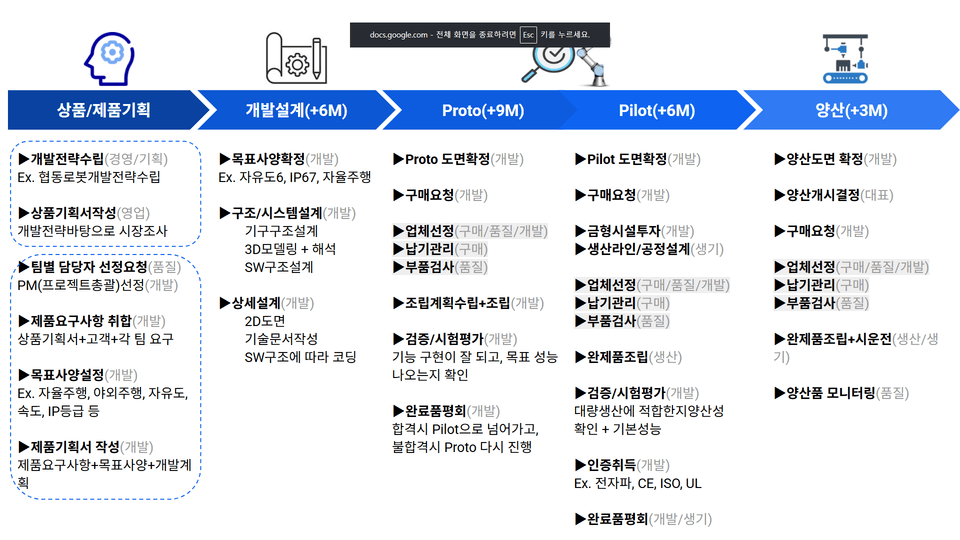
    • Move beyond laboratory-level prototyping and gain a complete understanding of the full 5-stage process used in actual companies: [Product Planning ➔ Development & Design ➔ Proto ➔ Pilot ➔ Mass Production].

    ### 2. Mastering the Global Manufacturing Standard 'APQP Process'

    • Learn the APQP (Advanced Product Quality Planning) system to prevent trial and error and defects that may occur during new development.

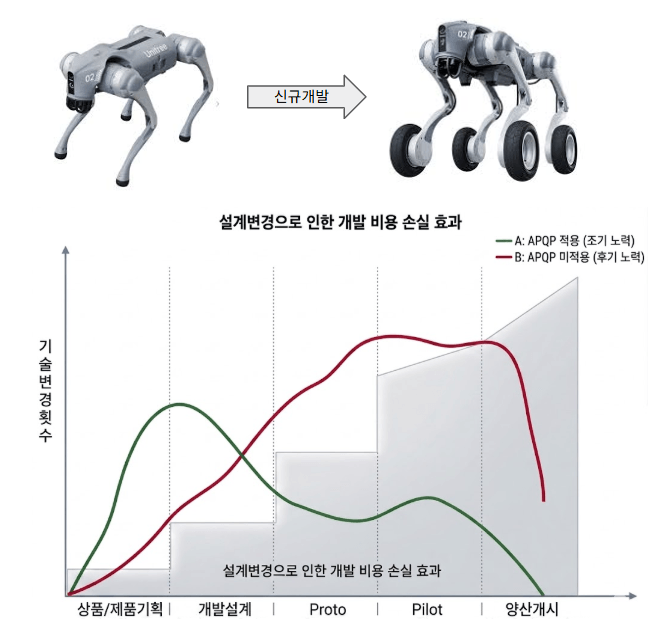
    • Understand design risk management techniques that minimize hundreds of millions of won in failure costs during the mass production stage by proactively implementing technical changes in the early stages of development.

    ### 3. Dominating Job Interviews and Maximizing Enterprise-wide Collaboration Skills

    • Interview Cheat Sheet: Instead of the common answer "I know how to use ROS or CAD," prove your competitiveness using the language of a practitioner: "I know how to reduce mass production loss costs based on APQP."

    • Interdepartmental Communication: By understanding the structure in which not only development (HW/SW) teams but also planning, sales, purchasing, quality, and manufacturing engineering teams work together organically, you will become a high-performing talent from the moment you join the company.

Features of this course

### 1. Excluding abstract theories, a vivid practical guide from an 'active developer'

We do not cover theories that only exist in research papers or textbooks. We have included only the real, field-oriented processes and engineering tips gained from launching products in the field at global corporations.

### 2. Thorough Loss Prevention Analysis Based on Global Standard APQP

Unlike simple production courses, this course perfectly integrates manufacturing standard manuals—designed to maximize profitability and customer satisfaction by minimizing quality defects—into robot and mobility development.

### 3. Expanding an 'Enterprise-wide Perspective' that Encompasses Both Hardware and Software

Robots cannot be created through coding or mechanical design alone. We guide you to become a convergence-type talent optimized for the field by teaching you how to coordinate interfaces with other departments (Procurement, Quality, Production Engineering, etc.).


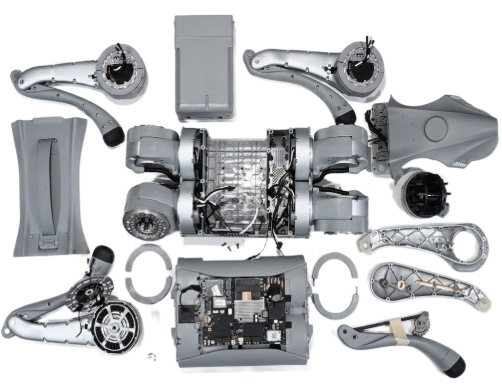
go2분해도


What you will learn

Subject 1. Robot Planning and Target Specification Setting (Product/Goods Planning)

  • Establishing development strategies for collaborative robots/mobility and how to write product planning documents based on market research

  • Selection of PM (Project Manager) and department-specific leads, and the process for gathering product requirements

  • Methods for defining target technical specifications such as autonomous driving, outdoor driving, degrees of freedom, speed, and IP ratings

Subject 2. Preliminary Design for Minimizing Design Risks (Development Design)

  • Finalizing target specifications (e.g., 6 degrees of freedom, IP67) and structure/system design flow

  • The interworking process between mechanical structure design (3D modeling and analysis) and SW structure design

  • Design defect prevention techniques through 2D drawing and technical documentation

Subject 3. Prototype Production and Initial Performance Verification (Proto)

  • Finalization of Proto drawings, purchase requests, and the [Purchasing/Quality/Development] collaboration system and parts inspection

  • Establishment of assembly plans, assembly of finished products, and the test evaluation process for verifying target performance

  • Preventing rejection risks through a final product evaluation meeting and reviewing conditions for entering the next stage

Subject 4. Mass Production Verification and Global Certification Acquisition (Pilot)

  • Production Technology Team's mold facility investment and production line/process design guide

  • Mass production feasibility verification and basic performance evaluation during the Pilot stage for mass production suitability assessment

  • Practical experience in obtaining essential international certifications (e.g., EMC, CE, ISO, UL, etc.)

Subject 5. Successful Product Launch and Quality Stabilization (Mass Production)

  • Mass production commencement decision process through final production drawing confirmation and representative approval

  • Finished product assembly, trial runs, and the quality team's continuous monitoring system for mass-produced goods

  • Analysis of the number of engineering changes and loss costs based on the application of the APQP process (Company A vs. Company B)

The person who created this course

"Real know-how gained from getting hands-on and overcoming challenges from the lowest level of HW to SW"

Hello, I am a robotics developer currently working at a global corporation. Having worked in the robot industry for several years, I have experienced everything from the bottom-level HW to the top-level SW.

This course is not an academic book filled with grand theories. I am creating this course to organize the know-how I have fiercely accumulated in the field, while also earning some side income.

If you have any questions about the lecture, please feel free to leave a comment anytime. I will help you gain so much that you'll feel the course fee was more than worth it!


Do you have any questions?

Write at least 3 questions and answers that prospective students might have before taking the course.
We recommend providing answers that showcase the instructor's unique personality rather than generic or formal responses.

### Q1. Is this course only for robotics majors or professional developers?

A. No. This lecture is not a technical course that dives deep into specific coding languages or complex mathematical formulas. It is a process for learning the "way of working and process (APQP)" from the moment an idea becomes a product until it hits the market. Anyone can take this course, from aspiring developers, college students, and new employees interested in the robot industry to practitioners in other departments who want to understand the overall manufacturing flow.


### Q2. Is the focus more on hardware or software?

A. The course does not lean toward one side but covers how the two fields converge to complete a single product. Due to the nature of robot development, mechanical design (HW) and control algorithms (SW) are closely linked. This lecture clearly highlights the organic process of how both parts communicate and collaborate at each stage (Planning-Design-Proto-Pilot-Mass Production).


### Q3. What is the difference between general manufacturing processes and robot development processes?

A. In a broad sense, the APQP (Advanced Product Quality Planning) protocol is the same. However, a robot is a complex system where software and hardware—such as multi-degree-of-freedom actuators, sensor perception systems, and autonomous driving algorithms—interact in real-time. Therefore, the test evaluation items and edge cases that must be verified during the Proto and Pilot stages are much more demanding than those for general injection-molded parts or simple electronic products. Through this lecture, you can learn practical know-how tailored specifically for robots.


Notes before taking the course

Practice Environment

  • Operating System: As this is a concept-oriented theory and process lecture, it can be taken regardless of the OS type, such as Windows, macOS, or Linux.

  • Tools Used: This is a pure job competency enhancement class that does not require the purchase of separate paid software or expensive hardware equipment.

Prerequisite Knowledge and Important Notes

  • Mindset: All you need is the passion to understand the big picture of the entire robot/mobility development process and to gain practical hands-on experience. (Coding skills are not required)

  • Copyright Notice: The intellectual property rights for this lecture and all provided teaching materials belong to the knowledge sharer, and unauthorized reproduction, distribution, or sharing may result in legal liability.

Recommended for
these people

Who is this course right for?

  • Job seekers and students who are interested in robotics development roles but feel overwhelmed about how to approach them.

  • A junior developer who wants to quickly adapt to the job by understanding the overall robotics development process.

  • Planners and developers who are curious about the planning and mass production process for new robot/mobility products that can be launched in the actual market, going beyond mere prototyping.

Need to know before starting?

  • All you need is the passion to grasp the big picture of the entire robot/mobility development process and gain practical experience. (Coding skills are not required)

Hello
This is jelly

Career Verified

Hello, I am a robotics developer currently working at a global corporation.

Having worked in the robotics industry for several years, I have experienced everything from the bottom-level hardware to embedded systems and high-level software.


I am organizing the know-how I have fiercely accumulated in the field, and

I am creating this course to share my knowledge and earn some side income at the same time.


If you have any questions about the lecture, please feel free to leave a comment at any time.

I will help you gain so much that you'll feel the cost of the lecture was well worth it!

More

Curriculum

All

16 lectures ∙ (42min)

Course Materials:

Lecture resources
Published: 
Last updated: 

Reviews

Not enough reviews.
Please write a valuable review that helps everyone!

Similar courses

Explore other courses in the same field!

Limited time deal ends in 21:45:10

$5,390.00

30%

$6.60