This course is Part 2 of the full-stack course series, following the Python backend (Part 1) course, and is designed to help you build a solid foundation in frontend development for full-stack development. It provides a detailed overview of and hands-on learning in HTML5, CSS, and JavaScript (VanillaJS, vanilla JavaScript) + ES6 for developing web services suitable for commercial use.
This is a special course created by considering the learner’s perspective as much as possible, rather than following the format of a typical IT course. Using a wide range of materials and examples, you will start with no prior knowledge of the relevant technologies and solidly master the essential skills to the point where you can list them on your résumé.
This course has been proven effective, with many people having learned from it and shared positive feedback.
If any issues arise, it may continue to be updated from time to time, as it is now.
Want to build a solid foundation in frontend development?
프론트엔드 기본 기술을 탄탄히 정리해야 합니다. 프론트엔드 기본은
HTML, CSS, Javascript 입니다. React 를 익히더라도, 프론트엔드 기본이 필요합니다. 탄탄한 프론트엔드 기본기가 핵심입니다. 꼼꼼하게 잘 쌓은 기본기 위에, React 든 Flutter 든 익히면 프론트엔드를 원하는대로 만들 수 있습니다. 여기에 최신 웹페이지는 반응형, 호환성등 정리해야할 배경지식과 관련 지식이 있고, 오래전 기술인 Jquery 를 깔끔한 Javascript 로 대체해야 합니다.
I have a rough understanding, but I feel like I can't organize it all
You may think you can use HTML, CSS, and JavaScript well enough, but when you actually try using them, they’re difficult to handle exactly as you want. With countless scattered syntaxes and technologies such as responsive design, compatibility, and ES6, front-end development in particular is more challenging than you might expect unless you organize and consolidate your knowledge properly.
I heard that becoming full-stack means you can build web services on your own...
Whether it’s the web or an app, modern services require backend, frontend, and deployment technologies to implement. This is what we call full-stack development. By becoming a full-stack developer, you can build modern web services on your own and become a competitive developer.
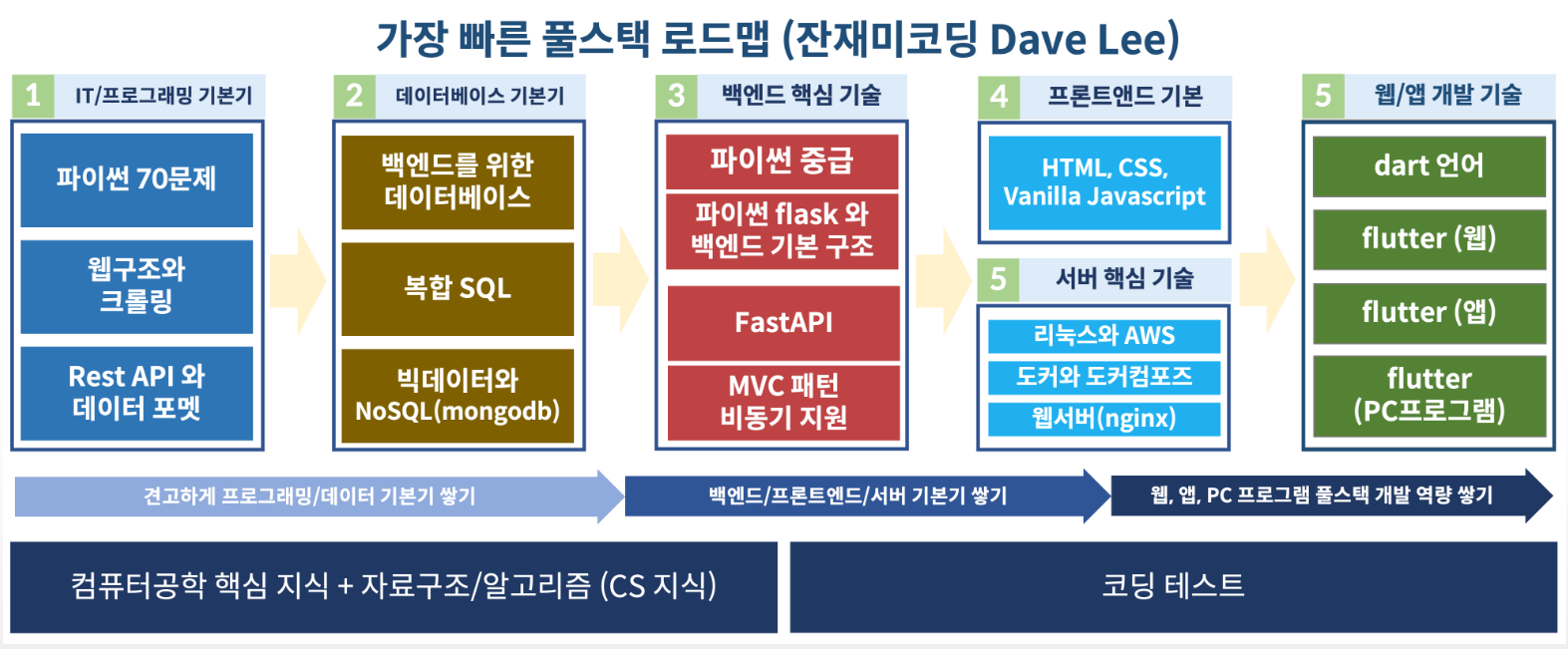
To learn and apply these skills as effectively as possible, you should learn Python and backend technologies in Part 1 of the Full-Stack Course, and build a solid foundation in frontend development in Part 2. You need a strong foundation! Only then can you truly become a full-stack developer, rather than simply copying the web services shown in the course. This course thoroughly covers HTML5, CSS, and JavaScript (vanilla JavaScript, VanillaJS) + ES6 so that you can build a solid foundation in frontend development.
We created a summary of the fastest and most up-to-date full-stack roadmap in a YouTube video. By referring to this video, you can understand not only this technology but also a roadmap for developing websites and apps on your own in a short amount of time.
Created it to build a solid and practical foundation in front-end development.
With countless syntaxes and features, your frontend journey should begin with the keyword “organization.”
We have organized the many diverse syntaxes and areas of knowledge according to the following criteria.
- We cover all the background knowledge needed for modern website development
- We thoroughly cover the CSS essential for creating polished web pages
- We do not cover jQuery, which is no longer used in modern web pages
- We cover everything using standard vanilla JavaScript + ES6 instead
- support responsive design
- We also consider compatibility
We organize HTML tags concisely, focusing only on the essential tags, including semantic tags,
and cover detailed CSS features while considering responsiveness and compatibility, which are essential for implementing a convincing web page.
As the name VanillaJS (Vanilla JavaScript) suggests, recent trends no longer use jQuery, so we implement web pages using only Javascript + ES6 syntax with compatibility in mind.
For each feature, we exclude extremely new syntax that cannot be used due to compatibility issues, as well as alternative technologies, and focus on the core technologies.
Don't waste your time!
It's not that we can't do it because we lack information!
With a proven course, you can learn it and get up to speed quickly!
Isn't it enough to learn only Javascript?
The biggest bottleneck in full-stack development is CSS. People say that even middle school students know HTML and CSS.
However, unless you are a fairly experienced front-end developer, you cannot create responsive, compatible, and convincingly modern web pages.
You need to organize countless detailed CSS features. HTML also needs to be reviewed once to ensure it follows the standards.
There is also a profession called a web publisher in Korea, but overseas, front-end or full-stack developers handle everything, including CSS.
To become a competitive front-end/full-stack developer, it is essential to thoroughly organize your knowledge of CSS features.
Don’t you need to learn React and Vue to build web services?
These frameworks are written in Javascript to improve upon some of Javascript’s shortcomings. Since you use Javascript even when working with these frameworks, you need to thoroughly learn and master the basic syntax of Javascript, regardless of which framework you choose. Once you have a solid foundation in the HTML, CSS, and Javascript basics covered in this course, you can learn frameworks such as React and Vue.
That is why this course focuses on the fundamentals of frontend development. To help you build a solid foundation, this course covers and practices all the essential technologies related to the subject.
Can even beginners do it?
This is a course that explains everything in detail and step by step so that beginners can follow along.
The most difficult IT courses are those that teach programming to people who know nothing about programming at all. Even such learners have acquired not only programming but also web scraping skills through my Python for Beginners and Web Scraping Basics Bootcamp course. If you are reasonable and considerate of one another, it is entirely possible.
If you just want to quickly organize your front-end knowledge, you can take this course alone. However, if you are a complete beginner who has never worked with programming before, I recommend that you gradually learn full-stack development through the roadmap along with the Python for Beginners and Web Scraping Bootcamp course. This will allow you to steadily build the skills you need.
So that even beginners can understand
Based on concise yet meticulously prepared materials,
you can test things yourself during the lecture
with sample code for each feature and test them right away
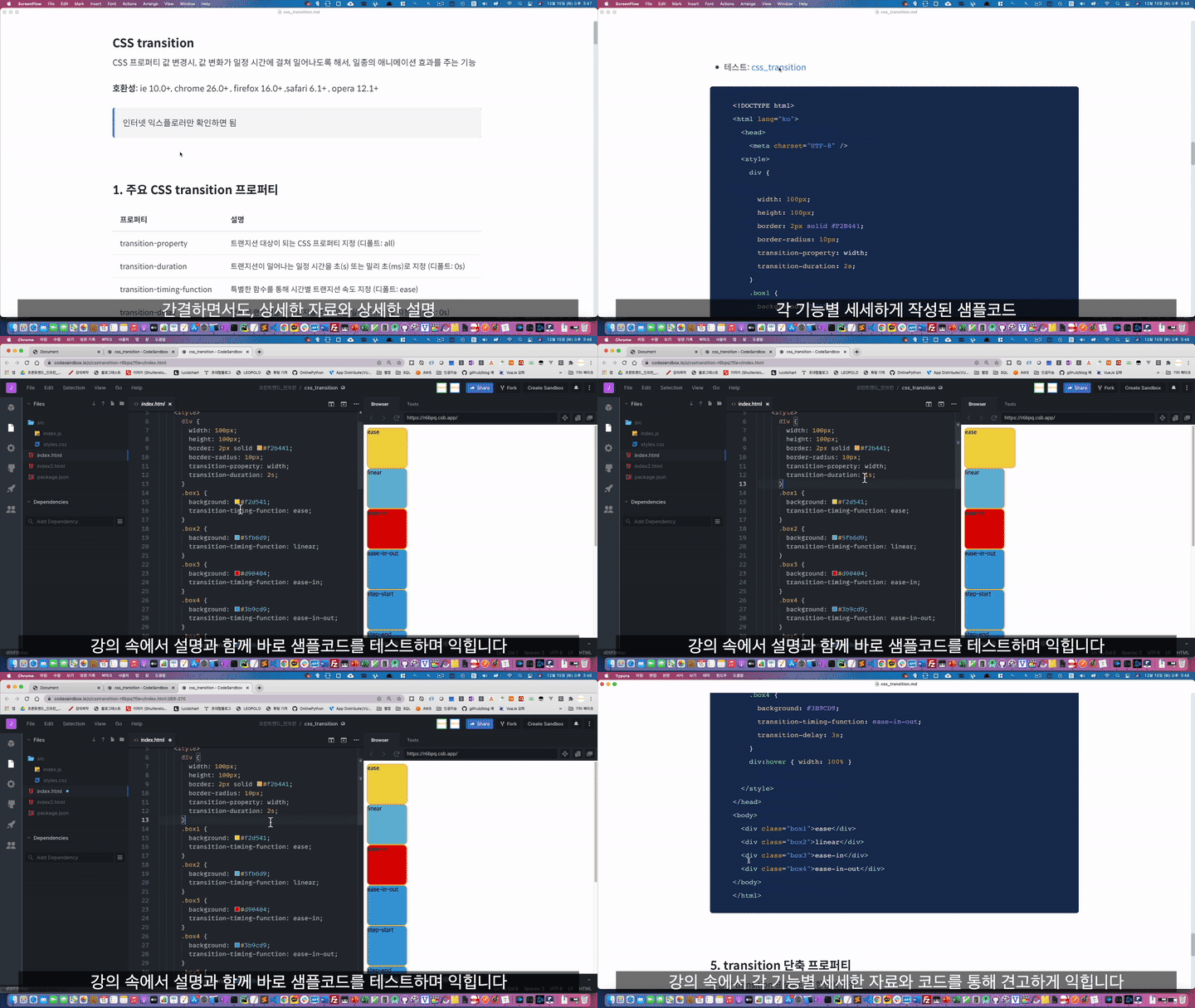
• We provide sample code for each feature as a project, along with code files for real-world web pages.
• The course materials are available online for you to access at any time. (However, copying and downloading are restricted due to copyright concerns.)
Can you learn it systematically?
We are creating this course so that you can start as a beginner and gradually increase the difficulty throughout the entire process of becoming a full-stack developer, learning in a detailed and systematic manner. To help you understand the relevant syntax and knowledge, we provide concise code and sufficient explanations, while also explaining the necessary computer science concepts as they arise, allowing you to build the fundamentals needed to become a good developer.
This course is Part 2 of the full-stack course series. In this course, we select a specific webpage for developing the following service and work together from a blank file all the way to completing the code, step by step, using HTML, CSS, and Javascript + ES6 without any frameworks or libraries.
You’ll be able to feel, 'Ah! This really is different!'
This is a thoughtfully designed course
Just follow along exactly, and you’ll be fine!







![[Updated] Your First Python Data Analysis (Easily! Learn the Entire Process of Preprocessing, pandas, and Visualization) [Data Analysis/Science Part 1]Course Thumbnail](https://cdn.inflearn.com/public/course-325576-cover/75d85753-8e0b-40f3-9f11-ca43e70c5200?w=420)



![Docker and Modern Server Technologies for Full-Stack Development (Linux, nginx, AWS, HTTPS, Deployment) [Full-Stack Part 3]Course Thumbnail](https://cdn.inflearn.com/public/courses/326771/cover/bc862b4d-abe6-4d80-a826-3a5324a9f998/326771-eng.png?w=420)
![[Renewed] Introduction to Python Backend and Web Technologies for Beginners (Intermediate Python, Understanding Backend and Web Technology Fundamentals with Flask) [Full-Stack Part 1-1]Course Thumbnail](https://cdn.inflearn.com/public/course-325804-cover/6afae82f-e06b-4a0b-914d-2bdf7b1f5b60?w=420)
![[Renewed] First-Time MongoDB and NoSQL (Big Data) Database Bootcamp [From Beginner to Practical Use] (Updated)Course Thumbnail](https://cdn.inflearn.com/public/courses/324183/cover/fbe9f0cc-4c42-4435-b855-f283f6932415/324183.png?w=420)
![First-Time Deep Learning and PyTorch Bootcamp (Easy! From the Basics to the Core Transformers Behind ChatGPT) [Data Analysis/Science Part 3]Course Thumbnail](https://cdn.inflearn.com/public/courses/329540/cover/1be7b8cb-800f-48cb-a30c-b7d78996c075/329540-eng.png?w=420)
![[Renewed] Beginner’s Python Machine Learning Bootcamp (Easy! Learn by Solving Real Kaggle Problems) [Data Analysis/Science Part 2]Course Thumbnail](https://cdn.inflearn.com/public/courses/327464/cover/55c4db7b-7764-43cc-ac75-d9e8d08098f1/327464-eng.png?w=420)
![[Renewed] First-Time SQL and Database (MySQL) Bootcamp [From Beginner to Practical Applications]Course Thumbnail](https://cdn.inflearn.com/public/courses/324208/cover/85872a8e-d2bb-4c43-82fc-d55fa067746e/324208.png?w=420)
![[Renewed] Python Introduction and Web Scraping Basics Bootcamp [From Python and the Web to Fundamental Data Concepts] (Updated)Course Thumbnail](https://cdn.inflearn.com/public/courses/324082/cover/57af93de-1021-40b4-80d7-a0dfc17190cf/324082.png?w=420)
![Python Backend for Beginners: An Introduction to FastAPI (From FastAPI to Asynchronous SQLAlchemy) [Full-Stack Part 1-2]Course Thumbnail](https://cdn.inflearn.com/public/courses/333248/cover/7323d828-100e-4ac9-8e6e-0e51a17ac741/333248.png?w=420)
![Flutter for Beginners: From Basics to Real-World Applications [Full Stack Part 4] (Easy, Robust, and Step-by-Step Through Various Projects)Course Thumbnail](https://cdn.inflearn.com/public/courses/331245/cover/1f8c5bb8-8aad-4542-b3bc-977cda51c846/331245.png?w=420)
![Mastering HTML + CSS: The Complete Guide from Beginner to Advanced - Part 1 [Basics]Course Thumbnail](https://cdn.inflearn.com/public/files/courses/335967/cover/01jqhgartxsvcyf89xymx5wh9f?w=420)
![Learning JavaScript Properly: A Complete Guide from Beginner to Professional Part 1 - [Basics]Course Thumbnail](https://cdn.inflearn.com/public/files/courses/336176/cover/01jqhh8293f4c24r6zpzcvskcr?w=420)
![From JavaScript to React [PART 2/4] The Road to Unyielding ReactCourse Thumbnail](https://cdn.inflearn.com/public/courses/335780/cover/a1e69ed1-63ad-4f4b-b3f2-fb44374699bd/335780.png?w=420)
![Modern Web Interactive CSS3 Bootcamp [Full vers.]Course Thumbnail](https://cdn.inflearn.com/public/courses/334857/cover/4ccc6c75-74aa-4aba-b3d9-8aabe36e9452/334857.jpg?w=420)
![Responsive Web Development Using Bootstrap [Basic Concepts] BootcampCourse Thumbnail](https://cdn.inflearn.com/public/courses/333092/cover/5a3043a4-fc2d-4b25-9096-306c8f707b5b/333092.jpg?w=420)
![[2026 Examination Standards] Perfect Guide for the Web Design & Development Technician Practical ExamCourse Thumbnail](https://cdn.inflearn.com/public/courses/324878/course_cover/12211037-e74b-46b3-8942-46d465b81bba/webdesign-cover-02.png?w=420)