Docker and Modern Server Technologies for Full-Stack Development (Linux, nginx, AWS, HTTPS, Deployment) [Full-Stack Part 3]
This course is Part 3 of the Full-Stack course series, designed to help you thoroughly master the latest server technologies and Docker. To enable you to genuinely incorporate Docker into your tech stack, the course meticulously tests Docker’s various options, covers related technologies such as Linux that you need to understand for Docker, and is structured so that you can even build complex real-world services.
I took this course with no foundational knowledge, but by following along, I was able to purchase a domain and access the site I deployed from my phone. Although I'm writing this review long after purchasing the course, this was the first course I listened to diligently. The instructor teaches Docker usage and basic commands, and explains everything in a way that even beginners can follow easily.
5.0
yg04076
100% enrolled
I am an undergraduate student taking the course. Thanks to you, I was able to successfully deploy the Spring/React project I am currently working on to EC2 by building a CI/CD pipeline with HTTPS, Docker, and Nginx!
5.0
fletcher_seth2335
15% enrolled
I am taking the course step by step according to instructor Dave Lee's Full-Stack roadmap, and I feel that the course was really prepared and created for the students ^_^
I wanted to understand Docker, but I couldn't find a well-organized, systematic course, so I wandered around among various biased knowledge and found this course like a ray of light!
I absolutely recommend this course, which is full of the instructor's know-how, technical expertise, and affection for the students, and of course, the course review is perfect ^.^
What you will gain after the course
Essential Docker Syntax
Dockerfile syntax
Docker Compose syntax
Intermediate Usage of the Web Server (nginx)
Reverse Proxy Configuration (nginx)
HTTPS Certificate Issuance and Server Configuration
Linux Usage Basics
AWS EC2 Server Setup Basics
Docker-Based Deployment Basics
20,000 students enrolled online and offline!
The latest server technologies to build a solid foundation in Docker
A high-quality course series (Full-Stack Part 3)
Built on 10 years of teaching experience with 100,000 students while working in the industry, this course was created with the learner’s perspective in mind more than typical IT courses. Through a variety of resources and examples, you can start without prior knowledge of the relevant technologies and master the core skills solidly enough to include them on your resume.
This is a proven course that many people have learned from and given positive feedback on. If any issues arise, we will continue to update it regularly, as we do now.
How can you make the essential technology stack, server technologies, and Docker your own for web and app services?
To deploy a real service to a server using Docker, you need to thoroughly learn Linux, web servers, and HTTPS well enough to use them.
You need to thoroughly organize the surprisingly numerous Docker options and syntax to the point where you can build complex services.
You should also organize the background knowledge surrounding Docker to build a solid foundation in modern server technologies.
It would be great if I could cleanly make Docker part of my tech stack...
This is what frustrated me as an instructor for a long time. Even after reading books and watching lectures, everything remained poorly organized, and I struggled to build the services I envisioned with Docker. Testing Docker configurations and scripts from blogs didn’t work either, and without a clear understanding of the server technologies connected to Docker, I ultimately couldn’t do anything. Through a variety of examples, we carefully test the options commonly used in the field, the options you absolutely need to understand, and the server technologies connected to Docker, making them easy to understand and apply in practice.
Made for a solid and practical foundation in Docker and server technologies.
How can we truly master the countless syntax rules and features? Using industry experience, well-organized materials, and examples—as if the instructor were learning them for the first time! From the simplest features and options to complex functionality and related technologies, we’ll master them one by one!
In a short time, we’ll organize and master the essential Docker image/container concepts, Dockerfile, and the detailed options and syntax of docker-compose by testing them directly through examples.
All the related technologies essential for building real-world services with Docker are explained and put into practice throughout the course → Linux usage → From signing up for the cloud (AWS) to setting up and using an EC2 server → nginx web server configuration for a reverse proxy → Docker-based deployment → HTTPS certificate issuance and server configuration
We also explain the background knowledge needed to understand Docker and server technologies as a whole, including how to use Linux!
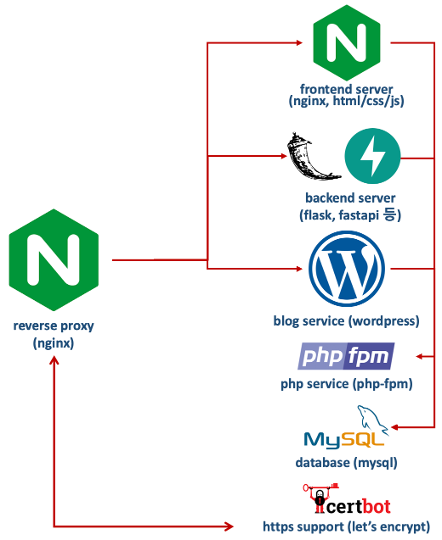
Create 7 Docker containers for each function using Docker Compose and deploy them all at once on an actual EC2 server.
We will also build complex Docker-based services suitable for actual production operations → Create 7 Docker containers for each feature with Docker Compose and deploy them all at once on an actual EC2 server.
Verified by 80,000 people over 9 years! Don't waste your time!
강사가 다르면, IT강의도 다를 수 있습니다!꼼꼼하고, 합리적인 분이라면 가능합니다!
To make use of Docker, you need to implement complex examples step by step!
By the end of this course, you will build a web service consisting of seven Docker containers and implement various examples for each option - Reverse Proxy, MySQL (database), your own web service (frontend server), a WordPress blog service, your own backend server 1 (Flask + Gunicorn, FastAPI + Uvicorn, etc.), your own backend server 2 (PHP-FPM), HTTPS support, automatic periodic authentication key updates, and more.
To become full-stack, wouldn't it be enough to learn just the backend and frontend?
Whether you are developing a web or app with vibe coding or building commercial web and app services in the real world, you need a server, and all server services run on Docker. Docker is the core of modern server technology and essential in the industry; it is a technology every developer must master.
We summarized the fastest, most up-to-date full-stack roadmap in a YouTube video. If you refer to it, you can understand the roadmap all the way to web/app development on your own in a short time.
To become a skilled developer?
Mastering the fundamentals is essential! Docker is the foundation of modern server technologies. Kubernetes, zero-downtime deployments, and automated deployments can be added one by one after building a solid foundation in Docker. You cannot properly learn and apply related technologies if you skip Docker or only have a superficial understanding of it
Organize it with concise summary materials and lectures covering the vast array of options and syntax!
Books are too detailed, difficult to search through, and time-consuming, right? Blogs are scattered, so it’s hard to organize things through searching alone, right? You need to prioritize what to learn, but you don’t know how much you need to learn to use Docker, right? When you understand it through a course that clearly explains detailed summary materials and a variety of examples, later, when you think, 'Ah! How did I use that feature?' you can immediately put it to use just by looking at the materials and examples
So you can understand and use exactly the relevant syntax Concise yet meticulously prepared materials, concise examples that use exactly that syntax and various example project files
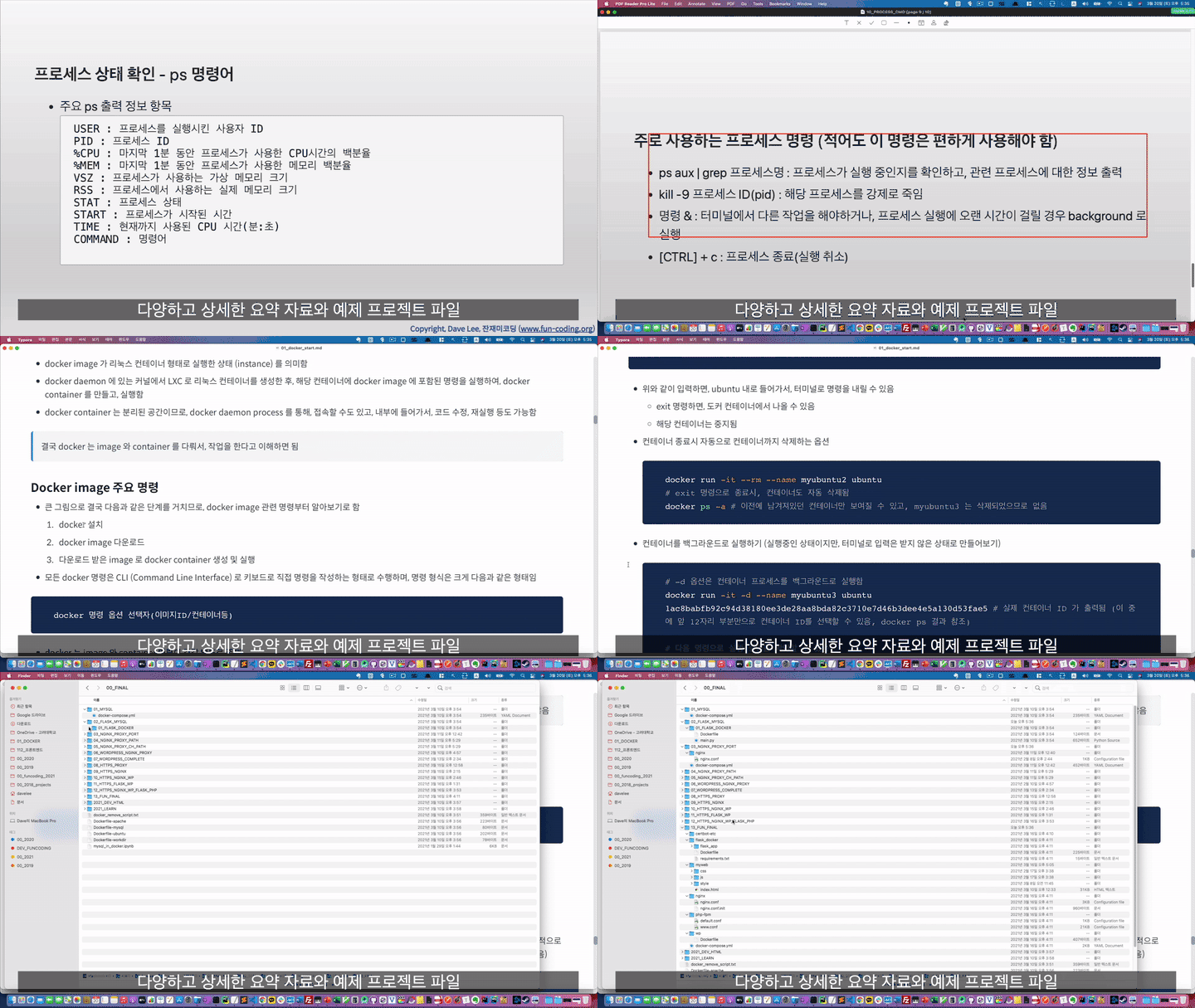
• We provide sample code for each feature and various Docker project examples as files, along with a PDF on how to use Linux. • You can also access the detailed Docker course materials online at any time, just like an ebook. (However, copying and downloading are restricted due to copyright concerns.)
Can beginners also do it?
This course also provides detailed, step-by-step explanations so that beginners can follow along. Those who have taken my courses will know this well. However, this course has a technical level of difficulty and is intended for junior developers or developers who want to learn Docker systematically for the first time. If you are a beginner, I recommend building your fundamentals by completing at least Parts 1 through 4 (Full-Stack Part 1) in the full-stack series below on this course details page before taking this course.
By carefully taking each course, creating your own code, and solving issues on your own, you can develop sufficient skills as a junior developer.
Can I learn it systematically?
We are creating the courses to help you learn the entire process from beginner to full-stack developer in a detailed and systematic way, gradually increasing the difficulty. We use concise code and provide sufficient explanations, while covering computer science concepts whenever necessary to help you build the fundamentals of a good developer.
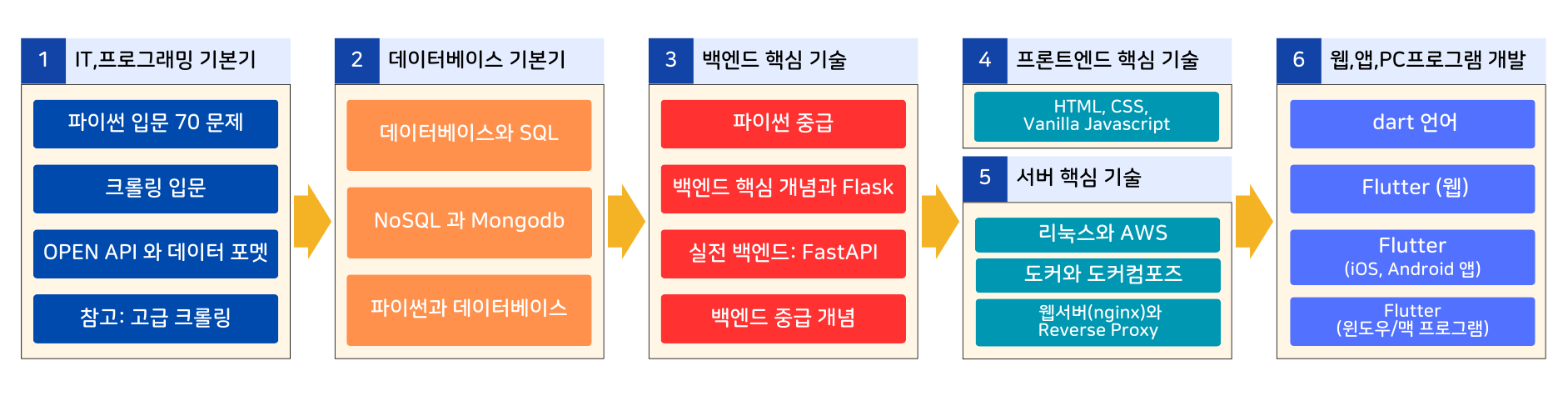
This course is Part 3 of a full-stack course series and covers the server technologies needed to develop the following types of web/app services. Taken together with Parts 1 and 2, you can develop a simple web service, launch it on the internet, and even run your own service.
This is an IT lecture series thoughtfully created so that you can feel, 'Ah! It really is different!' Only those who are reasonable, considerate of others, and willing to build good relationships please enroll!
Learn systematically Dave Lee’s roadmap from Fun Coding
Following this course, AI, development, data, and CS roadmaps that you can learn according to your goals
IT technologies are interconnected. By selectively learning interconnected technologies and adding AI to the mix, you can reach your goals much faster.
Every roadmap covers how to connect and use technologies together, is designed to gradually increase in difficulty from the beginner level to the expert level, and is continuously updated over the course of several years.
It is also more heavily discounted than taking the courses individually.
1. The fastest complete data roadmap
From Data Analysis to Data Science, the Complete Career Path
4. The Most Reliable Ultimate AI Utilization Roadmap (2026)
From Claude Code business automation to vibe coding, Codex, OpenClaw, Claude Code–based data analysis, advanced Claude Code techniques such as agentic, harness, and loop engineering, and even AI agent development.
Key Experience: Coupang Senior Development Manager/Principal Product Manager, Samsung Electronics Development Manager (Approx. 15 years of experience)
Education: BA in Japanese Language and Literature, Korea University / MS in Computer Science, Yonsei University (A complete mix)
Key Development Experience: Samsung Pay, E-commerce Search Service, RTOS Compiler, Linux Kernel Patch for NAS
Books: Linux Kernel Programming, Understanding and Developing the Linux Operating System, IT Core Technologies That Anyone Can Easily Read and Understand, Python Programming Primer for Absolute Beginners
This lecture was a great help to me when I was a job seeker, but it is even more helpful after I got a job. I think that Jjanjaemi Coding is the best choice for those who are new to related knowledge or do not have anyone around them to give them advice.
Although it is an online lecture, I am making it with the thought that it is a communication between people. I will not change my original intention in giving advice to my juniors. Thank you^^
I'm still halfway through the course, but thanks to the easy-to-understand explanations, I was able to create an AWS account, install a server instance, and even install Docker. I'll keep going through the rest of the course. Fighting~!!
My company uses Kubernetes, and I suddenly needed to apply it, so I looked for it and took the course, and it was really helpful!
I learned all the important parts of Docker in two days, and I think I have a rough idea. Thank you for the great lecture!
Now I will go look for Kubernetes..





![[Updated] Your First Python Data Analysis (Easily! Learn the Entire Process of Preprocessing, pandas, and Visualization) [Data Analysis/Science Part 1]Course Thumbnail](https://cdn.inflearn.com/public/course-325576-cover/75d85753-8e0b-40f3-9f11-ca43e70c5200?w=420)


![First-Time Deep Learning and PyTorch Bootcamp (Easy! From the Basics to the Core Transformers Behind ChatGPT) [Data Analysis/Science Part 3]Course Thumbnail](https://cdn.inflearn.com/public/courses/329540/cover/1be7b8cb-800f-48cb-a30c-b7d78996c075/329540-eng.png?w=420)
![[Renewed] Beginner’s Python Machine Learning Bootcamp (Easy! Learn by Solving Real Kaggle Problems) [Data Analysis/Science Part 2]Course Thumbnail](https://cdn.inflearn.com/public/courses/327464/cover/55c4db7b-7764-43cc-ac75-d9e8d08098f1/327464-eng.png?w=420)
![Python Backend for Beginners: An Introduction to FastAPI (From FastAPI to Asynchronous SQLAlchemy) [Full-Stack Part 1-2]Course Thumbnail](https://cdn.inflearn.com/public/courses/333248/cover/7323d828-100e-4ac9-8e6e-0e51a17ac741/333248.png?w=420)

![[Renewed] Python Introduction and Web Scraping Basics Bootcamp [From Python and the Web to Fundamental Data Concepts] (Updated)Course Thumbnail](https://cdn.inflearn.com/public/courses/324082/cover/57af93de-1021-40b4-80d7-a0dfc17190cf/324082.png?w=420)
![[Renewed] Introduction to Python Backend and Web Technologies for Beginners (Intermediate Python, Understanding Backend and Web Technology Fundamentals with Flask) [Full-Stack Part 1-1]Course Thumbnail](https://cdn.inflearn.com/public/course-325804-cover/6afae82f-e06b-4a0b-914d-2bdf7b1f5b60?w=420)
![[Renewed] First-Time SQL and Database (MySQL) Bootcamp [From Beginner to Practical Applications]Course Thumbnail](https://cdn.inflearn.com/public/courses/324208/cover/85872a8e-d2bb-4c43-82fc-d55fa067746e/324208.png?w=420)
![[Renewed] First-Time MongoDB and NoSQL (Big Data) Database Bootcamp [From Beginner to Practical Use] (Updated)Course Thumbnail](https://cdn.inflearn.com/public/courses/324183/cover/fbe9f0cc-4c42-4435-b855-f283f6932415/324183.png?w=420)
![Flutter for Beginners: From Basics to Real-World Applications [Full Stack Part 4] (Easy, Robust, and Step-by-Step Through Various Projects)Course Thumbnail](https://cdn.inflearn.com/public/courses/331245/cover/1f8c5bb8-8aad-4542-b3bc-977cda51c846/331245.png?w=420)
![A Solid Front-End Bootcamp for Full-Stack Developers (HTML, CSS, Vanilla JavaScript + ES6) [Full-Stack Part 2]Course Thumbnail](https://cdn.inflearn.com/public/course-326306-cover/4ea213de-f786-4af1-a9d0-b8932263885a?w=420)