I have a rough understanding, but I feel like I can’t organize it all
HTML, CSS, and JavaScript may seem easy enough to use, but in practice, they can be difficult to handle exactly the way you want. With countless scattered syntax rules and technologies such as responsive design, compatibility, and ES6, frontend development is more challenging than you might think unless you take the time to organize and learn the fundamentals properly.
I heard that once you become a full-stack developer, you can build web services on your own... thì có thể tự mình xây dựng dịch vụ web...
Whether it’s the web or an app, modern services require backend, frontend, and deployment technologies, and this is what we call full-stack development. Becoming a full-stack developer allows you to build modern web services on your own and become a competitive developer. The most effective path is to learn Python and backend development in Part 1 of the Full-Stack Course, then build a foundation in frontend development in Part 2. You need a solid foundation to truly become a full-stack developer rather than simply copying the web service examples in the course. This course covers HTML5, CSS, JavaScript (vanilla JavaScript, VanillaJS), and ES6 in detail to help you build a strong foundation in frontend development.
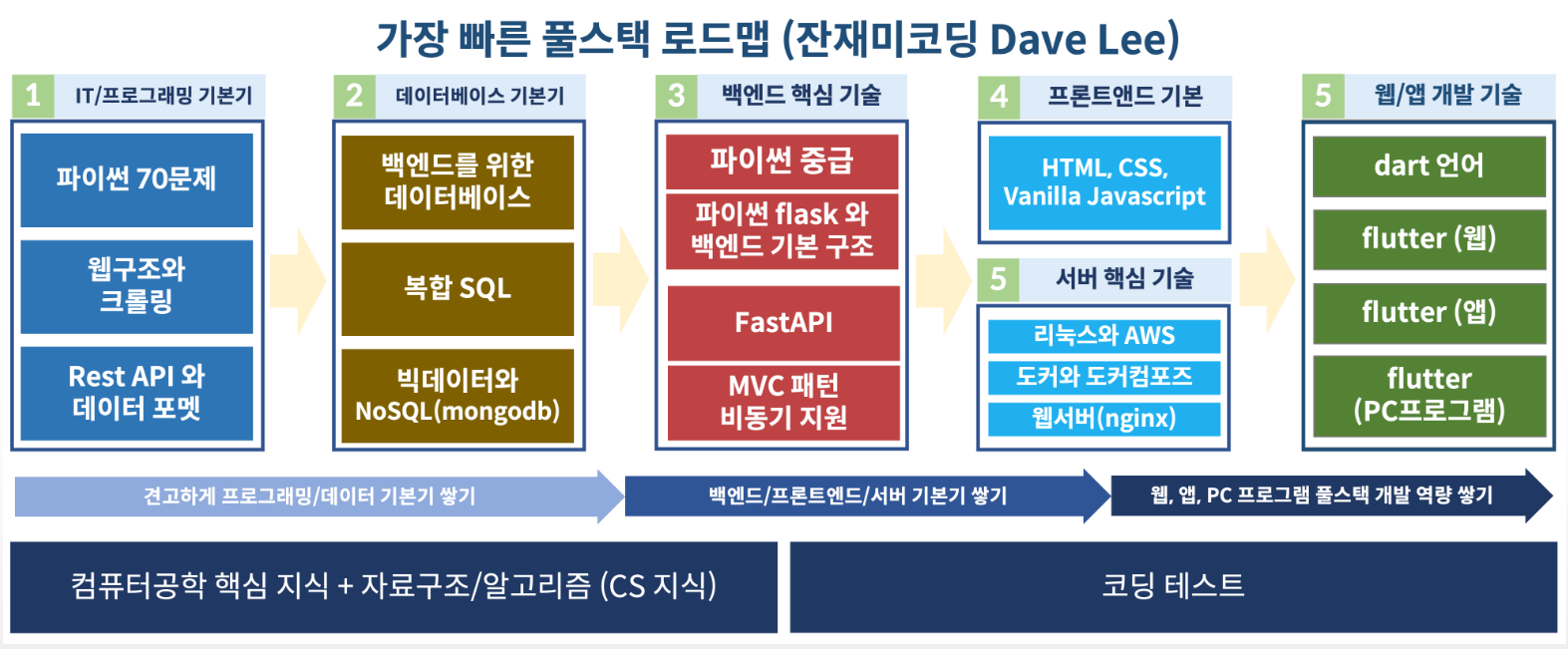
We have summarized the fastest, most up-to-date full-stack roadmap in a YouTube video. By referring to it, you can understand the roadmap to web/app development on your own in a short time.
Created for a solid and practical foundation in frontend development..
There are countless syntaxes and features, so the starting point for frontend development is to organize them.
I organized all that syntax and knowledge according to the following criteria.
- We cover all the background knowledge needed to develop modern websites
- Thoroughly cover the CSS essential for creating polished web pages
- We do not cover jQuery, which is not used in modern web pages
- We cover everything using standard Vanilla JavaScript + ES6 instead
- Support responsive design
- We also take compatibility into consideration
We focus on the essential HTML tags, including semantic tags, and
cover detailed CSS features while considering responsiveness and compatibility—both essential for building a polished web page.
As the name VanillaJS (Vanilla JavaScript) suggests, jQuery is not used in recent trends, so we implement web pages using only JavaScript + ES6 syntax with compatibility in mind.
We leave out the latest syntax that cannot be used due to compatibility issues, as well as technologies that can be replaced, and focus on the core technologies.
Don't waste your time!
We can't do it because we lack information!
By learning from a proven course, you can quickly organize everything!
Wouldn't learning just Javascript be enough?
The biggest bottleneck in full-stack development is CSS. People say that even middle school students know HTML and CSS.
However, unless you are a fairly experienced frontend developer, you cannot create a polished, modern webpage with responsive design and broad compatibility.
You need to organize countless detailed CSS features, and you also need to review HTML against the standards at least once. In Korea, there is a profession called a publisher, but abroad, frontend or full-stack developers handle CSS as well.
To become a competitive frontend/full-stack developer, it is essential to thoroughly organize your knowledge of CSS features.
Don’t you need to learn React and Vue to build web services?
These frameworks were written in JavaScript to improve upon its shortcomings. Since you also use JavaScript when working with them, you need to have a solid grasp of JavaScript's basic syntax, regardless of which framework you choose. You can learn React, Vue, and other frameworks on top of the HTML, CSS, and JavaScript fundamentals covered in this course.
That’s why this course focuses on front-end fundamentals, covering and practicing all the essential technologies among the related skills.
Can beginners do it too?
This course is explained in detail and step by step so that beginners can follow along.
The most difficult part of an IT course is teaching programming to people who know nothing about programming. Even such learners have acquired not only programming skills but also web scraping skills through my Python for Beginners and Web Scraping Basics Bootcamp course. If you are reasonable and considerate of others, it is more than possible.
If you want to quickly get up to speed on just the frontend, you can take this course alone. However, if you are a complete beginner who has never worked with programming before, I recommend learning step by step according to the full-stack roadmap along with the Python for Beginners and Web Scraping Bootcamp course.
So that even beginners can understand
Based on concise yet meticulously prepared materials,
you can also run your own tests during the course
with sample code for each feature and test them right away
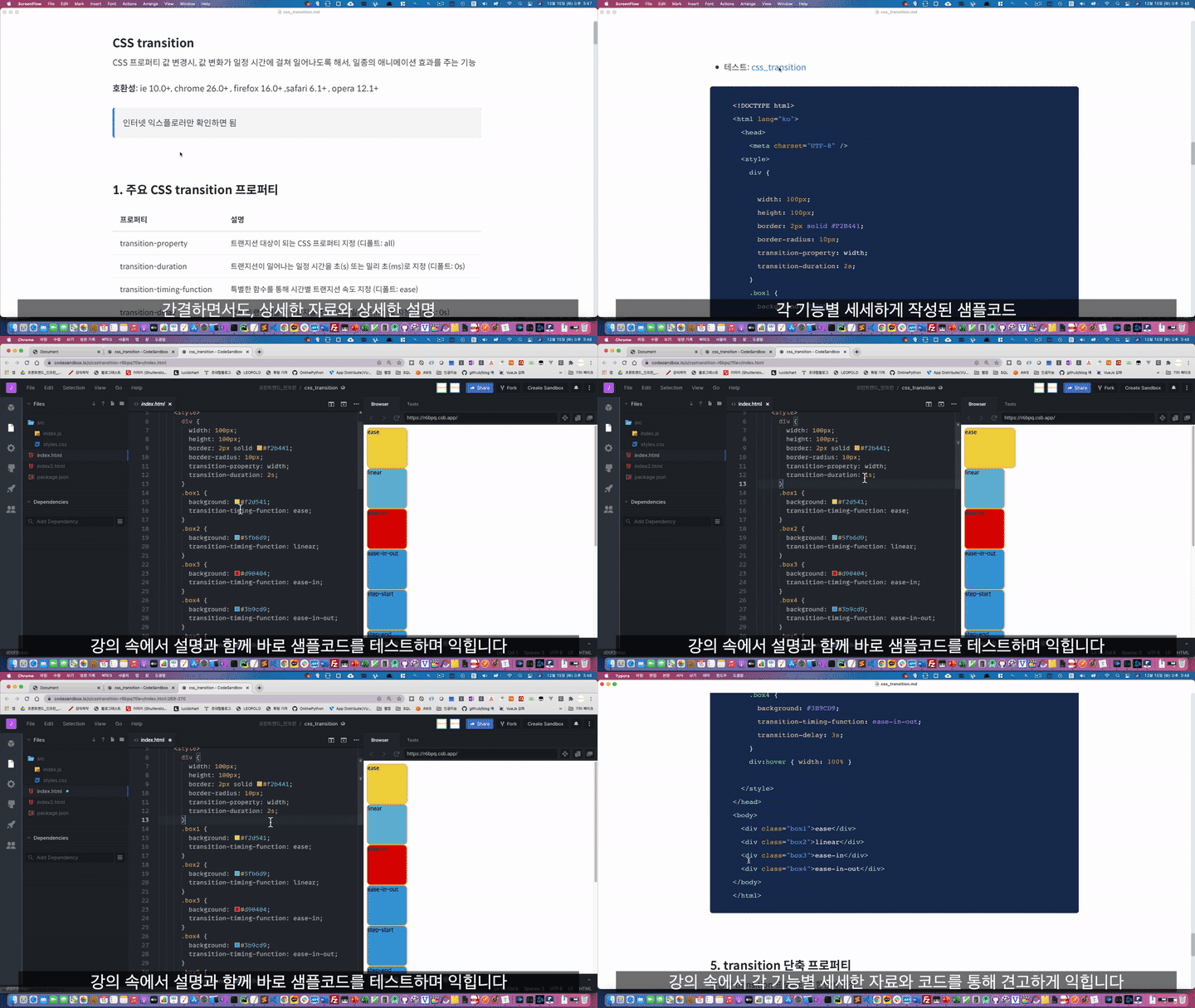
• We provide project-based sample code for each feature, along with code files for real-world web pages.
• You can access the course materials online anytime. (However, copying and downloading are restricted due to copyright concerns.)
Can I learn systematically? không?
I am creating this course so that you can learn the entire process of becoming a full-stack developer in a detailed and systematic way, gradually increasing the difficulty from beginner level. The code is kept concise and the explanations are thorough, while topics that require deeper understanding are explained—including the relevant computer science concepts—as they arise, helping you build the fundamentals of a good developer.
This course is Part 2 of the full-stack lecture series. You will select a specific webpage for developing the following service and carefully build the code from scratch, starting with a blank file, using HTML, CSS, and JavaScript + ES6 without any frameworks or libraries.
So that you can feel, 'Ah! It really is different!'
this course has been thoughtfully created.
Just follow along as is, and you’ll be all set!







![[Renewed] Python Introduction and Web Scraping Basics Bootcamp [From Python and the Web to Fundamental Data Concepts] (Updated)Course Thumbnail](https://cdn.inflearn.com/public/courses/324082/cover/57af93de-1021-40b4-80d7-a0dfc17190cf/324082.png?w=420)


![[Renewed] First-Time SQL and Database (MySQL) Bootcamp [From Beginner to Practical Applications]Course Thumbnail](https://cdn.inflearn.com/public/courses/324208/cover/85872a8e-d2bb-4c43-82fc-d55fa067746e/324208.png?w=420)

![Python Backend for Beginners: An Introduction to FastAPI (From FastAPI to Asynchronous SQLAlchemy) [Full-Stack Part 1-2]Course Thumbnail](https://cdn.inflearn.com/public/courses/333248/cover/7323d828-100e-4ac9-8e6e-0e51a17ac741/333248.png?w=420)
![Docker and Modern Server Technologies for Full-Stack Development (Linux, nginx, AWS, HTTPS, Deployment) [Full-Stack Part 3]Course Thumbnail](https://cdn.inflearn.com/public/courses/326771/cover/bc862b4d-abe6-4d80-a826-3a5324a9f998/326771-eng.png?w=420)
![Flutter for Beginners: From Basics to Real-World Applications [Full Stack Part 4] (Easy, Robust, and Step-by-Step Through Various Projects)Course Thumbnail](https://cdn.inflearn.com/public/courses/331245/cover/1f8c5bb8-8aad-4542-b3bc-977cda51c846/331245.png?w=420)
![[Renewed] Introduction to Python Backend and Web Technologies for Beginners (Intermediate Python, Understanding Backend and Web Technology Fundamentals with Flask) [Full-Stack Part 1-1]Course Thumbnail](https://cdn.inflearn.com/public/course-325804-cover/6afae82f-e06b-4a0b-914d-2bdf7b1f5b60?w=420)
![[Renewed] First-Time MongoDB and NoSQL (Big Data) Database Bootcamp [From Beginner to Practical Use] (Updated)Course Thumbnail](https://cdn.inflearn.com/public/courses/324183/cover/fbe9f0cc-4c42-4435-b855-f283f6932415/324183.png?w=420)
![[Renewed] Beginner’s Python Machine Learning Bootcamp (Easy! Learn by Solving Real Kaggle Problems) [Data Analysis/Science Part 2]Course Thumbnail](https://cdn.inflearn.com/public/courses/327464/cover/55c4db7b-7764-43cc-ac75-d9e8d08098f1/327464-eng.png?w=420)
![First-Time Deep Learning and PyTorch Bootcamp (Easy! From the Basics to the Core Transformers Behind ChatGPT) [Data Analysis/Science Part 3]Course Thumbnail](https://cdn.inflearn.com/public/courses/329540/cover/1be7b8cb-800f-48cb-a30c-b7d78996c075/329540-eng.png?w=420)
![[Updated] Your First Python Data Analysis (Easily! Learn the Entire Process of Preprocessing, pandas, and Visualization) [Data Analysis/Science Part 1]Course Thumbnail](https://cdn.inflearn.com/public/course-325576-cover/75d85753-8e0b-40f3-9f11-ca43e70c5200?w=420)
![Modern Web Interactive CSS3 Bootcamp [Full vers.]Course Thumbnail](https://cdn.inflearn.com/public/courses/334857/cover/4ccc6c75-74aa-4aba-b3d9-8aabe36e9452/334857.jpg?w=420)

![Modern Web Interactive CSS3 [PART2/3]Course Thumbnail](https://cdn.inflearn.com/public/courses/335745/cover/db39333d-68a5-4ca7-9629-dac891711a94/335745.jpg?w=420)
![[Code Camp] Highly concentrated backend course created at boot campCourse Thumbnail](https://cdn.inflearn.com/public/courses/329996/cover/2be99a0c-5d5a-4e15-b85b-53c09879058a/thumbnail-backnew.png?w=420)