inflearn logo

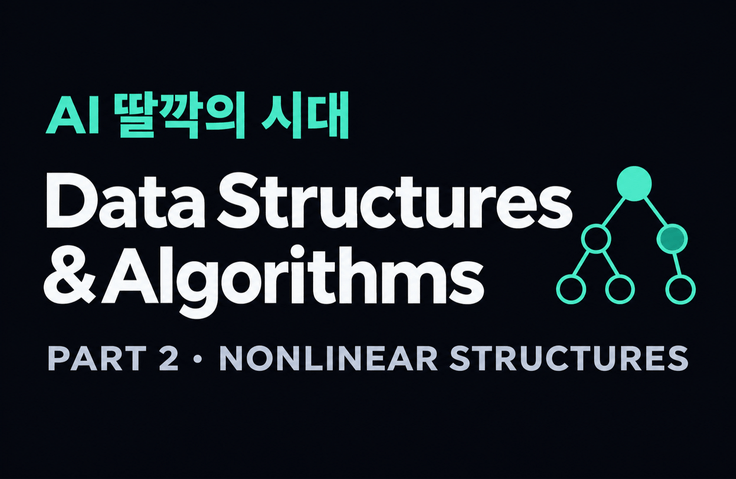
“The Age of AI at the Click of a Button”: An Unshakable Framework for Thinking — Data Structures and Algorithms, Nonlinear Edition

Even in an age when AI can write code for you, it’s up to developers to determine whether that code handles boundary inputs without errors and performs well as the data grows. In this course, you’ll implement recursion, binary search trees, tree traversals, heaps, graphs, sorting, and dynamic programming in JavaScript, and learn how to verify time and space complexity and edge cases through deliberate bug experiments and interactive visualization notebooks in every unit.

1 learners are taking this course

Level Basic

Course period Unlimited

algorithms
algorithms
JavaScript
JavaScript
recursion
recursion
trees
trees
algorithms
algorithms
JavaScript
JavaScript
recursion
recursion
trees
trees

What you will gain after the course

  • The ability to manually trace how recursive function calls accumulate on the call stack and return in last-in, first-out (LIFO) order.

  • Code that directly implements BST creation, insertion, and search, along with the four trickiest node deletion cases, using both iteration and recursion.

  • Criteria for implementing breadth-first search (BFS) and preorder, postorder, and inorder depth-first search (DFS), and choosing the right one for reconstruction, deletion, and sorting scenarios.

  • The ability to implement a max heap and priority queue (insert, remove, #sinkDown) in O(log n) using a single 0-indexed array without pointers.

  • Comparing the Time–Space Tradeoffs of Adjacency Matrices and Adjacency Lists, and How to Safely Handle Graphs Based on Object.create(null)

  • Implement bubble sort, selection sort, and insertion sort yourself, and understand why insertion sort runs in O(n) when the input is already sorted or has few inversions.

  • The ability to implement bubble sort, selection sort, and insertion sort by rearranging node links using only pointers, in O(1) space, on a singly linked list with no index access.

  • The ability to implement merge sort (merge, mergeSort) and quicksort (pivot, quickSort), and to assess worst-case O(n²) conditions and trade-offs in stability and memory usage.

  • The ability to identify overlapping subproblems and optimal substructure, and to optimize exponential-time recursion with top-down memoization and bottom-up tabulation (including BigInt).

  • The habit of testing edge cases in AI-generated code through deliberate bug experiments across 10 sections, including empty trees, negative inputs, NaN, `toString` key collisions, and cache misses for the value 0.

Recommended for
these people

Who is this course right for?

  • Those who have completed Part 1: Linear and want to complete their map of problem-solving with trees, heaps, graphs, sorting, and dynamic programming.

  • For those who understand arrays, stacks, and queues, but draw a blank whenever recursive functions and the call stack come up.

  • Those who have never fully implemented deleting a node from a binary search tree in code (especially replacing it with its successor when it has two children)

  • Those who understand the code differences between BFS and DFS (preorder, postorder, and inorder) but aren’t sure when to use each in practice.

  • For anyone who wants an intuitive understanding of why heaps and priority queues are tree-shaped but work using a single array.

  • For those who want to explain the differences between merge sort and quicksort in terms of memory usage, stability, and worst-case inputs—not just memorize them.

  • For those who feel lost about where to start with memoization or a bottom-up approach whenever they encounter a dynamic programming (DP) problem.

  • Someone preparing for common practical coding test and technical interview problems such as sorting a linked list and merging two sorted lists.

  • For those who want to verify that AI-generated recursive, sorting, and tree code is safe and won’t cause stack overflows with large datasets or boundary inputs.

  • A JavaScript developer who wants to understand the principles firsthand by running code and deliberately breaking things, rather than just watching theory lectures.

Need to know before starting?

  • It is enough to be able to read and write the basic syntax of JavaScript variables, conditionals, loops, functions, and classes.

  • You’ll find it much easier to follow along if you’re familiar with the basic concepts of arrays, objects, linked lists, stacks, queues, and Big O notation. (Taking Part 1: Linear first will provide the most natural progression.)

  • No separate paid AI tools or external libraries are required.

Hello
This is nhcodingstudio

Inflearn Verified

Career Verified

4,996

Learners

331

Reviews

82

Answers

4.8

Rating

28

Courses

Hello, and welcome to Our Neighborhood Coding Studio!

Our Neighborhood Coding Studio is an educational group founded by developers who studied computer science at leading North American universities such as Carnegie Mellon, the University of Washington, the University of Toronto, and the University of Waterloo and gained hands-on experience at global tech companies such as Google, Microsoft, and Meta.

It started as a study group formed by computer science students in the United States and Canada who wanted to learn and grow together. Although they attended different universities and were in different time zones, the time they spent solving problems together and learning from one another was special, and naturally led them to wonder:

“What if we shared the way we studied with other people just as it was?”

That question was the starting point for Our Neighborhood Coding Studio.

Currently, approximately 30 working developers and computer science students each lead their own areas of expertise, designing and teaching a curriculum that covers everything from the fundamentals to real-world practice. Beyond simply sharing knowledge, we provide an environment where you can learn through the eyes of real developers and grow together.

“You should learn from a real developer.”

We systematically cover every stage of web development, from start to finish, helping you build your skills through hands-on practice and practical, real-world feedback rather than theory alone.
Our philosophy is to support and guide the growth of every student.

🎯 Our philosophy is clear.
"True learning comes through practice, and growth is complete when we grow together."

From beginners just starting out in development to job seekers looking to build practical skills and young people exploring career paths, Neighborhood Coding Studio aims to be a starting point for everyone and a trusted companion on the journey.

You don’t have to figure it out alone anymore.
Neighborhood Coding Studio will be here to support your growth.


Welcome to Neighborhood Coding Studio!

Neighborhood Coding Studio was founded by a team of developers who studied computer science at top North American universities such as Carnegie Mellon, the University of Washington, the University of Toronto, and the University of Waterloo, and went on to gain hands-on experience at global tech companies like Google, Microsoft, and Meta.

It all began as a study group formed by computer science students across the U.S. and Canada, created to grow together by sharing knowledge, solving problems, and learning from one another.
Though we were attending different schools in different time zones, the experience was so meaningful that it led us to one simple thought:

“What if we shared this way of learning with others?”

That thought became the foundation of Neighborhood Coding Studio.

Today, we are a team of around 30 active developers and computer science students, each taking responsibility for their area of expertise—designing and delivering a curriculum that spans from foundational knowledge to real-world development.
We’re not just here to teach—we’re here to help you see through the lens of real developers and grow together.

“To become a real developer, you must learn from real developers.”

Our courses take you through the entire web development journey—from start to finish—focused on hands-on practice, real-world projects, and practical feedback.
We care deeply about each learner’s growth and are committed to supporting your path every step of the way.

🎯 Our philosophy is simple but powerful:
"True learning comes from doing, and true growth happens together."

Whether you're just getting started, preparing for your first job, or exploring your future in tech,
Neighborhood Coding Studio is here to be your launchpad—and your trusted companion on the journey.

You don’t have to do it alone.
Let Neighborhood Coding Studio walk with you toward your future in development.

More

Curriculum

All

84 lectures ∙ (3hr 27min)

Course Materials:

Lecture resources
Published: 
Last updated: 

Reviews

Not enough reviews.
Please write a valuable review that helps everyone!

nhcodingstudio's other courses

Check out other courses by the instructor!

Similar courses

Explore other courses in the same field!

Limited time deal

$614,728.00

69%

$77.00