inflearn logo
inflearn logo

Next.js Master Class: Part 1 Learning the Essence of App Router and Rendering Design through Missions

Next.js 15's App Router is a powerful architecture for building high-performance web services by providing complete control over the boundaries between server and client. This course clearly connects complex rendering mechanisms—from the operational principles of React Server Components (RSC) to the three major caching strategies (Static, Dynamic, and ISR)—through 12 practical missions. Through this, you will gain the ability to design file-system routing and nested layouts to meet business requirements, completely breaking free from the anxiety of "vibe coding" where you copy code without understanding the underlying principles. Ultimately, you will transform into a Next.js architect who can instantly spot the blind spots in AI-generated code and proactively direct the optimal structure.

(5.0) 2 reviews

71 learners

Level Basic

Course period Unlimited

JavaScript
JavaScript
React
React
TypeScript
TypeScript
Next.js
Next.js
frontend
frontend
JavaScript
JavaScript
React
React
TypeScript
TypeScript
Next.js
Next.js
frontend
frontend

What you will gain after the course

  • Beginners who know the basics of React but feel overwhelmed by Next.js's complex App Router architecture.

  • A developer who adds "use client" everywhere because they don't know the boundary between Server Components (RSC) and Client Components.

  • Those who feel the anxiety of so-called 'vibe coding' by copying and using code generated by AI without understanding the underlying principles.

  • A working professional who wants to systematically organize the latest asynchronous parameter handling and paradigm shifts in Next.js 15.

  • Developers who want to move away from useEffect-based client-side fetching and handle data intuitively on the server.

  • Those who are struggling with the issue of state being lost during page transitions and want to experience the magic of nested layouts (layout.tsx).

  • An aspiring architect who wants to design the optimal caching strategy among Static, Dynamic, and ISR, balancing performance and real-time requirements.

  • Those who want to learn ultra-fast Static Site Generation (SSG) optimization techniques that load tens of thousands of product pages in 0.01 seconds.

  • A marketing-oriented developer who wants to gain complete control over search engine optimization (SEO) and social sharing experiences using dynamic metadata.

  • Those who want to build system self-recovery techniques and an elegant UX using loading, error, and not-found files.

  • A developer who is curious about enterprise-grade folder structures and design philosophies that ensure easy maintenance even in large-scale projects.

  • Experienced developers who want to learn the essence of advanced 'composition patterns' for assembling server and client components without conflicts.

  • Architects who want to instantly identify technical flaws in AI-generated code and proactively direct optimal designs.

  • Job seekers who want the depth to logically explain rendering principles in technical interviews, going beyond simple functional implementation.

  • All learners who want to build a solid portfolio by verifying theory with practical code through 12 hands-on missions.

🎓Next.js Master Class through Missions: Part 1 The Essence of App Router and Rendering Design

🤖 "In an era where AI writes all the code in a second, is there really a need to dig deep into frameworks?"

I can say with certainty that now is the perfect time to understand the 'essence' of technology. We live in an era where ChatGPT or Claude can easily churn out Next.js code, but with powerful tools that are widely used, it is easy to fall into fatal traps if you don't understand their 'true principles'. Resolving mysterious rendering errors and hydration mismatches, and weaving together the fragmented code provided by AI into a solid, unbreakable architecture ultimately depends on the developer's 'fundamental design capability'.

Next.js is not just a tool with a few features added to React. It is the most dominant full-stack web framework of our time that has completely redefined "how to build a solid fortress upon the React ecosystem".

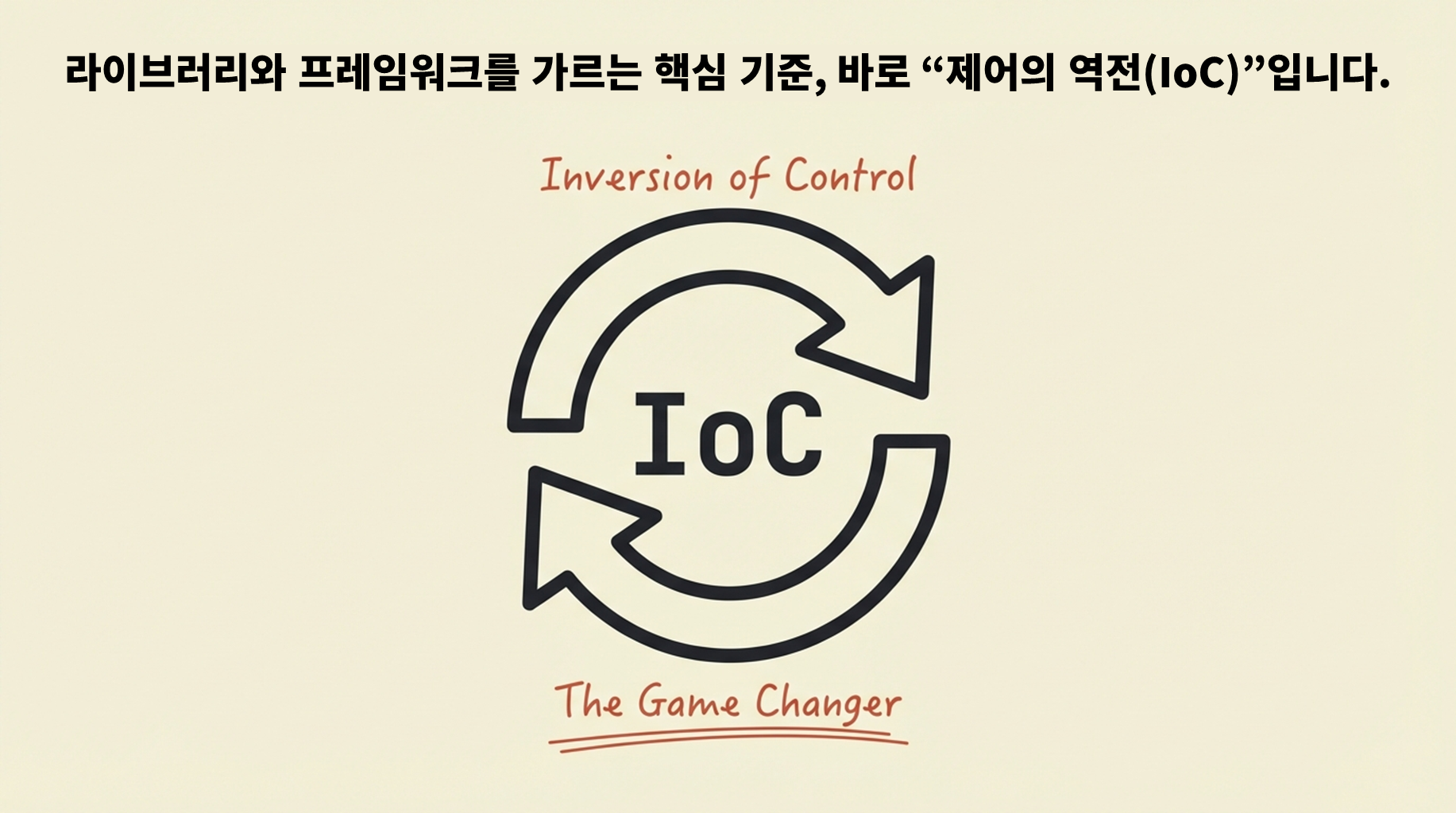
While many developers start learning Next.js by blindly creating folders and writing code based on surface-level API syntax, this course begins with the Inversion of Control (IoC) philosophy of "why pure React alone was not enough".

This course is not just about the surface level of Next.js, but its essence—a complete introductory guide to learning the App Router architecture and the mechanisms of server/client rendering step-by-step from the ground up.

From the evolution of rendering—CSR → SSR → RSC (Server Components)—to file system routing, data fetching and caching (Static/Dynamic/ISR), and error handling defenses, you will perfectly connect the dots of the grand flow. You will experience and master the entire process of how Next.js optimizes screens and handles data through visual observation and hands-on practice.

🧱 Core Philosophy of the Course Structure

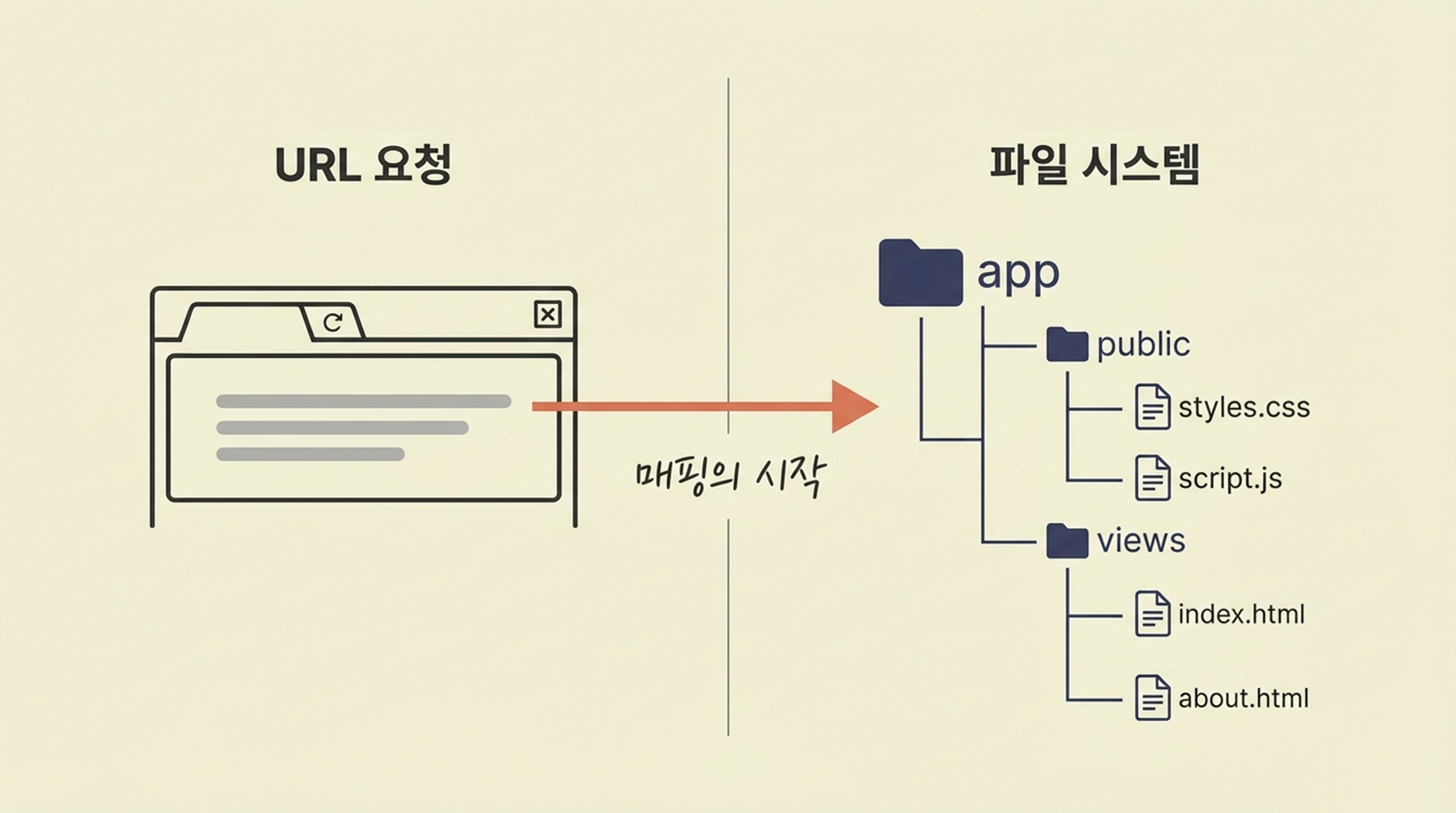
📌 Understand Convention over Configuration. → Instead of blindly memorizing code, you will learn the principles of why the file-system routing and special files (page, layout, error, etc.) enforced by Next.js were created.

📌 Rendering and data are not magic, but a flow. → You will experience firsthand the process of how state changes and data fetching lead to screen updates—the journey of data flowing from the invisible server to the browser screen and being assembled.

📌 Perfectly control the boundary between server and client. → Moving away from the pattern of manipulating everything in the browser, you will train in the 'Composition Pattern' that separates and combines the overwhelming performance of the server with the smooth interaction of the browser.

📌 Practical mission-based learning that doesn't end with theory → Complete your practical sense by directly solving real-world-oriented missions frequently encountered in the field for each section, such as building dashboards, cloud file explorers, and multi-filtering technology roadmaps.


✨ Features of this course

📌 The only Next.js introductory course that pierces through the "essence of frameworks," Inversion of Control (IoC)
→ Fully understand the difference between the React (Library) era, where you built a house on empty land, and Next.js (Framework), where you move into a model house, and take control of the architecture.

📌 Evolution of Rendering (CSR → SSR → RSC) and Perfect Visualization of Hydration
→ We delve into the hydration process—where JavaScript (water) is poured onto static HTML (dried vegetables) to breathe life into it—and uncover the causes of Mismatch errors at the code level.

📌 The magic of pure HTML forms and Search Params without JavaScript (useState)
→ Break free from the habit of excessive state management and master powerful server-side search and filtering logic that operates solely through web standard

and asynchronous URL query parameter control.

📌 Training on the 'Component Composition Pattern' to assemble Server and Client without conflict
→ Master the 'Leaf Component Pattern,' a top-tier professional technique that prevents rendering pollution by inserting Server Components (the photo) into Client Components (the frame).

📌 Designing the perfect compromise between performance optimization and freshness through Static Site Generation (SSG) and ISR
→ Load infinite pages in 0.01 seconds with generateStaticParams, and solve the dilemma between server costs and UX using the Stale-While-Revalidate mechanism.

Enterprise-grade folder architecture design training, not just simple coding practice
→ Develop structural thinking to physically and perfectly isolate dashboards and marketing landing pages using Route Groups and Private Folders.

Next.js 15 Latest Standards Linked with Practical Business Missions
→ Includes practical missions to immediately verify concepts learned in each section through code, such as a cloud file explorer, multi-filtering technology roadmap, and smart home solutions.

'Principle-centered' full-stack basic design that stays with you
→ Instead of simply following tutorials, you will build the ability to apply yourself to any business requirement based on the operating principles of the framework. (This serves as a powerful foundation for Server Actions and DB integration to be covered later.)


1️⃣ Next.js Rendering Philosophy: Understand the principles of Inversion of Control (IoC) and React Server Components (RSC) that overcome the limitations of traditional React.

2️⃣ File System Routing and State Persistence: Ditch the paper maps for autonomous routing! Experience the magic of state preservation during page transitions through nested layouts (layout.tsx) and Soft Navigation.

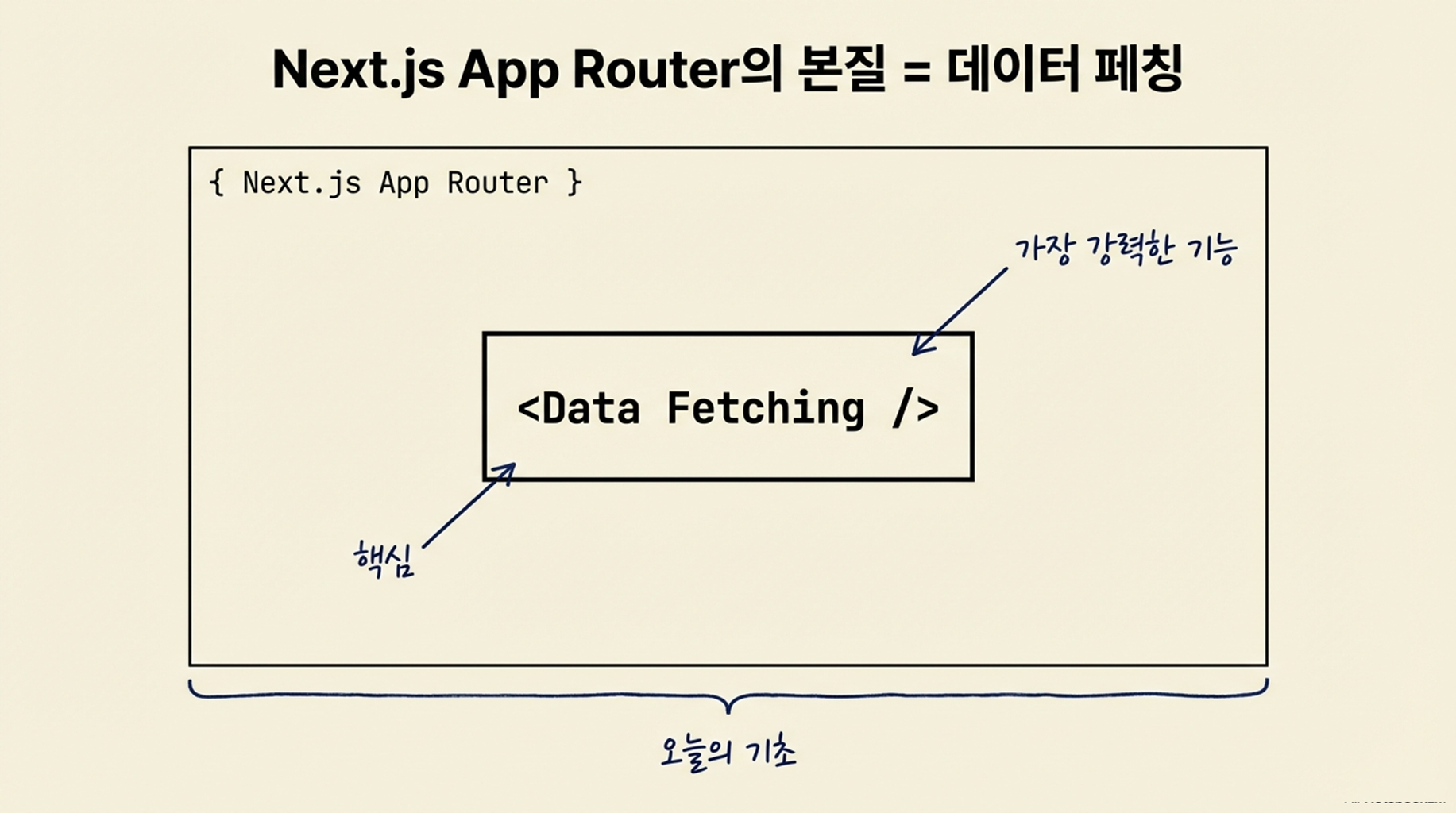
3️⃣ Intuitive Data Fetching: Escape the swamp of useEffect and learn the revolutionary flow of fetching data from the server with a single line of async/await.

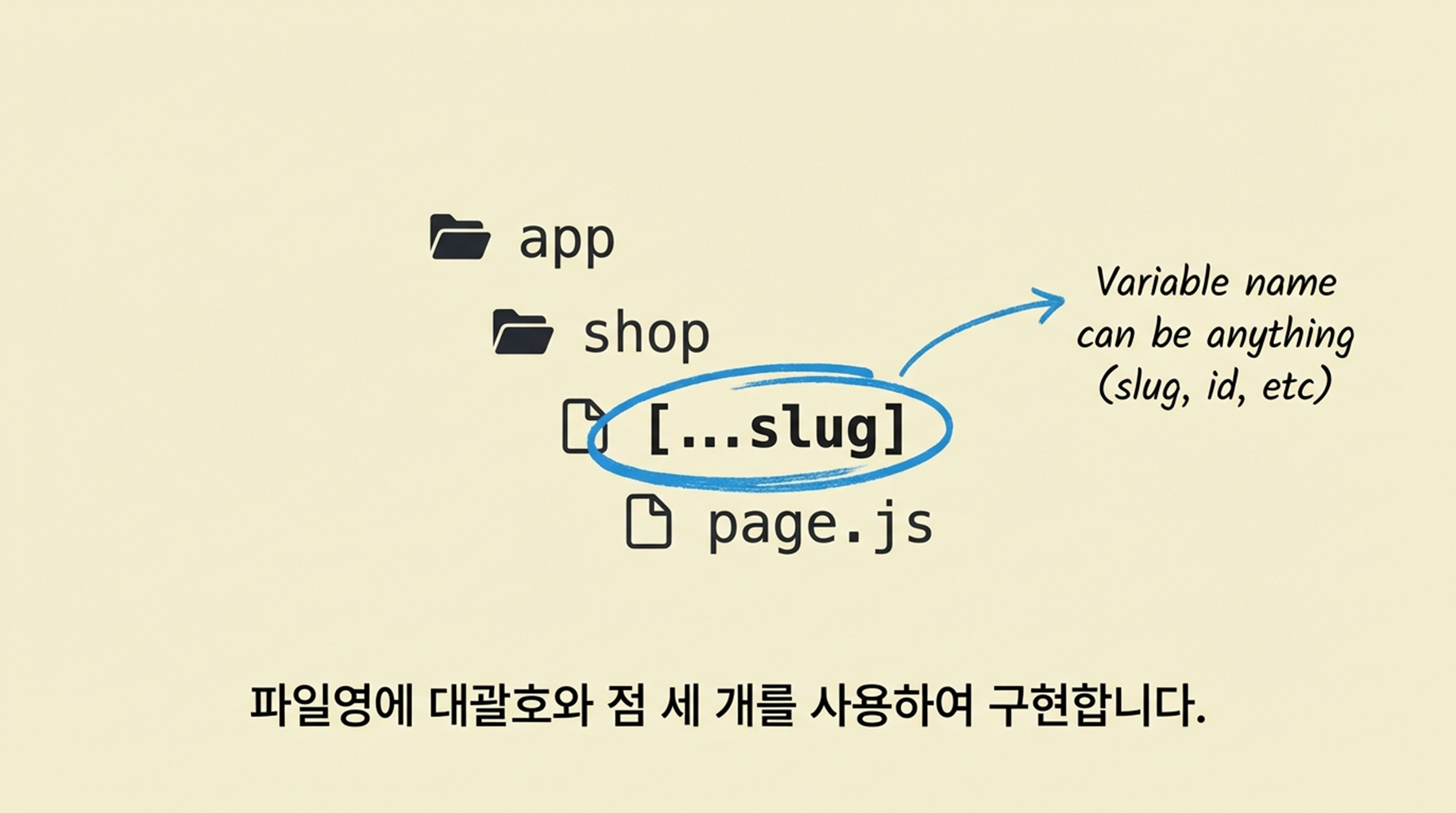
5️⃣ Infinite Expansion of Dynamic Routing:
Capture countless detail pages and infinite category hierarchies with a single file using the Catch-all ([[...slug]]) syntax.

4️⃣ Mastering Component Composition: Develop an architect's perspective by separating the boundaries between server (data) and client (interaction) and assembling them without conflict.

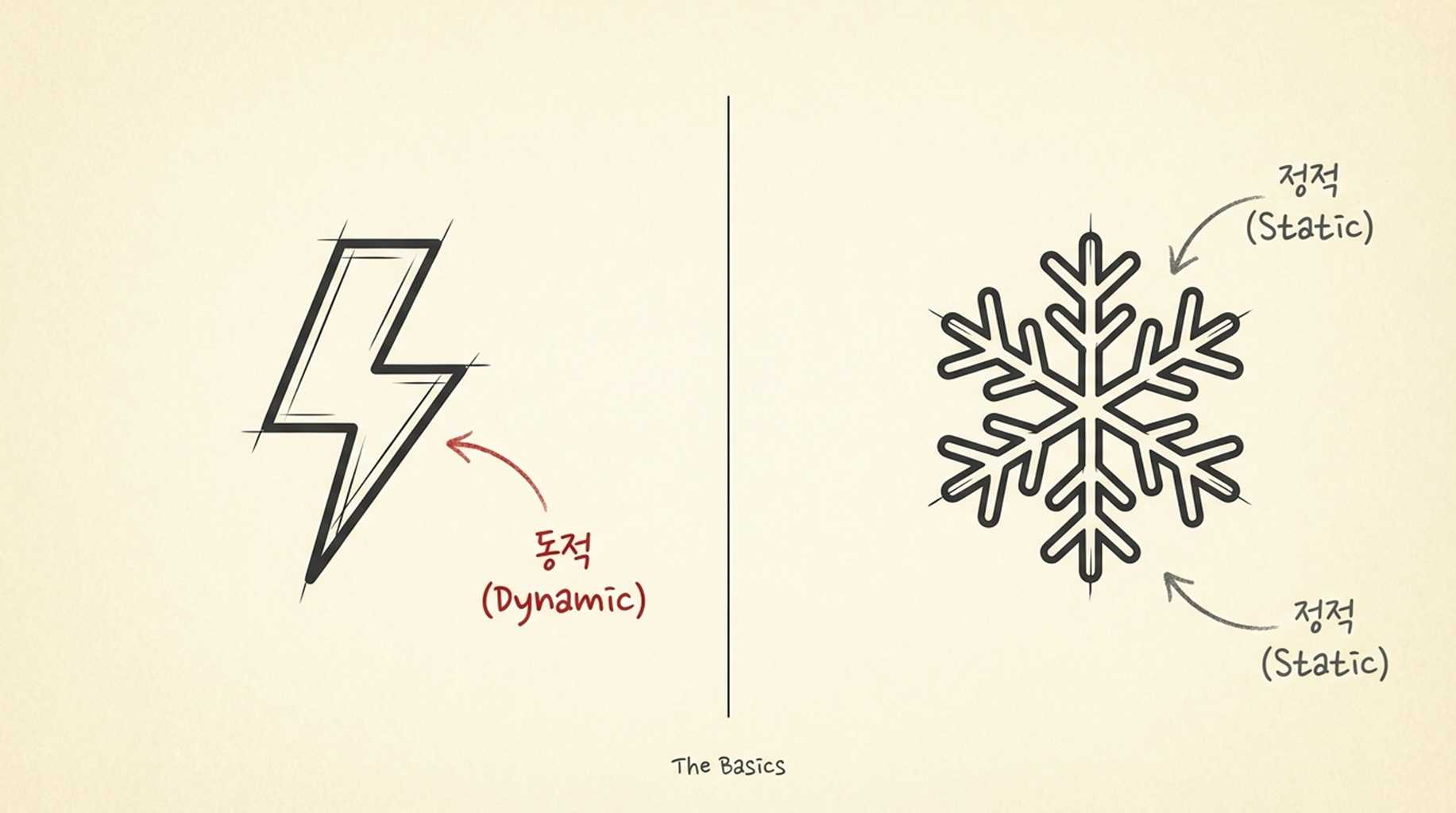
6️⃣ Master the 3 Major Caching Strategies: Design the optimal strategy among Static, Dynamic, and ISR rendering based on the nature of the data, and verify it through build logs.

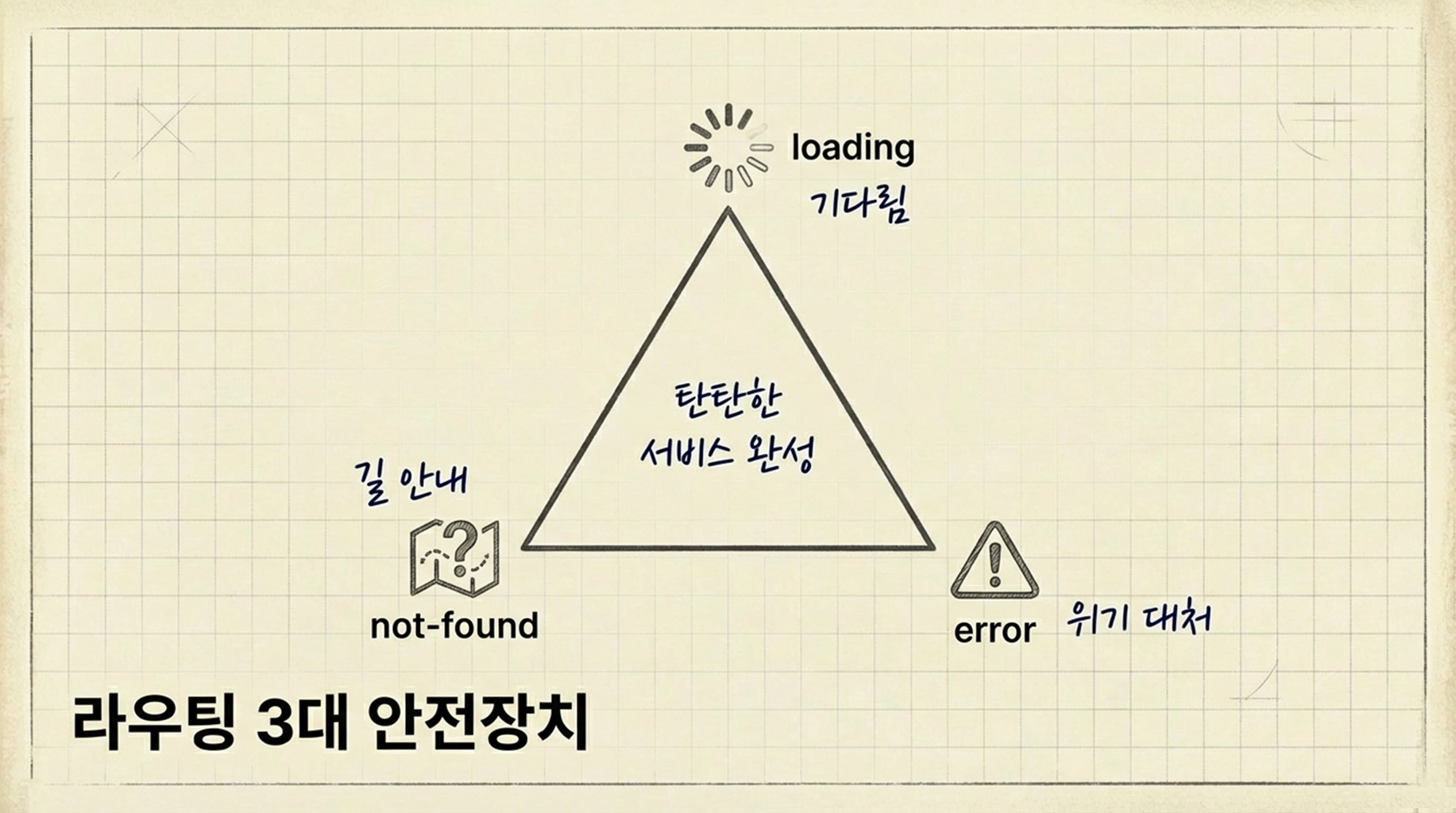
7️⃣ Three Safety Nets for UX: Perfectly build custom 404 pages, skeleton UIs, and system self-recovery logic using not-found, loading, and error files.

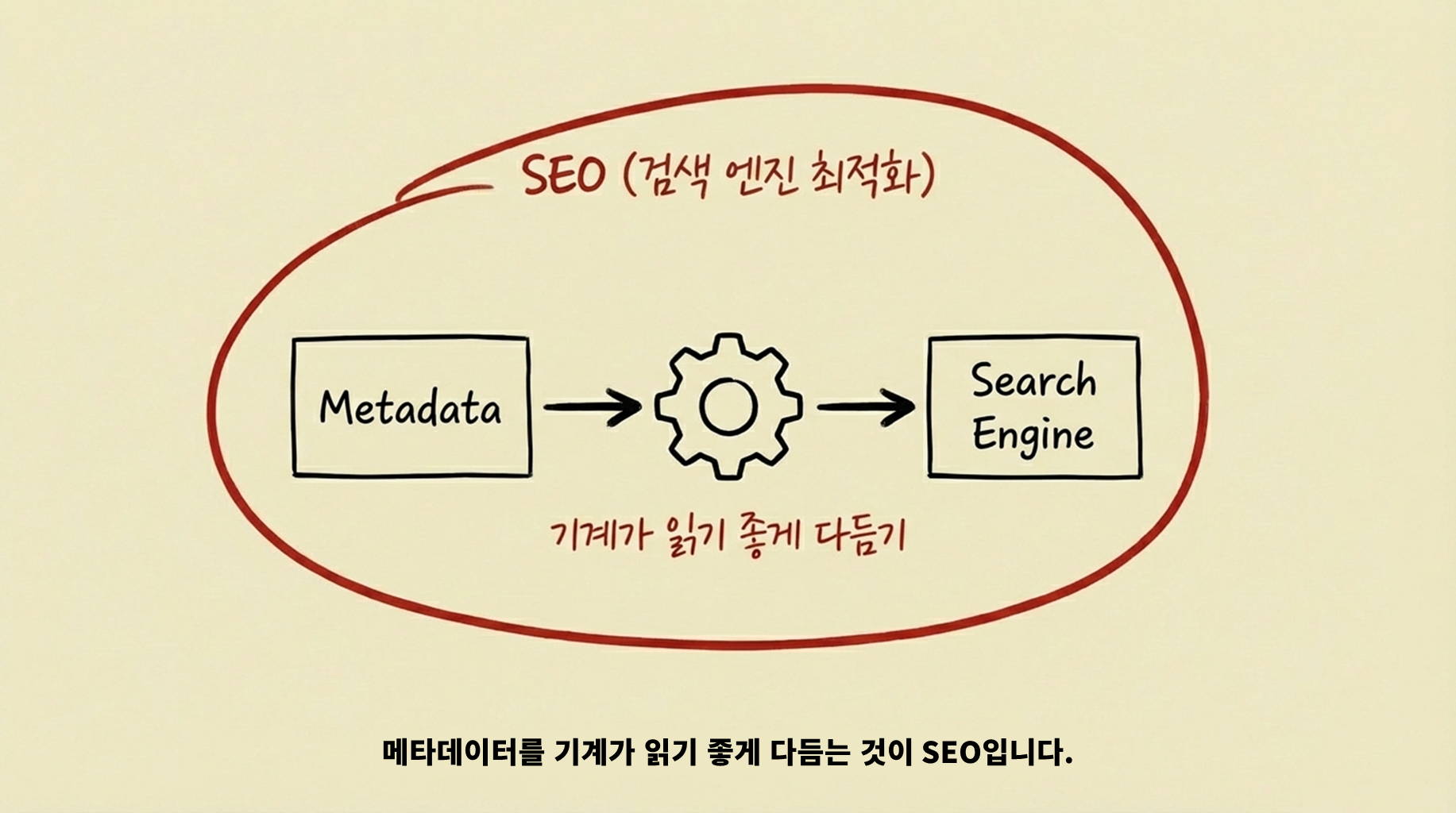
8️⃣ Complete SEO Optimization Control: Dominate search engines and maximize social media sharing experiences using dynamic metadata (generateMetadata).

Those who know the basics of React but don't yet feel "why" they should use the Next.js framework

Those who have heard of Next.js but don't know how to start when looking at the official documentation


Those who want to see with their own eyes the real principle of how Next.js pre-renders screens on the server (SSR)

Those who are curious about the exact routing principles behind how creating a file in the app folder automatically generates a URL

Those who understand the concepts but get stuck when trying to translate them into actual business logic (data fetching, caching, error handling) code

Developers who want to logically and solidly organize the latest paradigms and fundamentals of Next.js 15.

Those who have heard of Server Components (RSC) and "use client" for the first time or are still confused by them

Those who want to move away from the traditional SPA approach where everything is handled in the browser and transition to a more efficient full-stack mindset

Those who want to develop the 'technical insight' to distinguish whether an AI's answer is correct or incorrect and build their fundamental strength.

✨ After completing the course

  • “Why this component was divided into server (or client)” can be explained directly from an architectural perspective.

  • You will gain a perfect understanding of how file-system-based routing renders nested layouts (layout.tsx) and the UI.

  • You will fully internalize the evolutionary principles of rendering, from CSR and SSR to RSC (React Server Components).

  • Implement an intuitive data flow by fetching data directly from the server (async/await) without using useEffect.

  • The rendering and caching strategy mindset of "choosing between Static, Dynamic, and ISR based on the nature of the data" will naturally become second nature to you.

  • You will naturally understand why the three safety measures for protecting user experience (UX) (loading, error, not-found) are essential.

  • You will accurately understand the reasons for and methods of the Composition pattern, which involves safely nesting Server Components within Client Components.

  • You will develop practical coding habits for optimizing SEO and social sharing by handling dynamic metadata (generateMetadata).

  • You will gain the eye of an architect who can logically track, for every line of code, “whether the rendering initiative lies with the server or the browser.”

  • Moving beyond the stage of coding simply by "vibe," you will develop an architect's eye to logically track "where the rendering control lies" for every line of code and gain complete control over AI tools.

  • By mastering the evolutionary principles of rendering—from CSR and SSR to RSC (Server Components)—you will be able to perfectly filter out AI's "past data-based hallucinations" that conflict with the latest Next.js 15 paradigm.


🎯 Next.js Part 1 – Mission Summary Table

🟥 Layout Deep Dive — Implementing a search term that persists across page navigation

I realize that Next.js's nested layouts (layout.tsx) are not just shells, but "fortresses that preserve state." You will learn the magic of how only the page.tsx content is replaced while the input values in the layout remain intact when navigating between pages using the component. You will directly implement smooth, app-style UX transitions without full page refreshes.


🟧 My Page Tab Menu — Building a Tab Switching System Without State Loss

Design essential tab navigation for shopping malls or communities using file system routing. Learn techniques for state preservation, ensuring that data in the top search bar or common UI is not destroyed even as the URL changes while clicking through tabs. Experience the performance benefits of client-side routing firsthand.


🟪 Infinite Nested Category Blog — Mastering Multiple Paths with Catch-all Routes

Using the [[...category]] syntax, we handle tech blog category hierarchies of unknown depth with a single file. We automatically generate breadcrumbs that show the user's current location using array parameters and implement server-side search where the search state is maintained even after a refresh via URL query strings (?q=...).


🟦 Hierarchical Tech Roadmap Explorer — Designing a URL-based Complex Filtering System

Complete a complex routing system that filters beginner/advanced difficulty levels by combining Optional Catch-all and Search Params. Extract asynchronous parameters from Server Components and build hierarchical data filtering logic that AI often misses. Practice architecture-driven UI design through 'Spotlight Cards' that highlight the current location.


🟩 Infinite Folder Cloud Explorer — Server-Side Navigation That Works Without JavaScript

We will perfectly handle structures with infinite folder depth, like Google Drive, using the [[...path]] syntax. You will learn how to integrate in-folder searching and extension filtering using only HTML

and actionPath without useState. Gain the know-how to build a high-performance navigation system using only standard browser technologies, free from hydration costs.


🟨 Premium Roastery & Admission Dashboard — Perfect Separation of Server/Client Components

Utilize Route Groups (( )) to physically isolate customer and employee layouts, and hide security logic with Private Folders (_). Break the bad habit of attaching "use client" everywhere and master the 'Leaf Component Pattern' that isolates only the terminal nodes requiring interaction. Gain an architect's perspective by composing the server's static skeleton and the client's dynamic buttons into one.


🟫 Art Gallery & Smart Home Solution — Enterprise Design for Performance and Security

Master high-level composition patterns where server components maintain their server-side nature by receiving client components as children instead of importing them directly. Adhering to Next.js 15's asynchronous standards, you will gain full control over server-side filtering to ensure secure data never leaks to the browser. By minimizing hydration costs, you will complete a design where the initial screen loads within 0.1 seconds from anywhere in the world.


Video Platform StreamFlix — Streaming SSR that designs even the wait

We intentionally create data fetching delay scenarios to establish loading strategies that prevent user churn. By separately implementing a global spinner (loading.tsx) and domain-specific skeleton UIs, we prevent Layout Shift. You will learn the essence of UX design that builds trust by signaling that "data is on its way."


🟥 Financial Platform Vault-X — Building 3 Major Safety Devices to Prevent System Collapse

Build a self-recovering system where services do not stop even in exceptional situations such as financial data loading failures. Learn Error Boundary techniques to re-execute only the affected area using the error.tsx and reset() functions. Develop the defensive coding habits of a senior engineer by designing even global-error.tsx to prepare for the worst-case disasters.


🟧 Knowledge Curation & Internal Analysis Platform — Server-Side Data Fetching and Caching Strategies

Implement a revolutionary data flow that fetches data directly from the server without using useEffect. Choose the optimal rendering strategy between Static (frozen) and Dynamic (rendered every time) based on the nature of the data. Verify firsthand how caching explodes performance in production mode (build -> start) rather than development mode.


🟪 Finance StockView & Shoes Boutique — A High-Speed Boutique Implemented with ISR and SSG

Minimize server load with Incremental Static Regeneration (ISR), which refreshes data in the background every 10 seconds. Achieve 0.01-second entry speeds by pre-rendering tens of thousands of popular products into HTML during build time using generateStaticParams. Master advanced optimization techniques that find the perfect balance between real-time updates and performance.


🟦 Jewelry Store Lux-Jewel — SEO that Dominates Search Engines and Social Sharing

Build a dynamic metadata (generateMetadata) system that displays different titles and thumbnails for thousands of products. Optimize data requests for metadata and page rendering by leveraging Next.js's request deduplication feature. Implement Open Graph standards at a professional level to maximize click-through rates when sharing on KakaoTalk and Facebook.

Notes before taking the course

Practice Environment

  • 💻 Node.js (v20 or higher): Essential recommended specification for Next.js 15 practice

  • 🌐 Online Editor: Immediate practice is possible using only a browser (such as StackBlitz)

  • 🪶 Prerequisite Knowledge: Basic knowledge of HTML, CSS, JS, and fundamental React concepts is sufficient

  • 🧩 Systematic Structure: A 4-step learning process consisting of “Concept → Visualization → Practice → Mission”

  • 🧰 Modern Stack: Latest examples based on VS Code and Next.js 15 App Router

  • Core-focused: Understanding the “organic flow between server and client” rather than simple syntax memorization

Recommended for
these people

Who is this course right for?

  • Those who know the basics of React but are still unfamiliar with the concept of Next.js Server Components (RSC)

  • Those who want to break the habit of reflexively writing "use client" at the top of every file.

  • Those who are curious about the Next.js-style data flow of fetching data directly from the server without using useEffect

  • Those who are concerned about state loss during page transitions and need to understand the principles of nested layouts.

  • Those who want to build a solid foundation in Static, Dynamic, and ISR caching strategies for performance optimization.

  • Developers who are curious about the basics of ultra-fast Static Site Generation (SSG) that pre-renders tens of thousands of pages.

  • Those who want to directly control search engine optimization (SEO) and social sharing optimization at the code level.

  • Those who want to create a seamless user experience (UX) by utilizing loading and error screens

  • Those who want to logically understand the operating principles of Next.js, going beyond simply implementing features.

  • Those who want to develop a baseline architectural perspective to analyze and control code generated by AI.

Need to know before starting?

  • HTML/CSS, JS(ES6+/Asynchronous), React Basics (Props, State)

  • Understanding the very basic syntax of TypeScript

  • It is perfectly fine if you are new to Next.js, and no backend knowledge is required.

Hello
This is nhcodingstudio

1,164

Learners

59

Reviews

27

Answers

4.8

Rating

16

Courses

Hello, welcome to Our Neighborhood Coding Studio!

Our Neighborhood Coding Studio is an educational group founded by developers who majored in Computer Science at leading North American universities such as Carnegie Mellon, Washington, Toronto, and Waterloo, and gained practical experience at global IT companies like Google, Microsoft, and Meta.

It originally began as a study group created by computer science majors in the U.S. and Canada to study and grow together. Although we were at different universities and in different time zones, the time we spent solving problems together and learning from one another was very special, which naturally led to this thought.

"What if we pass on this exact way we studied to others?"

That question was the starting point for Our Neighborhood Coding Studio.

Currently, approximately 30 incumbent developers and computer science students are in charge of their respective fields of expertise, directly designing and teaching a curriculum that spans from introductory to practical levels. Beyond simple knowledge transfer, we provide an environment where you can learn from the perspective of a real developer and grow together.

“Real developers must learn from real developers.”

We systematically cover the entire process of web development from start to finish, but we don't stop at theory; we help you build your skills through practice and practical, real-world feedback.
Our philosophy is to care about and lead the growth of each and every student.

🎯 Our philosophy is clear.
"True learning comes from practice, and growth is completed when we are together."

From beginners starting development for the first time to job seekers looking to enhance their practical skills and teenagers exploring their career paths,
Neighborhood Coding Studio aims to be the starting point for everyone and a reliable companion walking right beside you.

Now, don't struggle alone.
Neighborhood Coding Studio will be there for your growth.


Welcome to Neighborhood Coding Studio!

Neighborhood Coding Studio was founded by a team of developers who studied computer science at top North American universities such as Carnegie Mellon, the University of Washington, the University of Toronto, and the University of Waterloo, and went on to gain hands-on experience at global tech companies like Google, Microsoft, and Meta.

It all began as a study group formed by computer science students across the U.S. and Canada, created to grow together by sharing knowledge, solving problems, and learning from one another.
Though we were attending different schools in different time zones, the experience was so meaningful that it led us to one simple thought:

"What if we shared this way of learning with others?"

That thought became the foundation of Neighborhood Coding Studio.

Today, we are a team of around 30 active developers and computer science students, each taking responsibility for their area of expertise—designing and delivering a curriculum that spans from foundational knowledge to real-world development.
We’re not just here to teach—we’re here to help you see through the lens of real developers and grow together.

“To become a real developer, you must learn from real developers.”

Our courses take you through the entire web development journey—from start to finish—focused on hands-on practice, real-world projects, and practical feedback.
We care deeply about each learner’s growth and are committed to supporting your path every step of the way.

🎯 Our philosophy is simple but powerful:
"True learning comes from doing, and true growth happens together."

Whether you're just getting started, preparing for your first job, or exploring your future in tech,
Neighborhood Coding Studio is here to be your launchpad—and your trusted companion on the journey.

You don’t have to do it alone.
Let Neighborhood Coding Studio walk with you toward your future in development.

More

Curriculum

All

78 lectures ∙ (3hr 23min)

Course Materials:

Lecture resources
Published: 
Last updated: 

Reviews

All

2 reviews

5.0

2 reviews

  • qkekxovnd5742님의 프로필 이미지
    qkekxovnd5742

    Reviews 2

    Average Rating 5.0

    5

    100% enrolled

    It was great, following the React course. Explaining based on the latest syntax and especially providing insights from a practical perspective was very helpful for prioritizing and focusing.

    • chuing님의 프로필 이미지
      chuing

      Reviews 15

      Average Rating 4.9

      5

      19% enrolled

      This is a review I'm leaving after watching only about 10% of the course. I've studied Next.js for about two years and have built one or two simple websites. The instructor explains in great detail the parts I used to use without fully understanding, as well as things I've been curious about. The explanations are spot on... I've only seen about 10% so far, but it seems like a great course.

      • nhcodingstudio
        Instructor

        Hello, Donghaebada. I am the knowledge sharer. First of all, thank you so much for taking the <Next.js Master Class: Part 1 The Essence of App Router and Rendering Design Learned Through Missions> course and for leaving such a precious review even though you are in the early stages of your studies. Your warm compliment that the "explanations are spot on" gives me great strength and a sense of fulfillment. Even though you have about two years of experience with Next.js, I am beyond happy as an educator to hear that the parts you used ambiguously in the past are being cleared up through this lecture. I will do my best in the remaining lectures to help you perfectly grasp the essence of the App Router and take your practical skills to the next level. To support your passionate learning, I would like to offer you a small benefit. If there are any additional courses you wish to take among our curriculum, please feel free to contact me at the email address below. I will send you a discount coupon immediately after checking. Inquiry Email: jeony0535@naver.com Thank you once again for taking the time to leave such kind words. I will sincerely root for your growth until you complete the course! :D

    nhcodingstudio's other courses

    Check out other courses by the instructor!

    Similar courses

    Explore other courses in the same field!

    Limited time deal

    $15.40

    80%

    $77.00