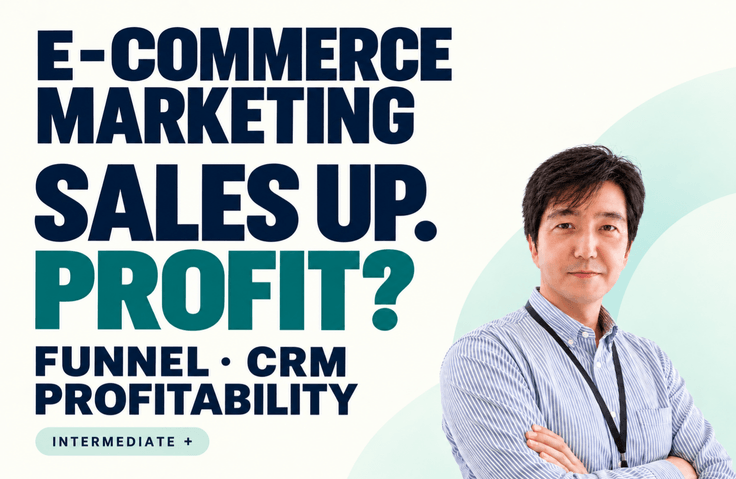
Sales are up, but what about profits? E-commerce Marketing in Practice
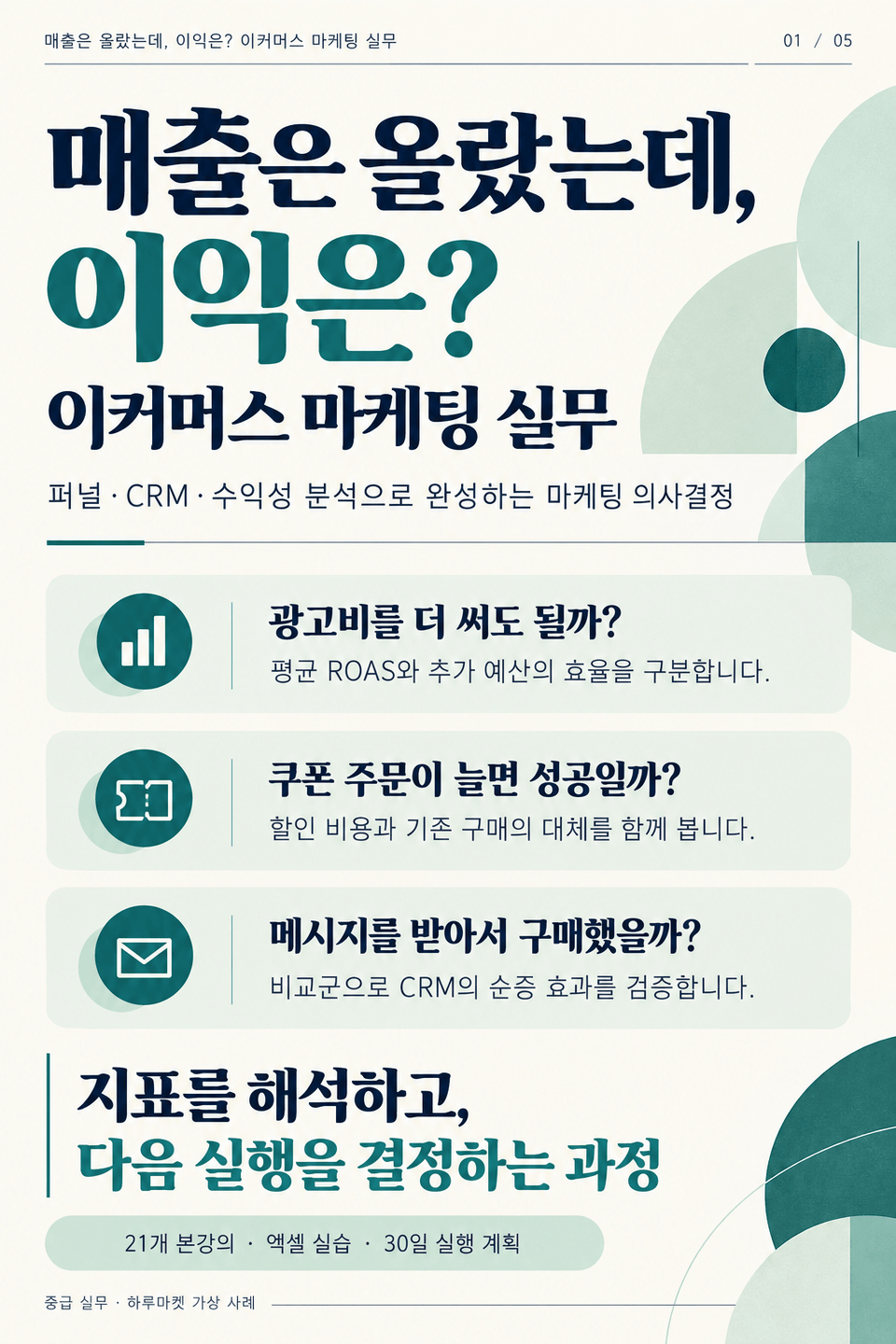
May we allocate more budget to advertising? Did the orders generated by the coupons actually lead to real profits? Can we attribute all purchases made by customers who received CRM messages to campaign performance?
This is an intermediate practical course that answers the questions encountered every day in online commerce with data and profit-and-loss analysis. Drawing on experience in the retail field, it establishes a framework for marketing decisions by connecting customer acquisition, purchase conversion, repeat purchases, and profitability analysis.
Centered around a fictional household-goods shopping mall called “Haru Market,” the course includes 21 lessons and Excel exercises. You will identify bottlenecks in the funnel, calculate the impact of additional ad spend and the incremental performance of CRM, and develop your own basis for deciding whether to scale up or discontinue an initiative.
From marketing and MD professionals who want to strengthen their practical skills to job seekers who want analytical capabilities they can use immediately after joining a company, everyone will complete their own 30-day marketing action plan by the end of the course.
Diagnosing Problems Through Revenue Structure and the Funnel: Break down revenue into traffic, conversion rate, and average order value, then identify the stages in the customer journey that hinder performance and prioritize improvements.
Designing Customer-Specific Purchase Offers and Channel Strategies: Connect targets, products, and benefits based on purchasing situations and customer segmentation, and develop purchase offers suited to discovery environments, including AI search.
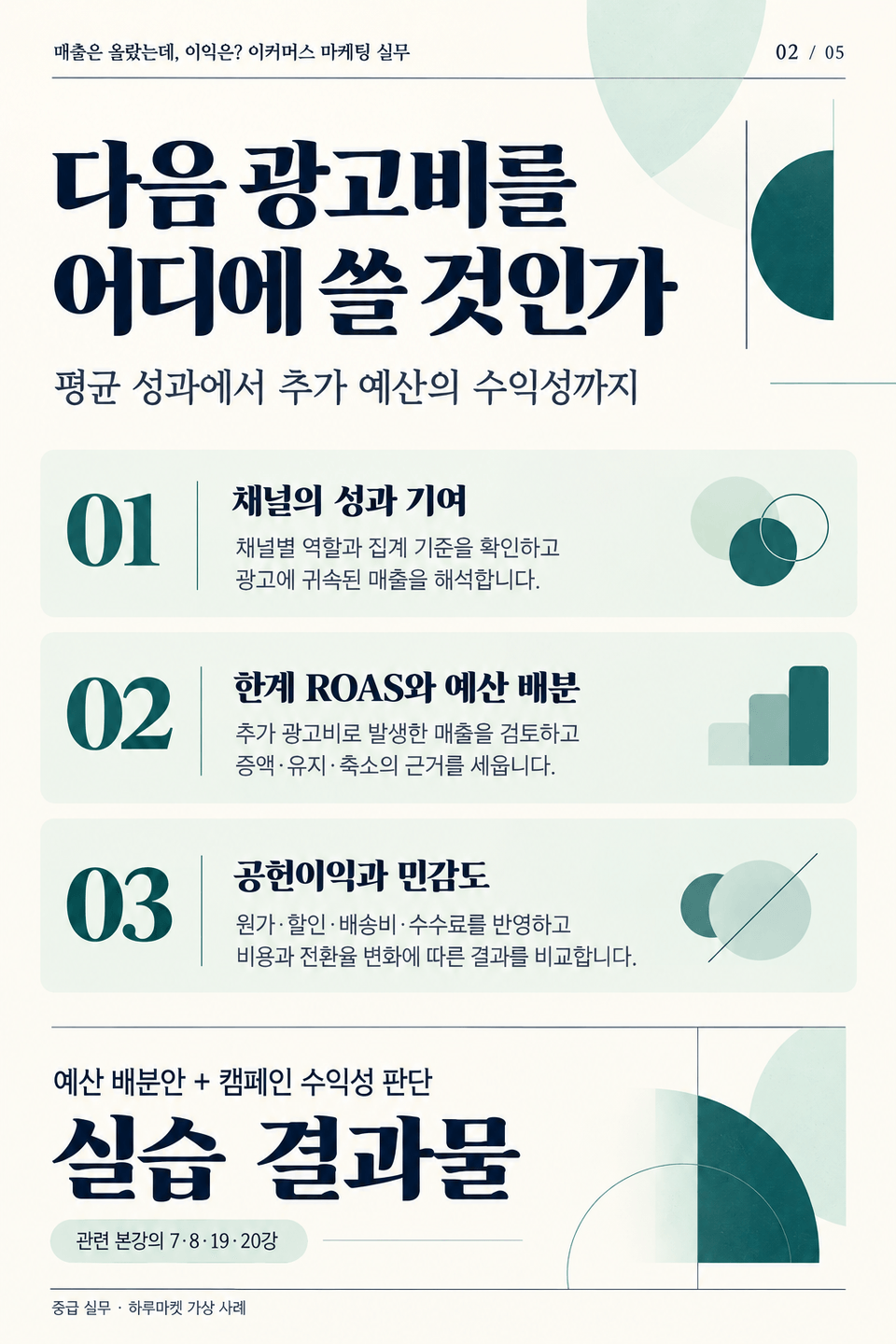
Allocate the advertising budget based on incremental profit: Analyze each channel’s contribution to performance and the effect of additional budget, then calculate marginal ROAS and contribution margin to determine whether to increase, maintain, or reduce the budget.
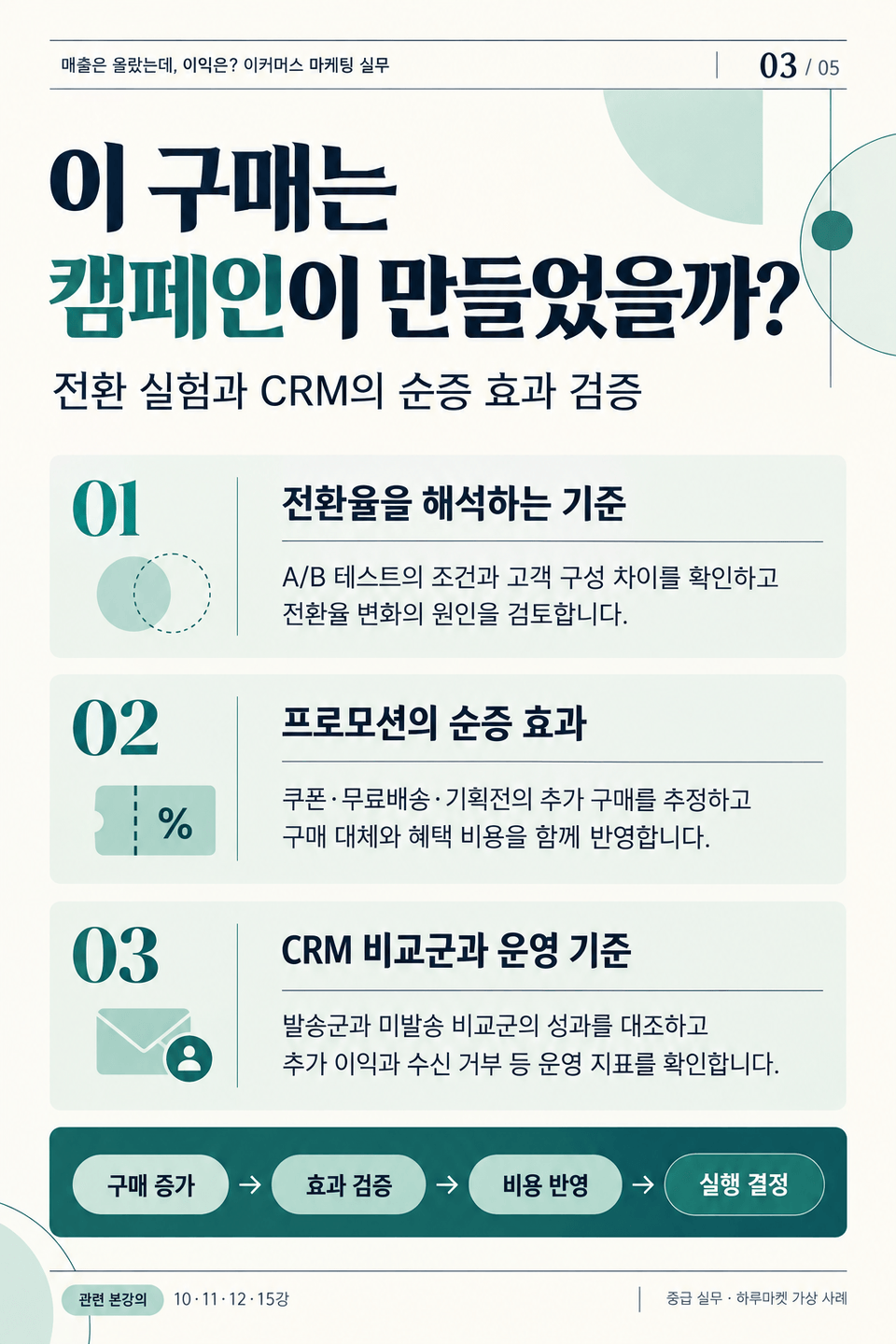
Validating the Actual Impact of Conversion Improvements and Promotions: Use A/B tests and control groups to analyze the incremental effects of coupons, free shipping, and curated promotions, and evaluate profitability while accounting for discount costs and purchase substitution.
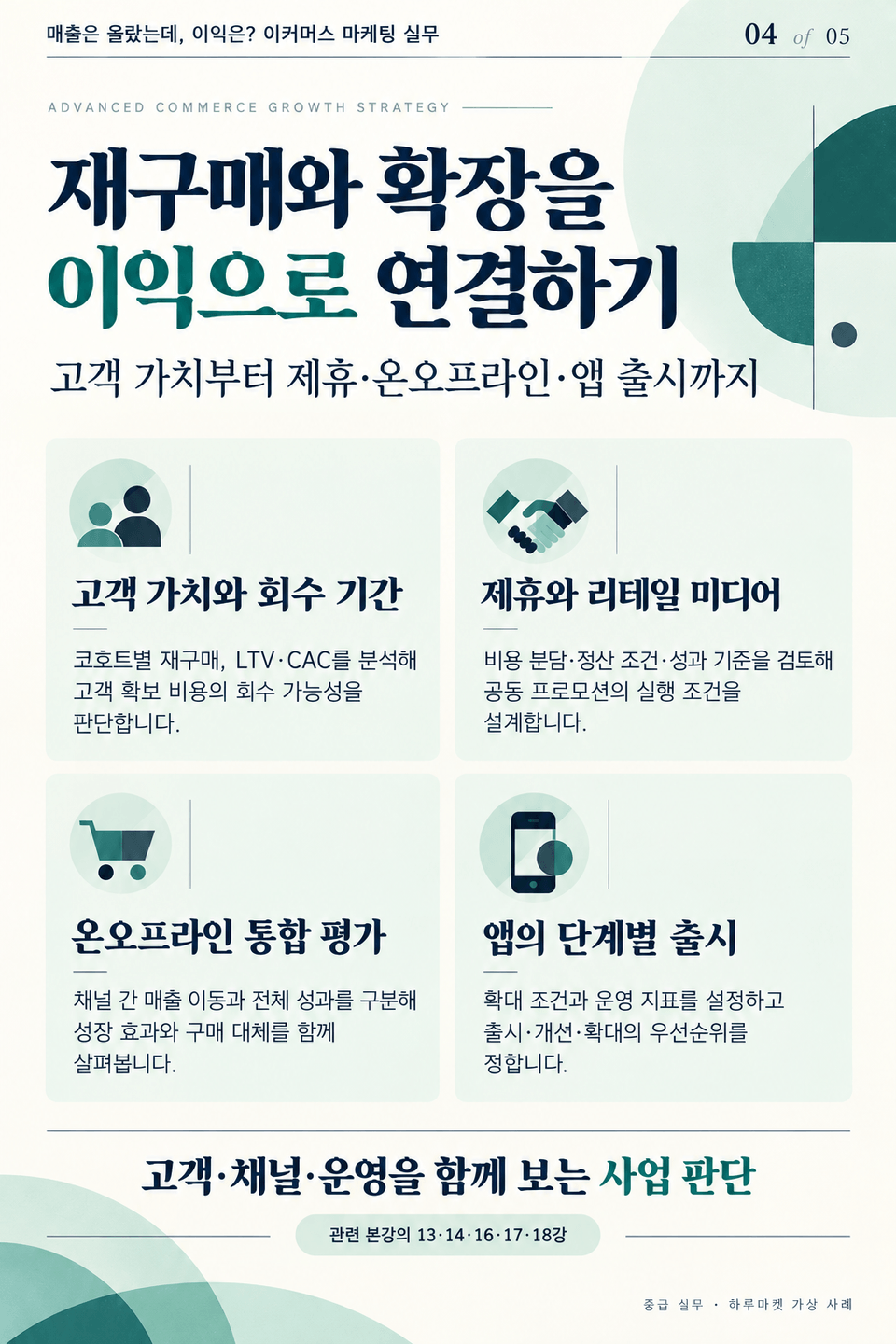
Operating CRM based on customer value and net incremental performance: Calculate the repurchase rate, LTV, and customer acquisition cost payback period for each customer segment, then compare them with a control group that did not receive messages to validate the additional revenue and profit generated by CRM.
Assessing the business viability of partnerships, online–offline integration, and app launches: Review the costs and settlement terms of joint promotions, sales shifts between channels, and stage-by-stage metrics for the app launch to establish execution conditions and criteria for scaling or discontinuation.
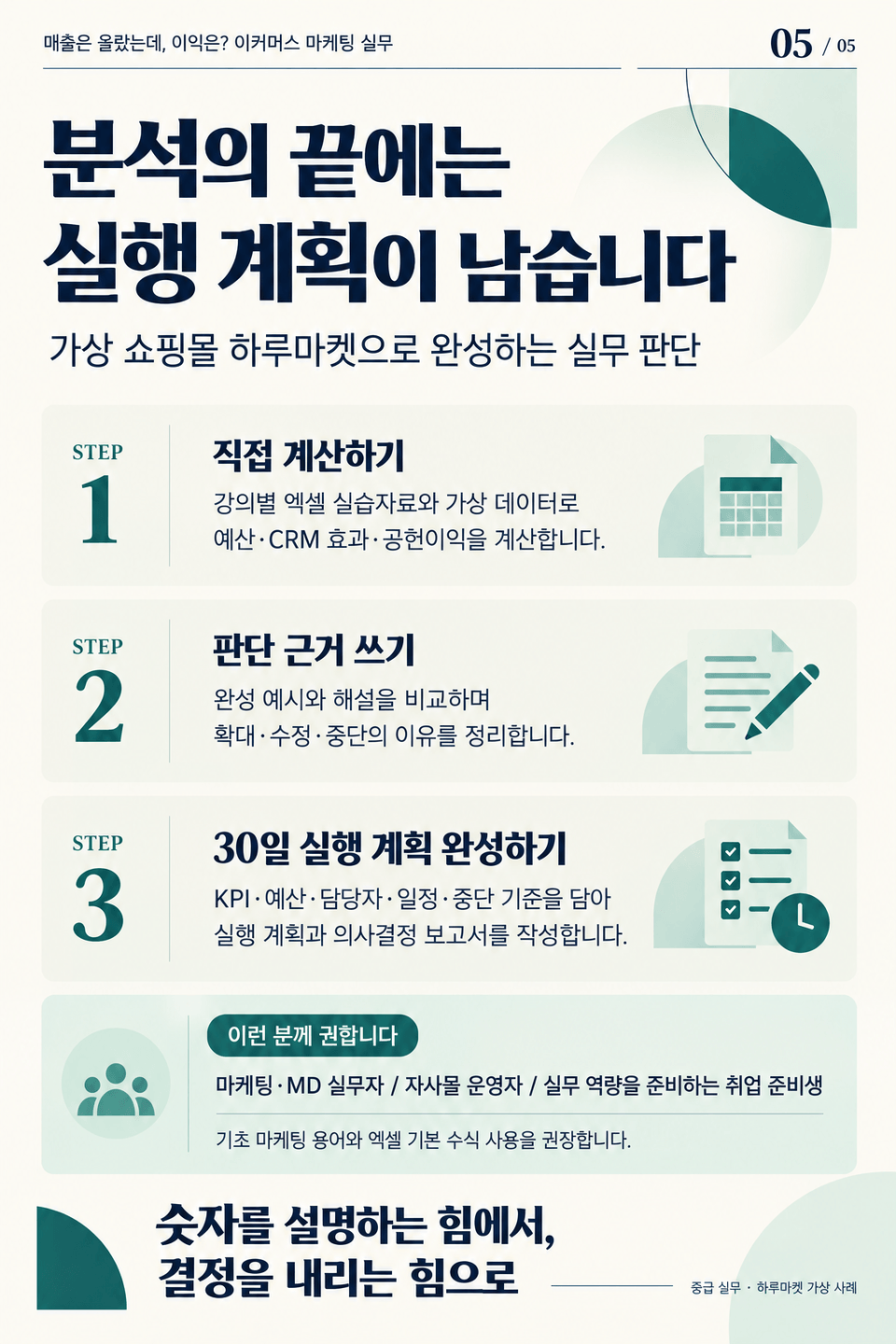
Complete Excel Analysis with a 30-Day Action Plan: Perform the calculations yourself using sample data and completed examples, then create an action plan and decision-making report covering key KPIs, budget, owners, schedule, and stop criteria.
If ad-attributed sales have increased but no profit remains, which metrics should you revisit first? How much of the increase in orders driven by coupons and purchases made by customers who received CRM messages is actually incremental performance?
“Sales went up, but what about profit? E-commerce Marketing in Practice” is an intermediate-level practical course that connects funnels, CRM, and profitability analysis to establish criteria for marketing decisions. You’ll distinguish between average ROAS and the efficiency of additional budget, use control groups to assess the incremental impact of campaigns, and evaluate action plans based on contribution margin that accounts for costs, discounts, shipping fees, and commissions.
The 21 main lectures cover everything from customer segmentation and channel strategy to conversion experiments, cohort-based repurchases, LTV · CAC and payback periods, partnerships, online–offline integration, and app launches. Each topic leads to decisions about where to allocate the budget and which activities to expand, modify, or discontinue.
Using data from the fictional household goods shopping mall “Haru Market,” along with Excel practice materials and completed examples for each lesson, you will perform calculations yourself and organize the basis for your decisions. Finally, you will complete a 30-day marketing action plan covering KPIs, budget, responsibilities, schedule, and criteria for discontinuation.
Recommended for marketing and MD practitioners, in-house online store operators, and job seekers preparing analytical skills to use after joining a company. Familiarity with basic marketing terminology and Excel formulas will be helpful for learning.
Recommended for these people
Who is this course right for?
Marketers who run ads and promotions but struggle to analyze performance and turn insights into their next actions
Online merchandisers and shopping mall operators who need to manage sales and discount rates together and assess the profitability of products, promotions, and coupons
A person responsible for learning how to analyze customers and verify the effectiveness of CRM campaigns to increase repeat purchases after a customer’s first purchase.
Those preparing for careers in e-commerce, marketing, or merchandising who want to develop practical skills they can apply immediately after joining a company through Excel analysis and execution planning.
Need to know before starting?
It would be good to understand the flow of product exposure → visit → purchase → repurchase in an online shopping mall.
Recommended for those familiar with basic marketing terms such as sales, advertising expenses, conversion rate, and average order value. The meaning and calculation methods of key metrics will be explained again in the lecture.
Being able to enter values in cells and use basic formulas, sums, and filters in Excel will help with the exercises. An Excel file for practice and a completed example are provided.
No coding or advanced statistical knowledge is required. This is an intermediate-level course that connects basic concepts with real-world data for analysis and decision-making.
Hello. I’m Kang-ho Ryu, sharing my 24 years of retail experience as practical knowledge that can be applied in the field.
Since 2002, I have gained experience in large-scale retail operations as a Category/Section Manager, assistant store manager, head of the online and strategic marketing team at headquarters, and in regional headquarters operations. I have handled retail operations from various perspectives, from working directly with products and customers in the field to developing strategies at headquarters.
■ Retail, Merchandising, and Product Planning Based on an understanding of products and customers, I handled merchandising changes, commercial area and competitor analysis, and initiatives to strengthen store competitiveness. In this course, you will learn how to establish a basis for product planning and turn your analysis into action plans and portfolios.
■ Sales and inventory management and store operations I gained experience managing key KPIs such as sales, customer count, average transaction value, inventory, and service, as well as standardizing store operations. I share a perspective on reading changes in the numbers, identifying their causes, and turning them into improvement initiatives to implement in the field.
■ Online commerce and digital marketing As the head of the online and strategic marketing team at headquarters, I gained experience in online commerce operations, CRM, targeted marketing, UI/UX improvements, and partnership marketing. I explain how to assess marketing performance from the perspectives of sales and profitability while considering both the customer purchase journey and operational conditions.
■ Project Execution and Collaboration I have worked on repeat and renewal PM, reopening marketing, customer experience (CX) improvement, and coaching for field employees and leaders. Based on my experience coordinating among headquarters, regional headquarters, stores, and partner companies, we will also cover the execution process needed to apply plans to actual work.
In the course, these experiences are complemented by data analysis and the use of AI to explain specifically how product planning, sales, inventory, store operations, and marketing are connected. The focus is on what to check, what evidence to base decisions on, and how to put them into action.
From job seekers preparing for careers in retail, merchandising, and marketing to practitioners and leaders looking to strengthen their on-the-job capabilities, we will help you explain and execute your analyses and proposals with sound reasoning.











![[Pass the Level 2 Computer Utilization Skills Practical Test in 5 Days]Course Thumbnail](https://cdn.inflearn.com/public/courses/330613/cover/820dc36f-c51d-4917-9eab-2fa9d5a291e5/330613-eng.png?w=420)

![[ONE PASS] Kang's Computer Proficiency Level 2Course Thumbnail](https://cdn.inflearn.com/public/courses/335729/cover/6822af7e-3c44-43fc-b654-aff82a9a2cef/335729.png?w=420)

![AI Automated Marketing for Successful Freelancers [No. 1 Author in AI Utilization]Course Thumbnail](https://cdn.inflearn.com/public/files/courses/338586/cover/01k2vfn09h9kdvcgc87sggzn8b?w=420)