inflearn logo

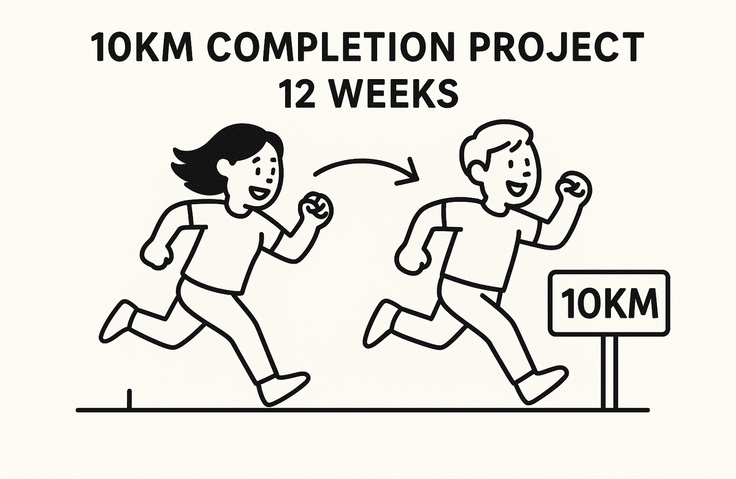
Running Zero Base: 10km Completion Project in 12 Weeks

This step-by-step program mixes walking and running to help your body adapt safely, aiming to complete a 10km run after 12 weeks. You will systematically learn proper posture, breathing techniques, injury prevention, and recovery management, building a sustainable running habit with 40-minute training sessions three times a week.

1 learners are taking this course

Level Beginner

Course period Unlimited

concurrency
concurrency
work out
work out
RunPod
RunPod
concurrency
concurrency
work out
work out
RunPod
RunPod

What you will gain after the course

  • Completing a 10km non-stop run and establishing a strategy for finishing your first race

  • Learning proper running posture and landing techniques for injury prevention

  • Design of personalized weekly training plans and pace control ability

Do you have a pair of nearly new running shoes in your shoe rack?

You probably bought them last year, or the year before, with great determination. You likely ran for a few days. And now, they are tucked away deep inside the shoe rack.

This course is a 12-week program designed to get you to take those running shoes out again.


Giving up after three days is not a matter of willpower

The process of starting to run and then quitting is surprisingly similar.

  • Just putting on running shoes and blindly running out

  • Running until you're out of breath from the very first day because you're in a good mood

  • The next day, your calves and knees hurt.

  • Three days later, you put your sneakers back in the shoe rack.

  • A few months later, the cycle repeats from the beginning.

Many people think this is because their willpower is weak. I see it differently. The way it started was structured in a way that the body simply couldn't handle.

If you run at full speed from the start, run every single day, and double your distance all at once, anyone will break down. Even trained athletes get injured if they do that.

The difference is not in your will, but in the design.


Posture and Breathing

We explain the gaze, upper body angle, arm swing, landing method, and even the sense of a 180-step-per-minute cadence, along with the reasons why you should do it that way.

A pace that fits my body

You will learn how to judge your pace based on the signals your body is sending right now, rather than the numbers on your watch. The concept of heart rate zones will also be covered at a level suitable for beginners.

Training plans you create yourself

It doesn't end with just following the plan I gave you. I will provide you with the criteria to judge where to go back when you fall behind schedule, and how much you can increase your workload when you're in good condition.

Injury Prevention and Management

Shin splints, knee pain, and plantar fasciitis. We cover the three most common issues beginner runners face, from their causes and prevention methods to how to handle them if you are already in pain.

Completing Your First Race

We cover everything from how to choose and register for a race, what to prepare the day before, to how to pace yourself for each segment on the day of the event.


Recommended for
these people

Who is this course right for?

  • A beginner who wants to start running but is hesitating because they don't know how.

  • Those who have suffered injuries from excessive attempts in the past and want to learn the correct method

  • Prospective runners who need systematic training with the goal of completing a 5km to 10km race.

Need to know before starting?

  • Basic physical fitness to be able to walk for about 40 minutes without any special health issues

  • The ability to manage a schedule to secure training time three times a week

  • The consistency and patience to follow a 12-week step-by-step program.

Hello
This is jjangkbg7719

Career Verified

547

Learners

35

Reviews

2

Answers

4.9

Rating

25

Courses

Hello, I'm Frank.

I am an infrastructure engineer who has been wrestling with servers for over 20 years. Starting with Linux server operations, I am now in charge of the cloud infrastructure for a large-scale payment service. My daily life involves migrating from data centers to AWS, managing hundreds of instances, and tracing the causes of failures in the early hours of the morning.

The reason I created this course is simple.

I often received questions like these from those around me: "I managed to connect to the server, but I don't know what to do next." "There are so many instance types; which one should I choose?" These are the exact same points where I got stuck at first. However, when I looked for resources, I found that most of them were written for people who already knew what they were doing.

So I decided to create the course I wish I had when I first started learning.

My lectures are based on three principles.

First, I help you understand rather than memorize. Instead of just listing commands, I explain why we use them in the first place.

Second, I boldly omit unnecessary content. I do not increase the volume by including information that is useless to beginners right now.

Third, I also talk about what doesn't work. Instead of just listing the pros, I clearly point out cases where it might not be a good fit. For someone who has to make decisions in the field, that is more important.

If you feel a sense of "Ah, I should start from here" after listening to the lecture, then my goal has been achieved.

Please feel free to leave any questions you may have at any time.

More

Curriculum

All

13 lectures ∙ (13min)

Course Materials:

Lecture resources
Published: 
Last updated: 

Reviews

Not enough reviews.
Please write a valuable review that helps everyone!

jjangkbg7719's other courses

Check out other courses by the instructor!

Similar courses

Explore other courses in the same field!

Limited time deal

$3.30

62%

$8.80