inflearn logo

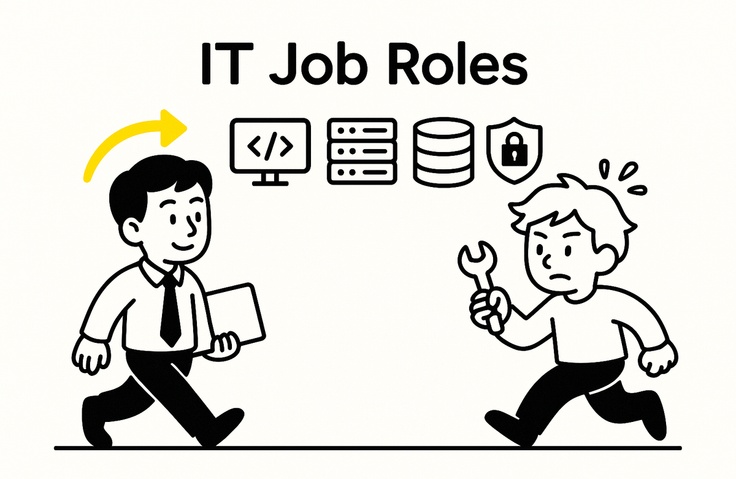
IT Job Map — What are the differences between Development, Infrastructure, DBA, Security, and SRE?

You will learn the criteria for distinguishing seemingly similar IT roles based on the nature of 'what they do' rather than just their titles. You will be able to grasp the reality behind confusing job names such as Backend, Infrastructure, DevOps, SRE, and Platform Engineer, and develop the ability to judge the nature of a position by reading job postings to set a career direction that suits you.

5 learners are taking this course

Level Beginner

Course period Unlimited

backend
backend
sre
sre
career-advice
career-advice
job-analysis
job-analysis
Information Strategy Planning
backend
backend
sre
sre
career-advice
career-advice
job-analysis
job-analysis
Information Strategy Planning

What you will gain after the course

  • Explanation of the job descriptions and differences between major IT roles (Development, Infrastructure, DBA, Security, SRE)

  • Determining actual job nature and interpreting requirements through job posting analysis

  • Designing an IT career path and entry sequence tailored to your aptitudes and goals

Lecture Information

  • Course Title — IT Job Map: What are the differences between Development, Infrastructure, DBA, Security, and SRE?

  • Subtitle — If you don't know where to apply even after looking at job postings

  • Category — DevOps·Infrastructure / Introductory

  • Length — 22 slides, approximately 30 minutes

  • Prerequisite Lectures — Lecture 1: Mastering IT Terminology, Lecture 2: How Computers Work (Recommended)

  • Provided Materials — Lecture slides PDF, Study materials PDF

Course Introduction

Backend Engineer. Infrastructure Engineer. DevOps Engineer. SRE. Platform Engineer. Cloud Engineer.

When you open a recruitment site, these titles appear side by side. The names are all different, but when you read the requirements, they are strangely similar. They say you need to know Linux, you need to know Cloud, and you need to know Containers.

It is natural to be confused. This is because they actually overlap.

Every company calls the same job by a different name. And even with the same name, the scope varies from company to company. A DevOps engineer at one company might only handle deployment automation, while a DevOps engineer at another company does everything from server construction to monitoring.

That's why this lecture doesn't make you memorize job titles. It provides you with a standard for distinguishing roles based on the nature of the work.

Once you have a standard, you will be able to read any job posting from any company and understand exactly which side the work falls on. That is the goal of these 30 minutes.

Created for people like this

  • Non-major job seekers — Haven't decided which position to apply for yet

  • New IT Professionals — I don't know exactly what the team next to me does

  • Those considering a career change — I can't see the next step from where I am now.

  • Planning & Operations Roles — I get confused every time about who I should direct this request to

After completing this course

  • You can explain which roles exist within an IT company and what each of them does.

  • You can distinguish between roles that seem similar based on the tasks they perform.

  • You can read job postings and determine the nature of the position.

  • You can determine the direction and entry sequence that is right for you.

Lecture Curriculum

Introduction

  1. Orientation — By what you do, not by your title

  2. This is what job postings look like.

  3. Curriculum structure

Section 1 · A Single Map of Job Roles

  1. The flow of how a service runs — from planning to operation

  2. It is largely divided into two branches — the work of creating and the work of keeping things running.

Section 2 · The People Who Build

  1. Frontend Developer

  2. Backend Developer

  3. Planner, Designer, QA, Technical Writer

Section 3 · The People Who Make It Run

  1. Infrastructure Engineer

  2. DevOps Engineer

  3. SRE

  4. DBA and Security Specialist

  5. Data Roles

Section 4 · Where to Go

  1. Comparison at a glance

  2. This is how your career will progress

  3. The best order for non-majors to enter the field

  4. Distinctions that are often confused

Conclusion

  1. Summary and Next Lesson Information

Features of this course

All job roles are explained in the same format

For each job, we present the tasks, required competencies, ideal candidates, and real-world stories in a fixed format. Using a consistent format makes comparison easier, allowing you to better judge which role suits you best.

We talk about not only technical requirements but also aptitude

The way you feel a sense of achievement differs between the work of creating and the work of making things run.

  • Creating things — the results are visible in what was made, and you feel a sense of accomplishment when what you created appears on the screen.

  • The work of keeping things running — success is seen as nothing happening, and you find fulfillment in the fact that no one noticed because you prevented it.

There are people who are well-suited for these quiet achievements, and there are others who feel energized only when the results are visible. This is not about which side is better, but about making a choice with that understanding in mind.

We directly address the most confusing distinctions

  • Infrastructure and DevOps — Infrastructure builds and protects the foundation, while DevOps automates the work on top of it

  • DevOps and SRE — DevOps focuses on rapid deployment, while SRE focuses on maintaining stability.

  • Backend and Infrastructure — Backend creates logic with code, and infrastructure creates the environment where that code runs

  • DBA and Data Engineer — The DBA manages operational databases, while the data engineer builds flows for analysis

We present a realistic entry sequence

I will explain why you should follow these five steps—basic knowledge, certifications, small-scale practice, first employment, and specialization—in this specific order.

And I must tell you this. Do not aim for SRE or DevOps from the very beginning. Those positions mostly hire experienced professionals. Since they require knowledge of both development and operations, the door is narrow for newcomers. Even if it seems like a detour, starting from the basics is ultimately the fastest way.

Provided Materials

  • Lecture Slide PDF — All 22 pages of slides used in the lecture

  • Study Material PDF — 8 A4 pages. Job-specific summary table, comparison table of 7 job roles, 6 pairs of frequently confused categories, career paths, entry sequence and rationale, 10 review questions and answers

The job-specific summary table in the study materials is useful to keep by your side for comparison when reading job postings.

Instructor Introduction

I have been working in Linux server operations and cloud infrastructure for 20 years. While operating large-scale payment service infrastructure, I collaborated daily with development, DBA, security, and data teams.

And I have spent a long time watching my juniors struggle with which direction to take. This course is a compilation of the advice I gave them back then. It includes things not written in job postings, such as why certain roles rarely hire entry-level candidates.

Notes before taking the course

  • This is a conceptual lecture without hands-on practice. No installation or preparation is required.

  • It will be much easier to understand if you listen to Lessons 1 and 2 first. The terminology from the previous lessons appears directly in the job descriptions.

  • Salary information or recruitment details for specific companies are not covered. This is because such information changes depending on the timing.

  • Job titles and scopes vary by company. This lecture presents the most general standards.

Recommended for
these people

Who is this course right for?

  • Non-major job seekers having difficulty choosing an IT role

  • New IT professionals who want to understand the roles of other functions for better collaboration

  • Planning and operations staff who do not know whom to ask or what to request when making work requests to developers.

Need to know before starting?

  • Basic interest and curiosity about the IT industry in general

  • Experience reading job postings or job descriptions

  • Recommended to take IT Introduction Series Lectures 1 and 2 (Not mandatory)

Hello
This is jjangkbg7719

Career Verified

476

Learners

32

Reviews

2

Answers

4.8

Rating

19

Courses

Hello, I'm Frank.

I am an infrastructure engineer who has been wrestling with servers for over 20 years. Starting with Linux server operations, I am now in charge of the cloud infrastructure for a large-scale payment service. My daily life involves migrating from data centers to AWS, managing hundreds of instances, and tracing the causes of failures in the early hours of the morning.

The reason I created this course is simple.

I often received questions like these from those around me: "I managed to connect to the server, but I don't know what to do next." "There are so many instance types; which one should I choose?" These are the exact same points where I got stuck at first. However, when I looked for resources, I found that most of them were written for people who already knew what they were doing.

So I decided to create the course I wish I had when I first started learning.

My lectures are based on three principles.

First, I help you understand rather than memorize. Instead of just listing commands, I explain why we use them in the first place.

Second, I boldly omit unnecessary content. I do not increase the volume by including information that is useless to beginners right now.

Third, I also talk about what doesn't work. Instead of just listing the pros, I clearly point out cases where it might not be a good fit. For someone who has to make decisions in the field, that is more important.

If you feel a sense of "Ah, I should start from here" after listening to the lecture, then my goal has been achieved.

Please feel free to leave any questions you may have at any time.

More

Curriculum

All

7 lectures ∙ (24min)

Course Materials:

Lecture resources
Published: 
Last updated: 

Reviews

Not enough reviews.
Please write a valuable review that helps everyone!

jjangkbg7719's other courses

Check out other courses by the instructor!

Similar courses

Explore other courses in the same field!

Limited time deal

$3,300.00

70%

$8.80