




inflearn logo

Practical Harness Engineering Completed in 2 Hours

Building an MVP with AI is no longer difficult. However, most projects stop at the next stage. 👉 You’ve built the features 👉 But development doesn't continue Why does this happen? The problem isn't the code; 👉 It's because there is no structure that allows AI to work continuously. --- In this course, based on an existing project, 👉 We will cover the process of building a structure 👉 That allows AI to continue development on its own. --- Instead of simply using AI tools, we will: * Create a docs structure * Define the SSOT (Single Source of Truth) * Execute development on a per-ticket basis * Connect QA and iteration cycles 👉 To complete a single "AI Development System." --- Through this process, you will: 👉 Create a structure where development continues 👉 Even without a human manually coding. In other words, you can: 👉 Build and understand a development system 👉 That operates AI like a team. --- This course is designed for: 👉 Those who want to build a structure applicable to their projects immediately 👉 Those who started development with AI but found it difficult to sustain 👉 Those who want to move to the next level after "Vibe Coding" --- Beyond just learning, we provide an experience where you: 👉 Take action 👉 Build a structure that actually works 👉 And walk away with a framework you can apply to your own projects.

4 learners are taking this course

Level Basic

Course period Unlimited

Python
Python
cursor
cursor
ChatGPT
ChatGPT
AI Agent
AI Agent
Vibe Coding
Vibe Coding
Python
Python
cursor
cursor
ChatGPT
ChatGPT
AI Agent
AI Agent
Vibe Coding
Vibe Coding

What you will gain after the course

  • We are directly building a structure where AI continuously carries out development based on SSOT.

  • Through ticket-based development, you will experience the process of completing a service from start to finish.

  • You can understand this structure from a harness engineering perspective and apply it to practical work.


Directly applicable to practical work,
we reveal the harness engineering method.


#Harness Engineering | #SSOT | #Ticket-Based Development | #Claude/Cursor | #Practical Application


Have you ever had an experience like this?

The AI worked well at first, but as requirements were added, it started producing increasingly irrelevant code.

I clearly gave the same development instructions, but I'm flustered because the AI's output today is different from yesterday's.

I built an MVP with AI, but the project was abandoned because I couldn't move on to the next stage.

I thought AI could do everything if I just asked...
What could be the problem?


why?
3 reasons that make AI development difficult

Context is not maintained.

Because AI cannot remember context over the long term, consistency breaks down as tasks accumulate.

The work units are not clear.

Because AI interprets ambiguous requests on its own, the results vary every time.

There are no verification and modification stages.

If development is repeated without verification and modification, the AI will continue to add code without any standards.


The common cause of these three problems is one thing.
There is no structure in place for AI to work.

Therefore, before starting AI development

Designing an environment that considers AI characteristics is essential.

A New Standard for AI Development

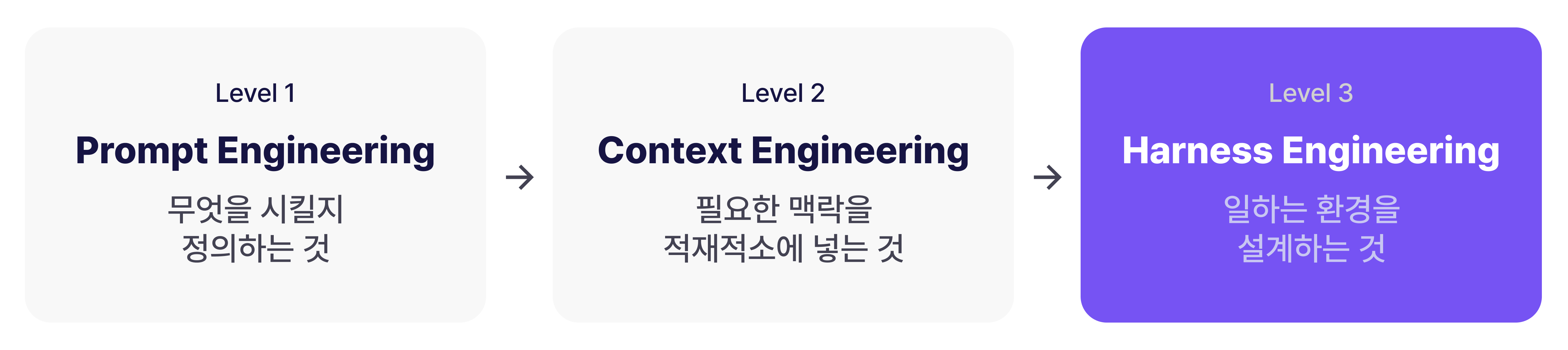
Harness Engineering

Harness Engineering means designing a development environment
so that AI can work stably.


Harness Engineering
How do we apply it in practice?

An ideal harness engineering design method does exist.
However, there is always a gap between the ideal environment and the reality of practical work.

Ideal environment

  • Start development based on clear requirements.

  • Start with a clean structure from the beginning.

  • Establish a perfect structure in advance before development.

The reality of practical work

  • Even during development, requirements change frequently.

  • Legacy code has already accumulated.

  • There is no time to establish a perfect structure from the beginning. ngay từ đầu.


Legacy environments, frequently changing requirements...

Therefore, practical application of
harness engineering must be different.


Immediately applicable to practical work

Ticket-based Harness Engineering


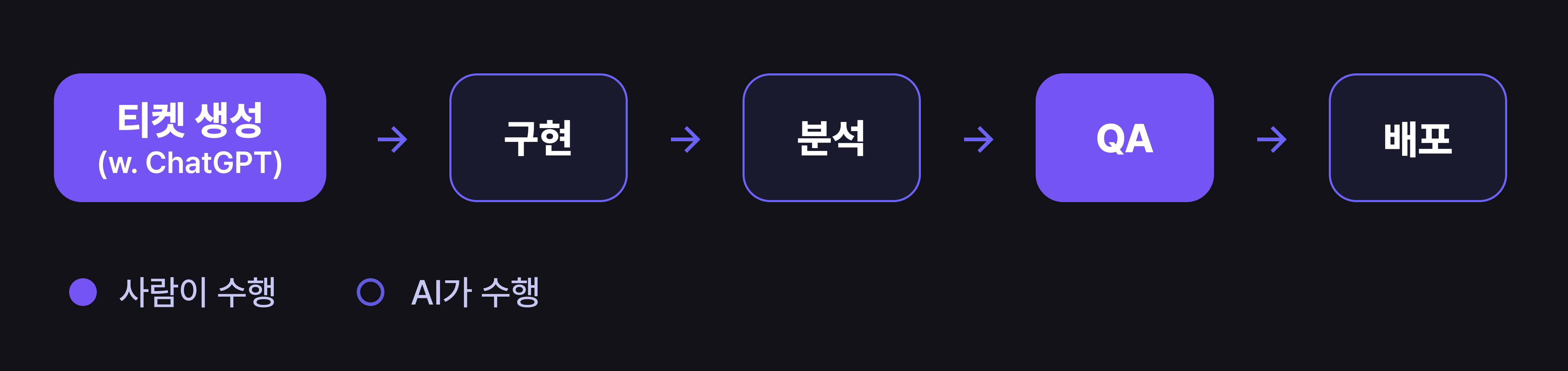
This is a method where humans handle ticket creation and QA, while AI performs the remaining implementation, analysis, and deployment.
Because humans establish the standards and verification while AI executes on a per-ticket basis,
you can achieve both stability and flexibility.

SSOT

Defining Consistent Principles

With a single reference document, the AI works consistently even as tasks accumulate.

Ticket Design

Actionable work units

Defining tasks in a size that AI can handle improves the quality of the output.

Iterative Loop

Development→QA→Revision→Completion

Create a structure that repeats a single workflow by collaborating with AI based on tickets.


Key Highlights of the Lecture

📚 Key takeaways from the lecture

01

Agent-first development

Transition to an AI Agent-centered development workflow.

02

SSOT-based Structure

Unify development standards with a Markdown-based Single Source of Truth (SSOT).

03

Ticket-driven development workflow

Generate tickets using ChatGPT and
configure a development workflow that executes automatically through Cursor.

04

Automated QA & Done

Configure an automated development cycle
from analysis report generation to completion criteria verification.

0505

Sustainable Development Loop

Build an AI-based development system that is repeatable
once set up.


This is a real-world AI development system that includes planning via ChatGPT, development using Cursor, and a Python-based execution structure.


🧩 Components used in this lecture

  • ChatGPT (Planning and Ticket Generation)

  • Cursor (AI-based code generation and modification)

  • Markdown-based SSOT

  • Python / API Structure

  • MongoDB

  • Hugging Face Space Deployment

  • Vercel Deployment

The core is not the technology, but the "structure."
This structure can be applied as is to any language or stack.

Target Audience

🎯 Highly recommended for the following people:

✅ Those who have built a service with AI but are unable to continue development

✅ Those who use ChatGPT or Cursor but get inconsistent results

✅ Those who want to continue development without repetitive tasks

✅ Those who want to utilize AI as a "development resource" rather than just a simple tool


How to create a structure where AI can continue to work,Cách tạo ra cấu trúc để AI có thể làm việc liên tục,

For those who want to build an AI Agent-based development system
themselves, this is highly recommended.

Recommended for
these people

Who is this course right for?

  • Those who have experienced building an MVP with AI, only to have the project stall because subsequent development didn't continue.

  • Those who are using tools like GPT and Cursor but are experiencing issues with inconsistent outputs and increasingly tangled contexts.

  • Developers and teams who want to utilize AI as an actual development resource, rather than just a simple code generation tool.

  • Those who want to apply AI to an existing legacy project but feel overwhelmed about where and how to start

Need to know before starting?

  • There are no required prerequisites.

  • It will be easier if you have experience creating repositories and committing with Git.

  • It is helpful to have an understanding of simple web service structures (FE / BE).

  • It is good if you have at least some experience using AI tools such as GPT or Cursor.

  • This course does not cover specific technologies, but rather the structure of how AI performs development.

Hello
This is knodark74

473

Learners

8

Reviews

3

Answers

4.6

Rating

2

Courses

As an engineer with over 25 years of development experience,
I have built a "structure where AI can continuously carry out development"
through a repeated process of building and dismantling MVPs directly with AI.

I am directly designing and operating an "AI development system that runs on its own," covering everything from
planning → development → QA → deployment
based on ChatGPT, Cursor, and Python.

It is not just simple vibe coding;
I am creating a structure where AI Agents can continuously perform development,
and I am validating this by applying it to actual services.

More

Curriculum

All

6 lectures ∙ (2hr 16min)

Course Materials:

Lecture resources
Published: 
Last updated: 

Reviews

Not enough reviews.
Please write a valuable review that helps everyone!

Similar courses

Explore other courses in the same field!

Limited time deal

$26.40

38%

$42.90