
inflearn logo

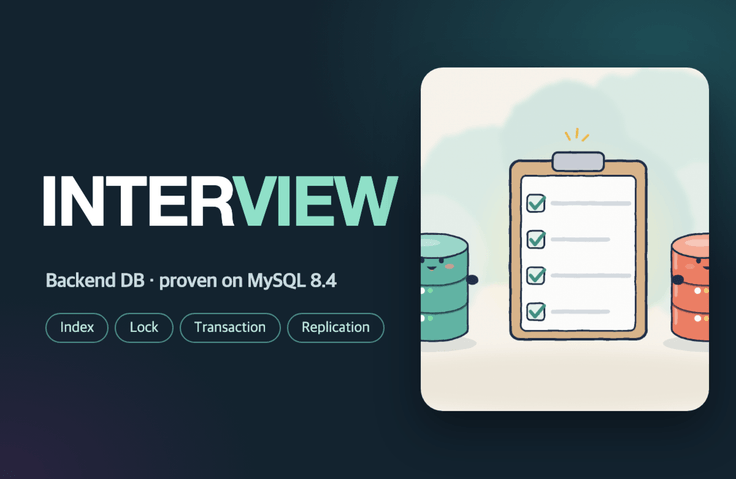
Backend Database Interview Questions from a Current DBA Team Lead — Verify and Answer Them Directly with MySQL

We answer 46 interview questions on indexes, execution plans, transactions, locks, replication, and failure handling from the interviewer’s perspective. Compare bad answers with good ones, and each question includes a hands-on verification exercise using MySQL 8.4 so you can answer follow-up questions by saying, “I checked it myself.”

1 learners are taking this course

Level Basic

Course period Unlimited

SQL
SQL
MySQL
MySQL
Docker
Docker
DBMS/RDBMS
DBMS/RDBMS
SQL
SQL
MySQL
MySQL
Docker
Docker
DBMS/RDBMS
DBMS/RDBMS

What you will gain after the course

  • You can answer questions about indexes, locks, and transactions in under 30 seconds, in this order: the underlying principle → numbers you’ve observed firsthand → trade-offs.

  • You can read EXPLAIN·EXPLAIN ANALYZE·data_locks·SHOW REPLICA STATUS output and use it as evidence in interview answers.

  • You can answer questions about replication lag, read-after-write consistency, semi-synchronous replication, and promotion (GTID) with hands-on results.

  • I can explain what to check first, in order, when the database slows down, CPU usage hits 100%, connections run out, or something is accidentally deleted.

This course is different in the following way.

① Build answers you’ve verified yourself, not just memorized

The question interviewers most often ask after an answer is, "Did you verify it yourself?" For every question, this course includes hands-on verification exercises that you run directly in MySQL 8.4. The type and rows in the execution plan, lock wait times, deadlock error codes, and replication lag in seconds—the numbers shown on screen are all results of actual executions.

② We show bad and good answers side by side

You can only fix your answers if you know where interviewers take points off. Each lesson brings together a bad answer an actual applicant might give → the framework for a good answer → a 30-second answer you can deliver verbatim in the interview → and the follow-up questions likely to come next.

③ We take a deep dive into topics other interview courses only skim

Rather than covering all of computer science broadly, this focuses on the six areas that actually make a difference in practical database interviews.

  • Indexes · execution plans · transactions and isolation levels · locks and concurrency

  • Replication (replication lag, why data you just wrote isn’t visible, semi-synchronous replication, promotion, and GTID)

  • Incident response (what to check first when things slow down, queries causing 100% CPU usage, connection pool exhaustion, and recovering accidentally deleted data)

④ Spin up the same environment with a single command

Use Docker to spin up two MySQL 8.4 instances—a source and a replica—and generate virtual commerce data (100,000 members, 10,000 products, and 1 million orders) with a single script. The data is generated according to rules, so everyone gets the same results when they run it.

Structure of One Lesson

What interviewers are looking for → bad answer vs. good answer → hands-on proof (MySQL 8.4) → 30-second answer → follow-up questions → summary

Supplementary Materials Included

  • Practice Materials ZIP: Docker Compose, data generation scripts, practice SQL and shell commands for each lesson, and actual execution results used as evidence for the lesson screens.

  • Interview Questions Summary PDF: Question · Interviewer’s Intent · Poor Answer · 30-Second Answer · Follow-Up Questions · Evidence Summary

Recommended for those who are

  • Entry-level and junior backend developers who have memorized the concepts before a database interview but get stuck on follow-up questions

  • Those who develop with Spring and JPA but have never directly examined indexes, locks, or replication.

  • An experienced developer who needs to discuss their incident response experience in a job interview while changing jobs.

Instructor Introduction

I’m the head of the DBA team at a major e-commerce company. I work with backend developers every day on issues involving indexes, locks, replication, and outages. I created this course around the questions that truly distinguish people’s skills in real-world situations. We don’t use company production data; all hands-on exercises use synthetic data I created myself.

I'll let you know.

  • The narration uses an AI-generated voice. The instructor personally ran the exercises and verified the figures shown on the slides.

  • Execution time (ms) varies from computer to computer. In the lecture, we explain performance in terms of the speedup factor and the reduction in the number of rows read.

  • These are not actual interview questions or past questions from any specific company. The instructor has created new questions based on topics commonly asked about in this field.

Recommended for
these people

Who is this course right for?

  • Entry-level and junior backend developers who have memorized database concepts but get stuck after just two follow-up questions.

  • A developer who builds with Spring and JPA but has never personally examined indexes, locks, or replication.

  • An experienced backend developer who needs to explain their incident-response experience and decision-making process in a job interview.

Need to know before starting?

  • Basic SQL knowledge sufficient to read and write SELECT, JOIN, and UPDATE statements.

  • A personal computer capable of running Docker (8 GB or more of memory recommended) and experience copying and running terminal commands.

Hello
This is dorian05202988

Career Verified

A data craftsman with over 20 years of experience in databases and IT. As a DBA and manager of a DB Platform team, I work with database platforms and specialize in MySQL, PostgreSQL, Oracle, MongoDB, SQL tuning, AWS, Terraform, and Python. Drawing on experience in the gaming, finance, and IT services industries, I explain database and cloud architecture. I have published 『Oracle Practical Tuning: Learning SQL Patterns』 and 『Oracle Pro*C Practical Project Guide』, and have presented on serverless architectures, database selection, and multi-database strategies at AWS Summit 2018 and 2019 and DataYa Nolja 2020. Recently, I have been working on slow-query analysis and tuning recommendations using Bedrock LLM, automated DB specification sizing, and query workflows through a DB metadata MCP server and Slack bot. I explain database automation for developers and AI applications for non-developers through hands-on exercises tailored to the audience and objectives of each course. Rather than applying AI suggestions as-is, I teach a decision-making framework that verifies result equivalence, execution plans, and observability conditions, and defers action when the supporting evidence is insufficient. Company operational data and credentials are not included in the course materials.

More

Curriculum

All

46 lectures ∙ (3hr 4min)

Course Materials:

Lecture resources
Published: 
Last updated: 

Reviews

Not enough reviews.
Please write a valuable review that helps everyone!

dorian05202988's other courses

Check out other courses by the instructor!

Similar courses

Explore other courses in the same field!

Limited time deal

$61,600.00

20%

$59.40