Cloud Security Programming for Practical Use (AWS, Python, Terraform)
It is configured to allow you to learn programming languages (Python, Terraform) for the cloud. You can directly create and apply simple yet tedious repetitive tasks, track when and how you deployed, and implement your company's unique policies that specific solutions cannot address. Specifically, we will apply a security architecture using Terraform, the most popular IaC (Infrastructure as Code) application, and also proceed with creating an ultra-simple dashboard using Python!
This is a great lecture because it presents the experiences and methods of practitioners. I was using CloudFormation and had to switch to Terraform, so I listened to it and it was very helpful.
5.0
열공보안
61% enrolled
I think this kind of lecture fits the purpose of the platform called Infraon. I want to learn other skills too!!! Thank you for the great lecture~!
5.0
Remy Baek
93% enrolled
I am a policy security officer and I took the course because I was interested in cloud security. Since I only have basic knowledge of AWS and no programming knowledge, it was difficult to follow the practical training. (I didn't even know that to run terraform init, you have to run it from the location where the tf file is lol) I followed along while Googling, but from the middle, I gave up on the practical training and listened to the lecture as if I was watching a demonstration of what can be done using Terraform. It's a shame because I think I could apply some of it to work right away if I only had basic knowledge. Still, it was a good lecture because I could see how it is used in the field. Please make many different lectures!
What you will gain after the course
Python
Terraform
AWS
Security
DevOps
DevSecOps
It's full of know-how accumulated through hard work and experience! Quickly absorb cloud practical information 🔒
The beginning of DevOps/DevSecOps, With a basic project 🖥️
After completing my military service, I joined my first company as a breach incident responder, but then switched roles to cloud security. Without any prior knowledge, I had to research documentation on my own. Not only was the workload overwhelming, but I also had no idea how to approach security. Some features seemed to do everything, while others didn't even make sense. I had to collect and filter logs to determine which ones were valid and which ones were not, contacting field staff to figure out what was right and what DevSecOps was all about.It was then that programming languages came to my rescue.
While this course covers very basic topics, it includes several practical exercises and projects that can be immediately applied to real-world situations.You'll learn basic programming languages for the cloud (Python, Terraform) and easily understand only the most frequently used functions . This course was created with the hope that you'll get started with DevOps/DevSecOps,move beyond the perception ofsecurity as a hindrance , and experience providingsecurity that protects .
Simple without expensive and difficult solutions You can deploy a firewall and manage it with code.
Improve visibility into your resources and create security dashboards.
The cloud is becoming so much fun, Creating and sharing what I want Hesitation disappears.
Learn how to deploy through code In connection with distribution or modification It can reduce fear.
I recommend this to these people 🙋
For those who work with the cloud only through the console
Anyone who wants to learn programming for the cloud
Anyone who wants to learn programming for automation
Infrastructure as Code (IaC) Anyone who wants to learn
AWS IAM and Project Anyone who wants to learn about events
Join us for this lecture! 🤗
Terraform allows you to easily check and work on changes without having to access the console.
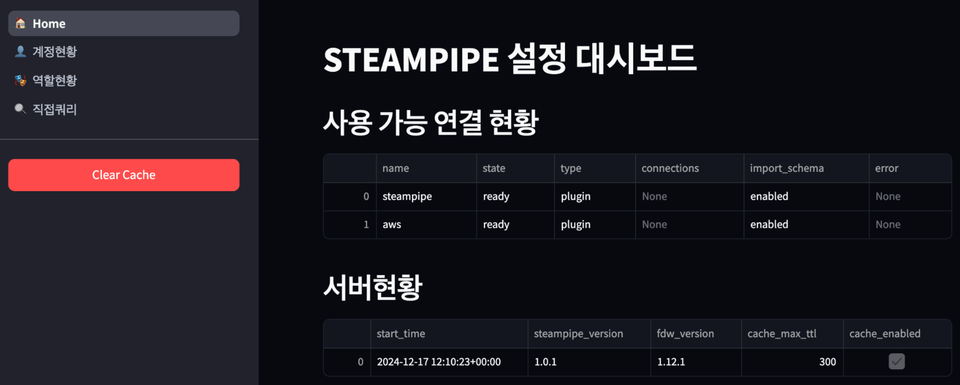
Building a security dashboard with Python + Streamlit.
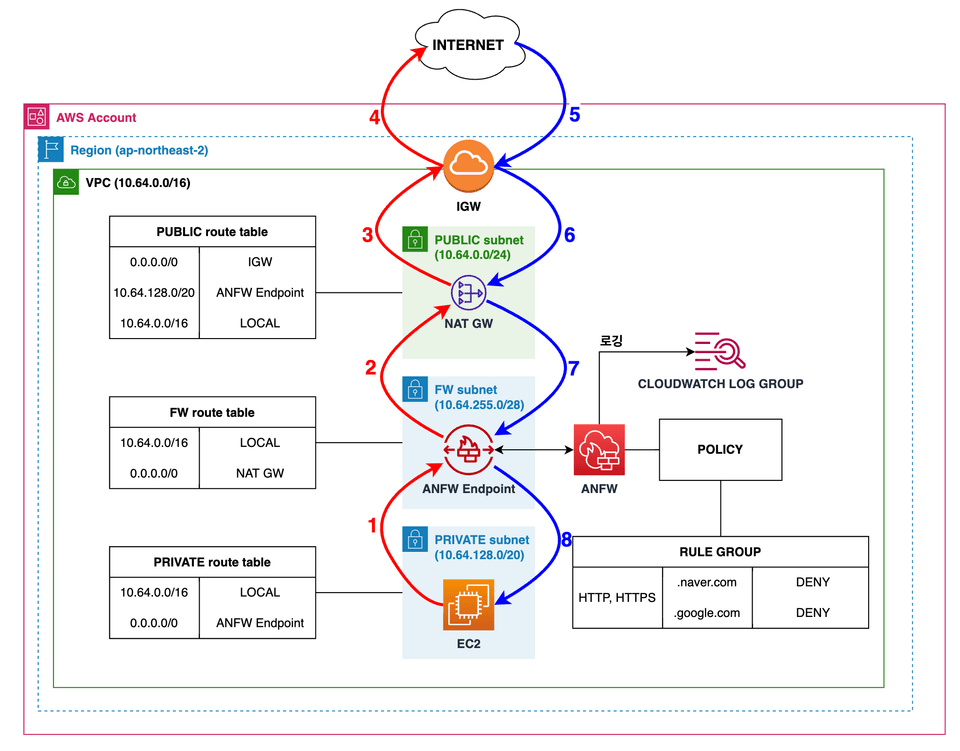
Let's design and deploy VPC Cidr and AWS Network Firewall and get familiar with Terraform!
What you'll learn 📚
1. Learn only the necessary parts of Python programming
Output, variables, data types
Loops, control statements
Functions, exception handling
boto3 practice
2. Terraform Programming for Practical Use
Variables, loops, expressions
terraform_remote_state, file structure
Actually creating multi-providers, modules, etc.
How to use modules created by others
3. Build an AWS Network Firewall (Project)
VPC and Firewall Architecture Design
Deploying a Firewall Using Terraform
4. Creating a Security Dashboard Using Steampipe + Streamlit (Project)
Introduction and Use of Steampipe
Creating a Simple Dashboard with Streamlit
Troubleshooting Steampipe + Streamlit Connection
Create a security dashboard
Things to note before taking the course 📢
Practice environment
There are no specific tools or operating systems required to conduct hands-on training in an AWS environment. However, it must be capable of running Python and Terraform.
Learning Materials
We provide lecture presentation materials (PDF).
We provide all the practice source code through GitHub.
Player Knowledge and Precautions
You must know how to enter commands through the terminal.
For practical training, we recommend that you do it separately rather than while listening to the lecture.
Experience with AWS is a plus.
Expected Questions Q&A 💬
Q. Can I learn Python and Terraform in such a short course?
There was a time when I thought I could become a good person by knowing as much as possible. However, the truly good ones are those who actually create and experience things . Since then, I've stopped trying to know everything and start learning, and instead, I've been exploring and studying the necessary knowledge through experience.
This course is designed to get you started. It covers the most frequently used functions in real-world work, along with helpful information for collaboration. You'll learn simple yet practical concepts , and as needed, you'll explore additional resources to help you quickly understand and apply the knowledge you need.
Q. I'm running a cloud platform other than AWS. Will this course be helpful?
Yes, it certainly helps. While there are certainly slight differences between each cloud, broadly speaking, almost all major cloud providers offer the same or very similar features . Ultimately, what matters is not which cloud you use, but whether it can implement and apply what you want . That's why I don't delve deeply into AWS itself unless it's necessary for my project.
Q. I've never experienced cloud computing before. Can I still take the course?
Honestly, if you've never had any prior experience, I think certain aspects might be difficult to understand. However, I feel that the nature of modern technologies is that even a brief experience can greatly help you develop and derive ideas in various directions , enabling you to implement and apply your various ideas. Furthermore, if you're pursuing a career in the cloud, I believe there's nothing faster than directly using the provided APIs to understand how the cloud works. Therefore, I've focused on simple content rather than complex ones, and I'll explain how to apply them to your projects based on these simple concepts.
Q. I don't work in cloud security, but can I still take the course?
Security isn't something only those with specific roles can perform. Even if you look at development frameworks, you'll see that they increasingly offer built-in security features. Even if you're not in a security role, being able to proactively consider security features during development and deployment will undoubtedly improve business productivity. I believe that adding security to your existing skills will contribute to a successful career. Even if you don't take a course, I recommend trying Steampipe and Streamlit.
Q. Why should I learn programming?
I'm sure you've all experienced the experience of not knowing what will change before deploying something, what's different from what you deployed, and not remembering what you actually deployed. This course will teach you how to deploy and manage your infrastructure with code, allowing you to track your deployments, history, and changes without having to fiddle around with code. This will significantly boost your productivity and confidence. Furthermore, as you gain a deeper understanding of the cloud , you'll learn about the APIs provided by the relevant vendors, making it easier to respond to security incidents .
How do you detect, address, and respond to vulnerabilities in the cloud? If solutions or open source solutions don't provide this functionality, how do you proceed? In fact, it can be quite simple, requiring just a few lines of code . How can you determine whether security group policies are actually being used in AWS? I encourage you to implement your own needs through programming and experience the dramatic productivity gains that result.
Recommended for these people
Who is this course right for?
Those who wish to learn programming for automation
Individuals wanting to learn IaC(Infrastructure as Code)
Those wishing to learn programming for cloud security
I am currently working as a Cloud Engineer (SRE) at KakaoBank. My role involves designing and providing service architectures, as well as creating, providing, or building various tools required by the organization.
I am a policy security officer and I took the course because I was interested in cloud security. Since I only have basic knowledge of AWS and no programming knowledge, it was difficult to follow the practical training. (I didn't even know that to run terraform init, you have to run it from the location where the tf file is lol) I followed along while Googling, but from the middle, I gave up on the practical training and listened to the lecture as if I was watching a demonstration of what can be done using Terraform. It's a shame because I think I could apply some of it to work right away if I only had basic knowledge. Still, it was a good lecture because I could see how it is used in the field. Please make many different lectures!
Hello. Thank you for your review. I will try to organize the next lecture to be more accessible, considering the contents you mentioned. If you have any difficulties with the progress, please let me know at any time! Thank you!!
Hello. Thank you for your course review. As you said (it may be difficult to teach exactly the same thing), I will try to teach you as many practical techniques and tips as possible. Thank you so much for your good course review. Thank you!
This is a great lecture because it presents the experiences and methods of practitioners. I was using CloudFormation and had to switch to Terraform, so I listened to it and it was very helpful.
When I first saw the lecture title, I wondered why it wasn't a Python lecture, AWS lecture, or Terraform lecture, but after listening to all the lectures and listening to the last lecture, I realized that the senior had made the lecture because he wanted to tell and teach his juniors. There are probably many better lectures that explain in more detail than this lecture on Python, Terraform, and AWS. However, I think this is the only lecture that gives advice like this from a senior who has experience in the field. I highly recommend it to beginners and intermediate users of cloud computing, especially infrastructure.
Hello. Thank you for your review.
I don't know what to do with all the praise. ㅎㅎ Technology is changing and appearing so quickly. As you said, even if you focus on just one fact, there are topics that can be covered in huge lectures. Even now, I think that the ability to program will become even more fundamental in the future, and I think the difference in productivity will be clearly revealed.
I hope that you will continue to move forward based on this lecture.
Thank you again for your sincere review (_ _)












![[DevOps] Creating a fast and secure application deployment pipeline (CI/CD)Course Thumbnail](https://cdn.inflearn.com/public/courses/332182/cover/f1183942-1754-4cc9-bd8f-8180146e5a1d/332182.png?w=420)


![[VANTA] MongoDB on Kubernetes - BasicsCourse Thumbnail](https://cdn.inflearn.com/public/files/courses/341003/cover/01kp0zg5xs18sjqrrm8328n7cs?w=420)