


[2nd Edition scheduled for completion in May 2026] Problemization: Foundational Competencies to Reduce Development Waste

Problematization is a term that can be translated as "raising a problem" or "problem framing." It can also be interpreted as problem setting or problem definition. It is a concept that involves questioning known facts—such as requirements or common sense—from a new perspective, defining the problem, and structuring the process to solve it. While problematization should be the starting point for all development, it is a topic that has not yet been sufficiently discussed in the field. Carrying out a project or developing a program is, in fact, the act of creating a plan to solve a problem. In other words, it is inherently linked to problematization. To solve a problem, the problem must first be clearly defined. However, most problems are given in the form of vague requests. Therefore, having the power to transform vague requests into clear problems can reduce unnecessary "development waste," facilitate smooth collaboration, and accurately identify the true needs of users. This course helps you train your "constructive thinking" regarding problems through practical cases and tools.

(5.0) 3 reviews

36 learners

Level Beginner

Course period Unlimited

Team Collaboration Tool
soft skills
soft skills
Business Problem Solving
Team Collaboration Tool
soft skills
soft skills
Business Problem Solving

What you will gain after the course

  • How to find the real problems hidden within requests, requirements, user feedback, and code reviews

  • How to express a real problem as a structured problem using problem statement formulas and other methods

  • How to find the root cause of a problem

  • The philosophical concept of 'problematization,' which gains insight into the essence from phenomena.

  • Various tools for performing 'problematization'

📋Change History

  • March 6, 2026

    • Overall, the content and class materials have been improved. I will replace the lessons and mark them as [2nd Edition].

  • January 2, 2026

    • We have begun work to improve the audio quality of the videos and supplement the lecture content. It may take some time to improve all the lessons. Lessons that have completed the improvement process will be marked with '[Audio Quality Improved]' in front of their names.

🎯Problem Statement: Foundational skills to reduce 'development waste'

The starting point for collaboration, requirements analysis, and code reviews for new and junior developers!

Basic competencies recommended for all team members to prevent 'development waste' from a PM/PO perspective!

Basic competencies related to collaboration tools, soft skills, problem-solving abilities, and more!

The competency that will protect developers' jobs even in an era where AI writes code!

✅ Have you ever had these concerns?

  • "The planning document is so vague that I don't know what I'm supposed to build."

  • "I received feedback from the review, but I have no idea exactly which part I need to fix."

  • "When I actually try to write the code... what was I trying to solve again?"

  • "I asked a question, and they just asked me back, 'So, what exactly is the problem?'"

At the core of all this confusion is the failure to accurately define the problem. Developers constantly face problems. However, a proper solution can only begin when you can look at the problem accurately and define it.

Ambiguous Requirements: Junior developers are often given unclear requirements in projects. For example, when receiving vague instructions like "make a widget," they feel confused about what specific functions to implement. According to developer blogs, new hires experience confusion due to “vague instructions” and a lack of sufficient guidance (codeanywhere.com).

Lack of Experience: Due to limited work experience, they find it difficult to systematically break down problems or find necessary information on their own. In a real-world case, one junior developer struggled with judging how much to solve independently and learned to ask questions only after attempting to solve it for an excessively long time (rachsmith.com). This uncertainty leads to anxiety (imposter syndrome), which hinders learning and collaboration.

Communication Gap: Without sufficient domain knowledge or business context, it is impossible to accurately identify the core issues of the requirements. Within the development community, it has been pointed out that a lack of domain knowledge leads to misunderstanding requirements (kedin.com), which in turn results in incorrect implementation and rework.

📌 What you will learn in this course

Practical thinking methods for clarifying ambiguous requirements and establishing core problems

  • Questioning techniques to derive problems from requirements

  • 5 criteria for making a 'problem' a true problem

  • Techniques for building consensus even with team members who speak differently

  • Diagramming methods for ‘defining’ and ‘structuring’ problems

  • Techniques for asking precise follow-up questions during code reviews, planning meetings, and task handovers

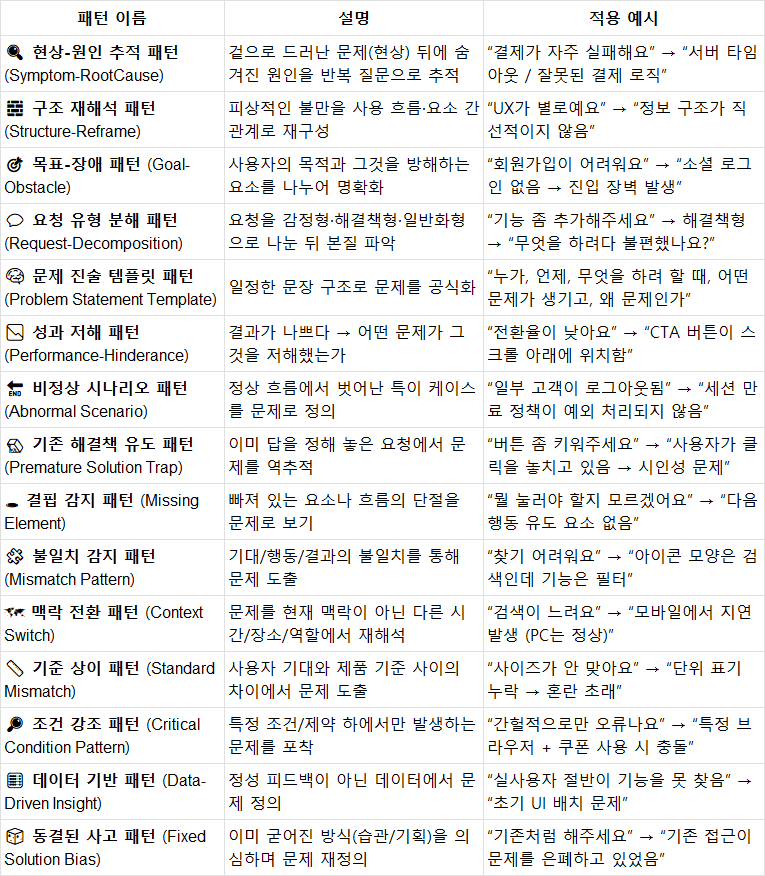
  • 15 major patterns

🎓 Who is this course for?

1. Developers who feel lost in the face of vague requirements

  • When you don't know what to build because the words from the client or planner are too ambiguous

  • Example: “The UX is a bit off,” “It’s slow,” “Please make it more intuitive.”

  • → A state where the ability to transform requests into problems is lacking

Request: "Please make the UX better"
Reaction: "They just said make the UX better... what does that even mean?"

“Have you ever hesitated when someone said, ‘Just make it more intuitive’? Start learning the skill of turning vague requests into clear problems right now.”

2. New or junior employees who lack confidence in the requirements analysis or design phase

  • Not yet familiar with the ability to analyze and structure problems

  • When you remain at the level of simply transcribing what the planner says

  • → Need the skill to define problems on one's own

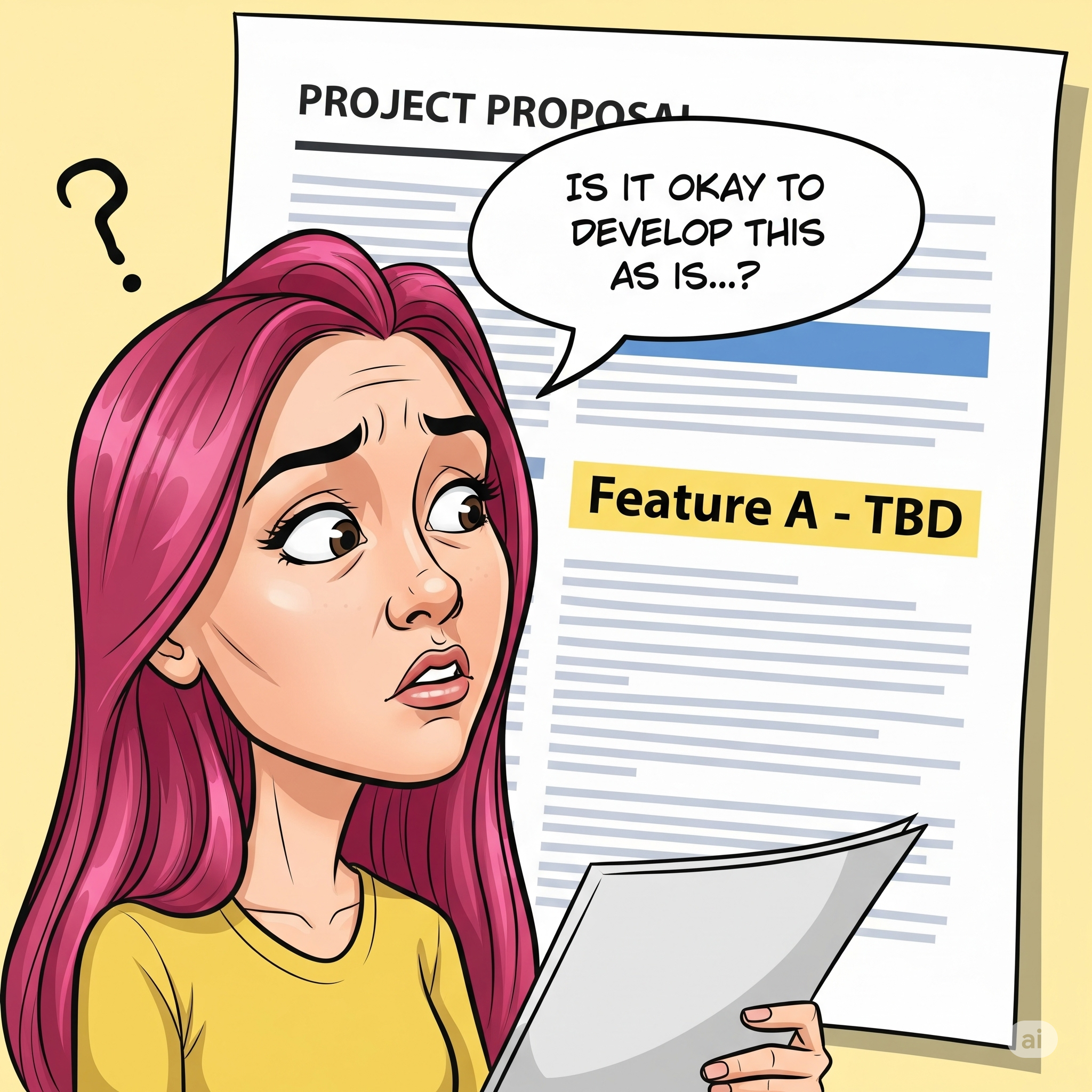
Request: 'OO' feature - currently undecided. Will be decided soon.
Response: "Is it okay to proceed with development in the current state while several features remain undecided?"


“Are you just building exactly what you're told? Grow into a developer who can interpret planning and define problems for yourself.”

3. Developers who have difficulty explaining "why we are developing this"

  • Good at implementing features, but unable to explain why those features are necessary.

  • Difficulty in designing the purpose of development and the context of the problem

  • → Developer → Problem Solver → Someone striving to grow into a Problem Setter

Request: Button size + 10 pixels
Response: "Well... I just thought it would be good to make it that way..."


“What if you can implement a feature but can't explain the reason behind it? Now is the time you need thinking that pierces through to the essence of the problem.”

4. Developers who have difficulty collaborating with planners or designers

  • There is a lot of back-and-forth communication, but no consensus is formed on "what the problem actually is."

  • Feedback is repeated, or communication conflicts occur frequently.

  • → People who want to establish a center for collaboration by structuring different languages

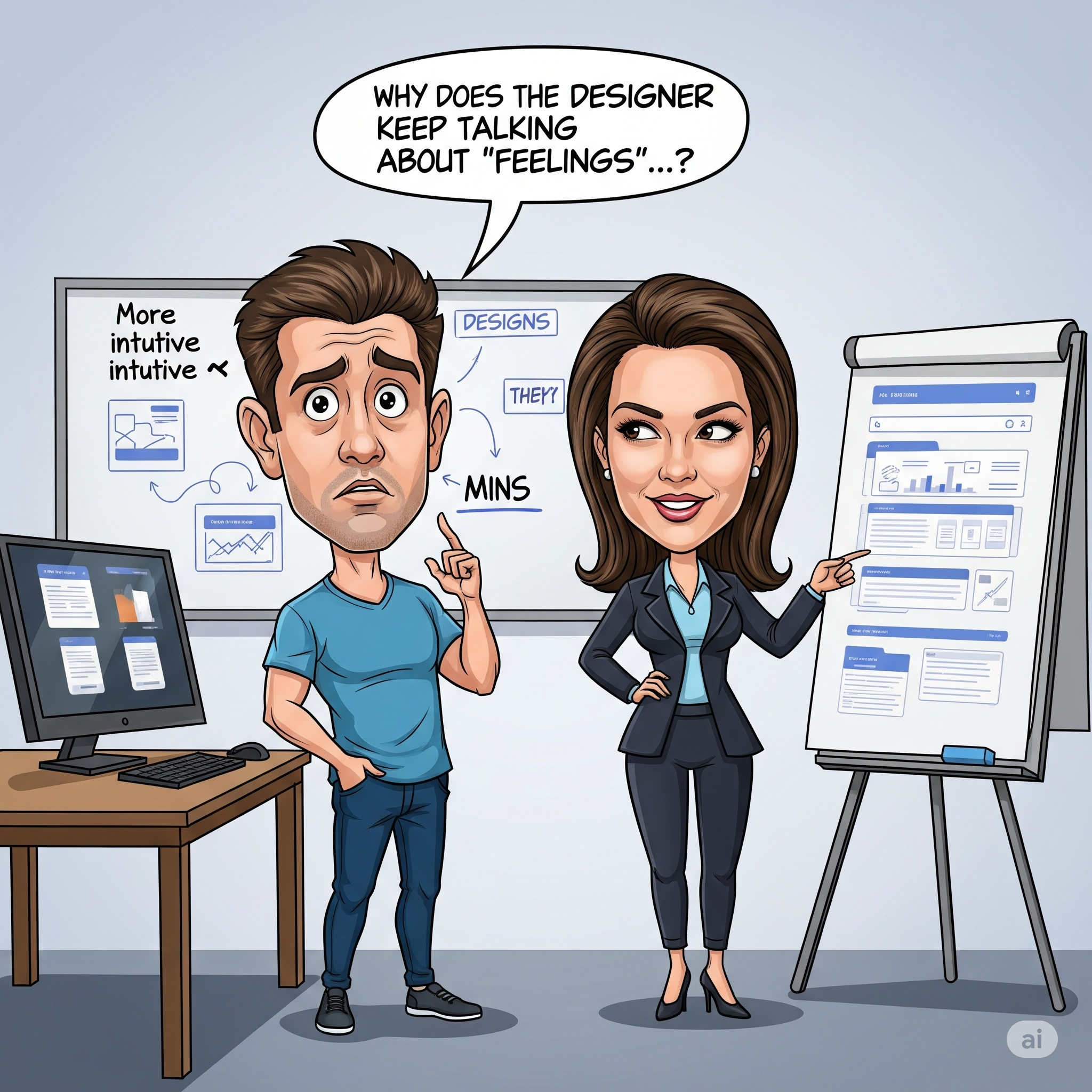
Request: "Please make it feel more intuitive"
Reaction: "Why do designers keep talking about things like a certain 'feeling' .... ?"


“Do you feel like you're not on the same page as the planner? When you organize each other's languages into 'problems,' collaboration changes.”

5. Mid-level or higher professionals preparing for planning, PM, or leadership roles

  • Developers growing into roles where they must define problems and provide direction

  • The ability to structure vague requests into actionable team tasks is required.

  • Defining the problem is the beginning of leadership

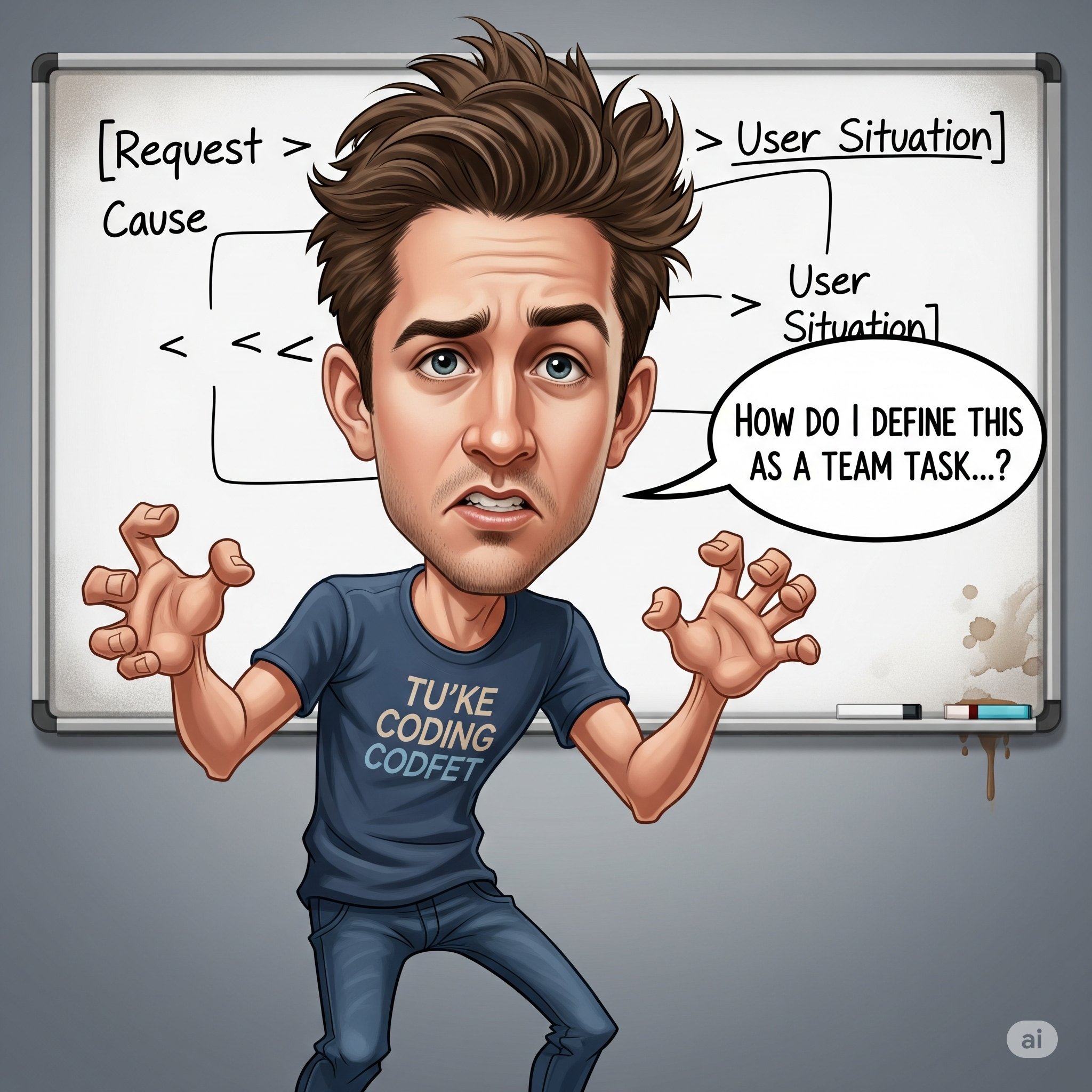
Request: According to the [Request > Cause > User Situation] structure ...
Reaction: "How should I define this to make it a team task?"


“The ability to structure vague requests into actionable tasks is the first step toward becoming a developer who leads a team.”

6. Summary

  • This course is essential for all developers who feel the struggle of "I can write code, but I don't know what I should be building."

  • It is an essential skill, especially for newcomers to junior developers with up to 3 years of experience.

Requirements Gathering Questions: On developer forums and Reddit, posts from juniors and aspiring developers asking "How do I gather and analyze requirements?" are frequently seen. For example, a computer science student sought advice from senior developers, asking, "How do you gather stakeholder requirements in practice?" (reddit.com). This demonstrates the demand for learning how to obtain clear requirements in real-world projects.

Emphasis on Role: According to advice from senior developers, the core of software development is “problem definition,” and it is mentioned that a true expert needs the ability to accurately define requirements (medium.com). Opinions emphasizing the importance of problem definition like this are frequently found in developer communities.

Need for Education: Korean developer blogs cite problem definition skills as a "fundamental" (medium.com), pointing out that when analyzing data or designing systems, it is essential to define the problem to be solved before choosing the tools (inflearn.com, velog.io). Such posts highlight the necessity of problem definition skills for learners.

💡 Course Features

  • Practical-based thinking:

    Structured around real-world collaboration problem cases

  • Short and clear lectures:

    Each lesson is generally structured to be under 10 minutes (with some exceptions), allowing for highly immersive learning.

  • Thought structuring training:

    A slide-oriented lecture that visually organizes the 'thought flow' of defining a problem.

  • Practical Examples:

    Includes conversation methods for turning vague feedback and abstract planning into clear problems.

📂 Curriculum Preview (Partial)

  1. What is Problem Setting – The Starting Point of Problem Solving

  2. Vague requests: where did they go wrong?

  3. 5 criteria for making a problem a true problem

  4. The art of asking "So, what"s the problem?" differently

  5. Code reviews, planning, schedule coordination… every moment where problem setting is applied

💬 Expected outcomes after taking the course

  • You can structure and organize even confusing requests on your own.

  • You can become a developer who gets straight to the point with just one question.

  • You can reduce unnecessary misunderstandings during work collaboration and lead accurate conversations.

  • Review feedback can also be transformed into solvable problems rather than just simple criticism.

💬 Why this course is practically beneficial for developers


1. Covers the problems most frequently encountered in practice

A developer's work always begins with receiving a 'request.' However, most requests are vague and ambiguous. If you cannot transform these into an accurate problem, the planning will go astray, development will spin its wheels, and the schedule will be delayed.

Example: “Please make the button a bit larger” →→ Why? For whom? What is the problem?


2. It is the skill that new hires and juniors lack the most

The most difficult part for new or junior developers is not simple implementation, but the ability to determine 'what needs to be implemented'. This lecture addresses exactly that point.


3. Directly linked to improving collaboration skills

Requirements analysis, code reviews, communication, and consulting with PMs… everything flows smoothly when the problem is well-defined. This lecture trains you in the way of thinking that extracts the essence from what is being said.


4. Provides realistic, practical frames and tools

It is not theory without practice, but rather provides problem statement formulas, feedback criteria, and questioning techniques that can be applied immediately in the field.


In summary, this course helps you become a developer capable of clear judgment and communication without being stopped by questions like “Why should we develop this?” or “Is this a real problem?”

🎯 In today's developer market, these "developers who know how to think" are the ones who grow the fastest.

Now, become a developer who excels at defining problems, not just solving them.

Only when you can see the problem accurately can both problem-solving and growth begin.

Recommended for
these people

Who is this course right for?

  • A developer who wants to cultivate the ability to think and judge for themselves what the real problem is, rather than simply implementing given requests.

  • Planners, designers, and PMs/POs who want to set the team's direction amidst ambiguous requirements and opinions and communicate smoothly with developers.

Hello
This is arigaram

667

Learners

35

Reviews

2

Answers

4.5

Rating

18

Courses

I am someone for whom IT is both a hobby and a profession.

I have a diverse background in writing, translation, consulting, development, and lecturing.

Curriculum

All

73 lectures ∙ (17hr 49min)

Course Materials:

Lecture resources
Published: 
Last updated: 

Reviews

All

3 reviews

5.0

3 reviews

  • paulmoon008308님의 프로필 이미지
    paulmoon008308

    Reviews 111

    Average Rating 4.9

    5

    31% enrolled

    • arigaram
      Instructor

      Thank you.

  • abcd123123님의 프로필 이미지
    abcd123123

    Reviews 330

    Average Rating 5.0

    5

    65% enrolled

    The audio quality isn't great, but it doesn't interfere with studying and the content is good

    • arigaram
      Instructor

      Thank you. I will re-record existing lectures in the future to improve the audio quality.

  • helloworld35님의 프로필 이미지
    helloworld35

    Reviews 2

    Average Rating 4.5

    5

    31% enrolled

    • arigaram
      Instructor

      Thanks.

arigaram's other courses

Check out other courses by the instructor!

Similar courses

Explore other courses in the same field!

$42.90