

“I was able to understand the core principles of how agents work by implementing them myself.”핵심 원리 이해
[Up to 1,500 USD Credit Available] Core Principles and Scalable Development of Practical AI Agents with a Silicon Valley Developer
You know about AI agent frameworks, but understanding how they work and applying them in practice can be difficult, right? Drawing on firsthand experience from Silicon Valley, we’ll guide you from the core principles to practical applications.
127 learners
Level Beginner
Course period Unlimited
Reviews from Early Learners
5.0
5.0
이중권
I was curious about the internal workings of AI but felt lost on how to start, and this lecture has quenched that thirst for knowledge. Thank you for always creating such great lectures.
5.0
02년생 개발자
I found the lecture very informative and helpful. I had only used coding agents superficially before, but through this lecture, I gained a clear understanding of how they work internally. To be honest, I think I’ve gained some confidence that I could try building one myself haha - Of course, there will be many challenges...!! So, the lecture was very beneficial, and I don't think there's a better course for grasping the overall theme and direction. Thank you!
5.0
이건머지
It is being a great help in building my fundamentals, from coding from scratch to handling things using libraries.
What you will gain after the course
Directly implement the core loop structure of an AI agent and understand its principles
Building and Optimizing a Local AI Work Agent Using Ollama
Designing a Practical Tool Calling and Function Execution Architecture
Practical Agent Development with File, Web, and Memory Integration
Understanding the Internal Principles of the Vercel AI SDK and Developing Extensions
Provided by MOONSHOT AI
A total of 1,500 USDworth of Kimi credits
These are Kimi K3 credits used in the bonus section. Once the total amount is exhausted, it will end even before the deadline.
An AI agent that uses tools,
built by hand
This course is a TypeScript course where you first implement an AI agent loop by hand and then rebuild it with the Vercel AI SDK. You’ll write the agent loop once without a framework to see how it works firsthand, and then complete it again with the Vercel AI SDK. A real agent that runs on your laptop—without the cloud or paid APIs. In the final bonus section, you’ll swap out only the agent’s model for Kimi K3 and see how far you can go beyond what a local model could do.
Instead of a hundred words of explanation, one minute is all you need.
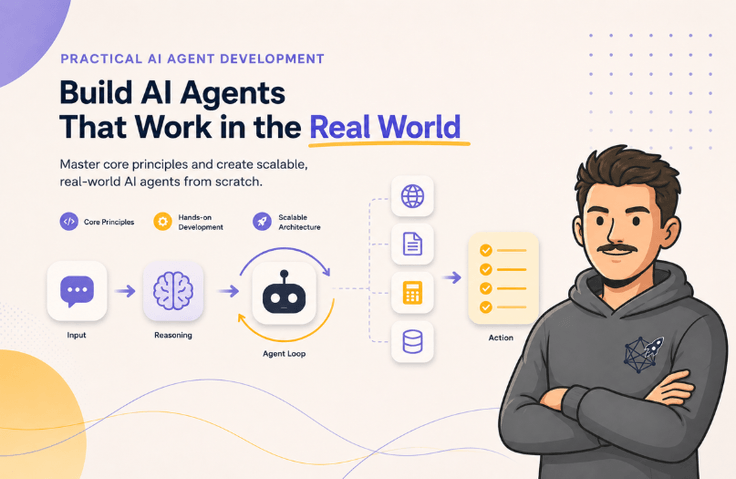
An AI agent is a program that understands a user’s request, selects tools on its own, performs tasks in multiple steps, and then verifies the results. First, see how the finished product actually works. In response to a single-line command, the agent chooses and uses tools, then decides what to do next on its own. The text-based flow below breaks it down step by step afterward.
A complete local work agent demo · Since it uses a local model, the wording may vary slightly with each run.
If you expand the conversation to include the tool calls
Once you turn it on, it can read and write files, perform calculations, fetch content from the web, and remember the user. Before carrying out risky operations, it asks a person for confirmation. Below is the actual conversation flow of the local work agent completed at the end of the lecture.
Tool use, multistep reasoning, memory, and human confirmation. It all runs on code written directly by you.
It does not stop at “knowing how to use it.”
There’s nothing special about it. The order is simply different—we first implement the principles by hand, then build the framework on top of them. Usually, people do it the other way around.
They know how to use a framework. But they don’t know what’s happening under the hood.
Because we wrote the loop ourselves, we know what the framework is doing under the hood. Even when we encounter a new tool, we adapt quickly.
Once by hand, then with the SDK
You’ll first implement the function-calling loop directly in raw code to see how it works, then rebuild the same thing with the Vercel AI SDK. You’ll understand what the framework does under the hood.
100% Local, 100% Free
Run the model on your own computer with Ollama. No API key, payment, or GPU is required. Experiment as much as you like at zero cost. Kimi K3 in the bonus section also supports credits, so you can follow along without making any payments.
We’ll cover robustness too.
We don’t stop at a demo. We build agents that truly hold up in practice—with error recovery, input validation, infinite-loop prevention, and human confirmation for risky actions.
You can start with that sequence right now.
Once you write one by hand, you’ll see frameworks in a completely different light.
지금 시작하기How far can we go by plugging K3 into the same agent?
In the agent we built through Section 7, we simply swap the model for Kimi K3. We leave the code almost entirely unchanged. We directly compare how far it opens up tasks that a small local model couldn’t handle—and what remains the same. Created together with Moonshot AI, with Kimi credits totaling 1,500 USD available on a first-come, first-served basis until August 21.
MOONSHOT AI · Collaboration Section
Moonshot AI’s latest flagship model. Start by writing this name in a single line of code.
OFFICIAL K3 MODEL SPEC
BrowseComp 90.4 is Kimi’s officially published evaluation score. It was measured without context compression using a 1M-token context and the max reasoning intensity setting.
Kimi K3 공식 성능 근거 보기 →Kimi credits worth a total of 1,500 USD · First come, first served
Until August 21 · First come, first served · Ends when supplies run out · The application link is in the lecture
Kimi CLI is this kind of tool.
Whole, without cutting it up
The context window is 1,048,576 tokens. You can insert a 3,600-line code file as-is without splitting it and ask, "Where is this value determined?"
The error screen as-is
It does not require OCR. If you capture a broken screen and send it as is, the model reads it and pinpoints the bug. It can be built into a tool and connected to the agent loop as well.
Parallel sub-agents
The orchestrator breaks the work down, distributes it to sub-agents, and gathers the results again. Up to 300 can run simultaneously (Beta, for members).
This is a scene where an image was inserted as-is to have it find bugs. We try it ourselves in Section 8.
It is a 2.8-trillion-parameter MoE model. We begin by reading the official blog together and distinguishing what has been empirically measured from what is merely marketing.
At the end of each section, the agent grows by one stage.
Rather than viewing it as a table of contents, it’s better to look at what gets added at each stage. I’ve noted what your agent will newly be able to do after completing each section.
What Is an Agent, and What Will We Build?
- The True Nature of AI Agents and Agent Loops
- The Big Picture of the Concepts You’ll Learn in This Course
- Preparing the development environment and setting up Ollama and a tool-calling model
Hand-Built Agent
- The meaning of the messages array and function calls
- Defining tools, executing them, and checking the results
- Write the agent loop yourself and add more tools
- Observing Multi-Step Reasoning, Infinite Loops, and Stopping Conditions
Rebuilding with the Vercel AI SDK
- Introduction to the Vercel AI SDK and Ollama Integration
- generateText call, tool definitions, and Zod schemas
- Step tracking, response streaming, and multi-step patterns
Local Work Agent — Tool Integration
- Tool schema design principles and a safe workspace
- File reading, writing, listing, and search tools
- Fetching Web Pages, Context-Saving Patterns
- Practical Scenarios for Chaining Multiple Tools
Agent Memory
- Why Memory Is Needed and the Limitations of the Context Window
- Managing Old Context and Designing Long-Term Memory
- Demonstration of tools for storing and recalling facts, and an agent that remembers
Robustness and Control
- Why Local Models Go Off Track and Loop Control
- Validate inputs, return errors as results, and recover
- Behavioral rules and human confirmation patterns through system prompts
- Debugging and Handling Common Failure Patterns
Capstone — A Complete Local Task Agent
- Capstone Design, Thin REPL Harness, Loop Assembly
- Streaming polish, multi-step end-to-end demonstration
- What We Didn’t Cover and Next Steps, Wrap-Up
Swap the same agent to Kimi K3.
- Read the official K3 blog together to distinguish its features from its limitations
- Run the agent built through Chapter 7 as-is with Kimi.
- Execute work workflows, coding workflows with Kimi CLI
- Throw in an image of the error screen as-is to find the bug
- Insert long code and documents in their entirety without cutting them.
- Differences from Claude · Codex, Token Cost Calculation
- Parallel execution of sub-agents with Agent Swarm
- Pricing, Adoption Decisions, and When to Use It
This is a bonus section created together with Moonshot AI, the company behind Kimi. We’re offering a total of 1,500 USD worth of Kimi credits on a first-come, first-served basis until August 21. There is no separate per-person limit, so the earlier you apply, the more generously you can receive. The offer ends when the deadline passes or the credits run out. The application link is included in the course.
If you’ve watched this far, it’s time to start with Step 1.
You can get started right away by installing just Ollama. The cost is 0 won.
수강 시작하기One agent, done properly from start to finish
We’ll go from the underlying principles all the way to completion. By the end of the course, you’ll be able to build things like these yourself.
You’ll build it yourself in this course.
- Implement the agent loop by hand yourself
- Using the Vercel AI SDK and How It Works Internally
- Function calling (tool use) and multi-step reasoning
- Integrating file, web, and calculation tools
- Short-term and long-term memory
- Error recovery · guardrails · human confirmation
- Swapping in the Kimi K3 Model (Bonus)
This is suitable for those who fit the following profile, and this is all you need to prepare.
◆Recommended for these people
- Those who are trying to properly build an AI agent for the first time
- Those who have found it frustrating to use frameworks as black boxes
- Those who want to be able to use it and understand how it works"
- Those who want to experiment freely on their local machine without worrying about costs
◆Requirements
- TypeScript / JavaScript Basic Syntax
- Experience using Node.js and npm
- macOS environment (using zsh)
- Install Ollama — CPU is sufficient without a GPU
A developer who likes building things from the ground up, starting with the underlying principles
Silicon Valley Developer Waddy
I’m Waddy, a backend server developer with 13 years of experience. After developing at various companies in Korea, I recently moved to Silicon Valley, where I’m now working on AI-related development.
I connected with a developer friend at Toss and ended up joining this way. I’m very excited about being able to provide a wide range of information online. I’ll do my best to share the knowledge I have in the easiest and most accessible way possible.
"Anyone can use a framework. Once you build one yourself, even just once, you’ll see those tools in a completely different way. That perspective is ultimately what makes the difference in skill."
Things You May Be Wondering About First
Can beginners who have just started coding follow along as well?
Do I need a GPU or a paid API?
What is Kimi K3, which is covered in the bonus section?
Don't you use frameworks like LangChain?
Is it possible on Windows as well?
What will I take away from the course?
Is there any reason to take this course even if I’ve already used the Vercel AI SDK?
A student who implemented it themselves gave this review:
“After implementing the agent loop and then rebuilding it with an SDK, I was able to see what was inside for the first time.”구조를 이해하는 실습
“You explained the core concepts in an easy-to-understand way, which made the course even more valuable.”쉬운 설명
“I initially thought it would be difficult, but I was able to take the course comfortably because the content was explained in an easy-to-understand way.”진입 장벽 완화
“I was able to understand the core principles behind how agents work by implementing them myself.”핵심 원리 이해
“Because we first implement the agent loop and then rebuild it with an SDK, I was able to see what was inside for the first time.”구조를 이해하는 실습
“You made the core concepts easy to understand, which made the course even more valuable.”쉬운 설명
“I initially thought it would be difficult, but you explained it in an easy-to-understand way, so I was able to take the course comfortably.”진입 장벽 완화
This review is excerpted from an actual Inflearn course review for an AI agent course. It is displayed separately to avoid being mistaken for a review of the course on this page.
AI Agents—Now Build One Yourself
Open the black box and complete an agent that works with your own hands.
수강 시작하기TypeScript · Ollama Local
So it doesn’t end with listening alone
Learning continues beyond the course. We run a KakaoTalk open chat where developers gather to freely share career concerns, real-world work situations, and technical topics. If you get stuck while taking the course, feel free to ask questions.
KakaoTalk open chat where developers gather
From career topics and real-world work situations to technical concerns—a space where you can casually ask questions and find answers together.
open.kakao.com/o/ggBVZsai
Recommended for
these people
Who is this course right for?
Developers seeking the core principles of AI agent development and their practical application
Developers with experience using LangChain/SDKs who want to understand the underlying principles.
Developers looking to build practical workflow automation AI beyond a simple chatbot
Developers who want to experiment with agents in a local AI environment without relying on paid APIs
Developers looking to strengthen their competitive backend development skills in the AI era
Hello
This is Hong
Inflearn Verified
Career Verified
9,245
Learners
591
Reviews
165
Answers
4.8
Rating
31
Courses
I started studying development after becoming interested in it while idling at home, and I am currently responsible for platform server development in Pangyo. I am continuing my activities as a knowledge sharer because I want to provide you with the methods I used to study, as well as the various problems and solutions you may encounter in practice.
These lectures are not created solely through my own knowledge. There are others who collaborate on every lecture.
Choi, who is working as a server developer and interviewer at Kakao
A server developer currently working at Toss
Ande, who worked at Shinsegae Group and is now a developer at NaverAnde
Silicon Valley developer who joined by the recommendation of a Toss developer, Waddy
[Instructor Career]
[Former] Blockchain developer related to Sandbox IP
[Former] Metaverse Backend Developer
[Current] A server developer becoming a veteran in Pangyo
[Interview History]
[Other Inquiries]
[Official Site]
Curriculum
All
36 lectures ∙ (6hr 57min)
Course Materials:
Reviews
All
16 reviews
5.0
16 reviews
rudnfai2986Reviews 5
∙
Average Rating 5.0
Edited
5
14% enrolledI was interested in AI agents, but until now, I had only gone as far as following examples using LangChain or various frameworks. Because of that, I only had a vague understanding of how agents actually operate internally, why Tool Calling is necessary, and how the Agent Loop functions. The best part about this lecture was that, rather than relying on complex frameworks from the start, I was able to understand the core principles of how an agent works by implementing them myself. I had heard the term "agent" many times but was curious about exactly how they are implemented; I am very satisfied that I was able to build one firsthand. Before taking the course, agents felt like a somewhat abstract concept, but now I have a clear mental framework of how to design the structure and what needs to be controlled when creating an agent. I highly recommend this course to anyone who wants to build a single agent from scratch, from start to finish.
- jhongInstructor
Thank you for leaving such a thoughtful review. Since it’s implemented with a small model, it isn’t a 100% perfect agent, but it’s designed so that you only need to swap out the model you use, making it easy to tune whenever you want. Have a great day!
lslsk08018196Reviews 6
∙
Average Rating 5.0
- anarira
Reviews 2
∙
Average Rating 5.0
5
19% enrolledThis curriculum first implements the tool-calling loop at the core of an agent directly in vanilla TypeScript to understand how it works, then refactors it using the Vercel AI SDK. It helps you understand what the framework handles internally and covers realistic challenges you encounter in production, such as preventing infinite loops, automatically recovering from errors, and requiring human approval for risky operations. It seems like a useful course for developers who want to control agents reliably in real-world applications.
- jhongInstructor
Thank you for leaving such a great review!! I felt that, rather than simply using commercially available AI Agents, it would be more fundamental to learn how they work internally, so I put this together. I hope you gain lots of insights from it, haha. Have a great day!
rgunnyReviews 3
∙
Average Rating 5.0
5
33% enrolledUntil now, I intentionally avoided diving deep into AI-related technologies. I prioritized other areas of learning because I believed that having a high-level understanding of my own technical stack was more important in the AI era. However, as AI evolves faster than expected, I began to feel that even simple side projects felt incomplete without some form of AI integration. Through this lecture, I easily gained insights into local LLMs and how to utilize them, enabling me to apply these technologies without worrying about costs. Up to Chapter 3, there were no difficult parts for a standard backend developer. However, I think the true charm of this course lies in learning the instructor's development philosophy and habits—things that aren't easily observed elsewhere. I'm learning a lot!
- jhongInstructor
That’s right. These days, it seems like most people intentionally avoid learning. - Since it does everything for them, they seem to think, “I’ll just use it.” However, as you mentioned, I wanted to include TMI-like elements such as philosophy and habits, while also showing you what direction you should take. Have a great day!
tellmemoreReviews 1
∙
Average Rating 5.0
Edited
5
8% enrolledI was able to learn the principles of AI Agents by building one myself. Previously, I only used AI for asking and answering questions in a chat format, but by implementing how an AI Agent works internally from scratch, I was able to understand AI systems. It was exactly the lecture I needed. Thank you!
- jhongInstructor
In fact, I don’t think the chatbot approach makes perfect use of AI agents. I recommend creating a more mature service based on the Loops and Tools I’ve shared with you. Thank you.
Hong's other courses
Check out other courses by the instructor!
Similar courses
Explore other courses in the same field!


![[AI Cheat Sheet] The secret to finishing work instantly, Agentic AICourse Thumbnail](https://cdn.inflearn.com/public/files/courses/340717/cover/ai/1/3b5cb844-25b5-4576-8224-d293d0989376.png?w=420)