inflearn logo

Practical LLM Service Development for Spring Developers

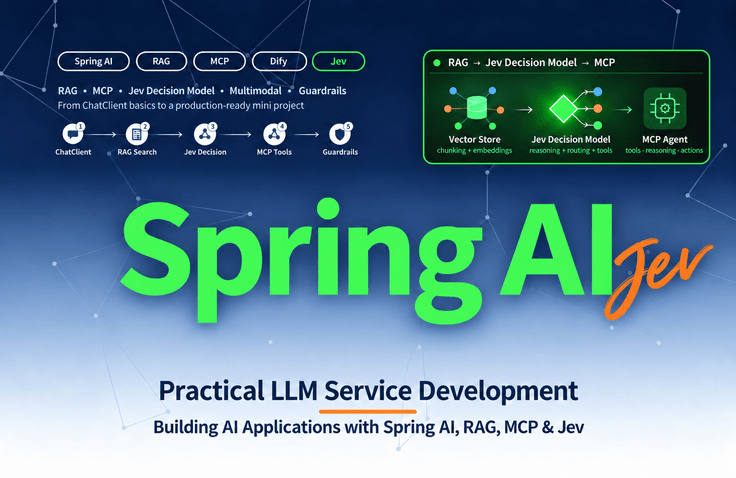
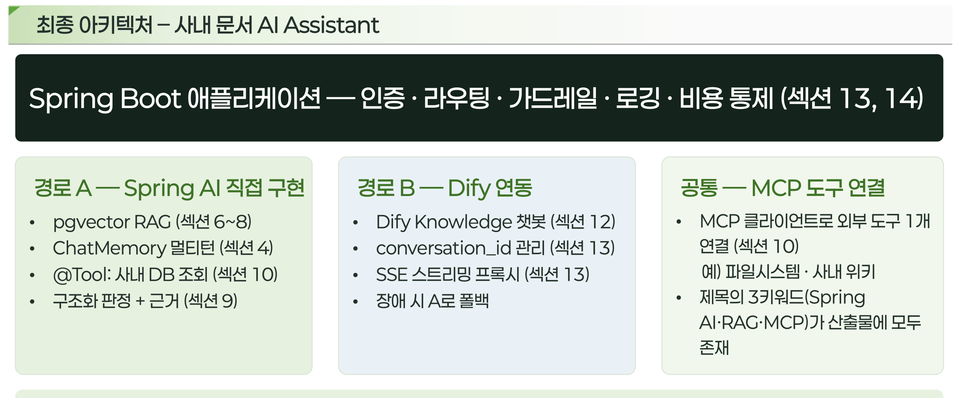
This is a hands-on course on building a RAG-based document search system using the OpenAI API and Spring AI in a Spring Boot environment. You will learn the entire process of developing an AI assistant step by step, from the concepts of prompt engineering, vector stores, and embeddings to rapid prototyping with Dify, MCP tool integration, multimodality, and guardrails. You can learn practical implementation strategies by comparing direct development with the use of no-code tools.

21 learners are taking this course

Level Basic

Course period Unlimited

openai
openai
vector-database
vector-database
prompt engineering
prompt engineering
RAG
RAG
Spring AI
Spring AI
openai
openai
vector-database
vector-database
prompt engineering
prompt engineering
RAG
RAG
Spring AI
Spring AI

What you will gain after the course

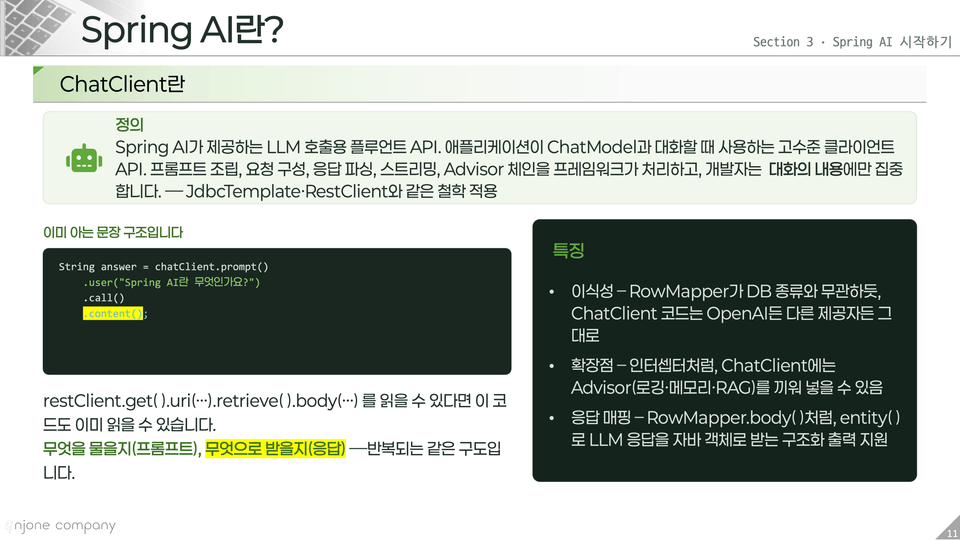
  • Practical Experience Implementing ChatClient, Structured Outputs, and Streaming Responses with Spring AI

  • The ability to build a vector store–based RAG pipeline from design to chunking strategy.

  • Experience completing production-grade LLM services, from MCP tool integration and multimodal processing to applying guardrails.

  • How to Configure a Dify Knowledge–Based AI Assistant and Integrate It with Spring Boot

Complete LLM Services with Spring, from RAG to Production

This course aims to equip Spring Boot developers with the LLM service development skills they can use right away in real-world projects. Starting with Spring AI’s basic use of ChatClient, structured outputs, and streaming response implementation, it progressively covers building RAG pipelines (vector store integration, chunking strategies, and search quality improvements), integrating external tools using MCP, processing multimodal inputs such as images, Dify integration, and applying guardrails for service stability. Finally, you will complete a practical service-like deliverable through a mini-project that integrates what you have learned.

  • Internal document/knowledge search: Transform internal documents, manuals, and wikis into a searchable chatbot using a RAG pipeline

  • Commerce/Retail AI integration: Configure LLMs to directly call backend functions such as order lookup and product recommendations through MCP-based tool integration (incorporating patterns used in an actual large-scale retail MCP commerce integration project)

  • Financial/Enterprise AI Services: Designing AI service architectures for the financial sector, where response reliability and stability are critical, by applying guardrails

  • Multimodal document processing: Services that analyze documents containing images (such as contracts and reports) together

Features of This Course

📌Rather than just explaining the theory, you will practice hands-on with a runnable Spring Boot example project.

📌 We share the real-world problems you may encounter when building a RAG pipeline (chunking strategies, degraded search quality, etc.) and how to solve them.

📌 Reflects the latest ecosystem trends from a practical perspective, including MCP, multimodality, and Dify integration

📌 Experience the structure of a complete service, rather than individual features, through a mini project :)

Recommended for people like these

I want to level up my LLM development skills.
For those with Spring backend experience who are unsure where to start with LLM services

I'm interested in building RAG services.
Those who know RAG only as a concept and want to understand its principles through hands-on implementation

I’m interested in the Spring AI development course.
Professionals who need to build internal document search, chatbot, and AI assistant features using Spring.

After completing the course,

  • You will be able to design and implement your own LLM service using the core components of the Spring AI ecosystem. You will develop the ability to turn ideas into service architectures by combining ChatClient, vector stores, MCP, and guardrails.. Bạn sẽ nắm được cách kết hợp ChatClient, kho lưu trữ vector, MCP và guardrail để chuyển ý tưởng thành cấu trúc dịch vụ.

  • You will be able to independently diagnose and improve issues arising in RAG pipelines. You will develop practical debugging skills to identify and fix the causes of poor search quality by examining them at the level of chunking strategies, prompts, and vector search parameters.. Bạn sẽ phát triển năng lực gỡ lỗi thực tế bằng cách phân tích và khắc phục nguyên nhân khiến chất lượng tìm kiếm giảm sút theo từng yếu tố như chiến lược chia nhỏ, prompt và tham số tìm kiếm vector.

  • You will be able to take charge of and carry out the work of converting internal documents and manuals into a searchable chatbot. You will reach a level where you can design an end-to-end RAG-based knowledge search system, from requirements analysis through implementation.. Bạn sẽ đạt đến trình độ có thể thiết kế hệ thống tìm kiếm tri thức dựa trên RAG từ đầu đến cuối, từ phân tích yêu cầu đến triển khai.

  • You will be able to design integrations that use MCP to let LLMs directly call backend functions (retrieval, recommendations, processing, etc.). You will be able to independently map out architectures that connect existing APIs, such as those for commerce and internal systems, to LLM workflows.

  • You will be able to lead the initial architecture of AI services that require guardrails and reliability standards (such as finance and internal regulatory compliance). You will be able to participate in design discussions based on the standard of a "service you can trust and use," not merely a "working demo.". Bạn sẽ có thể tham gia thảo luận thiết kế dựa trên tiêu chuẩn của một {{"demo hoạt động được"}} chứ không chỉ là {{"dịch vụ có thể tin tưởng để sử dụng"}}.

You will learn the following.

1. Spring AI Core Fundamentals

  • Basic structure and invocation methods of ChatClient, and prompt template configuration

  • How to safely map LLM responses to Java objects using Structured Output

  • Implementing Streaming Responses — Backend design to support a chat-style UI that displays answers in real time

2. Tool and Multimodal Extensions

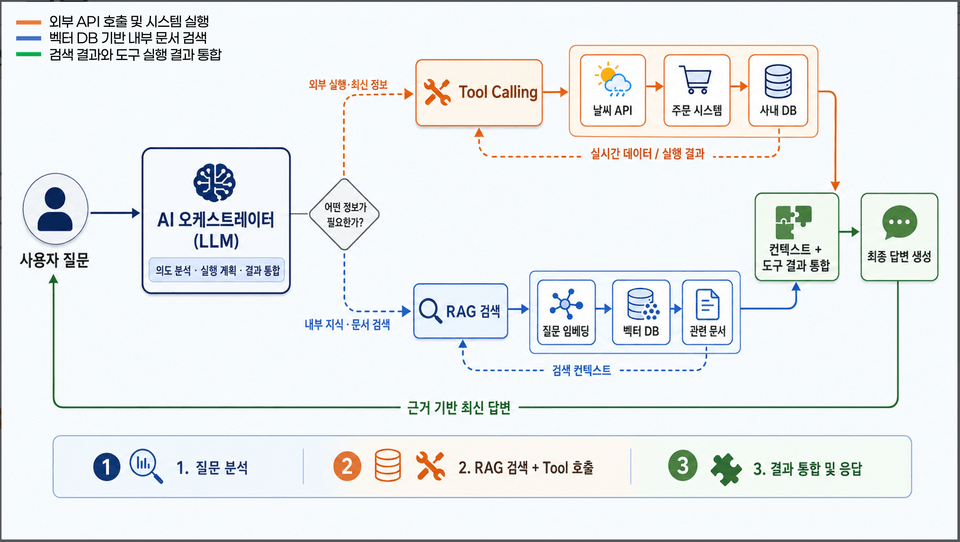
  • Integration using MCP (Model Context Protocol) so that the LLM can directly call external tools (backend functions such as retrieval, processing, and recommendations).

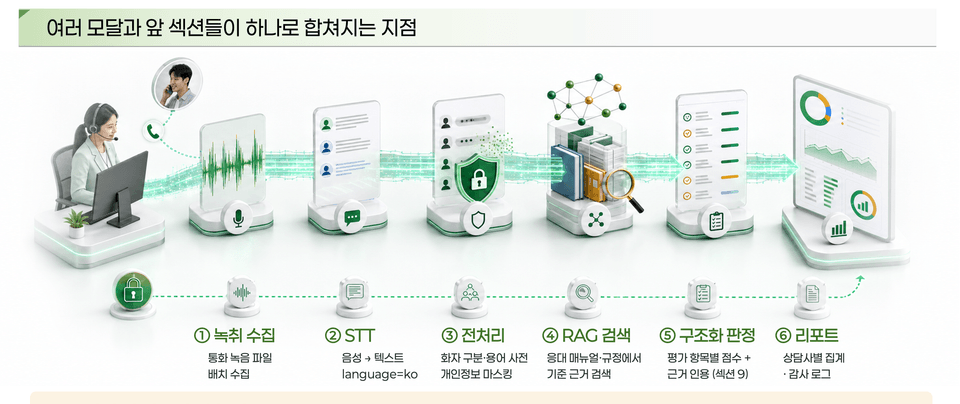
  • A service architecture that processes multimodal inputs, such as images, together (including examples of analyzing mixed document-and-image content such as contracts and reports)

  • How to integrate Dify to combine no-code workflows with a Spring backend


3. Building a RAG Pipeline

  • Designing Vector Store Integration and Embedding Storage/Retrieval Architecture

  • Comparison of document chunking strategies (token-based vs. paragraph-based) and criteria for choosing between them depending on the situation — an introduction to a case where search quality deteriorated in practice and the strategy was changed

  • How to diagnose and improve factors that degrade search quality (such as damaged semantic units and the inclusion of low-relevance chunks)


4. Service Stabilization and Real-World Projects

  • How to filter out incorrect responses and exploitable inputs by applying guardrails

  • Reliability design standards required in domains where trustworthiness is important, such as the financial sector

  • Conducting a mini project that integrates all the elements learned so far (ChatClient, RAG, MCP, multimodality, and guardrails) into one cohesive whole.

The person who created this course

"Knowledge in your head is not knowledge." With this thought in mind, I strive to package the small amount of experience and knowledge I have and explain it in a way that is easier to understand. I believe this will be a more accessible course for those who are interested in the fields of LLMs and AI based on Java and the Spring Framework.

  • With 26 years of experience in teaching, consulting, and development, I conduct lectures with explanations designed to help participants understand practical experience and know-how.

  • My current work as an architect and engineer: I personally design and develop GraphRAG-based knowledge graph systems and enterprise AI platforms.

    • 2023 ~ Present: CEO of NJ One Company Co., Ltd.


    • Formerly) Adjunct Professor, Department of Information Security, Graduate School of International Information, Dongguk University

    • Former) JP Morgan Chase AMJ Tech consultant (Japan)

    • Formerly a Principal Engineer in the CMS Business Division at Samsung SDS

  • AI/LLM projects in the financial sector: By repeatedly carrying out AI·LLM-related projects in the financial sector, I gained hands-on experience designing and implementing LLM services in the financial domain, where reliability and stability are especially important.

  • Years of teaching MSA, cloud-native technologies, and AI: I teach courses in Spring Boot, Spring Cloud, MSA, Kafka, Blockchain, Machine Learning, Deep Learning, and DevOps.

  • Corporate training and curriculum design: I have designed curricula and taught courses for numerous companies and boot camps in areas including cloud, MSA, security, and AI. My guiding principle is to incorporate hands-on project experience into my lectures rather than stopping at theory.


Do you have any questions?

Q. Can I take this course even if I know nothing about AI or machine learning?

A. Yes, it is. This course covers LLM service development from a Spring developer’s perspective, explaining AI-related concepts as needed.

Q. Will the exercises incur any costs?

A. Using LLM APIs may incur costs, and we also provide guidance on hands-on exercises using local models (such as Ollama). The total cost of taking the course may vary depending on how many times you run the exercises, but approximately $1~$2 in API costs may be incurred. The course uses models provided by OpenAI.

Q. Can I follow along even if I’m new to RAG and MCP?

A. Yes, the course is structured step by step, from explaining the concepts to hands-on practice, so even beginners can follow along without difficulty.

Q. Can I apply what I learn to a real service after completing the course?

A. The mini project in the latter part of the course reflects the structure of a real-world service, so you can apply it directly to an in-house project or a personal service.

Things to Know Before Taking the Course

Practice environment

  • The course is explained based on macOS (Sequoia 15.7.4), but those using Windows can also follow along easily.

  • In this course, we will practice using IntelliJ IDEA and Postman based on OpenJDK 21+.

  • Maven or Gradle is used as the build tool.

  • Docker Desktop must be installed to run a Docker container for the PGVector exercises.

  • Postman is used to test the implemented APIs and directly call and verify streaming responses.

Learning Materials

  • Section-by-section slide materials (in Korean) provided (PDF files)

  • Provide an executable Spring Boot example project (GitHub repository provided)

Prerequisites and Notes

  • Basic experience with Spring Boot is required (understanding of REST APIs).

  • No prior knowledge of AI/LLMs is required.

  • An LLM API key (or an environment for running a local model) may be required for the hands-on exercises (details will be explained in the exercise examples).

Recommended for
these people

Who is this course right for?

  • A backend developer with Spring Boot experience but no prior experience developing LLM/AI services

  • Developers who want to apply RAG, vector search, and more to real-world projects—not just at a tutorial level

  • An AI service planner who wants to understand RAG and LLM technologies through hands-on practice

  • Practitioners who need to directly implement in-house AI features (chatbots, document search, recommendations, etc.) using Spring.

Need to know before starting?

  • Understanding Spring Boot Basics and REST API Concepts

  • Understanding of Java programming fundamentals and object-oriented concepts

  • Basic understanding of HTTP communication and JSON data processing

Hello
This is Dowon Lee

Inflearn Verified

30,934

Learners

1,757

Reviews

1,381

Answers

4.8

Rating

9

Courses

I am an IT engineer. There was a time when I wondered which word I should choose for the occupation field: "office worker?", "developer?", or "instructor?" Then I came to think that “IT engineer” was the job title that suited me best, so I have continued to write "IT engineer" in the occupation field.

A profession represents the work you do, and I believe that work should be enjoyable and useful. Although no one can live by doing exactly the work they want, I am someone who likes the work I do and wants to do it well. Having worked as a developer, instructor, and consultant, I am constantly struggling to keep up with newly released and ever-changing IT technologies. Even so, I am one of those people who wants to encounter, share, and use them even a little earlier than others.

The field I have recently become interested in is online education consulting. The technologies I am interested in include Cloud Native Architecture, Blockchain, Machine Learning, Kafka, and Kuberbetes. I actually teach courses on these technologies and apply them in my work as well. However, since they are such vast topics, I am still continuously studying them.

They say that what you keep in your head is not true knowledge. I intend to share my knowledge and experience in various ways. And I will continue to be an IT engineer who takes on new challenges in new fields and with new technologies.


  • Current) CEO of NJ One Company

  • Current) Adjunct Professor, Department of Information Security, Graduate School of International Information, Dongguk University

  • Former) JP Morgan Chase AMJ Tech consultant (Japan)

  • Former) Samsung SDS CMS Business Division Lead Engineer



More

Curriculum

All

124 lectures ∙ (19hr 38min)

Course Materials:

Lecture resources
Published: 
Last updated: 

Reviews

Not enough reviews.
Please write a valuable review that helps everyone!

Dowon Lee's other courses

Check out other courses by the instructor!

Similar courses

Explore other courses in the same field!

Limited time deal

$19,470.00

70%

$50.60