Essential Backend Concepts You Must Know When Coding with AI ②
Have you ever actually run a service you built? Deployment and observability, external integrations and queues, files and extensions, and operating AI features. This is Part 2, where you learn what else needs to be decided to keep an AI-built backend serving real users continuously.
You can determine what needs to be checked before and after deployment, and whether it’s okay to start accepting requests as soon as it’s turned on.
You can read logs, metrics, and alerts to narrow down where the problem occurred.
You develop criteria for designing services to withstand failure-prone operations such as external APIs, queues, files, and AI responses.
All the Knowledge of Backend in the AI Era · Part 2
Let's run the service we built in a real-world environment.
The server is up, but is it ready to open to users?
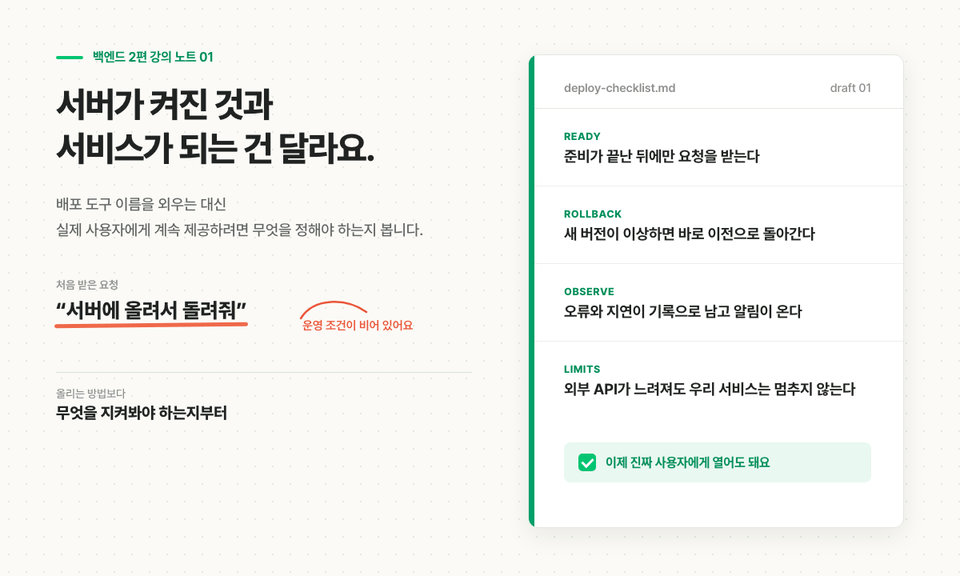
If you tell the AI, “Put it on the server and run it,” it will somehow get it up and running. But no one has decided what happens if the service briefly goes down while deploying a new version, whether our service will also stop if an external API slows down, or who will find out and how when an error occurs. We leave those gaps unaddressed and accept users anyway.
This course is not about learning how to use deployment tools. It is a principles-based course that walks you through, in order, what else needs to be decided for the service created in Part 1 to remain available to real users: deployment and observability, external integrations and queues, scaling, and operating AI features.
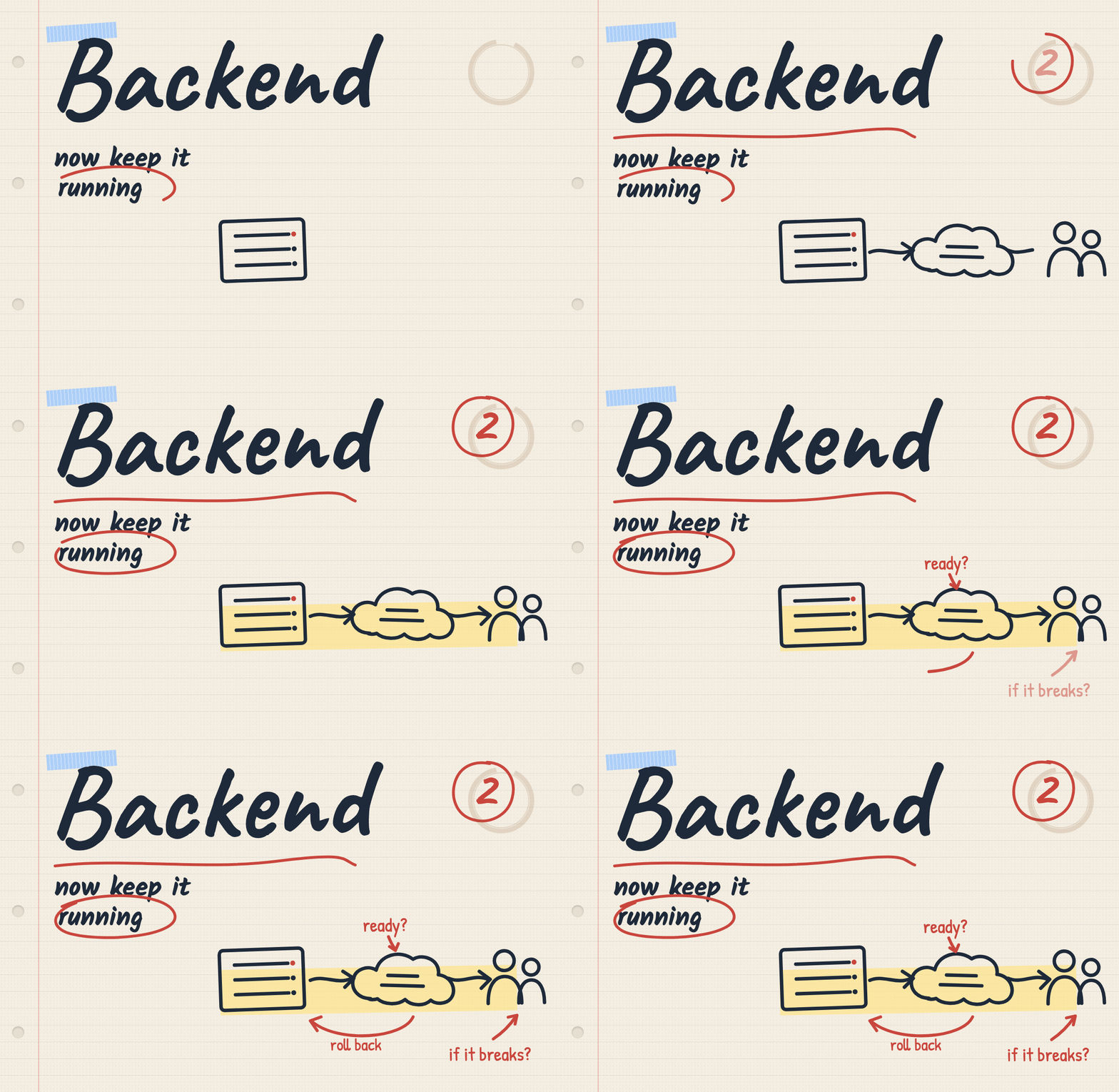
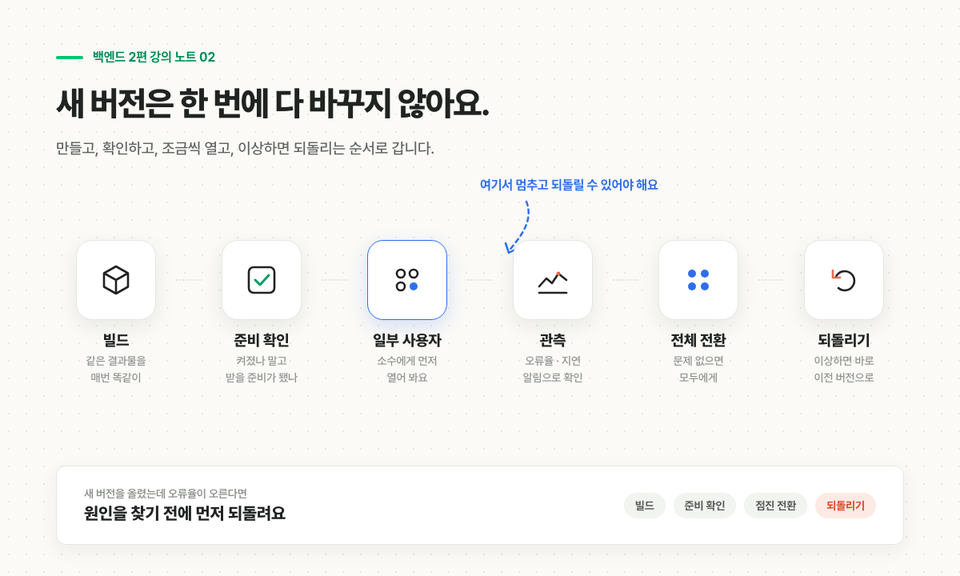
Instead of saying it’s on, you can say it’s ready, reversible, and observable.
01 · Reframing the Problem
A server being on is different from a service running properly.
Code that ran well on my computer throws an error briefly right after deployment, and on days when an external AI API slows down, even unrelated screens freeze along with it. When the number of users increases, you can’t tell from the code alone what will bottleneck first or who handles the long-running tasks instead.
It’s not because AI can’t deploy. It’s because we haven’t defined the conditions that must be monitored in production. Part 2 is a map showing where those conditions are hidden.
Are you ready?
Can we start accepting requests as soon as it’s turned on? What should we check before opening it up?
Can it be rolled back?
If the new version behaves strangely, can we revert to the previous version within a few minutes?
Is it visible?
Are errors and delays recorded, and if a problem occurs, who will find out and how?
Can it withstand it?
Will our service continue responding even if external services slow down or there is a surge of users?
If you can answer these four questions, you’ll have operational requirements to give the AI, as well as a basis for reviewing the configuration and code it returns. The course addresses these questions one by one, in the following order: deployment, observability, external integrations, queues, files, scaling, and AI features.
02 · From Deployment to AI Operations
Let’s run a service from start to finish.
First, let’s look at how to deploy and monitor it.
We separate the environment and configuration so it works with the same results outside my computer, and accept requests only after confirming everything is ready. We first roll out new versions to a small group of users, then watch the error rate and latency before expanding to everyone or rolling back. We distinguish which questions logs, metrics, tracing, and alerts each answer.
Then, make it resilient to slowdowns and traffic surges.
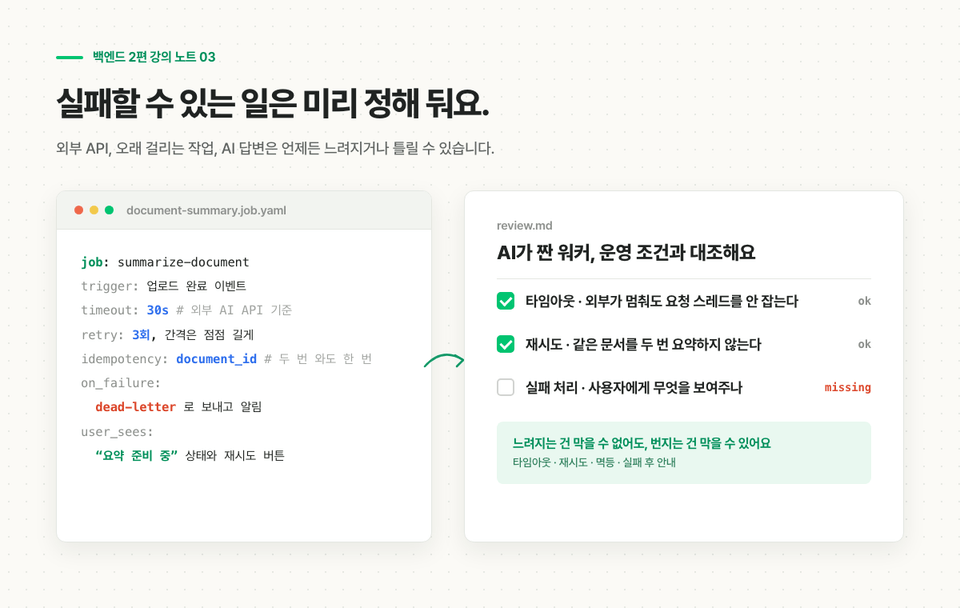
Handle timeouts, retries, and circuit breakers when external services slow down; delegate long-running tasks to queues and workers, and define idempotency and failure handling. Add file uploads, storage, and search, then identify bottlenecks as the number of users grows and prioritize what to change first.
Finally, we operate AI features like a real service.
We tailor AI responses to fit our service, make them find and use our documents as evidence when answering, and eventually entrust them with executing real tools. We first understand the reasons behind where to place permissions and confirmation procedures, execution logs and resumption, and points for human intervention.
03 · A Single Continuous Case Study
Continue the 50-lesson series with the same team document service
We carry over the same team document service from Part 1, where we followed requests and APIs, data, and authentication. We then add file uploads and document processing, search, AI answers, and tool execution one by one, proceeding through deployment and observability, external integrations and queues, scaling, and AI operations in sequence.
There are no coding exercises or environment setup. We only read brief configurations, logs, and pseudocode when needed, and explain the principles through flowcharts and comparison tables. We focus on the core principles of operations without being tied to any specific cloud or framework.
This is a continuation of Part 1.
The full series consists of 100 lessons in total: 50 lessons in Part 1 and 50 lessons in Part 2. Part 1 covers the principles of handling requests and data correctly, while Part 2 covers the principles of actually running that service. Even if you haven’t taken Part 1, you can follow along as long as terms like requests, APIs, databases, and authentication are familiar to you.
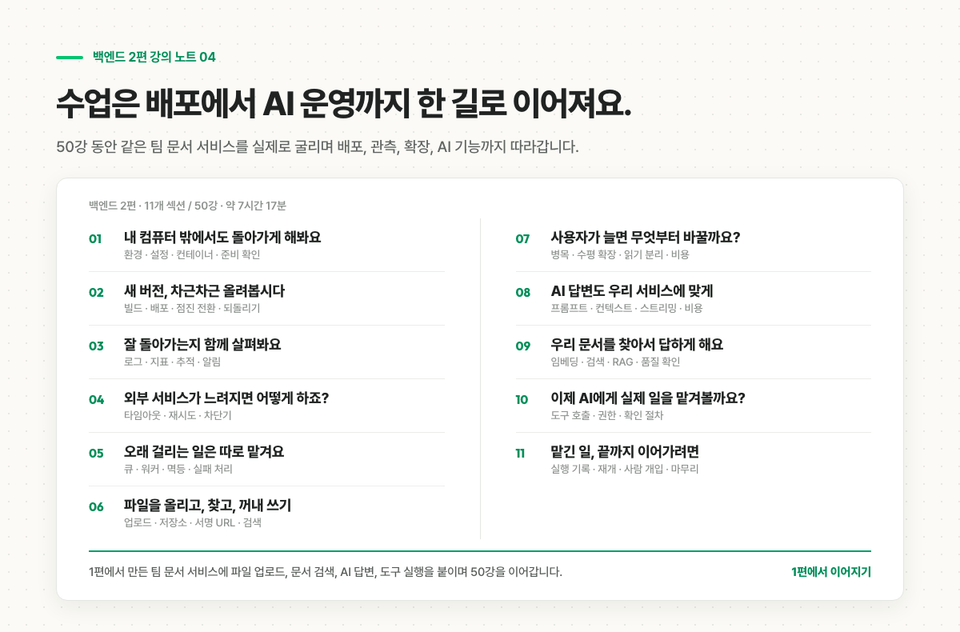
We’ll proceed in this order over 50 lessons.
We’ll start by making it run outside your computer. We’ll gradually roll out new versions and check that they’re working properly, then cover what to do when external services slow down and how to handle long-running tasks. After covering files and extensions, we’ll bring together 50 lessons on AI responses and document search, tool execution, and how to carry those tasks through to completion.
04 · Check Before Enrolling
This is a good fit for people like these.
Those who want to continue from Part 1 through deployment and operations
People who have launched a service created with AI but don’t know where to look when it slows down or stops responding
People who feel unsure about how to handle failures while integrating external APIs, queues, and file storage.
Those who want to add AI capabilities, such as document search or tool execution, to their services
This is not a hands-on course where you simply follow along.
This is not a course on deploying a project to a specific cloud. Each lecture is 5–10 minutes long, and across 50 lectures, we cover the principles through conceptual explanations, flowcharts, comparison tables, and case studies. No matter what environment you use, we focus on the criteria for making decisions that you can apply directly to your next service.
I’ll answer the questions you’re most likely to have first.
I didn’t take Part 1. Is that okay?
That’s fine. If terms like requests, APIs, databases, and authentication aren’t unfamiliar to you, you can start right away. Whenever we reach a point where the content from Part 1 is needed, we’ll briefly revisit it then.
Do I need to use a specific cloud or tool?
No. We cover why containers, queues, storage, and observability tools are needed and what needs to be decided, regardless of the specific type. The goal is to enable you to ask the same questions no matter which products you choose.
Is it okay to listen at a faster speed?
I enhanced the audio with AI to reduce noise and refine the pronunciation. I improved the sound quality and pronunciation so the explanation remains clear even when listened to at 2× speed.
Recommended for these people
Who is this course right for?
Those who want to continue from Part 1 through deployment and operations
People who have launched a service created with AI but don’t know where to look when it slows down or stops responding
Those who want to add AI features, such as document search or tool execution, to their services
Need to know before starting?
It’s helpful to be familiar with the content of Part 1 (requests, APIs, data, and authentication).
There are no coding exercises or environment setup. No knowledge of any specific cloud platform or framework is required.
I am Haeyeo, someone who explores the infinite possibilities of AI and computer science and wishes to share that journey with all of you.
During my undergraduate years, my passion for my major was so intense that I was nicknamed a 'Computer Science Addict.' I graduated at the top of my class with a major GPA of over 4.4. I then earned my Master's degree in AI from Seoul National University and further deepened my expertise through a doctoral program.
However, as I felt as much of a fascination for solving real-world problems with AI as I did for theoretical exploration, I took a break from my doctoral studies to gain valuable hands-on experience by working on AI-based LLM and video analysis projects at a startup.
Currently, I am working as an LLM project developer and PM at one of the top three conglomerates in Korea, contributing to creating positive changes that AI technology will bring to our lives. I will generously share with you the challenges I faced, the problem-solving processes I went through, and the vivid know-how I gained in the field. I will be your reliable guide on this journey into the exciting world of AI.






![[AI] Implementing Ideas with Prompts Only_Vibe Coding BasicsCourse Thumbnail](https://cdn.inflearn.com/public/files/courses/336725/cover/01jr2vbd3dr8hh1n4qn2jcyj02?w=420)






![Learning Docker and CI Environments by Following Along [Updated 2023.11]Course Thumbnail](https://cdn.inflearn.com/public/course-325821-cover/e5a56b04-463b-410c-9b3a-d769cd192add?w=420)
![[Done in a single word!] How to create your own monetized website with AICourse Thumbnail](https://cdn.inflearn.com/public/files/courses/336091/cover/01jxykkyatyya1dnv22ctkvtwe?w=420)