inflearn logo

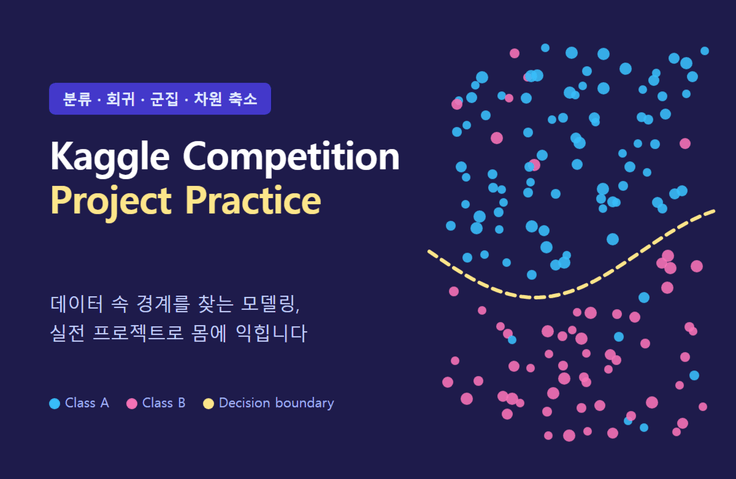
Kaggle Competition Project Practice

- Practical Kaggle Competition Project: From Data Exploration to Submission - Beyond Tutorials: Follow a Real Kaggle Competition from Start to Finish Have you signed up for Kaggle and completed the Titanic tutorial, only to feel lost about where to start when facing a real competition? If you simply copy someone else’s notebook and submit it, you’ll eventually hit the wall of wondering, "Why isn’t my score improving?" In this course, we’ll work through an actual Kaggle competition from start to finish, covering data exploration, validation design, feature engineering, modeling, and submission. Instead of memorizing code, you’ll develop an intuitive understanding of the competition mindset: “What should I try and why, and how can I validate its effectiveness?” [One line about your competition participation, awards, or practical experience]

2 learners are taking this course

Level Basic

Course period Unlimited

Python
Python
AI
AI
Machine Learning(ML)
Big Data
Big Data
Data Engineering
Data Engineering
Python
Python
AI
AI
Machine Learning(ML)
Big Data
Big Data
Data Engineering
Data Engineering

What you will gain after the course

  • The ability to independently repeat the competition workflow—from understanding the data and designing validation (CV), through establishing a baseline and making improvements, to submission.

  • An experimental habit of deriving feature ideas from EDA and evaluating the effects of changes through CV scores

  • Fundamentals of training, tuning, and ensembling tree-based models such as LightGBM

  • Final deliverables: one notebook submitted to the actual competition and a leaderboard record (can be used as a portfolio piece)

Kaggle Competition Project Practice is a 24-hour, hands-on course that teaches the entire machine learning process by having you directly solve nine representative Kaggle competitions and work with public datasets. Rather than simply listing theory, it teaches the competition workflow: “receive the data, build a model, submit the results, and check your ranking.”

What will you learn

  1. Preprocessing and basic modeling: The basic scikit-learn framework, cross-validation, data encoding, and Titanic survivor prediction. You will start with decision trees, random forests, and logistic regression.

  2. Evaluation metrics: Using diabetes prediction (Pima Indians Diabetes), you will learn accuracy, the confusion matrix, and F1 score.

  3. Classification in Practice: Santander customer satisfaction prediction and credit card fraud detection. Covers everything from KNN, AdaBoost, GBM, XGBoost, and LightGBM to stacking ensembles.

  4. Regression in Practice: House Prices, Bike Sharing Demand. Compare linear regression, Ridge, Lasso, ElasticNet, and polynomial regression using RMSE, MAE, MAPE, and other metrics.

  5. Feature engineering and clustering: Practice dimensionality reduction methods such as PCA, LDA, SVD, and NMF, as well as K-Means, hierarchical clustering, DBSCAN, and GMM clustering, evaluate them using silhouette analysis, and perform customer segmentation.


Recommended for
beginners who have tried tutorials but feel overwhelmed by real-world competitions, data analysis learners who want to cover classification, regression, and clustering all at once, and those who need project results to use in their portfolios.

Recommended for
these people

Who is this course right for?

  • Beginners who have finished the tutorial but can’t move on to actual competitions

  • Those who simply copy and submit a public notebook without knowing how to improve their score

  • Job seekers and career changers who need a data analysis/ML portfolio

  • A practicing data analyst who wants to develop a practical feel for modeling

Need to know before starting?

  • Python basics (variables, functions, loops) and basic usage of pandas

  • A free Kaggle account is required. The exercises will be conducted in Kaggle’s free notebooks. (Modify to fit the course environment)

Hello
This is 1159136

Career Verified

After majoring in electronic engineering at Kwangwoon University, he served as the head of the manufacturing team and the head of the manufacturing center in the semiconductor division of Samsung Electronics for 27 years from 1984 to 2011, and the head of the infrastructure technology center in charge of environmental safety, facility, and systems. After completing his career in semiconductors as an executive director, he served as the vice president of Samsung Display (OLED) for five years from 2011 to 2016 as the head of the manufacturing center and the general manager of the complex in charge of production, environmental safety, facility, and systems. After graduating from the Graduate School of Science in Seoul and Business School Lausanne (BSL), he earned MBA, Ph.D., and DBA degrees in big data from the Graduate School of Science in Switzerland, and is currently serving as the head of the manufacturing intelligence project as a professor at the Swiss School of Management (SSM), a research professor at the Korea Institute for Industrial Policy Studies, and vice chairman of the artificial intelligence association.

The above-mentioned consultant majored in electronic engineering at Kwangwoon University and worked in Samsung Electronics’ semiconductor division for 27 years, from 1984 to 2011. He served as a manufacturing team leader and manufacturing center director before becoming the director of the Infrastructure Technology Center, overseeing environmental safety, facilities, and systems. After completing his semiconductor career as an executive vice president, he served as a vice president at Samsung Display (OLED, LCD) for five years, from 2011 to 2016, as the head of the Manufacturing Center and the site general manager responsible for production, environmental safety, facilities, and systems. After retiring, he earned Big Data MBA, Ph.D., and DBA degrees from Seoul School of Integrated Sciences and Technologies and BSL (Business School Lausanne) in Switzerland. He currently serves as a professor at SSM (Swiss School of Management), a research professor at the Korea Institute for Industrial Policy Studies, and vice chairman of the Artificial Intelligence Association, where he heads the Manufacturing Intelligence Business Division.

More

Curriculum

All

15 lectures ∙ (19hr 40min)

Course Materials:

Lecture resources
Published: 
Last updated: 

Reviews

Not enough reviews.
Please write a valuable review that helps everyone!

Similar courses

Explore other courses in the same field!

Limited time deal

$33,000.00

70%

$84.70