Distribution Profit Structure and Capital Allocation Strategy: From Contract Design to Investment Decisions
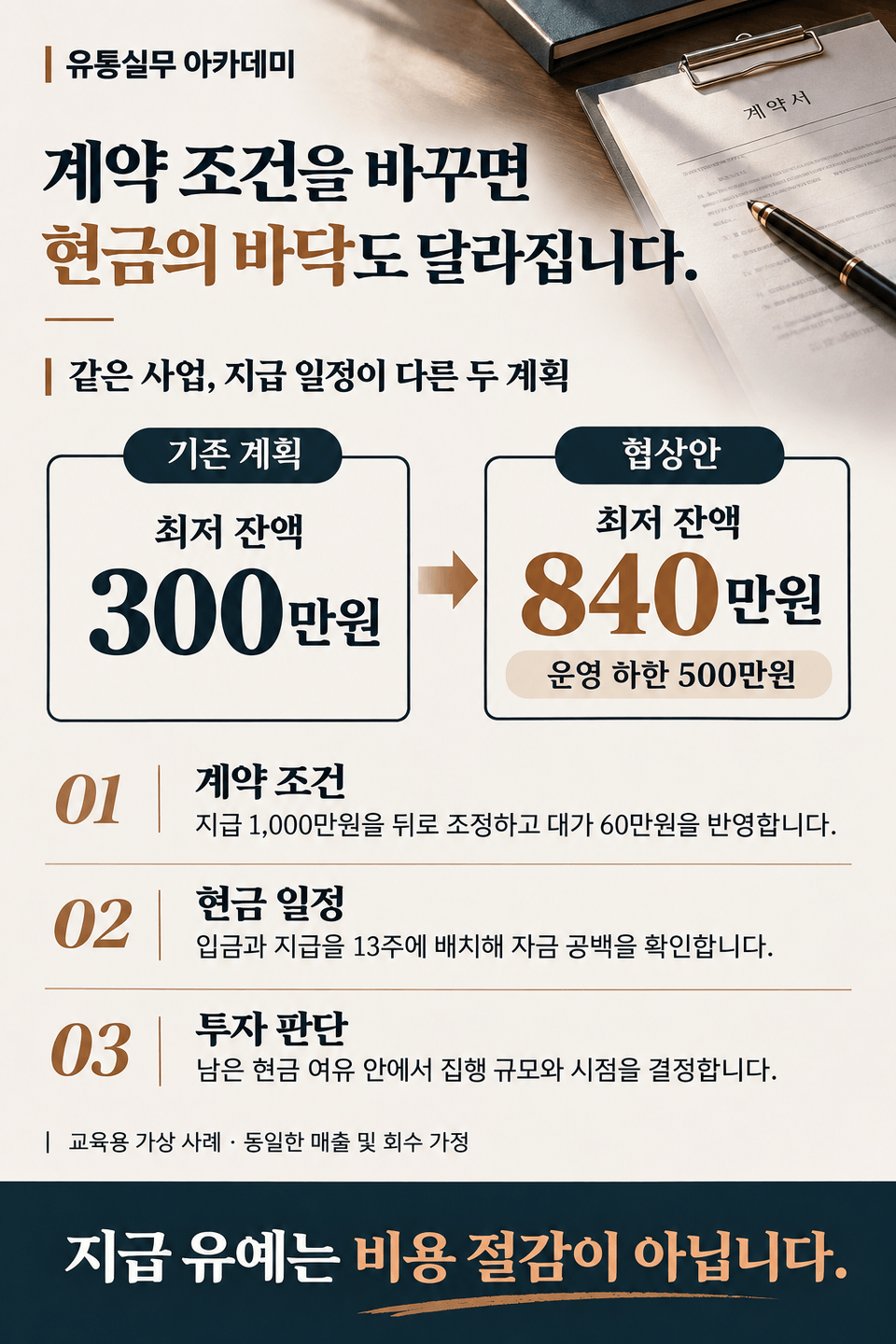
Even with the same revenue, a business’s profitability and viability can vary depending on the terms of trade and the timing of cash collection. Drawing on experience in distribution operations and corporate headquarters, this analysis connects the economic value of contract terms with 13-week cash flow and the net present value of investment proposals. Through a hypothetical business case, you’ll learn how to decide what to negotiate, where to allocate funds, and when to defer or withdraw from an investment.
This course is related to monetization/side business. Results may vary by individual, so please consider your purchase carefully.
What you will gain after the course
You can compare profitability, capital requirements, and risk allocation across purchase, consignment, and brokerage models to determine which transaction method best suits your business.
You can calculate the economic value of minimum purchase commitments, deferred payments, rebates, and return rights, and identify which terms to negotiate beyond the unit price.
You can create a 13-week cash flow statement that distinguishes sales from when cash is actually received, and estimate when you’ll run short of funds and how much financing you’ll need.
You can prioritize the allocation of a limited budget by analyzing the working capital requirements, payback schedules, and net present value of investment proposals such as launching private-label brands and expanding retail presence.
We can validate scenarios where declining demand, delayed collections, and increased returns overlap, and design the conditions for deploying, holding, or withdrawing investment at each stage.
Why might cash be tight even as sales grow, and why can it be difficult to pursue investments that would be profitable?
Drawing on experience in distribution operations and head office management, this course connects transaction terms, cash flow, and capital allocation within a single business framework.
Across 24 lessons, we use case studies to explore purchasing, consignment, and brokerage; deferred payments and return rights; 13-week cash planning; and private labels and expansion investments.
Current professionals can organize the rationale behind negotiations and investment decisions, while aspiring employees can understand decision-making in merchandising, purchasing, and business planning roles and practice explaining their own judgment in interviews.
Recommended for these people
Who is this course right for?
Merchandisers, buyers, and procurement managers who must review not only purchase prices and sales margins, but also payment terms, return rights, and minimum purchase commitments.
Distribution and e-commerce business operators who want to understand why they run short of cash because of inventory and settlement cycles, despite generating sales and profits.
Product planning and new business professionals who need to assess the investment required and the likelihood of recouping it before launching a private-label brand, securing new listings, or expanding sales channels.
A retail manager who understands the fundamentals of sales, inventory, and profit and loss, and wants to expand their decision-making scope to include negotiating deals and approving investments.
Business planning, management, and finance professionals who need to connect sales plans and contract terms to cash flow and investment feasibility analyses.
Job seekers preparing for roles in merchandising (MD), purchasing, or business planning at retail companies who want to go beyond basic profit-and-loss knowledge, learn the reasoning behind transaction terms, cash flow, and investment decisions, and demonstrate a concrete understanding of the role in their résumés and interviews.
Need to know before starting?
It would be good to understand basic profit-and-loss concepts such as revenue, cost of goods sold, expenses, and profit.
It is helpful to understand the basic flow of distribution transactions: purchasing and selling goods, then paying or collecting the proceeds.
You just need to be able to compare the numbers in the table using basic arithmetic and ratio calculations. Using a calculator or Excel makes it easier to review the cases.
Professional accounting knowledge or investment analysis experience is not required. Key concepts such as working capital and net present value are explained using examples from the course.
Hello. I’m Kang-ho Ryu, sharing my 24 years of retail experience as practical knowledge that can be applied in the field.
Since 2002, I have gained experience in large-scale retail operations as a Category/Section Manager, assistant store manager, head of the online and strategic marketing team at headquarters, and in regional headquarters operations. I have handled retail operations from various perspectives, from working directly with products and customers in the field to developing strategies at headquarters.
■ Retail, Merchandising, and Product Planning Based on an understanding of products and customers, I handled merchandising changes, commercial area and competitor analysis, and initiatives to strengthen store competitiveness. In this course, you will learn how to establish a basis for product planning and turn your analysis into action plans and portfolios.
■ Sales and inventory management and store operations I gained experience managing key KPIs such as sales, customer count, average transaction value, inventory, and service, as well as standardizing store operations. I share a perspective on reading changes in the numbers, identifying their causes, and turning them into improvement initiatives to implement in the field.
■ Online commerce and digital marketing As the head of the online and strategic marketing team at headquarters, I gained experience in online commerce operations, CRM, targeted marketing, UI/UX improvements, and partnership marketing. I explain how to assess marketing performance from the perspectives of sales and profitability while considering both the customer purchase journey and operational conditions.
■ Project Execution and Collaboration I have worked on repeat and renewal PM, reopening marketing, customer experience (CX) improvement, and coaching for field employees and leaders. Based on my experience coordinating among headquarters, regional headquarters, stores, and partner companies, we will also cover the execution process needed to apply plans to actual work.
In the course, these experiences are complemented by data analysis and the use of AI to explain specifically how product planning, sales, inventory, store operations, and marketing are connected. The focus is on what to check, what evidence to base decisions on, and how to put them into action.
From job seekers preparing for careers in retail, merchandising, and marketing to practitioners and leaders looking to strengthen their on-the-job capabilities, we will help you explain and execute your analyses and proposals with sound reasoning.