

inflearn logo

Corporate Analysis and Reading Financial Statements for Stock Investment: Business Risks and Financial Risks Read Through Numbers

Do you know how to read financial statements but still find it difficult to determine which companies are good? It is difficult to truly understand a company simply by calculating figures such as PER, PBR, debt-to-equity ratio, and operating profit margin. What matters is not just how large or small the numbers are, but understanding why they turned out that way. For many years, I analyzed and evaluated companies at financial institutions, reviewing countless financial statements. Through that experience, I came to realize that the key to corporate analysis is not memorizing numerous financial ratios, but understanding the characteristics of the industry and business and identifying a company’s profit structure and risks from changes in the figures in its financial statements. The current lecture materials are also structured around the perspective that a company’s environment and management decisions are reflected in its financial statement figures through its asset structure, capital structure, and cost structure. In this lecture, we will not study financial statements by memorizing them from beginning to end. Instead, from the perspective of actual corporate analysis, I will explain how to distinguish business risk from financial risk, why the figures you need to examine differ depending on the industry, and how a company’s cost structure and leverage change its profits and risks.

1 learners are taking this course

Level Beginner

Course period 6 months

Accounting
Accounting
Investment
Investment
Financial Management

Accounting
Accounting
Investment
Investment
Financial Management

What you will gain after the course

  • 1. You can discern a company’s causes and risks from changes in its financial statement figures. Rather than merely checking increases or decreases in figures such as revenue, profit, and debt-to-equity ratio, you can track the reasons behind the changes to analyze the company’s business and financial risks.

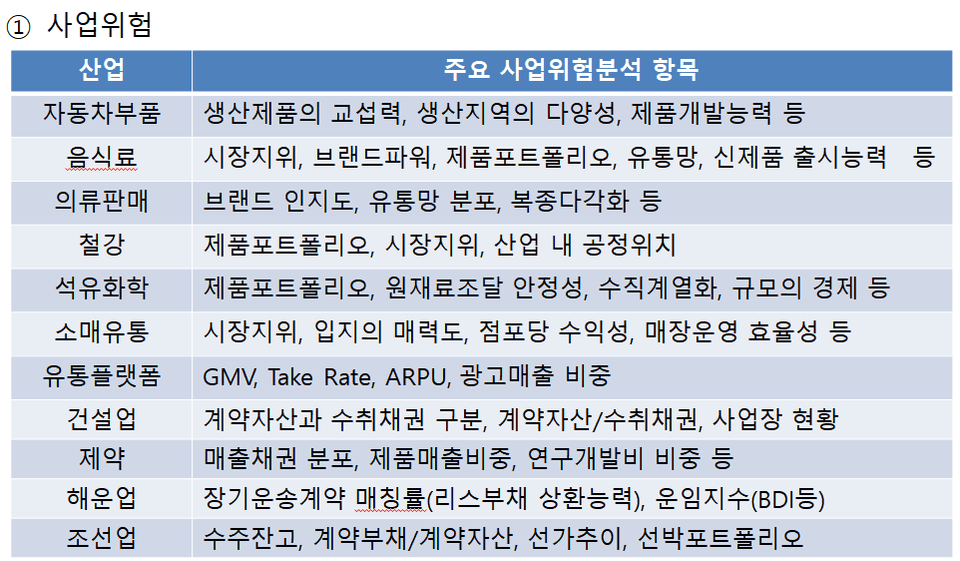
  • 2. You can determine what to examine first based on the characteristics of the industry and business. Rather than applying the same financial ratios to every company, you can learn a framework for corporate analysis that identifies the key risk factors and financial information to review according to the company’s business structure and industry characteristics.

  • 3. You can analyze the effects of a company’s cost structure and leverage on its profits and risks. You can understand the relationships among fixed costs, variable costs, operating leverage, and financial leverage, and assess how significantly changes in sales can affect a company’s operating income and net income.

  • 4. You will develop the ability to independently analyze companies based on their financial statements. Rather than simply judging that “performance has improved” or “the company has a lot of debt,” you will be able to analyze a company in the sequence of numbers → causes → risks → future impact and explain it in your own words.

📌 Course Introduction

Even if you study financial statements and know various financial ratios, when you actually open a real company’s financial statements, it is not easy to answer questions like “What should I look at first?”, “Why did this number change?”, and “So what are this company’s risks?”

This course is not about simply memorizing financial statement account items or financial ratios. It is a corporate analysis course where you learn how to identify the causes behind changes in the numbers shown on financial statements and connect them to a company’s business structure and risks for interpretation.

This course on corporate analysis draws on extensive practical experience analyzing and evaluating companies at financial institutions over many years, along with the perspectives on corporate analysis developed while writing “Financial Statement Analysis by 11 Industries”. It examines step by step how a company’s business environment and decisions lead to changes in its asset structure, capital structure, and cost structure, and how these changes are reflected in financial statement figures such as revenue and profit.


In particular, we analyze a company’s risks by distinguishing between business risk and financial risk. You will understand why a company’s key risks differ depending on its industry and business structure, and which financial information should therefore be examined closely. You will also learn how to assess a company’s financial risk and borrowing capacity through EBITDA and cash generation, as well as how its cost structure—including fixed and variable costs—and operating and financial leverage affect its earnings and risk.

Through this course, you will learn how to analyze companies by thinking for yourself about why the numbers changed → what caused them → what risks they lead to → what you should check going forward, going beyond simply explaining figures as “sales increased,” “the operating profit margin declined,” or “the debt ratio is high.”

If you have studied financial statements at least once but felt unsure how to apply them to actual company analysis, or if you want to analyze a company's performance and financial statements more systematically while investing in stocks, this course will help you go beyond “looking at financial statements” to learn “how to read a company through its financial statements.”


A Single Analytical Framework Running Through the Course

Numbers → Causes → Risks → Future. Rather than memorizing numerous financial ratios, it is more important to understand which numbers to look at and why.
This is the core of corporate analysis that this course aims to convey.


📌 Notable Teaching Experience

  • Hanyang University, Department of Business Administration (Adjunct Professor)

  • Korea Banking Institute (Adjunct Professor)

  • National Pension Service Fund Management Department

  • Korea Financial Investment Association Financial Investment Education Institute

  • Korea Federation of Savings Banks

  • Korean Standards Association

  • ※ Conducted numerous B2B and group training sessions primarily for financial institutions, pension funds, and associations.

Recommended for
these people

Who is this course right for?

  • 1. For those who have learned financial statements and financial ratios but feel unsure how to analyze an actual company

  • 2. Those who look at financial statements while investing in stocks but don’t know which figures to focus on

  • 3. Those who find it difficult to determine whether a company’s performance changes are temporary or structural, even after reviewing the news and earnings announcements

  • 4. Those who want to learn a systematic approach to company analysis: understand the company’s business structure → identify key risks → select the necessary figures → analyze their causes, rather than analyzing the entire financial statements from beginning to end.

Need to know before starting?

  • You do not need complex accounting knowledge or experience in financial analysis. However, to understand the course content more easily, it is sufficient to know what a balance sheet and an income statement are, as well as basic financial statement terms such as revenue, operating income, assets, liabilities, and equity.

  • If you’ve encountered financial statements before but felt unsure how to apply those numbers to actual company analysis, this course is suitable for you.

Hello
This is sjhun19099793

Career Verified

As a corporate finance expert, he has worked as a corporate banking credit analyst for over 15 years, conducting thousands of corporate analyses involving large corporations, mid-sized companies, acquisition financing, and more. His strength lies in analyzing risk, structure, and industry characteristics through the figures reflected in financial statements.

After earning a doctoral degree from Hanyang University, he has taught students as a professor while pursuing academic research and practical education in parallel. He has also lectured on corporate credit analysis, industry-specific financial analysis, and corporate valuation at securities firms, pension funds, and the Korea Banking Institute, as well as at KB Kookmin Bank, Shinhan Bank, IBK Industrial Bank of Korea, and Woori Bank.

“Financial Statements Analyzed Through 11 Industries: Accounting Accounts and Investment Decisions Explained Through Numbers” is a book that reconstructs financial statements as analytical tools that can be directly applied to investment and decision-making, based on recurring questions from the financial industry and real-world corporate cases.

I consistently write about financial statements and corporate valuation.
Naver blog The Value Bridge – A bridge connecting numbers and value (blog.naver.com/thevaluebridge)

More

Reviews

Not enough reviews.
Please write a valuable review that helps everyone!

Similar courses

Explore other courses in the same field!

Limited time deal

$35,750.00

35%

$42.90