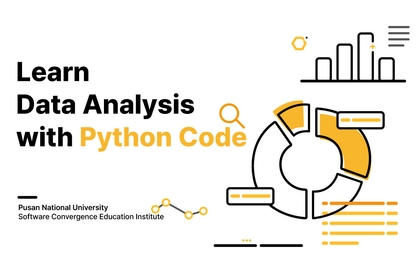
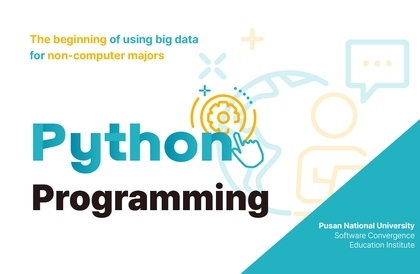
Introduction to Python for Data Analysis
pnuswedu
Let's build a solid foundation in Python and solve data analysis problems!

Beginner
Python
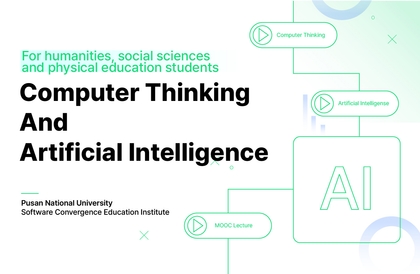
Computer Thinking and Artificial Intelligence
for Science and Engineering Students
With the arrival of the Fourth Industrial Revolution, the ability to not only operate computers proficiently but also to understand and utilize various software related to one's major and work has become an essential requirement for survival for everyone.
In particular, the ability to code directly to solve one's own problems is considered a very important skill, as it serves as the driving force of the 4th industrial society.
This course enables students in natural sciences or engineering to clearly identify given problems and learn how to express the sequence of tasks through logical procedures in the same way a computer processes them.
Furthermore, students will understand the principles of Big Data and Artificial Intelligence, which are at the core of the Fourth Industrial Revolution, and verify the utility of AI through basic examples. Through this course, students will improve their logical thinking skills, understand how to use programming tools, and cultivate the capacity to design algorithms for problem-solving.
This course does not provide a separate textbook or source code. It can be taken without a textbook.

Thank you for your valuable lecture. Take care of your health.
Thank you very much, it helped a lot.



![[Side Project After Work] Big Data Analysis Certification Practical Exam (Type 1, 2, 3)Course Thumbnail](https://cdn.inflearn.com/public/courses/329972/cover/dcfb28fd-48c1-4bb1-ab31-d59eac874194/329972-original.png?w=420)


![[Technologies Supporting Game Development in the AI Era] Hong Sabu's Diablo 1 PCG Dungeon Generation AlgorithmCourse Thumbnail](https://cdn.inflearn.com/public/files/courses/339418/cover/ai/3/35ec9a71-902f-46ed-85cb-75edb6d7fa4a.png?w=420)