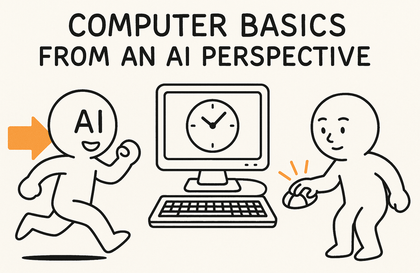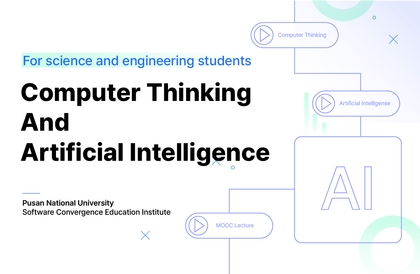

Understanding the computational thinking needed in the AI era

Computational thinking isn't something that only computer science majors learn. Every profession has problems that need to be solved, and computational thinking can be used to solve those problems.

(4.3) 6 reviews

20 learners

Level Beginner

Course period 12 months

Computer Architecture
Parallel Processing
Parallel Processing
Business Problem Solving
data-transformation
data-transformation
Computer Architecture
Parallel Processing
Parallel Processing
Business Problem Solving
data-transformation
data-transformation

Reviews from Early Learners

4.3

5.0

김인환

100% enrolled

I only had a vague interest in AI, but taking this course was a great opportunity to learn about it in a simple and clear way! After this lecture, I feel very motivated to take more courses on AI. Thank you!!!

5.0

바이트 탐정

100% enrolled

I liked that it was easy to understand the overall content.

What you will gain after the course

  • Computational thinking

  • Algorithm

  • Multimedia processing

  • Parallel computing

  • Artificial Intelligence Basics

  • Information protection techniques

As the AI era fully takes hold in our lives, the importance of computational thinking is growing. Computational thinking refers to a computer-like approach to problem-solving. In other words, it involves decomposing complex problems, recognizing patterns, simplifying problems through abstraction, and designing algorithms. These skills are essential for creative problem-solving and innovation in current and future societies.

So now let's learn how to develop computational thinking.

1. Decomposition : Breaking down a large problem into smaller ones. For example, when developing a complex program, breaking it down into smaller units makes it easier to manage.

2. Pattern Recognition : To solve a problem, you need to find patterns or similarities. Finding and applying similar patterns from problems you've already solved can help you solve problems much faster.

3. Abstraction : Complex problems need to be expressed in simpler terms. This is a way to understand the core of the problem by focusing on important information and eliminating unnecessary information.

4. Algorithmic Thinking : You need to think about a step-by-step procedure for problem solving. This involves creating clear instructions and designing specific steps to solve the problem.

5. Evaluation and Iteration : Evaluate your solution, refine it when necessary, and iterate. It's difficult to create a perfect solution from scratch, so the process of trying, evaluating, and refining is crucial.

In summary, computational thinking consists of five core elements: problem decomposition, pattern recognition, abstraction, algorithmic thinking, and evaluation and iteration. These five elements can dramatically improve our problem-solving abilities.

Recommended for
these people

Who is this course right for?

  • All members of society who face various problems and challenges

  • Project managers who must clearly communicate technical requirements

  • Anyone who wants to develop the ability to think and analyze smartly

  • Anyone curious about computational thinking in the AI era

Need to know before starting?

  • No pre-training required

Hello
This is sdj0831

367

Learners

61

Reviews

10

Answers

4.4

Rating

15

Courses

DefecUp — Turning learning into growth, and technology into opportunity

DefecUp Co., Ltd. is a technology education brand that started with the philosophy that “learning is growth.”
We are an e-learning company that goes beyond simply delivering knowledge to designing paths for human growth.

In a rapidly changing technological era encompassing AI, security, data, and smart factories,
DefecUp creates easy and practical convergence-style e-learning content so that anyone can upgrade their capabilities.

There are two brands operated by DefecUp.


The DefecUp brand produces professional national-certified and national technical e-learning content centered on IT, AI, security, data, and industrial digitalization, based on the philosophy of "teaching technology easily so that anyone can understand it."

Byte Detective is a content brand that represents DefecUp's educational philosophy,
centered on the concept of "analyzing knowledge like a detective and finding clues to technology."
In other words, Byte Detective is a convergence-oriented learning brand that helps learners understand the core principles of IT security, AI, and data in an engaging way.


"Turning learning into growth"

More

Curriculum

All

23 lectures ∙ (4hr 54min)

Course Materials:

Lecture resources
Published: 
Last updated: 

Reviews

All

6 reviews

4.3

6 reviews

  • 88888님의 프로필 이미지
    88888

    Reviews 19

    Average Rating 5.0

    5

    100% enrolled

    I liked that it was easy to understand the overall content.

    • kiminhwan78695님의 프로필 이미지
      kiminhwan78695

      Reviews 2

      Average Rating 5.0

      Edited

      5

      100% enrolled

      I only had a vague interest in AI, but taking this course was a great opportunity to learn about it in a simple and clear way! After this lecture, I feel very motivated to take more courses on AI. Thank you!!!

      • sdj0831
        Instructor

        Hello, learner. I'm glad to hear that this lecture was helpful. I will continue to provide great lectures in the future.

    • yyd13010317님의 프로필 이미지
      yyd13010317

      Reviews 2

      Average Rating 4.0

      4

      100% enrolled

      • newtoolra8349님의 프로필 이미지
        newtoolra8349

        Reviews 1

        Average Rating 3.0

        3

        100% enrolled

        • dfree14888님의 프로필 이미지
          dfree14888

          Reviews 2

          Average Rating 5.0

          5

          30% enrolled

          sdj0831's other courses

          Check out other courses by the instructor!

          Similar courses

          Explore other courses in the same field!