



inflearn logo

The qualities of engineers who thrive even in the AI era: mastering system design at major U.S. tech companies, algorithmic thinking, and open-source practice.

A comprehensive course covering AI-era-proof Silicon Valley internships, 30 big-tech system designs, and hands-on open-source contributions. Using real-world cases from Netflix, Tesla, Meta, Tinder, and other big tech companies, you’ll design and scale 30 practical system designs. Finally, you’ll design your own service from architecture to database to scaling.

(4.6) 32 reviews

563 learners

Level Intermediate

Course period Unlimited

DBMS/RDBMS
DBMS/RDBMS
software-design
software-design
system-design
system-design
AI
AI
ood
ood
DBMS/RDBMS
DBMS/RDBMS
software-design
software-design
system-design
system-design
AI
AI
ood
ood

Reviews from Early Learners

4.6

5.0

Chanuk

100% enrolled

I listened to the lecture carefully. The technical content was explained in a friendly and easy-to-understand way, so it felt like a skilled senior was teaching me. Personally, I had a few regrets. First, the sound was too low and the sound quality was not good, so it was difficult to listen to the lecture. There was a lot of explanation about the API specifications, but I felt it was unnecessary for me. Instead, I wish there had been a more in-depth explanation of system design methodology and scaling. In such cases, what components can be considered, what are the advantages and disadvantages of each (although it was explained in Section 2), and what problems and improvements might arise during actual use. Despite this, it was a lecture that I learned a lot from. The instructor said that he would continue to update the lecture and lecture materials, and that he would improve the lecture quality by using a high-quality microphone in the future, so I look forward to it.

5.0

놀란 거북이

51% enrolled

It was great to learn how to design systems to solve complex problems through various corporate cases! It was fun to learn concepts with examples, and I could understand in which situations the concepts would be used. Visualizing the design with Excalidraw was also a great help in learning! Thank you for the great lecture.

5.0

주아아빠

9% enrolled

This is the first time I've had a good design lecture in Korea. The content is really good. Please record the next lecture with the audio a little louder. I look forward to other good lectures. Be healthy and happy.

What you will gain after the course

  • Backend

  • Database Design

  • OOD Design

  • System Design

  • AI Agent

  • Open source

In an era when AI writes code, what becomes more important for engineers is the ability to decide what to build and why to design it that way.

Implementing a feature and designing a service that many users can use reliably are two different challenges.

As the number of users grows, which parts will slow down first? Should we split the database or introduce caching? How should we deliver real-time updates, and what should we prepare to keep the service running even if one server fails?

There is no single right answer that applies to every service. You need to understand the requirements and constraints, compare the pros and cons of different designs, and be able to explain why you chose one.

This system design course teaches you how to make design decisions through case studies of services from major U.S. tech companies. You’ll explore around 30 case studies, including Netflix, Tesla FSD, Meta, and Tinder, and then design the architecture, data model, and scaling plan for a service of your own. The course ties everything together in one learning path, from database and object-oriented design to hands-on implementation, open-source contributions, and coding interview prep.

If you've ever felt overwhelmed while designing something

Even people who have built services can get stuck when trying to design a new system from scratch.

  • When asked to draw an architecture diagram, you start with the server and database, but find it difficult to explain why that structure is needed.

  • You know the roles of Redis, Kafka, CDNs, and load balancers, but it’s hard to decide when to use them and when not to.

  • It’s difficult to choose between a relational database and NoSQL, and to anticipate what problems may arise as the data grows.

  • When asked questions in an interview or design review like “What if the number of users increases?” or “What if this component fails?”, it’s difficult to develop the design further.

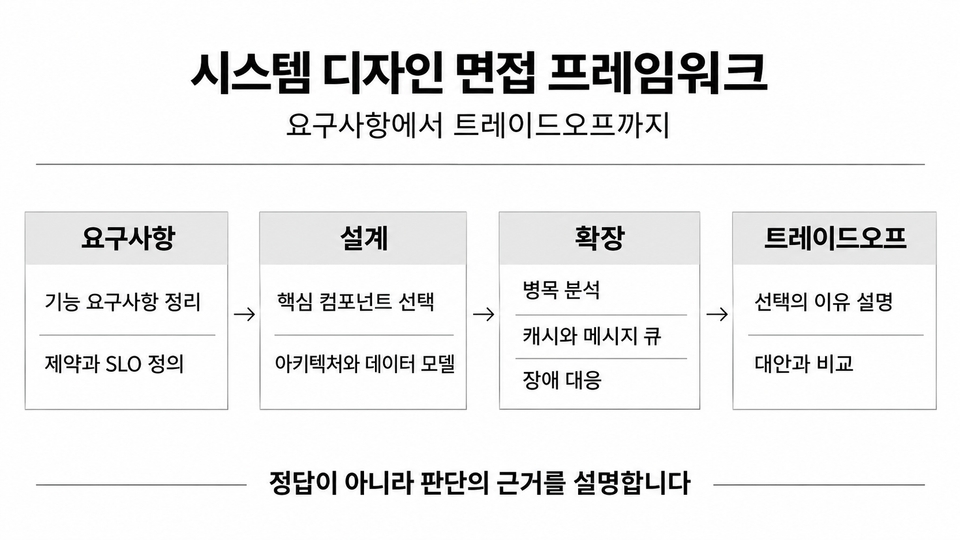
In this course, you won’t stop at memorizing technology names. You’ll start by defining requirements, choose the components you need, compare the costs and constraints of your choices, and think through failure scenarios and scalability.

From the fundamentals to designing real-world services, here’s how you’ll learn.

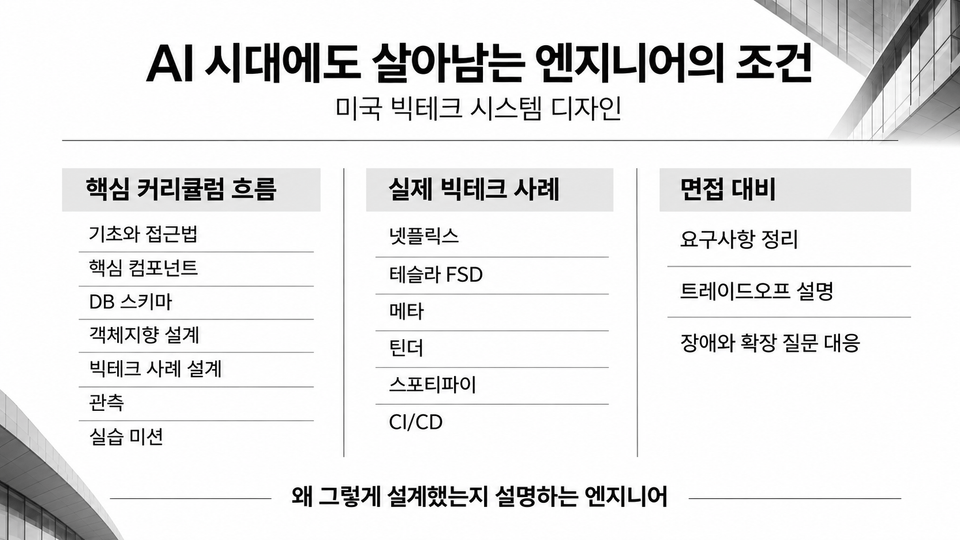
The full course consists of 72 lessons and 2 missions, totaling 29 hours and 3 minutes. Below is the learning flow for sections 1–10 of the currently available curriculum.

01. System Design Fundamentals and Approach

Instead of choosing a technology as soon as you read the problem, first clarify what needs to be built and what constraints to consider. Then learn a basic approach to working through case studies.

02. Core Components and Trade-offs

We cover CAP theory, load balancers, monoliths and microservices, Docker and Kubernetes, CDNs, message queues, Redis caching, relational databases and NoSQL, blob storage, WebSockets, proxies, and metrics and telemetry. We look not only at what each is, but also what problems it solves and what complexity it adds.

03. Database Schema Design

Through examples such as movie DVD rentals, airline ticket reservations, and school grade management, we practice modeling data as entities and relationships. This is the step where a system’s behavior is translated into data structures.

04. Object-Oriented Design (OOD)

Learn how to break down requirements into objects and responsibilities, and design models with extensibility and change in mind. Understand the distinction between overall service architecture and code-level design.

05. Big Tech and Real-World Service System Design & Scaling

We expand the design around real-world service examples such as Netflix, Tesla FSD, Meta, Tinder, Spotify, and CI/CD pipelines. This is a core section for thinking through which requirements to start from and how to choose databases, caches, message queues, distributed processing, and scaling strategies.

06. System Observability (Telemetry)

We look at what to measure and monitor when operating a system, and how to connect metrics and monitoring to design decisions and incident analysis.

07. System Design Practice Mission

This is a hands-on stage where you combine the components you’ve learned to explain a design. You move from understanding diagrams drawn by others to creating your own.

08. System Design Implementation Practice

We’ll explore architectural concepts from an implementation perspective, examining how design choices connect to real-world implementation.

09. Open-Source Contribution Practice

Learn how to contribute to open source using the public repository of an AI coding agent that’s actively in use. Using the repository and its contribution guidelines, you’ll try your hand at creating a PR.

10. Technical Interview Master Plan, Coding Tests

Alongside system design studies, there is a dedicated section for preparing for coding tests. It helps you assess both system-level design thinking and code-level problem-solving skills.

What kinds of services do you design?

The roughly 30 examples aren’t a list of famous company names to memorize. They’re learning materials for comparing how architectural choices change as the problems a service needs to solve change.

Netflix: Delivering content to many users

In streaming services, issues such as content delivery, caching, and traffic distribution become important. By considering where to place CDNs, storage, and servers, you learn how to handle large-scale read traffic.

Tesla FSD: Machine Learning Systems Aren’t Complete with Just a Model

We examine a pipeline that connects not only model training but also deployment and observability. This is an exercise in thinking of machine learning features as part of real-world service systems.

Meta: How does the architecture change as a service grows?

Using large-scale service infrastructure as examples, we consider scalability and fault tolerance together. Rather than simply explaining how to add servers, we examine design choices based on bottlenecks and data flow.

Tinder, Spotify, and CI/CD: Different requirements call for different answers.

User-centric services, content services, and development and deployment pipelines all have different requirements. By comparing these cases, we practice making design decisions based on the requirements rather than the technology itself.

The examples in this course are design exercises for learning, based on publicly known service characteristics and system design principles. They do not reproduce each company’s confidential internal architecture exactly.

This is a good fit for

  • Developers and students preparing for a job or career change
    Those who want to answer system design questions with their design process and rationale for their choices, not just a list of technologies.

  • Developers building side projects
    Those who want to think beyond implementing features and consider data structures, scalability, and failure handling

  • Backend developers and hands-on engineers
    Those who want to connect databases, caches, message queues, and distributed system components into a single architecture.

  • Those preparing for lead developer or architect roles
    Those who need practice designing services from scratch based on requirements and explaining trade-offs

  • Those interested in engineering challenges at global companies
    Those who want to learn how to think about large-scale system design through examples from services like Netflix, Tesla, and Meta

If that's what you're expecting, this course may not be the right fit.

This course is not about using AI tools to generate code quickly. Nor is it about learning only the syntax of a particular framework or completing a project by simply copying a predefined architecture.

The course is built on fundamental computer science concepts such as servers and databases, so if these concepts are new to you, it’s best to study the basics alongside it. Also, taking the course does not guarantee a job offer or that your open-source PRs will be merged.


Recommended for

Developers and students preparing for a job or career change

For those who want to answer system design questions with their design process and rationale for their choices, not just a list of technologies

Backend developers and practicing engineers

Those who want to connect databases, caches, message queues, and distributed system components into a single architecture

Preparing to Become a Lead Developer or Architect

For those who need practice designing a service from scratch based on requirements and explaining trade-offs

The Design Deliverable You’ll Complete Through the Course

The goal is not to look at lots of architecture diagrams, but to be able to explain your own design decisions through documentation and diagrams.

1. Service Architecture Diagram

It shows where client requests enter, which servers and storage they pass through, and what responsibilities each component has.

2. Database Schema and Data Model

Design how the service’s data will be divided and connected. Also consider why choices such as relational databases versus NoSQL, indexing, and sharding are needed.

3. Explaining Technology Choices and Trade-offs

Practice explaining what you gain and what you need to manage by introducing caching, and which situations are suited to message queues and real-time communication methods.

4. Incident Response and Scaling Plan

Assume increased traffic, bottlenecks, and component failures, and outline the order in which you would improve the architecture. This also includes defining goals such as availability and response time as SLOs.

5. Your Own Service Design Project

Create a deliverable that connects everything from requirements to architecture, data models, and scaling plans. You can use the provided template to organize it as a portfolio piece.

Finally, you’ll design a service of your own.

For the final project, choose a service you want to build or are already developing, and work through the entire design process from start to finish.

Requirements definition → SLO setup → overall architecture → data model → bottleneck and failure analysis → scaling plan

For example, after defining which user-facing features are needed, I draw the request flow in Excalidraw. I organize the required data into a schema and consider whether to use storage, a cache, or a message queue. Finally, I explain how to respond if traffic increases or some components fail.

In the completed document, it’s important to record not only what you chose, but why you chose it and how it differed from the alternatives. By organizing diagrams and design rationale using the provided project template, you can use the result to showcase your thought process in a portfolio or technical interview.

Experience contributing to real open-source projects beyond design

The course includes an open-source contribution track using the public repository of a Rust-based CLI AI coding agent.

Contributing to open source is different from simply putting code in your own repository. You need to understand a codebase maintained by others, explain your changes, and propose them in a form that can be integrated after review.

In this track, you’ll take on the challenge of submitting PRs to real repositories by following the contribution guides provided. Your contributions and PR links will serve as evidence of your work. Whether a PR gets merged depends on the actual code changes and the review results.

The goal of this track is to develop both the ability to design systems and the experience of responsibly proposing changes to existing software.

Instructor Introduction

Silicon Valley Survivor | American Snail

Majored in computer science and business administration, and gained development experience in Korea’s search and fintech industries, as well as at an AI fintech startup in Silicon Valley. Has interviewed with U.S. tech companies such as Apple, Meta, and Tesla, and currently runs an AI coding agent startup in Silicon Valley, developing Closiro CLI·Mac Desktop. Has been selected for the Google for Startups Program and the Anthropic for Startups Program.

Rather than listing technologies, this course focuses on a learning process that helps you determine which requirements to check first and consider the trade-offs of different choices when faced with real-world problems.

Notes to Review Before Taking the Course

Learning Tools and Prerequisites

  • Excalidraw
    A web-based diagramming tool for drawing architectures and data flows yourself.

  • GitHub
    Practice exploring and contributing to open-source repositories

  • Practice Environment
    Compatible with Windows, macOS, and Linux.

Learning Materials

PPT lecture materials
Provided to help you review what you’ve learned.

Prerequisites and Notes

The course is designed on the assumption that you know the basic concepts of computer science. You don’t need to have experience using every technology already, but understanding the basic roles of servers and databases will help you focus more on design decisions.

A Student Discord Community So You Don’t Have to Study Alone

You can continue discussing the course content and development in the Discord community for students.

Channels are available for Q&A, AI, coding and development, system design, and career changes and job hunting. Use them to ask about anything you didn’t understand while studying or discuss design problems you’re working through with other students. You can also use the course Q&A.

Join the student Discord community: https://discord.gg/4Ea38HWuY

Frequently Asked Questions

Q. Can I take this course if I’m new to studying system design?

We start with foundational approaches and key components. However, computer science prerequisites are listed, so if you’re unfamiliar with servers, networks, and databases, we recommend studying the fundamentals alongside the course.

Q. Do I need to learn a specific programming language or framework?

The course focuses on system architecture, data models, and trade-offs rather than the syntax of any particular language. It includes hands-on implementation exercises and an open-source contribution track, but the course as a whole is not structured around building a complete application with a single framework.

Q. What can I include in my portfolio after taking the course?

You can create a final design document outlining your service’s requirements, architecture diagram, data model, SLOs, and scaling plan. If you’ve made an actual contribution to open source, you can also document the changes and PR link separately.

Q. Do you learn the exact internal designs of Netflix or Tesla?

We learn design thinking based on service case studies and system design principles. This does not mean reproducing or disclosing the internal implementations of companies’ private systems.

Q. Do I have to get my open-source PR merged?

In the open-source contribution track, you’ll work on writing PRs for real repositories. Submitting a PR and getting it merged are separate steps; whether it gets merged depends on the changes and the project’s review criteria.

Q. Can I ask questions while studying or interact with other students?

You can use the course Q&A and the active student Discord community. You can talk not only about system design, but also in channels about AI, software development, and preparing for job applications or a career change.

Recommended for
these people

Who is this course right for?

  • Those who want to join a Silicon Valley Big Tech company

  • Those who need a new service designed

  • Those seeking greater growth as a developer

  • Those preparing to enter the workforce or looking to change jobs

Need to know before starting?

  • Computer Science

Hello
This is americasnail

Inflearn Verified

2,318

Learners

139

Reviews

86

Answers

4.5

Rating

9

Courses

  • Silicon Valley Survivor | American Snail

    Drawing on experience and know-how gained at the forefront of the Global Tech Scene, I show non-majors how to overcome technological barriers and become the owners of their businesses.

    • Current) Founder of a Silicon Valley AI coding & local model fine-tuning agent startup

      • Development and operation of Closiro CLI/Mac Desktop (20K+ downloads)

      • Selected for the Google for Startups Program

      • Selected for the Anthropic for Startups Program

    • Formerly: Engineer at U.S. Big Tech Companies and Promising Startups

      • Gave up Amazon’s final stage to start a company

      • Silicon Valley AI Fintech Startup Engineer

      • OpenAI / Meta / Apple / Adobe / Amazon Full-Stack Fellowship

      • Development at a leading domestic search portal and fintech company

      • AI Startup AR/B2B/SDK Development

    • Proven teaching expertise

      • Double major in computer science and business administration at a four-year university in Seoul, with extensive startup experience.

      • Trained over 2,300 students; 4.6K+ followers on Threads and 500+ on Substack.

More

Curriculum

All

74 lectures ∙ (29hr 3min)

Course Materials:

Lecture resources
Published: 
Last updated: 

Reviews

All

32 reviews

4.6

32 reviews

  • narciso님의 프로필 이미지
    narciso

    Reviews 44

    ∙

    Average Rating 5.0

    5

    100% enrolled

    I listened to the lecture carefully. The technical content was explained in a friendly and easy-to-understand way, so it felt like a skilled senior was teaching me. Personally, I had a few regrets. First, the sound was too low and the sound quality was not good, so it was difficult to listen to the lecture. There was a lot of explanation about the API specifications, but I felt it was unnecessary for me. Instead, I wish there had been a more in-depth explanation of system design methodology and scaling. In such cases, what components can be considered, what are the advantages and disadvantages of each (although it was explained in Section 2), and what problems and improvements might arise during actual use. Despite this, it was a lecture that I learned a lot from. The instructor said that he would continue to update the lecture and lecture materials, and that he would improve the lecture quality by using a high-quality microphone in the future, so I look forward to it.

    • americasnail
      Instructor

      Hello, thank you for your review. We are currently waiting for a microphone with specifications such as noise cancellation to improve the quality of the lectures. 😭 We will update the quality of the lectures and the quality of the lectures by reflecting the contents you wrote in the review from mid-January. Thank you again. We will continue to work to create better quality lectures in the future.

  • aicodinglabpro님의 프로필 이미지
    aicodinglabpro

    Reviews 51

    ∙

    Average Rating 5.0

    5

    9% enrolled

    This is the first time I've had a good design lecture in Korea. The content is really good. Please record the next lecture with the audio a little louder. I look forward to other good lectures. Be healthy and happy.

    • americasnail
      Instructor

      Thank you for taking the class. I will continue to strive to provide better lectures in the future :) I hope you always stay healthy and have a good day.

  • luc77y님의 프로필 이미지
    luc77y

    Reviews 7

    ∙

    Average Rating 5.0

    5

    51% enrolled

    It was great to learn how to design systems to solve complex problems through various corporate cases! It was fun to learn concepts with examples, and I could understand in which situations the concepts would be used. Visualizing the design with Excalidraw was also a great help in learning! Thank you for the great lecture.

    • americasnail
      Instructor

      Hello! Thank you for enjoying the lecture and leaving a good review. We will continue to strive to provide more useful lectures in the future.

  • powudt9327님의 프로필 이미지
    powudt9327

    Reviews 4

    ∙

    Average Rating 2.8

    3

    60% enrolled

    The subject of the lecture itself is very good, but on the contrary, the lecture as a whole feels very unrefined. The specific details are as follows: - The lecture lacks unity as it goes from the first to the last lecture. You will think, why didn't you do it this way before? - It is a raw lecture with no editing at all. There are quite a few places where the speaker stutters or says "uh" or where the audio is blank for more than 5 seconds. When the audio is blank, you check to see if the network is disconnected, which distracts you from concentrating. - In particular, in the Meta System Design section, there is a constant buzzing sound throughout the lecture, and the instructor's voice sounds a little distorted. At least the Meta section should be re-uploaded. - Also, as a minor point, you can sometimes hear Bluetooth connection sounds during the lecture.

    • americasnail
      Instructor

      Thank you for your feedback. First of all, I apologize for the inconvenience. We will reflect on this in the new update and provide the video again. Thank you again.

  • loomin100님의 프로필 이미지
    loomin100

    Reviews 5

    ∙

    Average Rating 4.0

    4

    47% enrolled

    The lecture content is really good, but... you say "uh" too much, so it's really distracting to listen to the lecture.

    • americasnail
      Instructor

      Thank you for your good feedback. I tried to fix it in the algorithm lecture. I plan to gradually update the lecture to a version without uh in the future. Thank you for taking the lecture, and I will repay you with a better lecture in the future.

americasnail's other courses

Check out other courses by the instructor!

Similar courses

Explore other courses in the same field!

25% off for new members

$106.40

25%

$136.40