A must-have for DevOps engineers.
Observability that works in practice!
Observability, a hot topic in DevOps.
1️⃣
After changing the system structure to MSA, which is the latest trend, has it become more difficult to identify and resolve the cause of errors ?
2️⃣
Are you curious about how to bring together log analysis and inter-service relationships in microservices?
3️⃣
Want to learn the theoretical foundations and practical implementation methods of Observability , one of the latest DevOps trends?
As many companies begin to adopt cloud-native and container technologies, tracking events occurring in distributed systems like microservices has become increasingly important. Observability, which demonstrates this importance, is also emerging as a hot topic in the microservice and DevOps fields. However, documentation or materials that explain how these concepts are implemented and implemented are rare.
• • •
Applying Observability in MSA Using OpenTelemetry + SigNoz
When changing the structure of a microservice-based system, an integrated analysis solution is required that can comprehensively analyze issues such as data correlation and exceptions between systems.
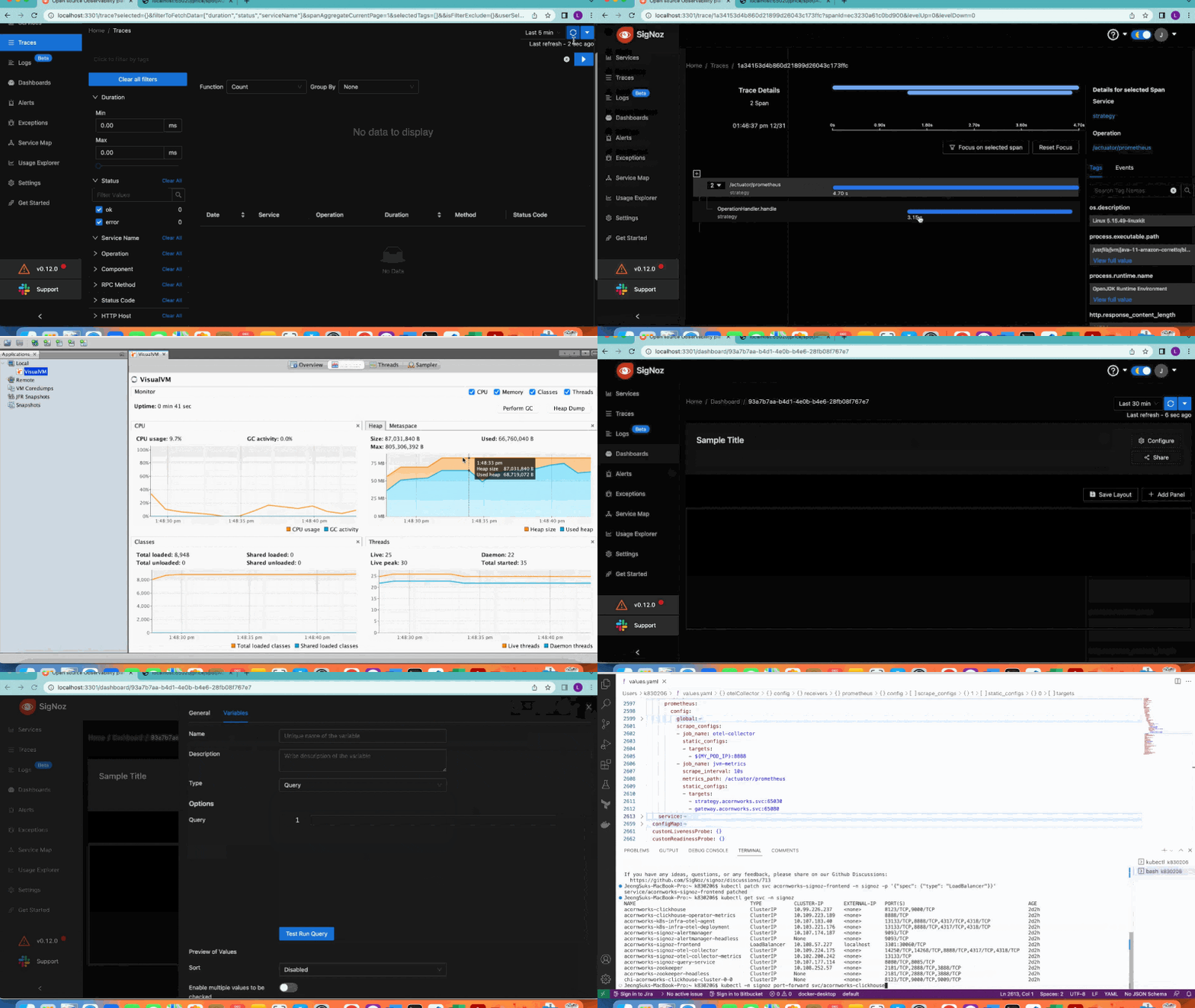
OpenTelemetry provides a foundation for tracking and analyzing the correlations and events between each microservice according to the flow of request calls through the concepts of Trace ID and Span ID.
This course will teach you practical methods for applying OpenTelemetry, Log, Trace, and Metrics to applications based on Java with Spring, Node.js, and Python.
In addition, you will learn how to analyze the correlation between systems using open-source APM and analyze which part of the system you manage is causing delays.
What the lecture covers
- ✅ Learn how to view logs on microservices.
- ✅ You can identify bottlenecks in the services you manage at a glance and see the relationships between each system at a glance.
- ✅ You can build JVM and Kubernetes Dashboard on APM.
- ✅ Access to a repository of materials on building an Observability Solution using OpenTelemetry and SigNoz.
Detailed Curriculum 📚
- What is Observability?
- Installing SigNoz using Helm
- Applying OpenTelemetry: Ticker service with Python
- OpenTelemetry application: Strategy/Gateway service with Java
- Applying OpenTelemetry: Price service with Node.js
- Configuring SigNoz - JVM & Kubernetes Dashboard
- Configuring the SigNoz - Alert Service
The basics of DevOps
This is Lee Jeong-seok .
I'm a digital nomad IT engineer with approximately 15 years of experience as a full-stack developer and DevOps engineer/consultant in Korea, Australia, and the UK. I'm constantly learning new topics to optimize IT organizational operations , and I dream of remaining an engineer until I retire. Currently, I work as a DevOps engineer on the Developer Experience team at a bank in Melbourne, Australia.
Detailed history
- I started my first job as an intern at The Latin Traveller! [London, UK]
- Former Hanjin Group Topas Travel Information - Java/Oracle Development [Seoul, KR]
- Former) NuSkin Korea - Java/Oracle Development [Seoul, KR]
- Curiosity about business flow led me to complete a full-time MBA program [Seoul/Nice, KR/FR]
- Former KOSCOM - C Development [Seoul, KR]
- Former KDB Daewoo Securities - Development using Java, C#, Python, MongoDB, Oracle, Sybase, ActiveMQ, etc. [Seoul, KR]
- Former) National Australia Bank (NAB) - Full-stack Development [Melbourne, AU]
- Formerly, one of Australia's top four banks - Full-stack Development/In-house DevOps Consulting [Melbourne, AU]
- Former) Amazon Web Services - DevOps Consultant [Seoul/Melbourne, KR/AU]
- One of Australia's top four banks is currently grappling with defining DORA metrics and implementing a scalable CI structure using DevOps... [Melbourne, AU]
Q&A 💬
Q. You show implementation examples using three languages . What level of understanding is required for each language?
The basic microservice implementation has already been completed, but only some programming knowledge is required for implementing OpenTelemetry. Therefore, a beginner-level programming level is required, with a basic understanding of how code works.
Q. What level of understanding of Kubernetes is required?
You need to have a good understanding of kubectl commands, and since the entire process of creating a Kubernetes Template is explained along the way, you can take the course even if you have no prior knowledge of Kubernetes.
Q. Do I have to take " DevOps Essentials " and " ProjectSet #1 " to take this course?
While you'll likely understand the material better if you take those two lectures before taking this one, you can still enjoy this lecture without having to take them. If you need prior knowledge of the previous two lectures, I'll provide a summary of those lectures before proceeding.
💾 Things to note before taking the class
The following PC specifications and service versions are required for this tutorial:
- CPU: 4 cores or more x86-64/amd64 series
- Memory 8GB or more, Storage 30GB or more
- Kubernetes 1.21 or later, Helm 3.8 or later
- For course materials, please see the notes at the bottom of the [Section 2 - Installing SigNoz] lesson . We provide a link to a Google Form requesting access to the source code repository. Approval may take up to 48 hours, and you are prohibited from sharing the source code or content of this course with others.
See related lectures together 📺




![[DevOps Basics 1] Monolith to Microservice Conversion with Spring/Python/Node.js and Strangler Fig PatternCourse Thumbnail](https://cdn.inflearn.com/public/courses/329980/cover/7687ff1a-6346-4e04-b2be-ceac51d6a1cc/329980-eng.jpg?w=420)




![[DevOps Basics 3] Building CI Properly with GitHub ActionsCourse Thumbnail](https://cdn.inflearn.com/public/courses/330205/cover/1fb88cde-cf81-4402-bd78-67246dd4010f/330205-eng.jpg?w=420)
![[2026 NEW] Easy Kubernetes from the Basics - Resources EditionCourse Thumbnail](https://cdn.inflearn.com/public/files/courses/339725/cover/01kc0ege08f3neqrtaandwysgf?w=420)