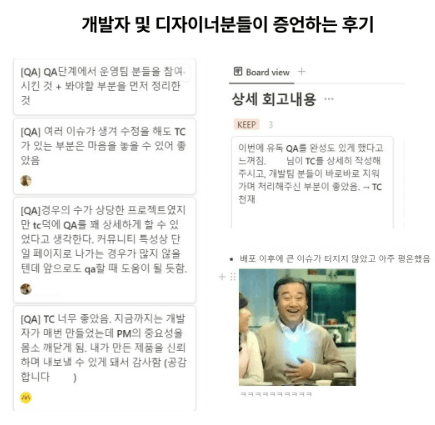
I am a QA professional.
I was able to learn about the purpose and direction of managing quality from the perspective of the entire project, not just managing quality from a QA perspective.
Before writing TestCase, it was a lecture that helped me develop practical know-how and the ability to look at things from various perspectives. Thank you.
5.0
서효석
31% enrolled
You explained it so well and in an easy to understand way!!!
5.0
가온누리
100% enrolled
As the title suggests, this was a simple but clear lecture for beginner planners/PMs to understand what Test Cases are and why they are needed.
However, as mentioned in the beginning of the lecture, it would be better to think of it as a lecture that can motivate and explain the necessity of Test Cases or QA to startups or planners who are just starting out, rather than those who are working in large companies or companies where QA is already well-organized.
What you will gain after the course
Know-how to write structured and logical test cases for thorough QA
How to write test cases that are good for communicating with developers
How to write a clear test case that anyone can participate in
Practical QA know-how based on Test Cases
Project management know-how based on QA results
Beginner planner, PM Want to learn how to stand on your own two feet? 💪
Surviving as PM 🤸♀️
For planners/PMs, the most important things are problem definition, reference, and data literacy. But what if the product you release is a mess?
The hypothesis can only be confirmed if the product works properly.
The products we plan are meant to provide value to our customers and serve as a means to verify our hypotheses. But if the planned product doesn't function properly after launch, are my plans and hypotheses truly worthless? Will the product truly deliver value to customers?
Let's learn the know-how to launch a product exactly as planned through test case writing and QA know-how.
Isn't this your situation? 👀
They say that we need to do something called QA before releasing a product. How do you do QA?
There are many issues that are discovered after the product is launched. Is there a way to do QA more properly?
Communication and coordination are always difficult during the QA process... Can't we communicate better?
There's still a lot to do after QA, Is there any way to manage projects more efficiently?
For these people I prepared it 👩
Project Management/Product Launch A beginner planner for the first time
A little more proper project Beginner PMs who want to manage
Launching a product in a small organization/team Product Manager in Charge
What you'll learn 📚
In this course, you'll learn test case writing and QA know-how to meticulously manage your products, which are like your own children. Whether you're a novice planner new to project management or product launching, or a PM of a small team taking on a large-scale project or product for the first time , this course will provide you with the practical know-how to properly QA your own products !
The Importance of Test Cases and QA
Understand why PMs need Test Cases and QA from a project/product perspective.
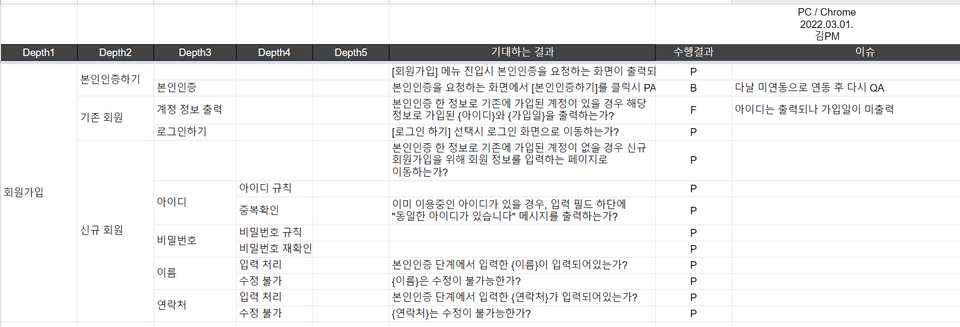
Writing Test Cases with Templates
Learn how to structure complex, multi-layered products and write test cases that anyone can clearly understand.
💡 We provide know-how for writing structured and clear test cases, as well as templates that can be applied immediately after the lecture.
Preliminary checklist before conducting QA
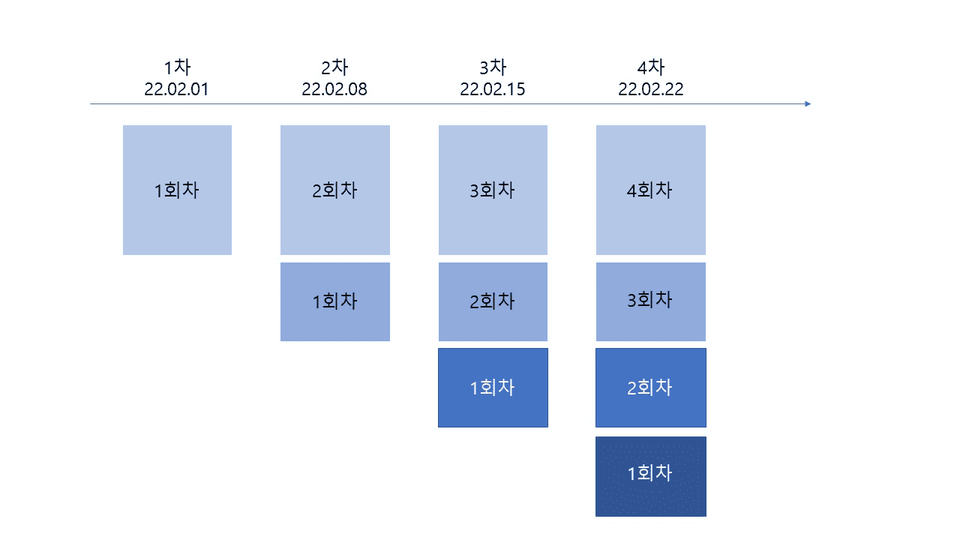
Cumulative QA considering product dependencies and project status
Random QA to discover things that cannot be seen through test cases
Project management and launch preparation know-how based on QA results
💡We will teach you specific QA know-how at the project management level, such as project schedule and dependency issues.
Anyone can do it easily So that you can understand 💪
We explain the know-how to write test cases and properly perform QA and management based on them.
Explains to project managers in simple and detailed terms why QA and Test Cases are needed, along with the context and background.
We will teach you test case writing and QA know-how based on real-life examples.
After the lecture, we provide templates that your team can use right away.
After attending the lecture You guys 👨🏫
You will be able to design clear and accurate test cases for what and how to QA the planned product.
You will gain the know-how and confidence to perform QA reliably and properly even on large projects.
You will be able to communicate more efficiently with various stakeholders throughout the project process, including QA.
Expected Questions Q&A 💬
Q. Aren't errors already visible? Do we really need test cases?
As a product grows, there's a lot to overlook. Test cases are the first step toward understanding and inspecting a product in a structured and clear manner!
Q. Isn't QA just about running the test cases from beginning to end?
Have you considered product dependencies and project schedules? I'll share QA know-how that takes complex, multi-layered project situations and legacy into account.
Q. Is this possible even though we are an agile team that doesn't create storyboards?
Even in an agile planning-development environment, planners/PMs ultimately end up handling QA. Even in these situations, we'll share tips for writing test cases and performing QA.
Recommended for these people
Who is this course right for?
1. A novice planner/PM who is worried about whether the planned product will be released soon and run smoothly without any issues
2. I am a beginner planner/PM who always misses something because I only do QA and proceed only as I see fit.
3. A planner/PM of a small team who wants to properly inspect a product that is being released for the first time
[Platter Worklab, a practical research lab that increases work density] We help practitioners and organizations work smarter and achieve results using generative AI.
Special Lecture and Hands-on Workshop on Work Automation Using Generative AI
Data Literacy & for Non-Data Professionals
Practical data analysis using SQL, Python, Amplitude, etc.
PM/PO/Service Planning Methodology
Key Teaching Experience
[Generative AI Workflow Automation Hands-on] GC Biopharma, Hyosung Electric, Handok, SD Biosensor, and many others
[Generative AI-based Data Analysis] Megastudy, Woowa Brothers, Sejong University, Hi-Teleservice, and many others
[Generative AI Utilization Special Lecture] Korea Hydro & Nuclear Power, Hyundai Engineering & Construction Technical Education Institute, Beiersdorf Korea, and many others
[Service Planning Methodology] Naver Cloud, Korea Tourism Organization, Global Fintech Industry Promotion Center, and many others
[University Special Lectures] Numerous special lectures on AI utilization and service planning for students at Seoul National University, Korea University, Hanyang University, etc.
As the title suggests, this was a simple but clear lecture for beginner planners/PMs to understand what Test Cases are and why they are needed.
However, as mentioned in the beginning of the lecture, it would be better to think of it as a lecture that can motivate and explain the necessity of Test Cases or QA to startups or planners who are just starting out, rather than those who are working in large companies or companies where QA is already well-organized.
Thank you :) As you said, I think it would be better to understand this lecture as one that explains concepts and context for those who are just starting out, or for those who are seniors or have to do it alone without any experience, rather than for those in organizations that already have a lot of systems and know-how! Thank you for the detailed review :)
I am a QA professional.
I was able to learn about the purpose and direction of managing quality from the perspective of the entire project, not just managing quality from a QA perspective.
Before writing TestCase, it was a lecture that helped me develop practical know-how and the ability to look at things from various perspectives. Thank you.
Thank you :)
I tried to convey the meaning and context of QA from a project perspective and planning purpose perspective beyond technical QA, and I am glad that I was able to convey this part well.
I am currently preparing a lecture that can convey the entire context and perspective of the product as a product manager beyond some functions. If you are interested, I will let you know soon. Thank you!
Since the tc writing lecture was paid, I listened to it with expectations that there would be something.
The entire lecture is more like an introduction, and it repeats itself again and again, saying that it will be reviewed every lecture. Also, it is full of obvious stories about what role it plays in project management.
I thought it would never happen, but it was like that until the end, and even the lecture attachments are worse than what you can find if you just search Google.
The actual writing examples are not even a few minutes long. I felt that there was nothing that practitioners would expect, such as basic practical writing methods or how to actually write and write in ambiguous situations. The price was also quite highㅜㅜ
It must have been difficult, but I think it is necessary to cover cases and efficient writing examples for each situation. Wouldn't the people who would pay to listen to this be beginners who are unfamiliar with the actual work or intermediate planners who are thinking about more efficient management? I don't think it will satisfy both.
Hello,
First of all, I would like to apologize for providing you with an unsatisfactory lecture experience.
However, as I introduced in the title and detailed content, this lecture was planned and produced for truly 'beginner' planners and those who are just launching a product. To this end, I focused on reviewing the overall context and definitions rather than visible forms and frameworks, and did not cover all the detailed cases.
Therefore, I think you may have found it lacking as a lecture for those with existing project experience, especially "intermediate planners who are thinking about more efficient management" as you mentioned.
In the future, I will refer to your valuable opinions and use them to plan and improve the lectures.
Thank you.








![[Game Planning/PM]Operation Tool/Back Office and Data Analysis PlanningCourse Thumbnail](https://cdn.inflearn.com/public/courses/333099/cover/716ba2cd-d746-495c-9499-4c1298d5b464/333099.png?w=420)

![[Game planning that will lead to employment if you follow along] Game business PM preparation/Collaboration with game plannersCourse Thumbnail](https://cdn.inflearn.com/public/courses/330882/cover/dd581231-ca52-4208-a1a0-35cc4713d840/330882-eng.png?w=420)
![Sunny Rider's Game Business and Game Planning Practice [E-book] 1230 PagesCourse Thumbnail](https://cdn.inflearn.com/public/files/courses/336837/cover/01jqk8h2vmgbd87ywjdvhck3hx?w=420)
![[Service Archive] Handling Black Consumers and Complaint CustomersCourse Thumbnail](https://cdn.inflearn.com/public/files/courses/337632/cover/01jwfdv39z6ng0fk1b74be5e69?w=420)

![[30 Years of Planning] 300 Pages / Romance of the Three Kingdoms Story / Data BookCourse Thumbnail](https://cdn.inflearn.com/public/files/courses/340963/cover/01khf3w1s19dzqgbx2ng1bgse1?w=420)
![[30 Years of Planning] 600 Pages / Romance of the Three Kingdoms: Rule of Three / Reference BookCourse Thumbnail](https://cdn.inflearn.com/public/files/courses/340964/cover/01khf3fpcaftgj2604r79c2g4v?w=420)
![[30 Years of Planning Experience] The Rule of Romance of the Three Kingdoms 3 / Self-Study / 150-page Textbook + 333-page WorksheetCourse Thumbnail](https://cdn.inflearn.com/public/files/courses/340999/cover/01khqrpwr7s0yy748na4jhdk1p?w=420)