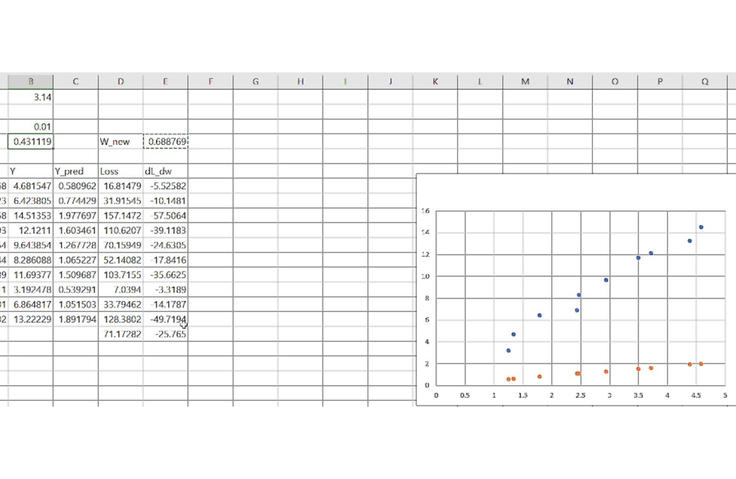
Demystifying AI with Excel (AI with Excel)
hjk1000
Deep Learning Math from Scratch and Practical Data Visualization: Conquering with Excel Without Coding

Basic
Python, Excel, AI
Let's learn the principles of deep learning by visualizing them with Excel.
565 learners
Level Beginner
Course period Unlimited
Reviews from Early Learners
5.0
yldn12016
Testing with Excel, which I use regularly, makes it much easier to understand.
5.0
753kg
Most introductory deep learning courses focus on using functions and looking at the resulting data, so I was curious about the process of creating and training models. This lecture was exactly what I wanted. It was fun to visually see the Excel implementation with easy examples. Thank you!
5.0
박언상
Understanding machine learning concepts was easy with the explanation using Excel.
Deep Learning Basics
How to use Excel
Let's explore the basics of deep learning by visualizing the process through Excel.
Today, artificial intelligence is like a "meal kit" where all the ingredients are pre-prepped. Libraries and APIs that produce results with just a few clicks are convenient, but they make it difficult to understand what chemical reactions are actually happening inside. This lecture begins by stripping away the packaging of flashy tools and placing the raw ingredients of "data" onto the cutting board of "Excel."
Behind the power of deep learning lies the 'fundamental knife skills' of clear mathematical operations and iterative optimization. Excel is the most powerful tool for visually and immediately verifying formulas and data. When you break down the movements of weights ($w$) and biases ($b$), which are often hidden behind complex code, into individual cells to observe and manipulate them directly, you finally begin to see the essence of deep learning.
Preparing Ingredients (Linear Regression): Understand the flow of data starting from the simplest formula, $y = wx + b$.
Adjusting the Seasoning (Loss Function): Diagnosing the state of the model by measuring the difference between the predicted and actual values.
The Art of Heat Control (Gradient Descent): Learn the sense of optimization by finding the gradient through derivatives and gradually reducing the error.
Feedback on Taste (Backpropagation): Implement the core logic of returning from the final output to the initial ingredient mix to precisely adjust the values.
You will gain the experience of making the heart of deep learning beat firsthand, even without frameworks (meal kits) like Python's TensorFlow or PyTorch. This goes beyond simple implementation and will provide you with a 'chef's perspective' for designing AI and solving problems. Now, shall we go and experience the true handmade taste of deep learning?
"The more complex the technology, the simpler its roots must be."
Author: Wrote "Python Artificial Intelligence TensorFlow"
I have incorporated the know-how to easily explain complex AI algorithms from a beginner's perspective.
Education: Graduated from Hanyang University Graduate School of Artificial Intelligence Convergence
I have researched the core principles of artificial intelligence based on academic depth and practical application skills.
Strengths: Beyond simply teaching 'how to use' it, I possess exceptional expertise in visualizing the 'internal working principles' of technology and delivering them through Unplugged methods.
Who is this course right for?
Those who are new to deep learning and curious about its principles
Anyone interested in implementing the basics of deep learning using Excel?

Career Verified
1,845
Learners
61
Reviews
10
Answers
4.7
Rating
13
Courses
Hello
I am an office worker from a non-major background who is diligently studying deep learning.
I would like to share the things I've felt while studying with all of you.
Thank you.
All
10 lectures ∙ (1hr 25min)
1. Deep learning
03:32
2. Data Preparation
09:01
3. Loss Definition
04:14
4. Gradient Descent
10:00
5. Preparing Data
12:34
7. GD issues
08:22
All
24 reviews
4.8
24 reviews

Reviews 4
∙
Average Rating 5.0
5
Understanding machine learning concepts was easy with the explanation using Excel.
Ah, thank you so much! I'm trying to explain deep learning concepts in an easy way, and I'm so happy to hear that you understood them well!
Reviews 3
∙
Average Rating 5.0
5
Testing with Excel, which I use regularly, makes it much easier to understand.
Thank you so much. I believe that knowing the basic principles will be a great strength in the face of rapidly changing technology. Great job on your studies.
Reviews 1
∙
Average Rating 5.0
5
Most introductory deep learning courses focus on using functions and looking at the resulting data, so I was curious about the process of creating and training models. This lecture was exactly what I wanted. It was fun to visually see the Excel implementation with easy examples. Thank you!
Thank you so much for understanding the part I was trying to explain!
Reviews 1
∙
Average Rating 5.0
5
It was a bit difficult for me as a liberal arts major in terms of mathematics, but I think it's the best for understanding deep learning concepts! Thank you!
Wow! Thank you so much for the course review! I think the concept is the most important thing! I hope it helps you understand the concept at least a little! Thank you
Check out other courses by the instructor!
Explore other courses in the same field!
$4.40








![[ICT Archive] Big Data Core and Business ModelsCourse Thumbnail](https://cdn.inflearn.com/public/files/courses/338811/cover/01k44rs7zkwq0ehc8vqsy2mdtb?w=420)









![[7-Day Complete] Pass MS AI-900 Certification in One GoCourse Thumbnail](https://cdn.inflearn.com/public/files/courses/338854/cover/01k4caartf5v7x2e574pq0wnp8?w=420)