Deep Learning with Excel
hjk1000
$4.40
Beginner / Excel, Deep Learning(DL), VBA
4.8
(24)
500+
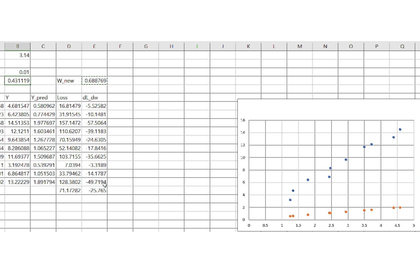
Let's learn the principles of deep learning by visualizing them with Excel.

Beginner
Excel, Deep Learning(DL), VBA

[Lecture Summary: From Pixels to Practice, Building a Business Card Recognition System] * **Pre-processing:** We learned how to remove noise and extract the 'skeleton' of a business card using Gaussian Blur and Canny Edge detection. * **Hough Transform:** We went through an "audition" process to select the real 'borders' from tens of thousands of points using the $(\rho, \theta)$ voting system. * **Geometric Reasoning:** By solving complex linear equations through substitution and matrices, we precisely targeted the four corners $(x, y)$ of the business card. * **Data Sorting & Filtering:** We mastered data refinement techniques, such as removing overlapping lines and labeling the found points in the order of 'top-left, top-right, bottom-right, bottom-left.' * **The Magic of Transformation (Perspective):** We concluded with practical techniques for straightening tilted images or, conversely, compositing an image into a frame of your choice. 📢 "Does looking at formulas give you a headache? It was the same for me." When I first took on an image processing project in the field, what bothered me most were the screens full of $\sin$ and $\cos$ formulas. Textbooks were full of nothing but equations, and nowhere provided answers to practical problems like, **"Why can't this find the business card in my code?"** Through this lecture, I want to help you solve three chronic problems you will encounter: 1. **"The problem where math feels like an alien language"** → Solved through [The Power of Analogy]. Instead of simply memorizing linear equations, I help you understand them through **'lasers fired from the origin'** and **'shadow play.'** Once you understand the principles, the code follows naturally. I translate formulas into the 'easiest language' that I discovered after countless trials and errors. 2. **"The problem where you know the theory but can't apply it"** → Solved through [Data Auditions]. Why are there 10 borders on my business card? Why is the order of the corners scrambled? I have revealed all my debugging know-how on how to filter and sort the 'messy data' you inevitably encounter in practice. The audition logic for separating the wheat from the chaff will take your project to the next level. 3. **"The problem where the result is boring"** → Finished with [Interactive Composition]. This isn't a lecture that ends with just looking at black-and-white edges. The moment you tuck the business card you created into a 'Hall of Fame frame' that you clicked yourself with a mouse, you will experience **'the magic of manipulating space'** beyond simple coding. "Computer vision is not about math; it's the process of gaining a new set of eyes to see the world." I want to pass on to you that thrilling 'A-ha!' moment I realized in the field. You can close the complex theory books now. Let's paint images freely with the brush of code together!

Confidence in implementing mathematical principles into code
Know-how for handling messy real-world data
Geometric thinking that twists space at will
My own completed image processing pipeline
Have you ever experienced a situation where code that worked perfectly in a tutorial suddenly failed when applied to a business card photo you took yourself?
The core of image recognition lies not simply in calling functions, but in the mathematical thinking required to refine messy, real-world data. This course covers the A to Z of vision programming—from preprocessing to geometric transformation and image composition—through a practical business card recognition project.
Core Technologies: Gaussian Blur, Canny Edge
Content: You will learn preprocessing techniques to remove light smearing and noise, leaving only the sharp "edges" that serve as candidates for the business card's borders.
Core Technology: Hough Transform ($\rho, \theta$ space)
Content: We select strong edge candidates by counting the votes cast by scattered points. We pass on practical logic for organizing redundant lines and filtering the top 4 core lines through the analogy, "Similar ones are on the same team!"
Core Technology: Substitution method of simultaneous equations and matrix operations
Content: Mathematically calculate the 'intersections' where lines meet. Implement the magic of finding the exact vertices $(x, y)$ through the extension of lines, even if the image is cropped.
Core Technology: Coordinate Normalization and Sorting Algorithm
Content: Assign an order to the four points so the computer can understand them. Build a robust logic to find the 'top-left' from any angle using $x+y$ and $x-y$ operations.
Core Technology: getPerspectiveTransform, warpPerspective
Content: Unfold a crooked rectangle into a straight rectangular canvas with a 'snap!' Furthermore, complete the project by naturally compositing your own business card into the 'Winner's Frame' background that you personally selected with your mouse.
"The computer handles the formulas. You just need to understand the flow."
Curing Math Phobia: You don't need to memorize $\sin, \cos$ formulas. I will first help you visualize the principles in your mind using intuitive metaphors like 'lasers' and 'shadows.'
Practical Debugging: "Why isn't the line visible?", "Why is the intersection point appearing in the wrong place?" I have embedded solutions for the most common real-world exceptions throughout the code.
Interactive Practice: We aim for 'living coding' where you don't just see the results, but experience synthesis by clicking on the screen and capturing coordinates yourself.
Design Ability: You will be able to design complex vision projects as step-by-step pipelines.
Implementation Confidence: You will gain the implementation skills to immediately translate mathematical logic into Python code.
Application Scalability: Beyond business card recognition, you will build the foundational strength to advance into high-level vision technologies such as lane detection, OCR preprocessing, and AR marker recognition.
Prerequisites: An understanding of basic Python syntax and the curiosity to see a business card through to the end!
Recommended for: Developers who struggle with math, beginners lost between theory and practice, and anyone who wants a taste of the essence of vision technology.
Who is this course right for?
A junior developer who used to be a "math abandoner" (someone who gave up on math)
A 'tutorial maze' escapee who is well-versed in theory but unable to apply it.
Vision beginners who want to jump to the next level
Need to know before starting?
Python Basics
Middle school level mathematics

Career Verified
1,884
Learners
70
Reviews
10
Answers
4.7
Rating
13
Courses
Hello
I am an office worker from a non-major background who is diligently studying deep learning.
I would like to share the things I've felt while studying with all of you.
Thank you.
All
14 lectures ∙ (4hr 57min)
Course Materials:
Check out other courses by the instructor!
Explore other courses in the same field!
Limited time deal ends in 8 days
$4,130.00
24%
$4.40