

inflearn logo

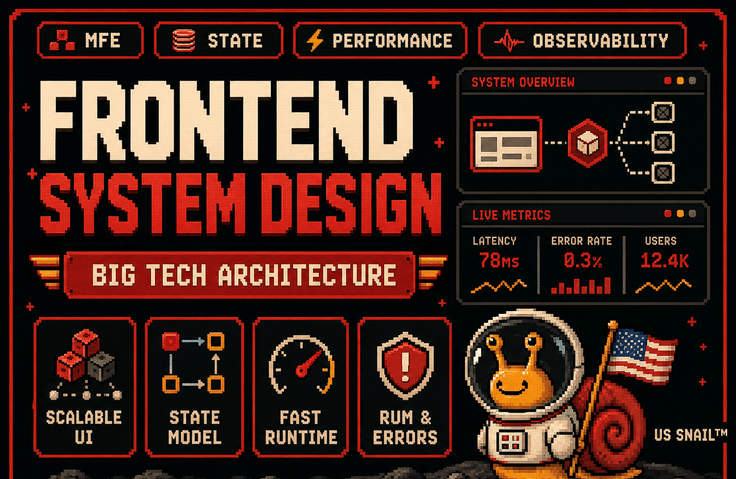
U.S. Big Tech Frontend System Design in Practice: For Frontend Developers Who Don't Want to Remain Just Simple Implementers

This course trains your frontend system design mindset through real-world service cases such as Threads feeds, Amazon shopping carts, Netflix streaming UI, Google Docs collaborative editing, Micro Frontends, Agentic UI, and Observability.

38 learners are taking this course

Level Basic

Course period Unlimited

frontend
frontend
system-design
system-design
AI
AI
frontend
frontend
system-design
system-design
AI
AI

What you will gain after the course

  • In a frontend system design interview, you can organize requirements and construct a consistent response covering architecture, data flow, component structure, and operational strategies.

  • I can select the appropriate rendering strategy—such as CSR, SSR, SSG, ISR, and Streaming—for large-scale web applications and explain the associated trade-offs.

  • I can distinguish between Local State, Global State, Server State, URL State, and Cache State, and design state management architectures for complex screens.

  • Beyond simply being a developer who implements screens, you can acquire the mindset of a frontend architect who enables users to understand and operate complex products and systems.

  • You can write practical frontend system design documents that include performance, accessibility, security, testing, observability, and deployment strategies.

  • From a frontend perspective, I can structure UIs for complex domains, such as a SpaceX-style rocket parts cost analysis platform, a Threads-style real-time feed, or a Figure AI-style robot operations dashboard.

  • In a frontend system design interview, you can organize requirements and construct a consistent response covering architecture, data flow, component structure, and operational strategy.

The reason it is difficult for frontend engineers to increase their salary is not because they lack knowledge.

The problem is that many frontend developers
are still evaluated as "people who implement screens."

And in an era where AI writes code,
this evaluation is becoming increasingly dangerous.

Button implementation, card UI, API connection, CRUD screens, and simple state management are
already being quickly caught up to by AI.

In the future, the differentiator for frontend engineers will not be
“how quickly they can implement,”
but rather whether they can design complex product requirements into a system..


To reach higher salaries and better positions,
you must be able to decompose and design complex requirements into state, data flow, rendering strategies, performance, observability, and deployment structures.


This course trains your frontend system design thinking through real-world Big Tech-style cases,
ranging from Threads feeds, Amazon shopping carts, and Netflix streaming UI to
Google Docs collaborative editing, Micro Frontends, performance optimization, and observability.


This course goes beyond simply implementing screens in frontend development; it covers how to structure and design complex service requirements from a frontend system design perspective.

Students will learn the mindset for designing large-scale UI architectures through cases such as Threads-style real-time feeds, Amazon-style product lists and shopping carts, Netflix/YouTube video streaming UIs, Google Docs collaborative editing UIs, SpaceX-style rocket part cost analysis platforms, and Figure AI-style robot operation dashboards.

In the lecture, you will learn step-by-step the core elements that must be considered in frontend system design, ranging from requirements analysis, rendering strategies, data flow, and state management to component structure, performance optimization, accessibility, security, testing, observability, and deployment strategies.

This course can be applied to fields such as US Big Tech, global startups, enterprise SaaS, real-time dashboards, operations consoles, observability platforms, and AI/robotics/space infrastructure UI. Beyond simple implementation skills, the goal is to develop the capability to design complex systems into interfaces that users can understand and operate.

The reason I planned this lecture is because I believe that even in an era where AI writes more and more code, the ability to understand complex domains and translate requirements into design remains a powerful differentiator for developers—one that creates high added value.


This course was created to help students grow into frontend engineers who understand the entire product and system, rather than just developers who create screens, and to bring out the greatness within each student.

Recommended for these people

I feel like I'm constantly being evaluated only as a UI implementer.

Developers who can handle frontend implementation but want to be evaluated at a higher level

I want to increase my salary as a frontend developer, but I don't know what else I should learn.

Developers preparing for frontend/full-stack system design interviews at US Big Tech companies, startups, and global tech firms

I want to be recognized for my system design capabilities, just like a backend/infrastructure developer.

Developers who want to train in large-scale UI architecture based on real-world service examples such as Threads, Amazon, Netflix, Google Docs, SpaceX, and Figure AI

This is how you will change after taking the course

Before taking the course, you might first think of components when you see a complex screen.

But after taking the course, the questions you ask yourself will change first.

Instead of simply asking, “What component should I build?”, you will start looking at it from the perspective of, “How should I design the structure of this product experience so that it lasts long, operates quickly, and allows for tracking when problems arise?”

This difference creates the greatness and depth of the students, leading to roles and responsibilities where they can handle larger problems in practice.

What you will learn

1. This is a lecture that changes the evaluation criteria for frontend developers.

If you are aiming for a higher salary and a better position as a frontend developer, simply having the ability to implement UIs faster is not enough.

The reason many frontend developers get stuck at a certain point in their growth is not because they lack skill.
It is because they are still seen by companies and interviewers merely as "someone who implements screens."

In an era where AI quickly generates components, forms, card UIs, and API connection codes, this evaluation becomes even more dangerous.
With simple implementation skills alone, you will be more easily compared and pushed into lower-cost roles.

A higher-level frontend engineer is not someone who just builds screens, but someone who structures complex requirements.

You must be able to design everything from what states exist and where the source of truth for data lies, to which screens require SSR and which should be isolated with CSR, where race conditions occur, and which telemetry to use for tracking issues after deployment.

This course was created specifically to meet those evaluation criteria.

This is not a lecture for memorizing more frontend knowledge, but a lecture designed to change your mindset so you can be evaluated as a frontend engineer who understands and designs the entire product and system.


2. Instead of memorizing theory, you will understand it through reverse engineering actual service cases.

In frontend system design, what matters is not knowing a lot of terminology.

What matters is that your questions change when you look at a complex screen.

Before the lecture, you might think like this.

"How should I divide this screen into components?"

But after the lecture, the questions change.

"What is the core user experience of this screen?"
"Which data must be absolutely accurate?"
"Which state can be temporarily stale?"
"Is the source of truth for the state the server or the client?"
"How can we prevent a slow response from overwriting the latest UI?"
"What numbers should be used to define performance?"
"What data will be used to trace the cause if a problem occurs during operation?"

This course does not make you memorize difficult theories first.

It starts with real-world service examples such as the Threads feed, Amazon shopping cart, Netflix streaming UI, Google Docs collaborative editing, Micro Frontend, and Observability.

First, we analyze the product experience from the user's perspective, then explain in reverse why state management, data flow, rendering strategies, performance optimization, and observability are necessary to make that experience stable.

Therefore, students will develop the ability to explain why such a structure is necessary, going beyond simply "how to implement it."

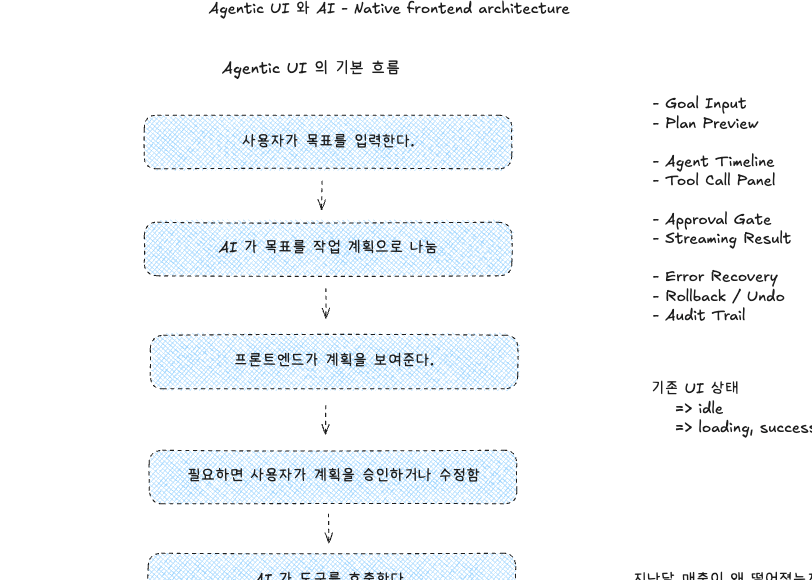
3. In the era of AI writing code, frontend is shifting toward Agentic UI

AI can already write a lot of frontend code.

Buttons, forms, card UIs, CRUD screens, API call codes, and basic styling are being created faster and faster.

Therefore, simple implementation skills alone may weaken a frontend developer's competitive edge.

But there is an even bigger change.

AI is not just changing the way we develop, but is changing the UI structure of the product itself.

In traditional UI, users performed every step themselves.

They entered search terms, selected filters, checked results, clicked buttons, and moved to the next screen.

But in Agentic UI, the user states the goal first.

"Analyze this problem."
"Compare this data."
"Process this task automatically."
"Recommend the next action based on these results."

Then, the AI interprets the goal, selects the necessary data and tools, and executes multiple steps.

The role of the frontend becomes even more important here.

You must show what the AI is currently doing.
Intermediate results must be expressed in a way that the user can understand.
Risky actions must require user approval.
Failed tool calls must be recoverable.
When AI results are uncertain, they should not be finalized as-is but presented in a reviewable state.

In this lecture, we will also cover Agentic UI design for these AI-native product experiences.

We will look into how to model Agent run states, how to display tool-calling UIs, how to handle streaming responses, how to design user approval flows, and how to represent AI-generated results through verifiable UIs.

In the AI era, the work of a frontend engineer is not decreasing, but rather changing.

Simple implementation may become more automated,
but the ability to design complex product experiences where AI and users work together is becoming increasingly important.

In line with these changes, this course helps frontend engineers grow beyond being simple UI implementers into engineers who design AI-native product experiences.

4. Train in frontend system design through real-world Big Tech-style cases

This course does not just explain abstract concepts.

We train frontend system design based on complex UI problems frequently encountered in real-world services.

In a Threads-style feed, we don't just render a list of posts; we cover infinite scroll, deduplication, optimistic reactions, stale responses, real-time updates, and preserving the scroll position.

Amazon-style commerce doesn't end with just creating product lists and shopping carts.
It covers everything from guest cart merging, price changes, and inventory validation to payment unknown states, idempotencyKey, and hydration mismatch.

In Netflix/YouTube-style streaming UIs, it doesn't end with just using the <video> tag.
It involves handling buffering, playback status, network quality, resolution switching, and disaster recovery as state models.

In a Google Docs-style collaborative editing UI, it is not just about creating an input field; it involves handling local editing states, server synchronization states, conflict resolution, real-time updates, and the balance between latency and consistency.

In Micro Frontends, you don't just learn how to split an app.
We also look at organizational deployment units, team responsibilities, the boundaries between shell and remote, shared dependencies, and design system consistency.

Through these cases, students will learn frontend system design not just as simple theory, but as a mindset for solving real-world service problems.

5. You will learn state management not as how to use libraries, but as how to design states.

In this lecture, we will cover how to model complex UI states using the X-M method, going beyond the limitations of boolean state combinations.

The X-M (the "X-" will remain undisclosed here) method is one of the approaches I studied while auditing a course at a UC university through an acquaintance and discussing it with Indian colleagues during a Big Tech fellowship program. I decided to add it to the curriculum because I believe it will be a useful method for documentation, collaboration, and design within a company.

But what’s more important is “what to define as state.”

A like button might not end with just a single isLiked.
A shopping cart quantity might not end with just a single quantity.
A payment status might not end with just loading, success, and error.

In actual services, states are more complex.

There is the state the user first sees, the state the client shows optimistically, the state confirmed by the server, the state that must be rolled back upon failure, and the unknown state where the result is not yet determined.

Students will learn not just "how to use state management libraries," but how to design complex product experiences into predictable state flows.

6. Performance optimization is treated as a system requirement, not just a collection of tips

Frontend performance optimization is not simply a matter of lazy loading images or splitting code.

In actual services, you must first define which user experiences will be guaranteed by which metrics.

On a product detail page, LCP can be important.
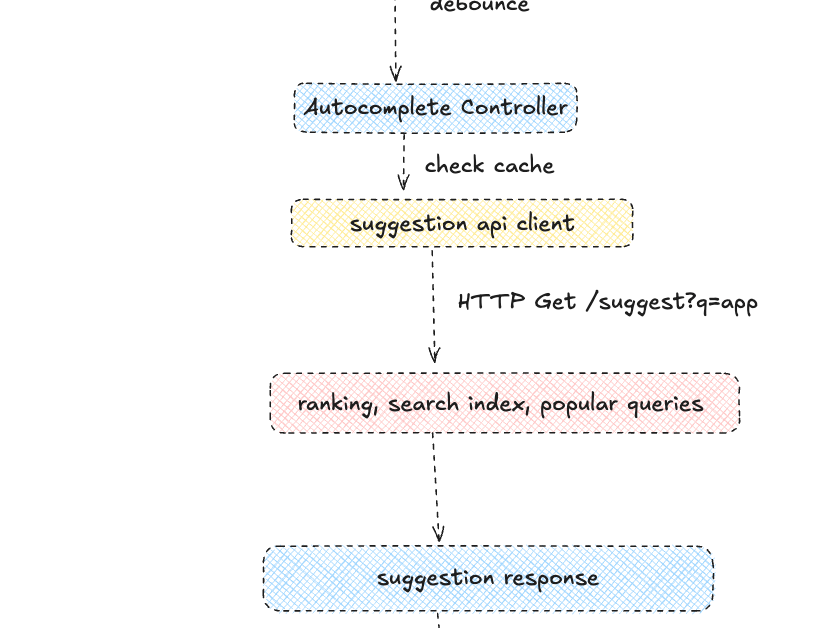
In an autocomplete search bar, Time to First Suggestion can be important.
In a real-time feed, scroll stability and deduplication can be important.
In a video UI, buffering rate and playback recovery time can be important.
In a collaborative editing UI, input latency and synchronization delay can be important.

In this course, we do not treat performance vaguely as just "making it fast."

We will look at which performance metrics are important for specific screens, which rendering strategies should be chosen, which states and data flows create performance bottlenecks, and even how to observe the performance of actual users after deployment.

Therefore, students will develop the ability to design for performance according to product requirements, rather than just learning simple optimization tips.

7. Learn frontend design that considers both operations and observability

Important frontend problems in practice do not only occur before deployment.

Rather, the real problems occur after deployment.

Buttons may not work only in specific browsers.
Payment status may fall into an unknown state in certain network environments.
The shopping cart rollback rate may suddenly increase in a specific version.
As search responses slow down, stale responses may increase.
Hydration mismatches may occur only on specific pages.

At this point, simply saying "I have integrated an error tracking tool" is not enough.

Frontend engineers must be able to design which events to collect, which state transitions to record, and which metrics indicate issues in the user experience.

In this course, observability is not viewed as a simple implementation like installing Sentry.

We view frontend systems through an operable structure using metrics such as RUM, error tracking, telemetry contract, state transition logs, rollback rate, stale response ignored count, and payment unknown rate.

With this perspective, a frontend developer can grow beyond being a simple implementer into an engineer who takes responsibility for quality even after deployment.

This is not your typical clone coding; it covers frontend system design.

This course is not about simply following along to build screens. You will analyze and design actual complex services from a frontend perspective, such as a Threads feed, Amazon product listings, Netflix video UI, Google Docs collaborative editing, a SpaceX-style rocket part cost analysis platform, and a Figure AI-style robot operation dashboard.


The person who created this course

  • Silicon Valley Survivor | American Snail

    Based on the experience and know-how accumulated at the forefront of the global tech scene, I present a path for non-majors to overcome technical barriers and become masters of their business.

    • Current) Founder of a Silicon Valley AI Coding Agent Startup

      • Operating self-developed AI tool 'Snailer CLI' (13K+ downloads)

      • Selected for the Google for Startups Program

    • Former) Engineer career at US Big Tech and promising startups

      • Reached the final stage at Amazon, but gave it up to start a business

      • Engineer at a Silicon Valley AI Fintech startup

      • OpenAI / Meta / Apple / Adobe / Amazon Full-stack Fellowship

      • Domestic search engine portal and fintech development

      • AI Startup AR/B2B/SDK Development

    • Proven Educational Capabilities

Do you have any questions?

Q1. How does frontend system design differ from general frontend development?

General frontend development often focuses on implementing given screens or features. In contrast, frontend system design is the process of analyzing requirements and designing the entire frontend system, including rendering strategies, data flow, state management, component structure, performance, accessibility, security, testing, and observability.

Q2. Do I need to know React?

While having experience with React makes it easier to understand, this course is not strictly limited to React. This course focuses more on the mindset of designing frontend systems rather than specific framework syntax.

Q4. Can I take this course even if I have no experience in system design?

Yes. In the early stages, I explain the step-by-step strategy covering requirements organization, architecture design, data and state design, interface design, and operational strategy. While basic knowledge of HTML, CSS, and JavaScript, along with experience using frontend frameworks, will make it much easier, they are not mandatory.

Notes before taking the course

Practice Environment

This course does not heavily depend on a specific OS. You can practice design or take the course using Excalidraw in any environment, including Windows, macOS, and Linux.

Learning Materials

Course materials are provided as section-specific design notes, frontend system design checklists, case-by-case architecture diagrams, data/state model examples, and interview answer structure examples.

If necessary, some example code, pseudocode, and component structure examples will also be provided.

Prerequisites and Important Notes

  • Basic knowledge of HTML, CSS, and JavaScript is recommended. It is even better if you have experience using one of the frontend frameworks such as React, Angular, or Vue.

  • It will be much easier to follow the course if you have a basic understanding of API calls, asynchronous processing, state management, and browser rendering.

  • This course is not about replicating a specific company's internal system exactly as it is; rather, it is a training process for developing a frontend system design mindset based on publicly known product types and practical architectural patterns.

Recommended for
these people

Who is this course right for?

  • Those who want to become frontend engineers who design complex systems like those of US Big Tech, going beyond simple CRUD.

  • Those who want to understand frontend architecture in enterprise environments based on not only React, but also Angular, C#, and .NET.

  • Those who want to develop the "ability to understand complex domains and structure them into interfaces," a skill that is not easily replaced even in the AI era.

  • Developers interested in the product design methods of companies like SpaceX, Starlink, Tesla, Figure AI, Meta, Amazon, and Netflix

Need to know before starting?

  • Basic knowledge of HTML, CSS, and JavaScript is required.

  • Experience using either React or Angular frontend frameworks is preferred.

  • It's okay if you don't have experience in system design.

Hello
This is americasnail

Inflearn Verified

1,049

Learners

35

Reviews

46

Answers

4.5

Rating

6

Courses

  • Silicon Valley Survivor | US Snail

    Based on the experience and know-how accumulated at the forefront of the global tech scene, I present a path for non-majors to overcome technical barriers and become masters of their business.

    • Current) Founder of a Silicon Valley AI Coding Agent Startup

      • Operating self-developed AI tool 'Snailer CLI' (13K+ downloads)

      • Selected for the Google for Startups Program

    • Former) Engineer career at US Big Tech and promising startups

      • Reached the final stage at Amazon, but gave it up to start a business

      • Silicon Valley AI Fintech Startup Engineer

      • OpenAI / Meta / Apple / Adobe / Amazon Full-Stack Fellowship

      • Domestic search engine portal and fintech development

      • AI startup AR/B2B/SDK development

    • Proven Educational Capabilities

      • Double major in Computer Science and Business Administration at a 4-year university in Seoul, with extensive experience in multiple startups.

      • Produced 1,000+ cumulative students, with 4.4K+ followers on Threads and 460+ followers on Substack

More

Curriculum

All

29 lectures ∙ (3hr 54min)

Course Materials:

Lecture resources
    Published: 
    Last updated: 

    Reviews

    Not enough reviews.
    Please write a valuable review that helps everyone!

    americasnail's other courses

    Check out other courses by the instructor!

    Similar courses

    Explore other courses in the same field!

    Limited time deal

    $1,461,624.00

    29%

    $77.00