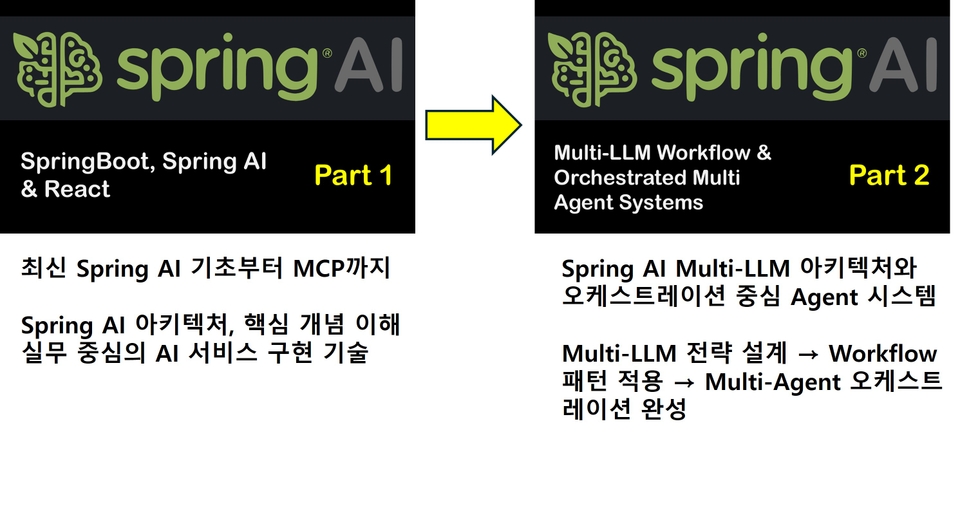
Multi-LLM & Orchestrated Multi-Agent System Implemented with Spring AI

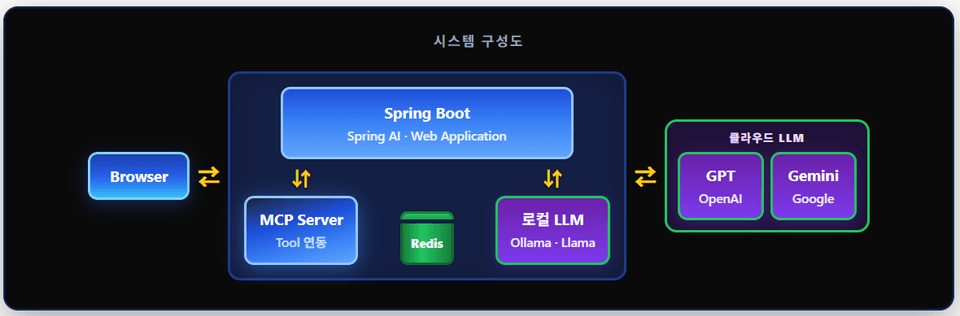
This is an advanced course focused on designing and implementing Multi-LLM architectures and orchestration-centered Agent systems (Main/Sub, Tool, Task Runtime, Agent Registry) by strategically combining GPT, Gemini, and LLaMA (local) based on Spring AI and Spring Boot. Moving beyond simple LLM calls, the curriculum covers the implementation of scalable, stable, and continuously improving AI systems. This involves applying Agentic Workflow Patterns (Chain, Parallel, Routing, Orchestrator–Workers, Evaluator–Optimizer) and Multi-Agent structures, separating execution layers like RAG and external APIs/DBs via Tool/ToolRegistry, and utilizing DAG engines, YAML declarative workflows, and Validated DSL (validation immediately after loading). Furthermore, the course includes Circuit Breakers, Reactive Streams, Redis monitoring, parallel processing, and iterative evaluation loops. It expands from Thymeleaf (SSR) exercises to decoupled Front-end/Back-end architectures using React and REST, while integrating tool and agent runtimes via MCP (Model Context Protocol) to build AI architecture design capabilities at a production-ready level. The ultimate goal is to evolve beyond being a simple AI user who merely integrates APIs and writes prompts, becoming a developer capable of designing AI systems—explaining and balancing Multi-LLM, agents, workflows, declarations, and validation within a single execution architecture.
(4.8) 5 reviews

67 learners

Level Basic

Course period Unlimited

Spring Boot
Spring Boot
orchestration
orchestration
multi-agent
multi-agent
SpringAI
SpringAI
AI Agent
AI Agent
Spring Boot
Spring Boot
orchestration
orchestration
multi-agent
multi-agent
SpringAI
SpringAI
AI Agent
AI Agent

Reviews from Early Learners

4.8

5.0

김정현

41% enrolled

I needed knowledge on how to utilize Multi-LLMs with Spring AI and how to develop Agents... and this was very helpful. The explanations were clear and the examples were great, making it easy to understand.

5.0

이은범

55% enrolled

It was a lecture where I could systematically learn about Multi-LLM architecture and Agent-based AI system design. It was great to experience structures close to actual services through hands-on practice, such as Orchestrators, Workflow patterns, and quality evaluation loops, rather than just simple LLM utilization. I think this is a helpful lecture for developers interested in AI backend architecture!!

5.0

희성

45% enrolled

Following Part 1, I highly recommend this Part 2 lecture not only to beginners who have just encountered advanced Spring AI courses but also to those who need efficient architecture design. In my case, thanks to the detailed learning materials provided for the Multi-LLM architecture and Agentic Workflow configuration, I am learning with ease as I can quickly grasp core logic by directly executing the provided code rather than just keeping complex orchestration concepts as theory.

What you will gain after the course

  • Ability to design Multi-LLM based AI architectures

  • How to apply Agentic Workflow patterns in practice

  • Ability to design and build Orchestrated Multi-Agent system implementations

  • Ability to design and implement DAG (Directed Acyclic Graph) workflow engines

  • Implementation of DAG-based Declarative Workflow and Validation System

  • Understanding the backend architecture of AI services at a professional level

Multi-LLM & Orchestrated Multi-Agent System Implemented with Spring AI

(Enterprise AI System Design based on DAG · Tool · Task · YAML DSL)


The system learned in this course is designed to build a system that handles the following complex tasks and decision-making processes.

is the objective of this course. In other words, we aim to build a Multi-LLM-based Orchestration-centered Multi-Agent system.


This course is a practical-level program designed to architect and implement Multi-LLM architectures and Orchestrated Multi-Agent systems by strategically combining GPT, Gemini, and LLaMA based on Spring AI.

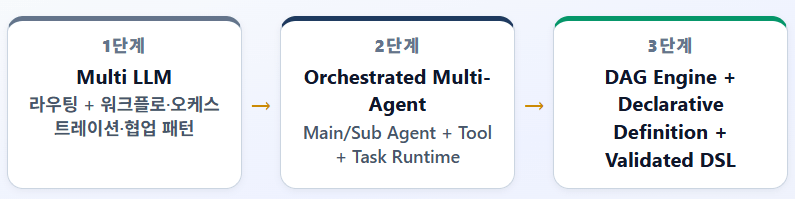
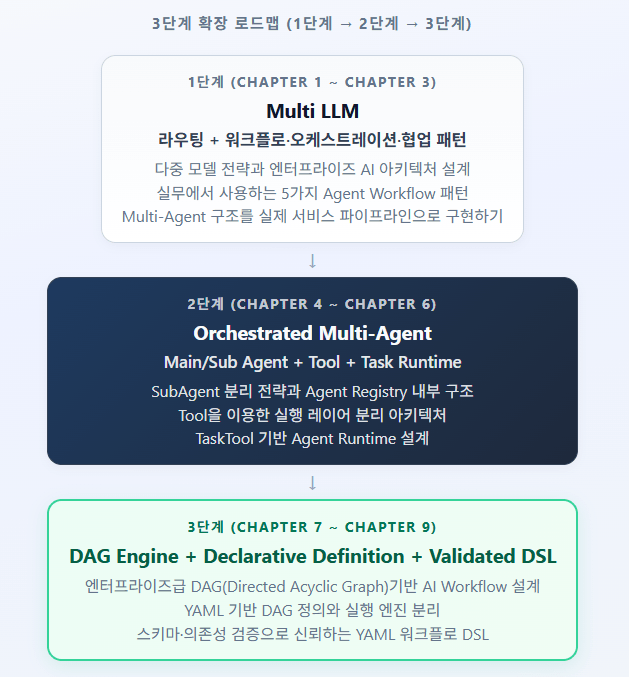
We will build the structure according to the 3-step expansion roadmap below. Each step assumes the execution, model, and collaboration methods of the previous step.

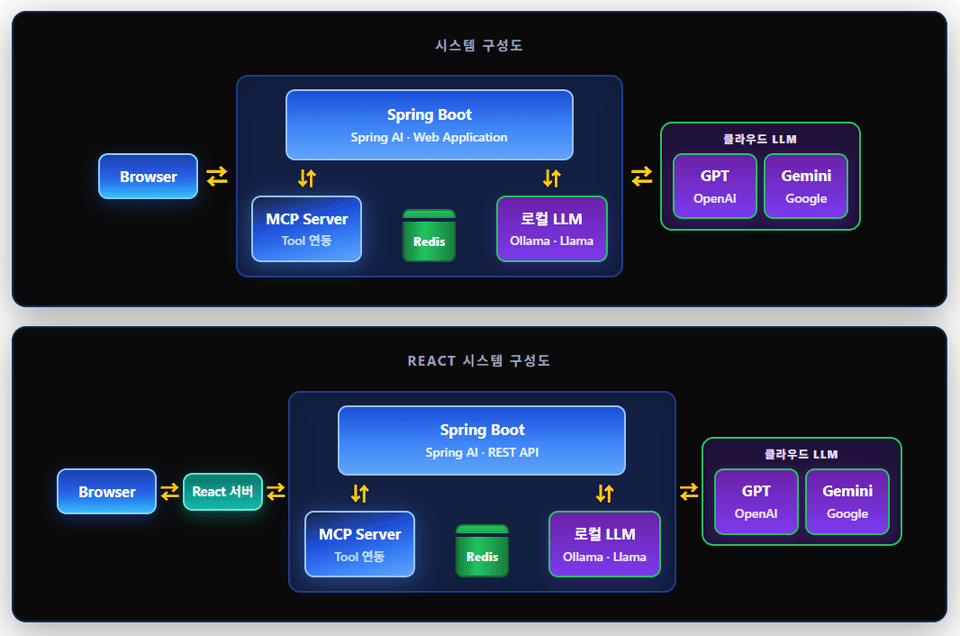
In the Appendix, we will proceed with React·REST API expansion and MCP Integration (integrating Tool·Agent runtime with Model Context Protocol) expansion.


💡Core content of this course

  • Multi-LLM Architecture

  • Agentic Workflow Patterns

  • Orchestrated Multi-Agent

  • Main Agent & Sub Agent + Agent Registry

  • Tool-Orchestrated

  • Task-Orchestrated & Runtime


  • DAG-Orchestrated (Declarative/Validation DSL)

  • HTTP, SSE, and Redis Integration

  • Circuit Breaker, Redis monitoring, parallel processing, Evaluator–Optimizer, etc.

  • Scalability: React·REST· MCP Server/Client Extension

💡Key Features of This Course

  • Not just theory, but Spring AI and Spring Boot-based implementation and practice (Thymeleaf + React·MCP extension)

  • Multi-LLM — Designing a model strategy rather than relying on a single model through routing, fallback, and security branching

  • Orchestrated Multi-Agent — Implement a system that coordinates agents through Main/Sub, Tool, Task Runtime, and service pipelines (strategic, precision, and voting-based collaboration)

  • DAG-Orchestrated Multi-Agent (DAG-based AI Workflow Design)

  • HTTP·SSE·Redis based monitoring structure that links task-unit progress and statusHTTP·SSE·Redis構造

💡Learning Content

1⃣ Setting up Spring AI development environment and Multi-LLM environment in Spring Boot

2⃣ Chapter 1. Multi-LLM Architecture (Multi-Model and AI Architecture Design)

3⃣ Chapter 2. Agentic Workflow Patterns (5 Agent Workflow Patterns)

4⃣ Chapter 3. Orchestrated Multi-Agent Patterns (Implemented as Pipelines)

5⃣ Chapter 4. Multi-Agent Architecture (Main Agent & SubAgent Separation Strategy)

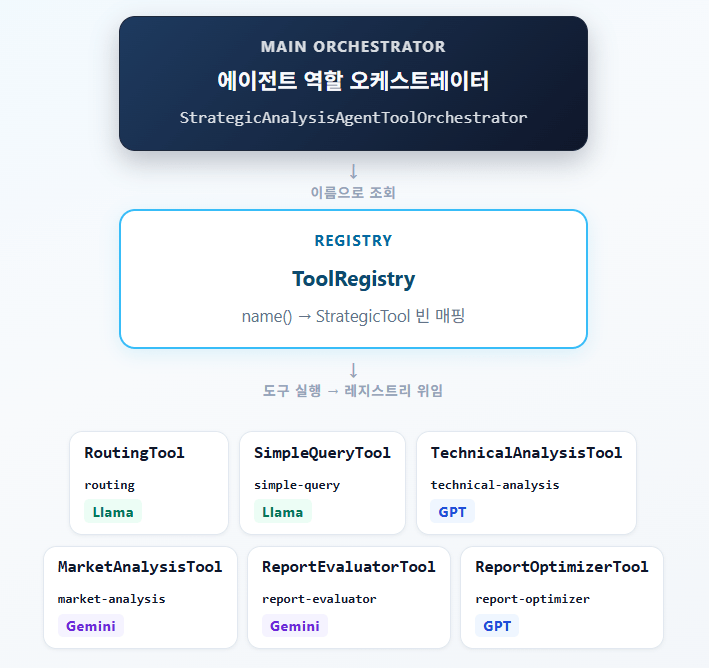
6⃣ Chapter 5. Tool-Orchestrated Multi-Agent (Separating the Tool-based Execution Layer)

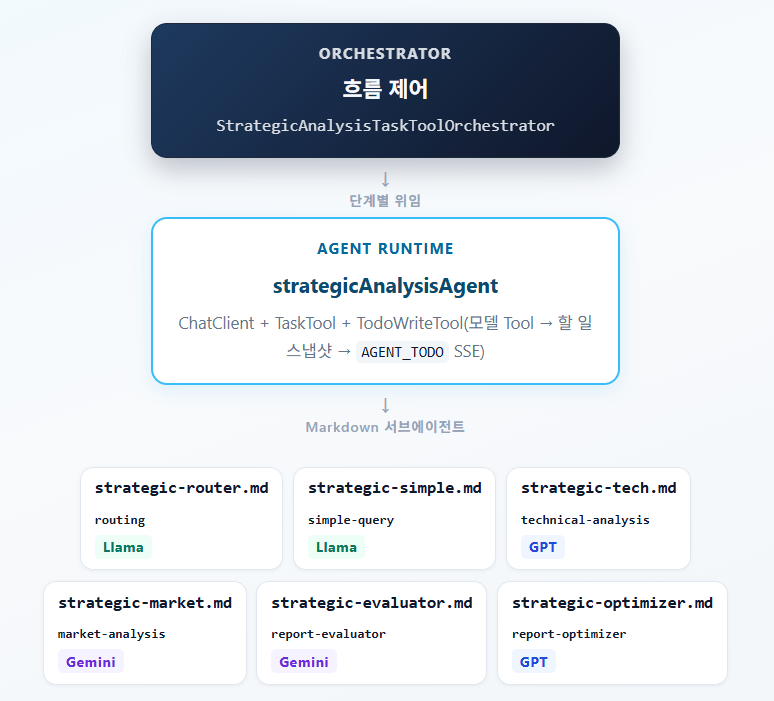
7⃣ Chapter 6. Task-Orchestrated Multi-Agent(TaskTool Agent Runtime)

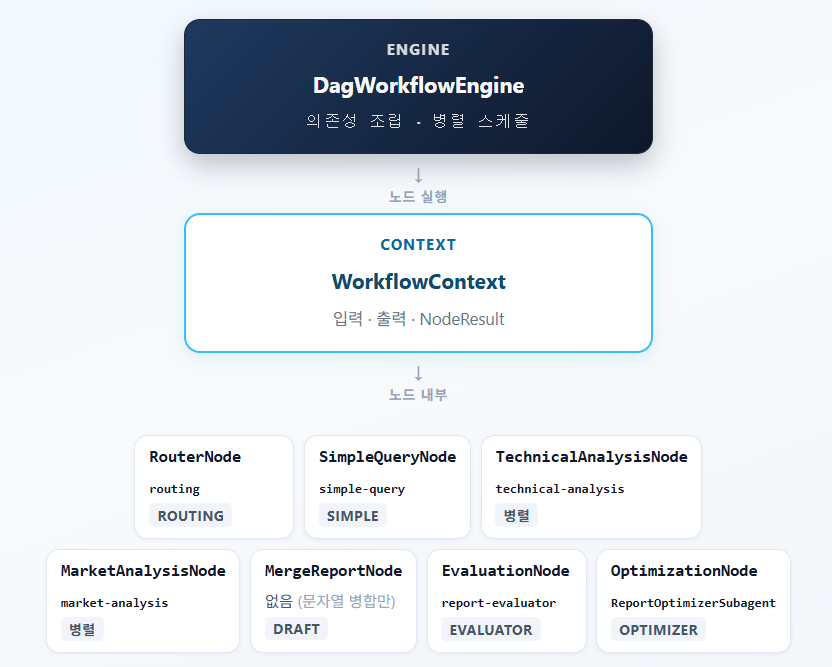
8⃣ Chapter 7. DAG-Orchestrated Multi-Agent (DAG-based AI Workflow Design)

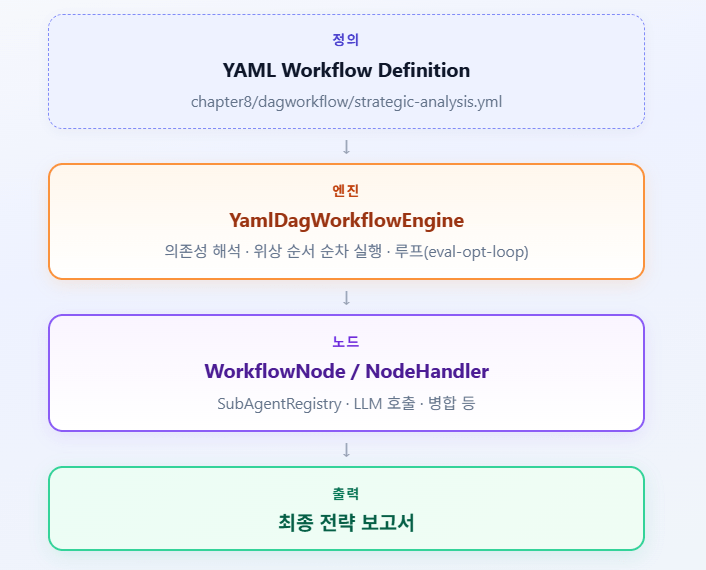
9⃣ Chapter 8. Declarative Agent Workflow with YAML (YAML-based DAG)

🔟 Chapter 9. Validated Agent Workflow DSL (DSL Validation-based DAG)

🅰️Appendix A. React Front-End & REST API Server Integration

🅱️ Appendix B. MCP Integration (Integrating Tool and Agent Runtime with MCP)

What you will learn


1⃣ Building a Spring AI development environment and Multi-LLM environment in SpringBoot


Before designing the AI architecture, we will complete a professional-level Spring AI development environment.

The class is conducted based on hands-on projects rather than simply adding libraries.

✔ Teaching materials included within the practice project
✔ Check code and theory simultaneously
✔ Provides a ready-to-run structure

Learning Content

  1. Explanation of the development environment and overall course structure

  2. Creating the practice project and setting up the teaching materials

  3. Issuing and integrating OpenAI API Key

  4. Issuing and integrating Gemini API Key

  5. Ollama environment setup and Llama 3.2 setup

  6. Spring AI Environment Configuration and Understanding the Basic Structure

  7. Redis integration settings


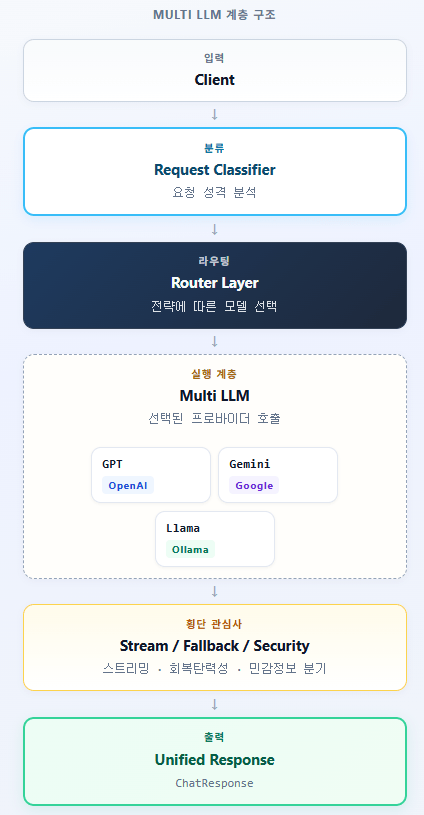
2⃣Chapter 1. Multi-LLM Architecture (Designing Multi-Model and AI Architecture)

Design a strategic Multi-LLM architecture, rather than relying on a single model.

As the number of models increases, operational, cost, and security issues grow. Multi-LLM Architecture serves as the foundation for creating long-term replaceable, scalable, and auditable AI services, and becomes a core foundational technology for building subsequent Orchestrated Multi-Agent Systems.


Learning Content

1. Multi LLM

We will implement a Multi-LLM based service architecture that utilizes three LLMs—GPT, Gemini, and LLaMA—simultaneously and selects the appropriate model based on request types and strategies.

2. Multi LLM Stream

Streaming processing based on Reactive Streams (Project Reactor)

3. Fallback (Fault Tolerance Architecture)

In the enterprise, availability is as important as accuracy. By grouping primary and secondary models, failover/timeout switching, and retry policies, we ensure that a single model failure does not stop the entire service. (Applying Resilience4j CircuitBreaker)

4. Router (Model Strategy Classification)

After understanding the request, this is the decision-making layer that routes it to the appropriate model based on criteria such as request type, cost, accuracy, complexity, and latency. It is not a simple conditional branch, but a layer where service policies are manifested.

5. Security (Sensitive Information Protection Architecture)

After analyzing the input and determining the sensitivity of the information, it decides whether to send it to an internal (on-premise, etc.) model or an external API model. This is security-focused routing tailored to data sovereignty and regulatory requirements.


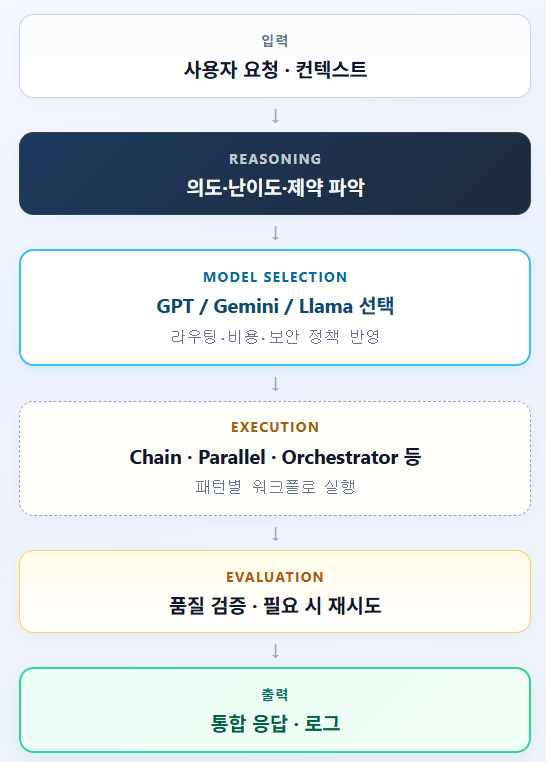
3⃣Chapter 2. Agentic Workflow Patterns (5 Agent Workflow Patterns)

It covers patterns that wrap LLM calls into orchestration with state, branching, concurrency, and feedback loops.

Based on the workflow types presented in Spring AI's Effective Agents and the Building Effective Agents post by Anthropic Engineering, which emphasizes simple abstraction and explicit composability, this is explained by dividing it into five patterns.


Learning Content

1. Chain Workflow

  • A structure that connects tasks sequentially, passing the output of the previous step as the input for the next step.

  • Reason for use: Ensures step-by-step thinking and procedural execution

2. Parallelization Workflow

  • A structure that executes the same input across multiple LLMs in parallel and merges the results.

  • Reason for use: Simultaneous utilization of expertise across models

3. Routing Workflow

  • A structure that branches to the optimal LLM based on input conditions

  • Reason for use: Selecting the optimal model based on the difficulty and type of the request

4. Orchestrator-Workers

  • A structure where a central Orchestrator executes multiple LLMs by role and then combines the final results.

  • Reason for use: Implementing a role-based separation of responsibilities structure

5. Evaluator-Optimizer

  • An iterative structure that evaluates and improves generation results

  • Reason for use: Stabilizing quality through iterative improvement


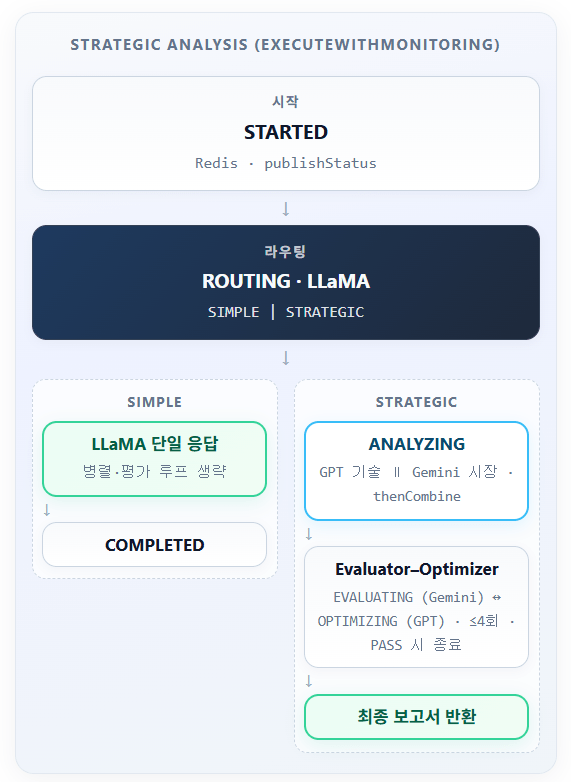
4⃣Chapter 3. Orchestrated Multi-Agent Patterns (Pipeline Implementation)

Implementing Multi-Agent structures into actual service pipelines

By combining five different patterns, we will materialize the Orchestrated Multi-Agent Pattern.
It covers the end-to-end flow, including step-by-step state transitions, exception isolation, and retries. The goal is not just simple response generation, but designing a system that considers scalability (additional steps), quality stability (evaluation and improvement), and reliability (consensus and cross-validation) required in various real-world operational environments.

Learning Content

1. Strategic Analysis Pattern

  • Implement an iterative improvement-based analysis service to maximize strategic quality.


2. Precision Execution Pattern

  • Implement an execution-oriented service that transforms ideas into actual deliverables (code/documents).


3. Voting Analysis Pattern

  • Implement a consensus-based analysis service to eliminate model bias and improve reliability.


4. Auto Pattern Routing

  • Analyzes the question and automatically delegates it to the appropriate pipeline among Strategic, Precision, or Voting.


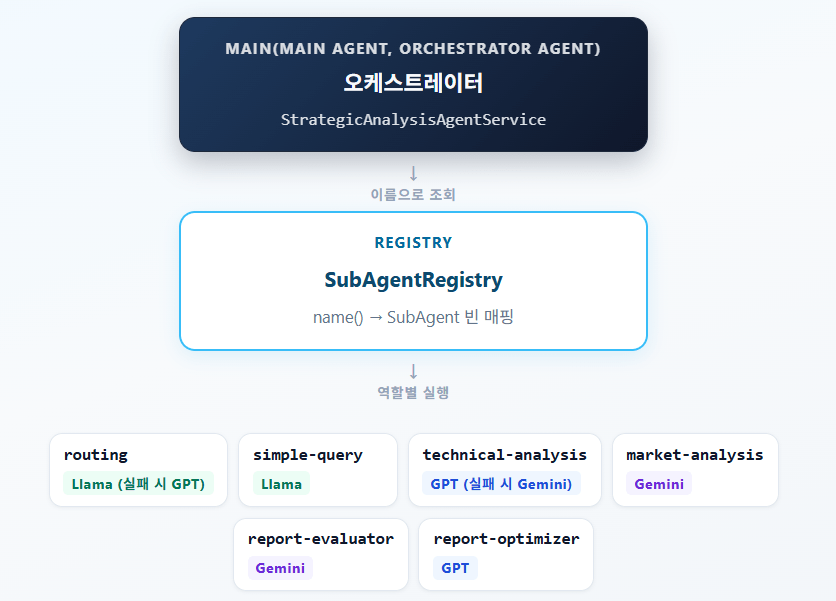
5⃣ Chapter 4. Multi-Agent Architecture (Main Agent & SubAgent Separation Strategy)

A structure consisting of one Main (Main agent, Orchestrator agent) + multiple role-specific SubAgents

This covers a Multi-Agent structure that divides the control layer handled by the Main (Main agent, Orchestrator agent) and the execution layer (Sub agent) dedicated to specific roles handled by the Sub (Sub agent, Tool agent, etc.) .


6⃣ Chapter 5. Tool-Orchestrated Multi-Agent (Tool-based Execution Layer Separation)

Execution Layer Separation Architecture Using Tools

If RAG or database integration is required, you can bundle “Agent + Tool + SubAgent + External Data” into a single layer by calling external APIs, DBs, or Vector Stores within that Tool and passing the results to the SubAgent.

7⃣ Chapter 6. Task-Orchestrated Multi-Agent (TaskTool Agent Runtime)

TaskTool-based Agent Runtime Design

“Agent Runtime(TaskTool) + Markdown Sub-Agent + TodoWrite” Implementation

8⃣ Chapter 7. DAG-Orchestrated Multi-Agent (DAG-based AI Workflow Design)

Enterprise-grade DAG-based AI Workflow Design

Build a DAG (Directed Acyclic Graph) engine to change the system into a form that reads the graph and schedules executable nodes.


9⃣ Chapter 8. Declarative Agent Workflow with YAML (YAML-based DAG)
Separation of YAML-based DAG Definition and Execution Engine

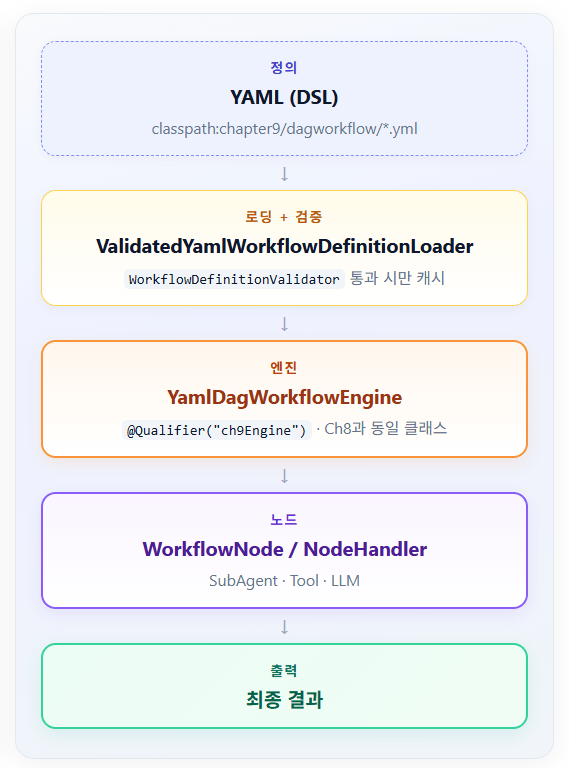
By replacing the workflow with a declarative YAML-based workflow DSL definition on top of the DAG engine, complex Agent Workflows can be operated more safely and flexibly. Furthermore, using the DSL on a single DAG engine provides flexibility in changing workflow structures and facilitates easy runtime reconfiguration.

🔟 Chapter 9. Validated Agent Workflow DSL (DAG based on DSL validation)

Reliable YAML Workflow DSL with Schema and Dependency Validation

Before putting the DSL statement into the DAG engine's scheduling, add a validation layer in the loading pipeline that filters out declaration errors such as typos, incorrect content, cycles, or missing required fields.

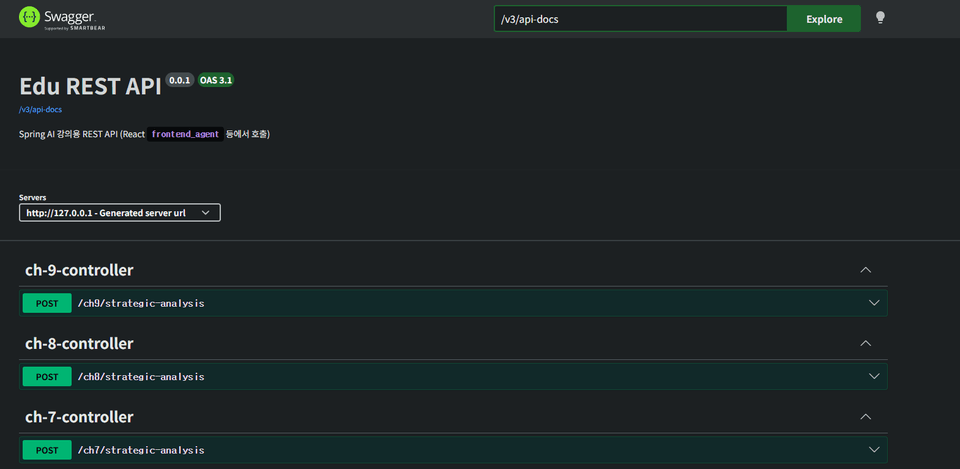
🅰️Appendix A. React Front-End & REST API Server Integration

Convert the Thymeleaf practice into a React and REST API server.


🅱️ Appendix B. MCP Integration (Integrating Tool/Agent Runtime with MCP)
MCP Client and how it connects to the MCP Server's agent/orchestrator.


💡Key content you will learn in this course

✔ Multi-LLM Strategy Design
✔ Agentic Workflow Implementation
✔ Orchestration-based Collaboration Structure
✔ Failure Response + Stability Design
✔ Quality Improvement System Based on Iterative Evaluation

💡Final Goal

  • This course is not simply about learning how to use LLMs.


    Multi-LLM Strategy Design → Workflow Pattern Application → Multi-Agent Orchestration CompletionThiết kế chiến lược Multi-LLM → Áp dụng Workflow pattern → Hoàn thiện Multi-Agent Orchestration

    This is a course designed to build AI system design capabilities that can be applied to actual services.

Notes before taking the course

Practice Environment

  • Operating System and Version (OS): All OS types including Windows, macOS, and Linux are supported.

  • Tools used: JDK, Intellij(Ultimate or Community), Redis& Docker, VSCode

  • LLM: GPT, Gemini, Llama

  • PC Specifications: A basic specification PC with internet access

Learning Materials

  • Format of provided learning materials: Various types of materials provided, including educational environment projects and teaching plans

  • Quantity and Capacity: Learning materials provided for each section

Prerequisite Knowledge and Precautions

  • Those with basic knowledge of HTML, CSS, and JavaScript.

  • Those with experience in Java and SpringBoot development

  • Please post your questions on the bulletin board, and I will make sure to respond as quickly as possible.


  • The copyright of this lecture belongs to Tonesol Co., Ltd., and unauthorized distribution or reproduction is prohibited. The learning materials are also copyrighted and may not be used for any purpose other than personal study.

This template is provided with reference to the 'Artificial Intelligence and Autonomous Driving with AWS DeepRacer' lecture.

Recommended for
these people

Who is this course right for?

  • ✔ Multi-LLM Strategy Planner

  • ✔ Agentic Workflow Architect

  • ✔ Orchestration-based Multi-Agent System Implementation Developer

  • ✔ A Production-Level architect who designs with incident response and quality improvement in mind

Need to know before starting?

  • Basic knowledge of HTML, CSS, and JavaScript

  • Experienced in Java and SpringBoot system development

Hello
This is tootoo

200

Learners

15

Reviews

3

Answers

4.9

Rating

2

Courses

Hello

I am Jinman Lee (nickname tootoo), a knowledge sharer.

I have communicated with you in the classroom for a long time.

Now, I will create great content so that I can communicate with all of you online.

jmlee@tonesol.com

Thank you.

More

Curriculum

All

44 lectures ∙ (14hr 8min)

Course Materials:

Lecture resources
Published: 
Last updated: 

Reviews

All

5 reviews

4.8

5 reviews

  • unicodaum님의 프로필 이미지
    unicodaum

    Reviews 16

    Average Rating 5.0

    5

    41% enrolled

    I needed knowledge on how to utilize Multi-LLMs with Spring AI and how to develop Agents... and this was very helpful. The explanations were clear and the examples were great, making it easy to understand.

    • bum0107님의 프로필 이미지
      bum0107

      Reviews 2

      Average Rating 5.0

      5

      55% enrolled

      It was a lecture where I could systematically learn about Multi-LLM architecture and Agent-based AI system design. It was great to experience structures close to actual services through hands-on practice, such as Orchestrators, Workflow patterns, and quality evaluation loops, rather than just simple LLM utilization. I think this is a helpful lecture for developers interested in AI backend architecture!!

      • joohsd875347님의 프로필 이미지
        joohsd875347

        Reviews 2

        Average Rating 5.0

        5

        45% enrolled

        Following Part 1, I highly recommend this Part 2 lecture not only to beginners who have just encountered advanced Spring AI courses but also to those who need efficient architecture design. In my case, thanks to the detailed learning materials provided for the Multi-LLM architecture and Agentic Workflow configuration, I am learning with ease as I can quickly grasp core logic by directly executing the provided code rather than just keeping complex orchestration concepts as theory.

        • syyeo812098님의 프로필 이미지
          syyeo812098

          Reviews 2

          Average Rating 5.0

          5

          50% enrolled

          I bought this previously and have been reading it, and I see it was recently updated. I felt the previous content was a bit lacking, but looking at the table of contents now, a lot of material has been added. haha I'm busy these days and don't have much time to read, but I'll give it another shot.

          • sthwin님의 프로필 이미지
            sthwin

            Reviews 13

            Average Rating 4.3

            4

            100% enrolled

            I complied.

            Similar courses

            Explore other courses in the same field!