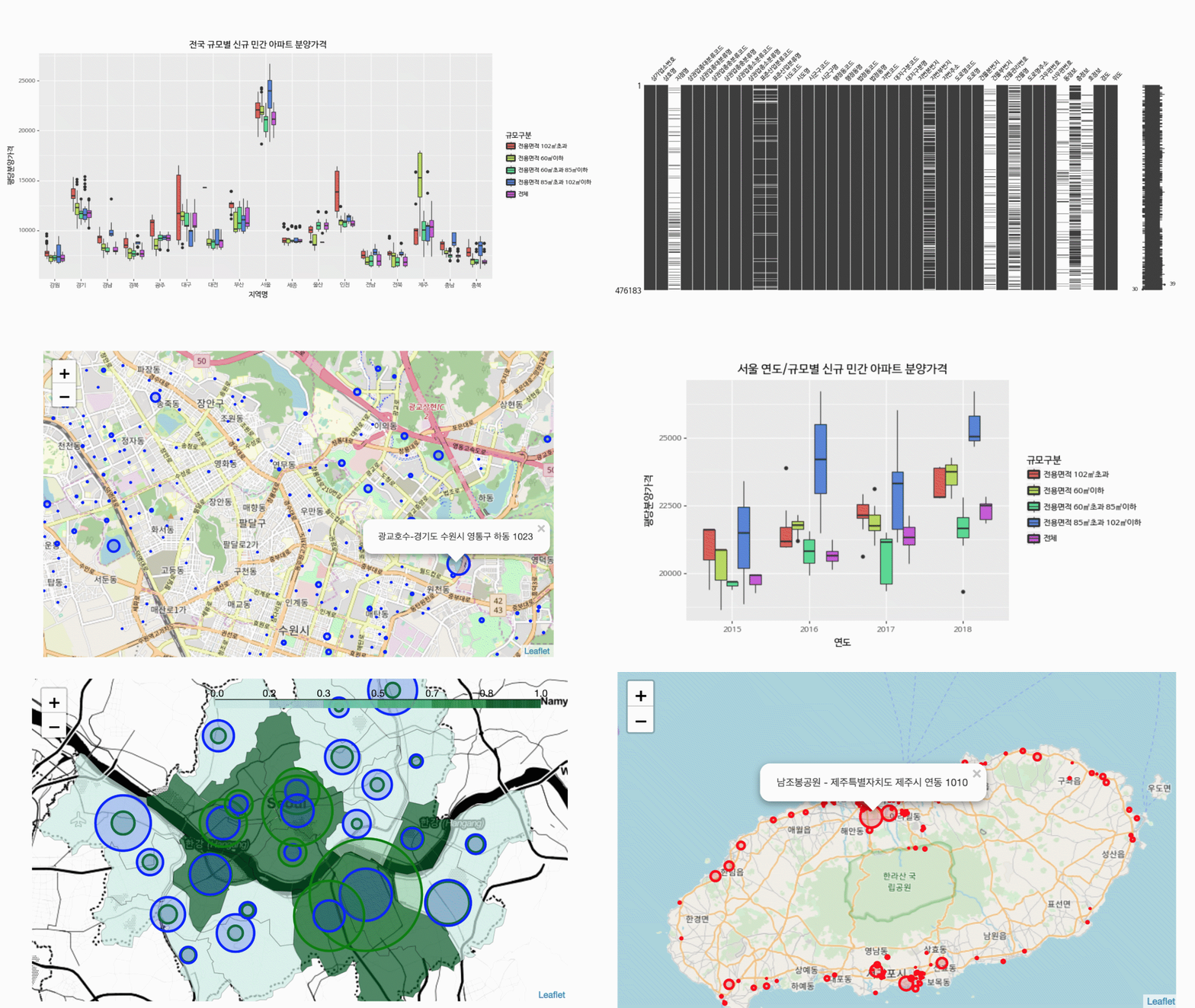
Let's visualize it using a visualization tool called plotnine, which can use ggplot syntax in Python.
I mainly use the Python standard library, Numpy, and Pandas.
Learn about and practice various preprocessing techniques required to obtain or process the desired data.
You will learn and be able to use the tools necessary to perform data analysis with Python.
Study popular courses online!
By taking the lectures and solving assignments, you can master the parts you were curious about. You can get a refund of your tuition just by completing the online study! :)
Benefits of studying online
It's motivating. The refund rewards and instructor feedback provided upon completion are more motivating than studying alone!
You can study efficiently. Since it is an online study, I can study wherever I want.
You are not alone anymore. When I feel frustrated and unsure if I am doing it right, Connect with your fellow students and discuss any questions you have with your instructor.
🌱If you go alone, you can go fast, but if you go together, you can go far.
Study Detail Requirements
1. If you complete the course, we will provide a refund of 50,000 won . - 100% progress in lecture videos - Please submit three of the four assignments by the deadline. (Week 4 is mandatory!)
2. Study Period: June 24, 2019 - July 21, 2019 The study goes like this :) - (Week 1) June 24th - June 30th: Opening remarks, Week 1 video and assignments - (Week 2) July 1st - July 7th: Assignment code review and Week 2 video and assignment progress - (Week 3) July 8th - July 14th: Assignment code review and Week 3 video and assignment progress - (Week 4) July 15th - July 21st: Assignment code review and Week 4 video and assignment progress * Please check the content of the video to be provided in “Curriculum”.
3. How to conduct the study
Weekly progress notice
Ask questions via Slack
Submit weekly assignments
You can watch the video even after the study is over.
Lecture Details
Getting Started with Python Data Analysis Using Public Data
There were rumors that Ediya would open a store near Starbucks. How different would the locations of Ediya and Starbucks be? Read the related article and analyze and visualize Ediya and Starbucks locations by district, similar to the article!
-
We will use Python, Pandas, ggplot(plotnine), Numpy, and Folium. Let's analyze data from the public data portal using Pandas' reshape functions such as melt, concat, pivot, and transpose. And we will summarize and analyze data using groupby, pivot_table, info, describe, value_counts, etc.
There are many city parks across the country. Which parks are in your neighborhood? How can I best utilize the data in the public data portal? And what kind of data is available there? -
Visualize where each park is located in each region using Folium.
The goal is to become familiar with Python and various data analysis libraries while working with various types of data through public data.
# I recommend this to these people.
Those who are interested in data analysis but are not yet ready to start
People who have learned the Python language but don't know how to use it
Someone who doesn't know anything but wants to accomplish something
# You can do things like this.
Load data with Pandas, which you can do without knowing Python.
You can use Numpy to do numerical calculations "simply."
Create some really cool visualization charts.
It's an expensive computer, but anyone can use it with a sense of ease.
#Related Courses
If you just want to listen to the lecture, please click below!
FAQ
Q1. What is the Python version? Python 3.6 or higher is available.
Q2. Does it matter if it's Windows or MAC OS? While the OS doesn't matter, this tutorial was written for OSX. We'll provide a Colab link to help you learn regardless of your OS.
Q3. I'm not a computer major. Will I be able to follow along? While this curriculum is already widely followed by non-programmers, individual differences may exist. The goal is to spark interest in programming through engaging case studies, even for those with no prior programming experience. I hope this study will provide an opportunity for you to discover and learn more about the topics you need.
Lecture summary
Recommended for these people
Who is this course right for?
Anyone interested in becoming a data analyst
For those who want to learn data visualization with Python
Those who want to learn the basics of Python libraries such as Pandas and NumPy
Those who want to utilize public data
Anyone interested in data journalism
For those who want to find meaning through data
Anyone who wants to use data analysis in their work
Instructor and Curriculum Designer for Data Science at Naver Connect Foundation Boostcourse
Seoul National University Big Data Innovation Sharing University, Seoul National University Continuing Education Center, Yonsei University DX Academy, Hanshin University ABC Camp, Hanyang University Graduate School, Chonnam National University,
Lectured at numerous educational institutions and corporations, including Korea Management Association (KMA), IGM Institute for Global Management, Samsung SDS Multicampus, LIKE LION, Fast Campus, Modulabs, and National Cancer Center.
Corporate data analysis across various domains (pharmaceuticals, telecommunications, automotive, commerce, education, government agencies, etc.)
Over 20 years of professional experience as a web backend developer and data analyst across various domains, including gaming, advertising, and education.
It was great to be able to hear detailed explanations of various analysis methods ^^
Also, the teacher gave notice of assignments every week, which made me feel more nervous and helped me take the class within a limited period of time :) ♥